
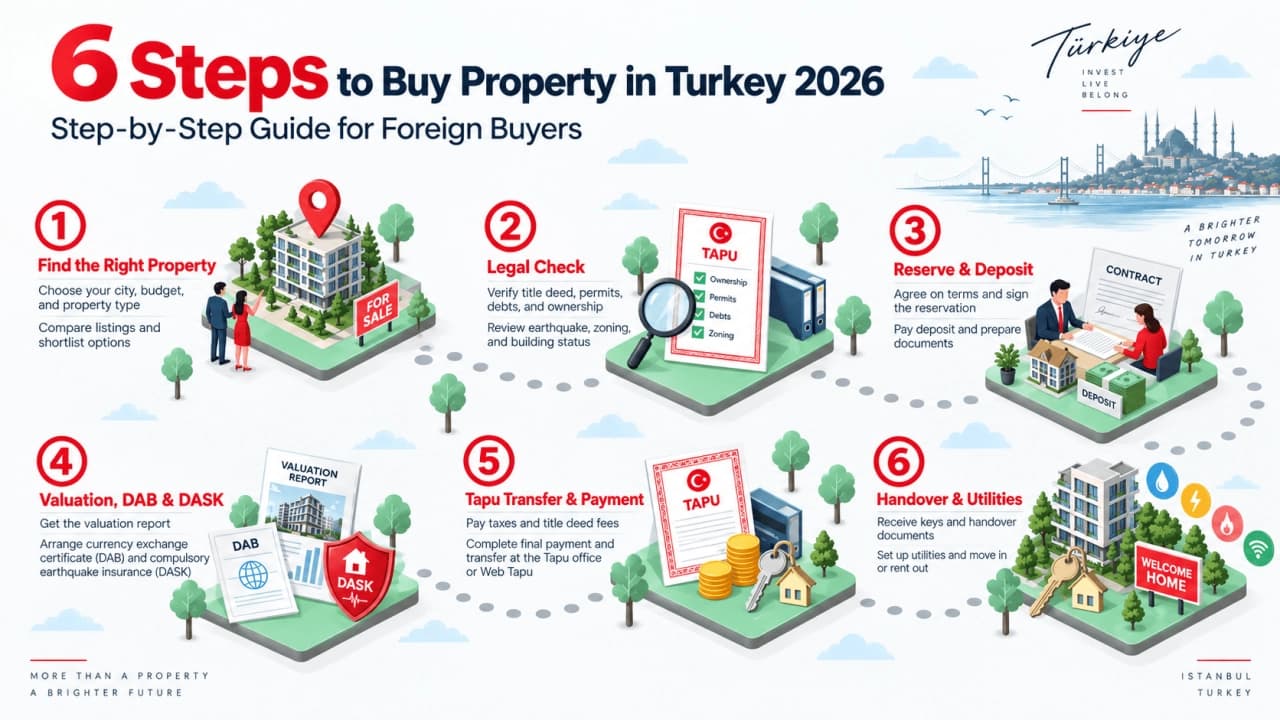
The property purchase process in Turkey can be completed efficiently by foreign buyers when each stage is handled in the correct order.
The typical transaction moves through several distinct phases:
Property Search
↓
Initial Verification
↓
Reservation / Kapora
↓
Legal & Technical Due Diligence
↓
Purchase Contract
↓
Banking & Source of Funds
↓
Valuation
↓
DAB
↓
DASK
↓
Web Tapu / Sale Application
↓
Taxes & Fees
↓
Final Title Check
↓
Official Sale & Registration
↓
Payment Completion
↓
Property Handover
The most important principle is that these stages should not be treated as disconnected administrative tasks.
A mistake early in the process can affect everything that follows.
For example:
paying a non-refundable deposit before checking the Tapu can reduce the buyer's negotiating position;
transferring money before planning the DAB process can create payment-documentation problems;
signing a purchase contract before verifying seller authority can create legal risk;
waiting until Tapu day to arrange DASK can delay closing;
relying on an old title record without a final check can expose the buyer to a newly registered restriction.
Turkey's General Directorate of Land Registry and Cadastre — Tapu ve Kadastro Genel Müdürlüğü (TKGM) — allows land-registry applications to be initiated electronically through Web Tapu, including through a dedicated foreign-user portal. The land-registry process then proceeds through document review, fee notification, appointment/signature and final registration.
This guide explains the entire Turkey property buying process in 2026 from the perspective of an international buyer.
Important: The exact procedure can differ according to the buyer's nationality, property type, whether the property is resale or developer-owned, whether financing is used, whether the buyer acts through a Power of Attorney, and whether Turkish citizenship is part of the investment objective.
Property Purchase Process in Turkey: Quick 18-Step Summary
For a typical foreign individual buying an Istanbul apartment, the process can be summarized as follows:
Define your property objective and total budget.
Confirm foreign-buyer eligibility.
Find and inspect the property.
Verify the seller and exact property.
Negotiate price and key commercial terms.
Sign a controlled reservation agreement if necessary.
Complete legal, developer and technical due diligence.
Finalize the purchase contract.
Prepare Turkish banking and source-of-funds documentation.
Obtain the required property valuation report.
Complete the DAB foreign-currency procedure.
Arrange Power of Attorney/interpreter if required.
Obtain buyer-side DASK where required.
Submit the sale application through Web Tapu / official channel.
Pay Tapu fees and applicable service charges.
Recheck title and closing conditions.
Complete the official sale and registration.
Verify the Tapu and complete physical handover.
Each step serves a different purpose.
Skipping one does not make the others stronger.
How Long Does the Property Purchase Process Take?
There is no single guaranteed transaction period.
A straightforward cash resale purchase with:
clean title;
ready documentation;
buyer funds already available;
completed valuation;
completed DAB;
can move much faster than:
an off-plan purchase;
a mortgaged resale;
a citizenship transaction;
a remote acquisition using foreign-issued Power of Attorney;
a transaction requiring additional foreign-buyer review.
The timeline should therefore be built around transaction readiness, not a salesperson's promise that:
“Everything will be finished tomorrow.”
Article 29 will examine the transaction timeline in detail.
Step 1 — Define Why You Are Buying
Before choosing a property, define the objective.
Possible goals include:
personal residence;
long-term rental income;
short-term investment;
capital appreciation;
future relocation;
Turkish citizenship by investment;
family use;
diversification.
The correct property for one objective may be unsuitable for another.
For example:
A high-end central apartment may suit a lifestyle buyer.
A smaller metro-connected apartment may offer stronger rental economics.
A $400,000+ property may be marketed for citizenship, but citizenship suitability requires separate legal checks.
Step 2 — Establish the Real Budget
Your budget should include more than the listing price.
Consider:
Property Price
The negotiated acquisition value.
Tapu Fee
Property transfers are subject to title-deed fees.
Valuation
Where required.
Banking / FX
International transfer and currency-conversion costs.
DASK
Compulsory earthquake insurance where applicable.
Legal / Translation / POA
If required.
Agency Commission
Where applicable.
Furniture / Renovation
Especially for resale apartments.
Aidat
Monthly building/site-management charges.
Post-Purchase Reserve
Utilities, insurance, maintenance and management.
A €300,000 property therefore requires more than exactly €300,000 of available capital.
Step 3 — Confirm Foreign-Buyer Eligibility
Foreign natural persons may acquire Turkish real estate subject to the applicable restrictions.
Before paying a substantial deposit, confirm that:
the buyer's nationality is eligible;
the property location is not subject to a relevant restriction;
applicable foreign-ownership limits are not exceeded;
the property can legally be acquired by that buyer.
This is especially important for:
land;
unusual property types;
sensitive geographic areas.
For most standard Istanbul apartments, this step may be routine—but it should still be confirmed.
Step 4 — Find and Inspect the Property
Once eligibility and budget are understood, shortlist suitable properties.
Evaluate:
district;
neighborhood;
building;
transport;
floor;
view;
orientation;
net area;
building age;
physical condition;
rental profile.
Do not evaluate a property using listing photos alone.
For resale property, physically inspect:
apartment;
building entrance;
basement;
common areas;
parking;
surrounding street.
For remote purchases, arrange a live video inspection rather than relying only on prerecorded marketing material.
Step 5 — Identify the Exact Property
Before negotiating seriously, establish exactly what you are buying.
Relevant information can include:
province;
district;
neighborhood;
ada;
parsel;
building/block;
floor;
independent section;
property type.
For developer projects, distinguish:
marketing unit number
from
official independent-section number.
They can differ.
The difference must be traceable.
Step 6 — Verify the Seller
Determine who has legal authority to sell.
The seller may be:
registered individual owner;
developer company;
another corporate entity;
representative under Power of Attorney.
For individuals, confirm that the person offering the property corresponds to the registered ownership.
For companies, confirm:
exact legal entity;
company details;
signatory authority.
Do not send a deposit merely because a salesperson has keys to the apartment.
Step 7 — Negotiate the Commercial Terms
Before paying money, agree the core transaction terms.
These normally include:
purchase price;
currency;
deposit;
payment schedule;
date for main contract;
expected Tapu transfer date;
furniture included;
vacant possession;
developer delivery where relevant.
For mortgage buyers, financing conditions should also be addressed.
Important commercial promises should ultimately appear in writing.
Step 8 — Sign a Reservation Agreement Only If Needed
A reservation payment — commonly called Kapora — may be requested to take the property off the market.
Before paying, the reservation document should state:
exact property;
purchase price;
amount paid;
reservation period;
whether the amount becomes part of the purchase price;
refund conditions;
seller cancellation;
buyer cancellation;
due-diligence conditions.
Do not assume every Kapora payment is legally identical.
Turkish law distinguishes concepts such as:
bağlanma parası;
cayma parası.
For the full explanation, see:
Property Deposit in Turkey 2026 — Article 21.
Step 9 — Complete Legal Due Diligence
This is one of the most important stages of the property purchase process in Turkey.
Before becoming materially committed, check:
Ownership
Who owns the property?
Property Identity
Does the apartment match the registry?
Takyidat
Are there:
mortgages;
attachments;
annotations;
easements;
other restrictions?
Seller Authority
Can the person/company actually sell?
Building Status
What is the:
kat mülkiyeti;
kat irtifakı;
İskan;
permit status?
Foreign-Buyer Eligibility
Can this particular buyer acquire this particular property?
A property should not proceed to closing merely because the seller says:
“Tapu is clean.”
The underlying record should be reviewed.
See:
Legal Due Diligence for Property in Turkey — Article 22.
Step 10 — Complete Technical and Physical Checks
Legal due diligence answers:
“Can I legally buy it?”
Technical inspection answers:
“What am I physically buying?”
Depending on property age and value, inspect:
cracks;
moisture;
plumbing;
electrical systems;
windows;
heating;
air conditioning;
roof;
basement;
lifts;
common areas.
For earthquake-related concerns, consult an appropriate technical professional rather than treating:
DASK;
building age;
appearance;
as definitive engineering evidence.
See:
How to Check a Property in Turkey Before Buying — Article 27.
Step 11 — Perform Developer Due Diligence for New-Build Property
If buying from a developer, add another layer.
Verify:
legal seller;
MERSİS records;
land ownership;
construction contractor;
building permit;
project structure;
technical specification;
payment protection;
delivery history.
For off-plan projects, determine what protects your payments if the project is not completed.
See:
Developer Due Diligence in Turkey — Article 26.
Step 12 — Finalize the Purchase Contract
Once material risks are understood, finalize the property purchase agreement.
The contract should clearly state:
parties;
exact property;
purchase price;
currency;
payment schedule;
deposit credit;
title-transfer conditions;
delivery;
default;
refund conditions;
penalties;
dispute terms.
For off-plan property, add:
technical specifications;
project documents;
delivery deadline;
project-change provisions.
A private contract does not by itself replace the official registration process through which real ownership is transferred.
For the detailed contract guide:
Property Purchase Contract in Turkey 2026 — Article 20.
Step 13 — Obtain a Turkish Tax / Identification Number as Required
Foreign buyers need appropriate identification information for the official transaction and related banking procedures.
Depending on the buyer's status, this may involve:
Turkish Foreign Identification Number;
Turkish Tax Identification Number.
Foreigners who do not already have the appropriate Turkish identification may obtain the relevant tax-number arrangements before moving into the banking and closing stages.
This is often completed early in practice because banks and other transaction participants may need it.
Step 14 — Prepare the Bank Account and Money Flow
A Turkish bank account is often useful but is not a universal requirement for every property purchase structure.
Before sending substantial funds, determine:
where the money currently sits;
which currency it is held in;
which bank will receive it;
who the final beneficiary is;
what source-of-funds evidence will be required;
how DAB will be arranged.
Do not wait until Tapu day to discover that your bank:
has transfer limits;
needs compliance documentation;
has not cleared the incoming funds.
See:
Opening a Bank Account in Turkey for Foreign Property Buyers — Article 24.
Step 15 — Prepare Source-of-Funds Documentation
Large international property transfers can trigger ordinary KYC/AML checks.
Depending on the source of money, documentation may include:
bank savings;
salary records;
sale of another property;
company dividends;
business income;
investment liquidation;
inheritance.
A legitimate transaction is much easier to process when the buyer can clearly document:
where the money came from
and
why it is being transferred.
Step 16 — Obtain the Property Valuation Report
TKGM currently requires valuation reports for specified transactions where a foreign natural person is the buyer. TKGM states that the current valuation framework applies to relevant acquisition transactions by foreign natural persons and that valuation reports are prepared through authorized valuation organizations.
The valuation process generally determines the property's officially assessed market value for the applicable transaction.
The report should not be confused with:
legal due diligence;
engineering inspection;
investment advice.
Each has a different function.
Can the Valuation Be Lower Than the Purchase Price?
Yes.
For example:
Agreed purchase price: TRY 20 million
Valuation: TRY 17.5 million
This does not automatically prevent an ordinary purchase.
But the difference may matter for:
financing;
citizenship;
buyer price analysis.
A large unexplained difference deserves investigation.
Step 17 — Complete the DAB Process
Foreign natural persons buying real estate in Turkey are subject to the Döviz Alım Belgesi — DAB process.
TKGM confirms that foreign buyers must sell the relevant foreign currency through a bank to the Central Bank framework and submit the bank-issued DAB for the land-registry transaction. The DAB requirement has applied to acquisitions by foreign natural persons since January 24, 2022.
This should be coordinated before the official sale.
Do not:
convert all your foreign currency informally first
and then ask:
“How do we create the DAB?”
Plan the transaction flow before conversion.
Who Can Arrange the DAB?
Depending on the transaction structure, the conversion can be handled through the relevant bank by the permitted transaction parties or authorized representatives under the applicable rules.
What matters is that:
buyer details;
property transaction;
currency amount;
banking documentation;
are correctly coordinated.
For the full process:
DAB in Turkey for Foreign Property Buyers 2026.
Citizenship Buyers Need Additional Bank Evidence
For ordinary foreign-buyer property sales, TKGM identifies the DAB as the key currency document.
For Turkish citizenship property transactions, TKGM additionally requires bank evidence showing the payment from buyer to seller.
This makes payment sequencing particularly important.
Step 18 — Prepare Power of Attorney if You Will Not Attend
A foreign buyer does not necessarily need to attend every step personally.
A properly prepared Power of Attorney — Vekaletname can authorize a representative to handle specified acts.
If prepared abroad, the POA may require:
Apostille or applicable legalization;
Turkish translation;
appropriate form;
specific acquisition authority.
TKGM maintains dedicated guidance for foreign-issued Powers of Attorney used for land-registry transactions.
See:
Power of Attorney in Turkey for Property Purchase — Article 19.
Step 19 — Arrange a Sworn Interpreter if Required
If a party personally participating in the official transaction does not speak Turkish, a sworn interpreter may be required.
TKGM's published foreign-sale procedure lists a sworn interpreter among the requirements where a party does not speak Turkish.
Do not rely on the real estate salesperson to serve informally as the official interpreter at closing.
Step 20 — Arrange DASK Before Closing
For relevant buildings, compulsory earthquake insurance forms part of the Tapu process.
But there is an important new 2026 rule.
For residential sales registered on or after September 5, 2026, DASK states that:
the seller's existing policy terminates on the transaction date;
the buyer must obtain a valid Compulsory Earthquake Insurance policy in their own name before the property transfer;
the buyer's policy is checked during the sale;
the same rule applies whether the sale is completed before the Land Registry Directorate or before a notary.
This is a major change for 2026 closing checklists.
DASK Does Not Prove Earthquake Safety
DASK is an insurance requirement.
It does not certify that the building:
meets every structural standard;
is earthquake-resistant;
has passed an engineering assessment.
Structural due diligence is separate.
Step 21 — Submit the Official Sale Application
The sale application can be initiated through the official land-registry channels, including Web Tapu.
TKGM explains that Web Tapu allows property owners or authorized users to:
submit transaction applications online;
send necessary documents electronically;
follow the process;
receive fee and appointment information.
Foreign natural persons who lack a Turkish Foreign Identification Number/e-Devlet credentials can use the dedicated FOR FOREIGNER portal.
Typical Documents for the Foreign Buyer Sale
TKGM's published sale procedure identifies documents including:
passport / identity document;
representation document where applicable;
property title information where available;
required property valuation report;
compulsory earthquake insurance where applicable;
sworn interpreter where required.
Depending on the transaction, additional documents such as:
DAB;
bank payment evidence for citizenship;
POA;
corporate documents;
may also be required.
Step 22 — Wait for Document Review
After the application is submitted, the Land Registry reviews the file.
This can involve verifying:
parties;
property;
restrictions;
documents;
foreign-buyer requirements;
fees.
The applicant can track relevant application information, including:
current stage;
missing documentation;
fee codes;
appointment details;
registration completion,
through TKGM's application-tracking systems.
If documents are incomplete, resolve the deficiency before the closing appointment.
Step 23 — Receive the SMS / Appointment Information
Under the Web Tapu workflow, TKGM sends relevant notifications after the file has been processed.
These can include:
required Tapu fee;
revolving-fund/service fee;
payment codes;
signature date and time.
TKGM's published Web Tapu procedure explains that after the application is reviewed, the applicant receives payment and appointment information and completes the signature stage at the designated time.
Never pay a fee simply because someone sends you an unofficial bank account.
Verify official payment instructions.
Step 24 — Pay the Tapu Harcı
As of 2026, the official property transfer fee remains:
Buyer
2% of the declared real transfer/acquisition value
Seller
2% of the declared real transfer/acquisition value
Total statutory burden:
4%, split 2% + 2%.
Turkey's Revenue Administration confirms that buyer and seller are separately charged 20 per thousand (2%) and that the declared value cannot be lower than the property's applicable real-estate tax value for fee calculation.
Example: Tapu Fee
Suppose the declared real transfer price is:
TRY 15,000,000
Buyer statutory share
2%
=
TRY 300,000
Seller statutory share
2%
=
TRY 300,000
Total:
TRY 600,000
Commercially, parties sometimes negotiate who economically bears certain costs.
But the statutory liability framework should be distinguished from private commercial arrangements.
Do Not Declare an Artificially Low Sale Price
The Revenue Administration specifically warns buyers and sellers to declare the true property transfer price.
Where the declared price is below the property's real-estate tax value, the applicable calculation cannot simply use that lower figure.
Under-declaration can create:
tax exposure;
penalties;
future capital-gains issues;
citizenship inconsistencies;
banking-documentation mismatches.
Step 25 — Pay the TKGM Revolving-Fund / Service Fee
In addition to Tapu harcı, land-registry transactions can involve an applicable döner sermaye service fee.
TKGM publishes a specific 2026 tariff effective from January 1, 2026.
The amount depends on the applicable transaction/tariff category rather than being a universal percentage of the property price.
Confirm the official amount from the transaction notification.
Step 26 — Perform the Final Title Check
Before the final purchase price becomes irreversible, check the current registry again.
Confirm:
seller remains registered owner;
expected mortgage status;
attachments;
annotations;
agreed releases;
no unexpected new restriction.
This is especially important when weeks or months have passed since initial due diligence.
Think of the process as:
Due Diligence Check
“What is the property's legal position when I decide to buy?”
Closing Check
“Is it still in the agreed legal position today?”
Both matter.
Step 27 — Confirm Mortgage Release if the Seller Has Debt
A resale property can be sold while an existing bank mortgage is being discharged as part of closing.
The transaction must coordinate:
seller debt;
bank payoff;
mortgage-release documentation;
buyer payment;
registration.
TKGM states that once the relevant bank sends mortgage-release documentation electronically, the Land Registry can process the deletion.
Do not rely only on the seller saying:
“I paid the bank yesterday.”
Step 28 — Coordinate Final Payment
Before closing day, everyone should know:
When exactly does the money move?
Possible structures depend on the transaction.
The key risk is the classic closing question:
Does the buyer pay first, or does ownership transfer first?
The process should minimize the period in which one party has given up value without receiving the agreed counter-performance.
Güvenilir Hesap / Secure Payment
TKGM and Takasbank operate Güvenilir Hesap, a digital system intended to reduce payment-versus-title risk.
Under the system:
the sale application is initiated;
purchase funds are transferred to a special Takasbank account;
the funds remain blocked;
after registration is completed, the money is automatically released to the seller.
However, the current published user requirements include specific Turkish identity/IBAN information, so foreign buyers should confirm their own eligibility and transaction structure rather than assuming the system is universally available to every international buyer.
Step 29 — Attend the Official Closing
The final sale can be completed through the formal authorized route.
For the standard Land Registry process, the required parties or their authorized representatives attend the relevant signature stage.
The official documents and declarations are checked.
If the buyer does not speak Turkish and is personally participating, an approved sworn interpreter may be required.
The buyer should verify before signing:
name;
property;
price;
ownership share;
transaction type.
Do not sign first and ask questions afterward.
Step 30 — Alternative: Official Property Sale Through a Notary
Turkey also permits notaries to execute official immovable-property sale contracts.
The Ministry of Justice confirms that the system allows notaries to:
receive the application;
check restrictions and legal requirements;
prepare the official sale contract;
obtain a land-registry journal number through the system;
transmit the transaction for registration.
This is an alternative official route—not the same as merely notarizing a private purchase agreement.
Foreign-buyer requirements such as applicable:
DAB;
valuation;
acquisition restrictions;
DASK;
still need to be satisfied.
The September 5, 2026 DASK buyer-policy rule expressly applies to sales conducted either at the Land Registry or before a notary.
Notary Sale Fee in 2026
The 2026 notary tariff provides that where a notary prepares an official immovable-property sale contract, the notary fee is calculated at 1 per thousand of the property sale value, subject to the tariff's applicable minimum and maximum.
The normal property transfer fee framework remains separate.
Therefore, compare total procedure costs before choosing the notary route.
Step 31 — Registration Transfers Ownership
This is the critical legal moment.
A reservation agreement does not make the buyer the registered owner.
A private sales agreement does not by itself make the buyer the registered owner.
The actual ownership change occurs through the official registration process.
After the sale is approved and registered:
Seller
↓
Registered Ownership
↓
Buyer
The buyer should then verify the official result.
Step 32 — Verify the New Tapu
After registration, confirm:
buyer's full identity;
ownership share;
exact independent section;
property details.
Do not leave the transaction with only:
a salesperson's congratulations message;
payment receipt;
private contract.
Confirm registered ownership.
Step 33 — Keep the Complete Transaction File
Retain:
Legal
purchase agreement;
POA;
due-diligence report.
Land Registry
Tapu;
application/closing records.
Banking
incoming SWIFT;
DAB;
seller payment receipt.
Valuation
Ekspertiz / valuation documentation.
Insurance
DASK.
Costs
Tapu fee receipts;
service-fee receipts;
legal/agency invoices.
Citizenship buyers should be particularly disciplined about transaction records.
Step 34 — Complete Physical Handover
Legal ownership and physical possession are related but separate.
At handover, check:
keys;
access cards;
parking remotes;
storage;
furniture;
appliances;
meter readings;
visible defects.
For a developer property, use a written handover/snagging record where appropriate.
Step 35 — Check Aidat and Building Management
Contact the site or building management.
Confirm:
monthly aidat;
payment method;
outstanding seller balance;
access systems;
management contact details.
The purchase contract should clarify responsibility for liabilities accrued before transfer.
Step 36 — Transfer / Open Utility Accounts
Depending on the property, arrange:
electricity;
water;
gas;
internet.
This will be covered comprehensively in:
Utility Subscriptions in Turkey for Foreign Property Owners — Article 32.
Step 37 — Arrange Property Management if You Live Abroad
Foreign owners who will not live in Turkey should decide who will manage:
emergencies;
bills;
maintenance;
tenants;
keys;
inspections.
Do this immediately after closing rather than waiting for the first problem.
Cash Buyer Process
A straightforward cash transaction may follow:
Property Selected
↓
Deposit
↓
Due Diligence
↓
Contract
↓
Valuation
↓
Funds Prepared
↓
DAB
↓
DASK
↓
Web Tapu Application
↓
Fees
↓
Final Title Check
↓
Payment + Registration
↓
Handover
Cash does not eliminate legal checks.
It simply removes lender underwriting.
Mortgage Buyer Process
A financed purchase adds another track:
Pre-Approval
↓
Property Selection
↓
Bank Property Appraisal
↓
Legal / Collateral Review
↓
Final Credit Approval
↓
Buyer Equity + Loan
↓
DAB / Payment Coordination
↓
Tapu + Mortgage Registration
The property contract should deal with what happens if:
financing is rejected;
appraisal is too low;
bank approves less than expected.
See:
Mortgage in Turkey for Foreigners 2026 — Article 23.
Remote Buyer Process
A buyer purchasing from abroad may use:
Remote Property Selection
↓
Independent Due Diligence
↓
Foreign/Consular POA
↓
Contract
↓
Banking / DAB
↓
Representative Handles Closing
↓
Tapu Verification
↓
Remote Handover / Management
See:
Buying Property in Turkey Remotely 2026 — Article 25.
Off-Plan Buyer Process
Off-plan purchases require additional steps before the ordinary closing process.
Typical workflow:
Developer Verification
↓
Land / Permit Check
↓
Pre-Contract Information
↓
Formal Prepaid Housing Structure
↓
Payment Security
↓
Installments
↓
Construction Monitoring
↓
Completion / İskan
↓
Final Transfer
For qualifying prepaid housing, current Ministry of Trade rules impose additional consumer protections.
Citizenship Property Purchase Process
A citizenship-oriented acquisition adds another compliance layer.
Typical structure includes:
select appropriate property;
check citizenship eligibility;
perform legal due diligence;
verify seller/property eligibility;
obtain valuation / TTB;
structure bank payments;
obtain DAB;
transfer qualifying amount;
complete Tapu;
register the required restriction/undertaking;
proceed with citizenship documentation.
Do not treat citizenship eligibility as a simple final checkbox.
It should influence the transaction from the beginning.
New 2026 Closing Checklist
For property sales completed in September 2026 and afterward, the closing file should specifically account for the new DASK rule.
Before Tapu
Buyer DASK policy issued in buyer's name
Policy is valid
Property information correct
Required policy check can be completed
DASK states that this requirement applies to residential sales registered on or after September 5, 2026.
Full Foreign Buyer Document Checklist
Buyer
Passport / accepted identification
Turkish tax/YKN details as applicable
Contact information
POA if represented
Sworn interpreter arrangements if required
Property
Current title information
Exact independent section
Valuation report where required
DASK
Building/property documentation as relevant
Legal
Due-diligence review
Mortgage-release documentation where applicable
Seller authority
Purchase contract
Banking
Source-of-funds evidence
DAB
Transfer receipts
Seller account verified
Closing
Tapu harcı paid
Döner sermaye/service fee paid
Final title check
Appointment confirmed
Final payment structure confirmed
Citizenship Where Applicable
TTB / required valuation
Bank receipt buyer → seller
DAB
Qualifying value verified
Required annotation/undertaking arranged
What Happens on Tapu Day?
A simplified closing-day sequence can look like:
1. Confirm the appointment
Ensure documents and parties/representatives are ready.
2. Confirm fees have been paid
Use official payment instructions.
3. Confirm DASK
For qualifying residential transactions after September 5, 2026, buyer-side policy should already be active.
4. Perform final title review
Confirm no unexpected restriction.
5. Confirm payment readiness
Buyer funds must be available according to the agreed closing mechanism.
6. Review official transaction details
Check:
property;
price;
parties.
7. Sign official sale documents
Buyer/seller or authorized representatives complete the formal declarations.
8. Registration occurs
Ownership is registered to the buyer.
9. Complete payment
According to the controlled closing mechanism.
10. Confirm new title position
Verify registration.
What Should You Never Do on Closing Day?
Do not:
bring the full purchase price in cash without a documented reason;
send money to a newly changed IBAN without verification;
sign documents you do not understand;
rely on an informal interpreter;
skip the final registry check;
accept a new mortgage/annotation you were not expecting;
declare an artificially low sale price;
assume the seller's old DASK remains sufficient after the new 2026 rule.
Closing day should execute decisions already made.
It should not be the day you first discover the structure of the transaction.
Common Property Purchase Mistakes
Mistake 1 — Paying Before Due Diligence
The buyer loses leverage before knowing the risks.
Mistake 2 — Confusing the Contract With Ownership
Ownership depends on official registration.
Mistake 3 — Treating Kapora as Automatically Non-Refundable
Its legal and contractual character matters.
Mistake 4 — Opening the Bank Account Too Late
International funds may require compliance review.
Mistake 5 — Converting Currency Before Planning DAB
This can complicate foreign-buyer payment documentation.
Mistake 6 — Using an Old Tapu Copy
Current restrictions can differ.
Mistake 7 — Ignoring Buyer-Side DASK in September 2026
The new rule requires the buyer's own policy before applicable residential title transfers.
Mistake 8 — Under-Declaring the Property Price
GİB requires the real transfer price to be declared, subject to the minimum property-tax-value rule.
Mistake 9 — Paying an Unrelated Account
The payment trail should make legal and commercial sense.
Mistake 10 — Not Verifying the Final Tapu
The transaction is not finished merely because the seller received money.
Property Purchase Process Red Flags
| Red Flag | Why It Matters |
|---|---|
| Deposit requested before property identification | Buyer may not know what is reserved |
| Seller cannot be matched to registered owner | Ownership/authority risk |
| Tapu check delayed until after payment | Buyer loses protection |
| Buyer told valuation is “not necessary” without checking transaction type | Foreign-buyer procedure may be incomplete |
| DAB discussed only after funds converted | Payment structure risk |
| Seller's bank account changes immediately before closing | Fraud risk |
| Mortgage removal depends only on verbal promise | Title may remain encumbered |
| Buyer asked to declare lower price | Tax/legal/documentation risk |
| Official SMS/payment code not verified | Fraud risk |
| Buyer does not understand Turkish documents | Consent risk |
| No final title recheck | New restriction may be missed |
| Seller's DASK assumed to transfer automatically after Sept. 5, 2026 | New buyer-policy rule ignored |
| Full payment made long before registration | Closing risk |
| Citizenship process added only after purchase | Transaction may not qualify |
Property Purchase Process: Who Does What?
| Participant | Main Role |
|---|---|
| Buyer | Selects property, approves deal, provides funds |
| Seller | Transfers legal ownership |
| Real Estate Agent | Facilitates search/negotiation |
| Buyer's Lawyer | Reviews legal risk and contract |
| Valuation Company | Prepares required valuation |
| Bank | Handles payments / DAB / mortgage |
| Sworn Interpreter | Supports non-Turkish-speaking party at official stage |
| Tapu Müdürlüğü | Processes official registration |
| Notary | Can conduct authorized official real-estate sales |
| DASK Insurer | Issues required compulsory earthquake policy |
| Engineer | Reviews technical/structural concerns |
Understanding roles reduces the risk of expecting one party to do everything.
FAQ: Property Purchase Process in Turkey
What is the process of buying property in Turkey as a foreigner?
The typical process includes:
property selection;
seller/property verification;
reservation where necessary;
legal and technical due diligence;
purchase contract;
banking preparation;
valuation;
DAB;
DASK;
Web Tapu application;
fee payment;
final title check;
official sale;
registration;
handover.
Can foreigners buy property in Turkey?
Eligible foreign natural persons can buy Turkish real estate subject to statutory nationality, geographic and quantitative restrictions.
The specific buyer and property should be checked before substantial payment.
Do foreign buyers need a lawyer?
A private lawyer is not a universal statutory prerequisite for every Tapu sale.
However, an independent lawyer can review:
title;
takyidat;
contract;
seller authority;
foreign-buyer restrictions;
closing conditions.
Do foreigners need a property valuation report?
TKGM's current framework requires a valuation report for specified transactions where a foreign natural person is the buyer.
The required report should be coordinated through the applicable official system.
Do foreign buyers need DAB?
Yes, foreign natural persons purchasing real estate under the applicable foreign-buyer acquisition framework must complete the Döviz Alım Belgesi process before the sale.
Do I need a Turkish bank account?
Not universally.
A Turkish account is often very useful, but compliant foreign-buyer payment structures can also involve funds originating directly from abroad.
The DAB and payment route should be planned before transfer.
How much is the Tapu fee in Turkey in 2026?
The statutory title-deed transfer fee is 2% for the buyer and 2% for the seller, calculated on the declared real transfer value, subject to the rule that the basis cannot fall below the applicable real-estate tax value.
Is there another Tapu service fee?
Yes.
TKGM applies an applicable revolving-fund/service fee and has published the tariff in force for 2026.
Do I need DASK before buying an apartment?
For qualifying residential sales registered on or after September 5, 2026, the buyer must obtain a valid Compulsory Earthquake Insurance policy in their own name before the title transaction.
Can I use the seller's DASK policy?
For sales registered from September 5, 2026, the seller's policy terminates on the day of transfer and the buyer must have their own valid policy before the transaction.
Can foreigners use Web Tapu?
Yes.
TKGM provides a FOR FOREIGNER Web Tapu route for foreign natural persons who do not have YKN/e-Devlet credentials.
What documents are normally required at Tapu?
TKGM's published foreign-buyer sale procedure includes:
passport/identity;
representation document where applicable;
valuation report;
DASK where applicable;
sworn interpreter where required.
The specific transaction may require additional documentation.
Can I buy property through a Power of Attorney?
Yes, provided the Power of Attorney is valid and grants the necessary authority.
Foreign-issued POAs must satisfy the applicable Turkish land-registry requirements.
Can a notary transfer property ownership in Turkey?
Yes.
Notaries have had authority to execute official immovable-property sale contracts through the integrated title system, after performing the required legal checks.
Is signing a private property contract enough to own the apartment?
No.
The purchase contract can establish contractual obligations, but registered ownership depends on completion of the official transfer and registration process.
When should I pay the full purchase price?
The payment should be coordinated with the official transfer structure.
Avoid making the full amount irreversibly available to the seller long before title registration unless the transaction provides adequate protection.
What happens if the property has a mortgage?
A mortgaged property can potentially be purchased, but the transaction should specify how the mortgage is paid and removed.
The buyer should confirm the current registry status before registration.
Do I have to attend the Tapu office personally?
Not necessarily.
The transaction may be completed through a properly authorized representative under Power of Attorney or another legally available official route.
When do I legally become the property owner?
Registered ownership transfers when the official transaction is completed and the acquisition is registered in the land registry.
What should I do immediately after receiving the Tapu?
Verify the title details and then complete:
physical handover;
key transfer;
utilities;
building management registration;
aidat arrangements;
insurance;
property management where required.
Final Property Purchase Process Checklist
Before Choosing
Objective defined
Budget defined
Foreign-buyer eligibility considered
Before Deposit
Seller identified
Property identified
Initial Tapu check
Price agreed
Deposit conditions written
Before Contract
Legal due diligence complete
Technical inspection complete where needed
Developer checked where applicable
Building status understood
Mortgage/restrictions understood
Before Banking
Tax/YKN arrangements ready
Bank/payment path planned
Source-of-funds evidence prepared
Seller beneficiary verified
Before Tapu Application
Contract finalized
Valuation complete
DAB complete
POA ready if required
Interpreter arranged if required
Buyer DASK ready under current rule
Before Signing
Tapu fees paid
Service fee paid
Current title rechecked
Mortgage-release mechanism confirmed
Final payment ready
Official property details verified
After Signing
Registration confirmed
New Tapu verified
Payment records saved
Keys received
Handover documented
Utilities arranged
Aidat/management set up
Final Advice for Foreign Buyers
The safest way to understand the property purchase process in Turkey is not to think of it as one transaction.
It is a sequence of controlled decisions.
The buyer should move from:
“I like this apartment.”
to:
“I know exactly what it is.”
then:
“I know who owns it.”
then:
“I understand its legal and technical risks.”
then:
“I know what I am signing.”
then:
“I know exactly how the money will move.”
and only finally:
“I am ready to become the registered owner.”
The strongest workflow is:
Search
→ Verify
→ Inspect
→ Negotiate
→ Reserve Carefully
→ Due Diligence
→ Contract
→ Valuation
→ Banking
→ DAB
→ DASK
→ Web Tapu
→ Fees
→ Final Registry Check
→ Official Sale
→ Registration
→ Handover
Several 2026 details deserve particular attention.
Foreign natural-person buyers continue to need the applicable DAB process before property acquisition.
The Revenue Administration confirms the statutory Tapu fee structure remains 2% for buyer and 2% for seller based on the real declared transfer value.
And for qualifying residential transactions registered from September 5, 2026, the buyer must now have their own valid DASK policy before title transfer, rather than relying on the seller's policy.
These procedural details matter.
But the larger principle matters more:
Never organize the transaction around the seller's preferred payment date. Organize it around the point at which each buyer risk has been satisfactorily controlled.
That approach turns buying property in Turkey from a series of administrative steps into a structured acquisition process.