
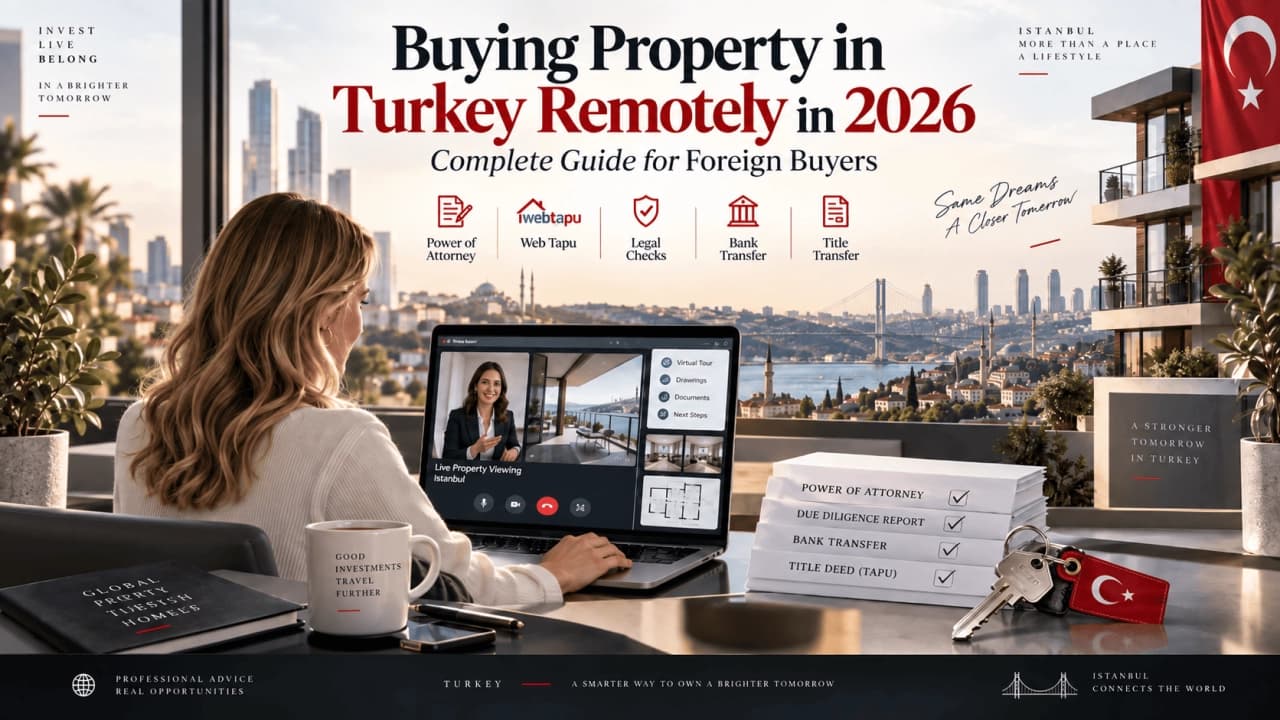
Buying property in Turkey remotely is possible in 2026.
A foreign buyer does not necessarily need to travel to Istanbul personally to complete every stage of a Turkish real estate purchase.
Depending on the transaction and the buyer's location, the process can be structured through:
- remote property search and virtual viewing;
- independent legal due diligence;
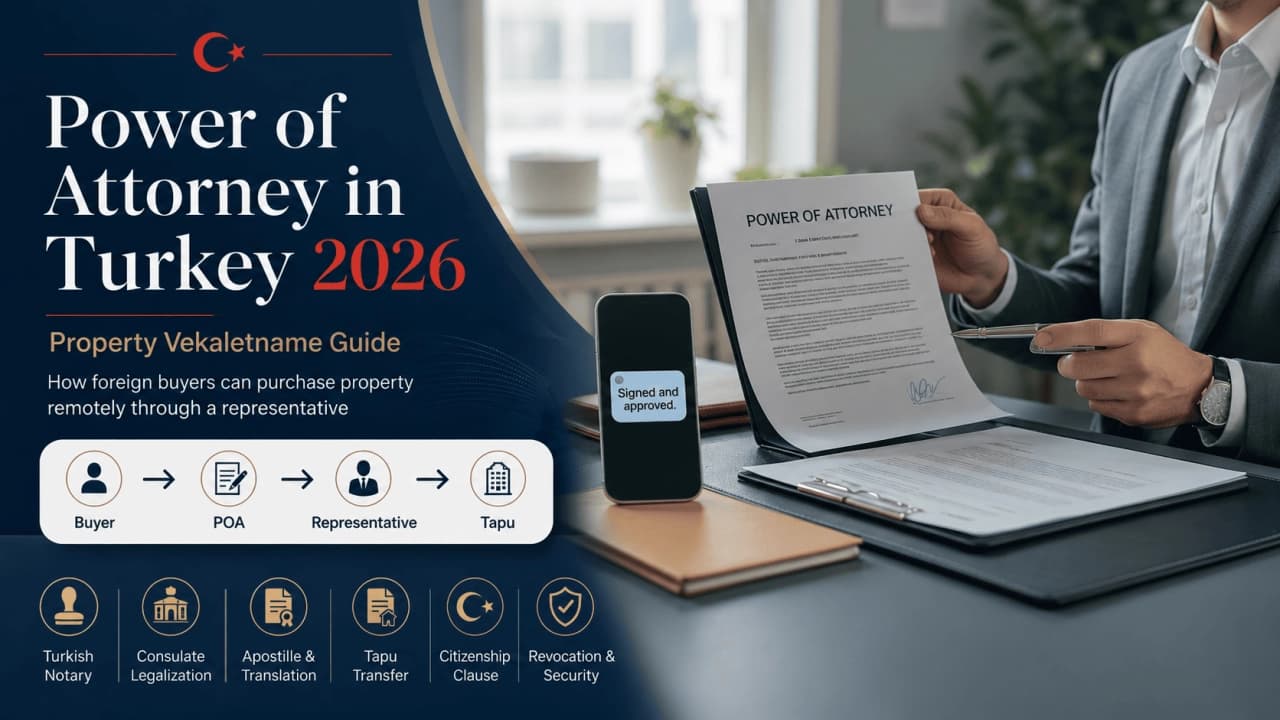
- a properly prepared Power of Attorney — Vekaletname;
- the Web Tapu Foreign Portal;
- international bank transfers;
- DAB and foreign-buyer banking procedures;
- valuation and title checks handled in Turkey;
- representation at the Tapu office;
- or, in certain circumstances, direct land-registry procedures through Turkey's overseas Land Registry representation in Berlin.
TKGM currently confirms that foreign individuals without a Turkish Foreign Identification Number or e-Devlet password can use the Web Tapu “FOR FOREIGNER” portal for relevant land-registry procedures.
There is also an important second route.
As of September 2026, TKGM states that its Berlin Tapu ve Kadastro Temsilciliği is currently the only overseas Land Registry and Cadastre representation where land-registry transactions can be carried out abroad. Foreign investors can therefore, in qualifying cases, complete Turkish Tapu procedures through Berlin without travelling to Turkey.
For most international buyers outside that route, however, the practical model is:
Buyer Abroad
↓
Independent Representative / Lawyer in Turkey
↓
Power of Attorney
↓
Legal Due Diligence
↓
Banking + DAB
↓
Tapu Transfer
↓
Remote Handover
The important point is that:
Remote buying should not mean blind buying.
A foreign buyer may be thousands of kilometres away, but the legal and financial checks should be at least as strong as they would be if the buyer were physically standing in Istanbul.
This guide explains how to buy Turkish property from abroad in 2026, how Power of Attorney works, how Web Tapu fits into the process, how overseas payments and DAB should be coordinated, what can be completed remotely, what still requires formal representation or official attendance, and how to reduce the most common risks of remote property purchases.
Important: This article provides general information, not transaction-specific legal advice. Formal requirements can differ according to the buyer, country where documents are issued, property, intended use, financing method and citizenship objective.
Can You Buy Property in Turkey Without Visiting Turkey?
Yes.
A foreign buyer can structure a Turkish property purchase without personally travelling to Turkey.
The most common method is to appoint a representative in Turkey through a properly drafted Power of Attorney.
That representative may then perform the specific acts authorized in the POA.
Depending on the wording, these can include:
- submitting land-registry applications;
- signing documents;
- completing the Tapu transfer;
- handling valuation procedures;
- arranging certain banking or DAB steps;
- receiving documents;
- completing post-transfer formalities.
However:
The representative can only exercise powers actually granted.
A vague or incomplete Power of Attorney can create delays at closing.
Remote Buying Is Not the Same as Buying Completely Online
This distinction matters.
Many parts of the process can be digital:
- viewing property;
- document exchange;
- contract review;
- Web Tapu applications;
- bank transfers;
- due-diligence communication;
- valuation coordination.
But an official property transfer remains a formal land-registry transaction.
Web Tapu can be used to initiate and manage procedures, but it should not be misunderstood as:
“Click Buy and automatically become the legal owner.”
TKGM has explained that Web Tapu allows foreign individuals to submit and advance land-registry applications electronically and bring many procedures to the final stage without initially visiting the Tapu office.
The final transfer still needs the legally required declarations and formalities, either:
- personally;
- through an authorized representative;
- or through an available official overseas land-registry mechanism.
Three Main Ways to Buy Turkish Property Remotely
A remote buyer should understand the three main structures.
| Method | Buyer Travels to Turkey? | Representative Needed? | Best Use |
|---|---|---|---|
| Power of Attorney | No | Usually yes | Most foreign remote purchases |
| Berlin Tapu Representation | No travel to Turkey, but attendance in Berlin may be required | Not necessarily | Buyers able to use Berlin overseas Tapu service |
| Hybrid Purchase | Usually one short visit or partial remote process | Sometimes | Buyers who want to inspect personally but delegate closing |
There is no single best structure for every buyer.
Option 1 — Buy Through a Power of Attorney
The most common remote purchase model is:
Buyer remains abroad
↓
Buyer issues POA
↓
Representative acts in Turkey
A properly structured POA allows the buyer to delegate specific legal acts.
For remote property purchases, the representative might be:
- independent Turkish lawyer;
- trusted family member;
- another trusted individual;
- another legally appropriate representative.
From a risk perspective, the buyer should think carefully before granting broad property and banking authority to anyone whose commercial interests are tied to making the sale happen.
Who Should Receive Your Power of Attorney?
The legal ability to appoint someone does not mean every possible representative is equally appropriate.
Consider whether the representative:
- is independent;
- understands the Turkish property process;
- has a professional obligation toward you;
- has a financial interest in completing the sale;
- controls seller-side information;
- will also receive your purchase money.
For a substantial remote acquisition, concentration of too much authority in one commercial party can increase risk.
For example:
Agent selects property
Agent tells you it is legally safe
Agent holds POA
Agent receives funds
Agent signs closing
creates a very different control environment from:
Agent finds property
Independent lawyer checks property
Bank handles funds
Limited POA covers closing
Separating functions can improve transaction controls.
What Should a Property Power of Attorney Include?
The exact wording depends on what the representative needs to do.
Potential powers can include:
- acquiring a specific property;
- signing official land-registry documents;
- making Tapu declarations;
- applying for valuation;
- submitting documents;
- paying defined charges;
- arranging DAB-related procedures;
- receiving the Tapu;
- obtaining utility or insurance documentation;
- completing citizenship-specific formalities if applicable.
TKGM requires a foreign-issued POA to contain authorization for the transaction that is actually being performed.
Therefore:
Do not use a generic POA without checking whether it covers the actual purchase workflow.
Specific POA vs General POA
For many property buyers, a limited or transaction-specific POA is preferable.
For example, the document can limit authority by:
- property;
- developer;
- purchase amount;
- type of transaction;
- permitted actions;
- expiry date.
A broad POA might allow much more than the buyer intended.
The appropriate scope depends on the transaction, but remote purchasing should not automatically mean giving someone unlimited authority over all assets and bank accounts.
How Can You Issue a Power of Attorney Abroad?
There are generally two main routes.
Route 1 — Turkish Embassy or Consulate
A foreign individual may be able to arrange the relevant property POA through a Turkish diplomatic mission that provides the applicable notarial service.
A current February 2026 Turkish Embassy guidance for foreign individuals confirms that property-sale POAs are among the limited notarial matters that may be handled for foreign individuals through Turkish diplomatic missions.
This can often simplify later use in Turkey because the document is created within the Turkish consular system.
Route 2 — Local Foreign Notary
A POA may also be issued through an authorized local notary or authority abroad.
TKGM's foreign-buyer procedure guide states that, except for POAs prepared by Turkish consulates, foreign-issued POAs generally need to:
- be issued in the official language of the country;
- include the person's photograph;
- contain the required transaction authority;
- receive an Apostille where the Hague Convention applies, or appropriate Turkish consular certification where applicable;
- be submitted with a notarized Turkish translation.
The exact authentication route depends on the country in which the document is prepared.
What Is an Apostille?
An Apostille is an authentication mechanism used between countries participating in the Hague Apostille Convention.
For qualifying foreign-issued POAs, an Apostille can remove the need for a separate Turkish consular legalization stage.
However:
Apostille ≠ Turkish translation
and
Apostille ≠ confirmation that the POA contains the right powers.
All three questions must be considered separately:
- Was the POA legally issued?
- Was it authenticated correctly?
- Does it authorize the intended Turkish transaction?
Can a Foreign POA Be Used Without Apostille?
Potentially, depending on the relevant legalization framework.
TKGM's published guidance provides an alternative to Apostille where the document is appropriately certified by the Turkish Consulate in the jurisdiction connected to the authority/notary issuing the POA.
Because the process depends on the issuing country, confirm the required authentication route before signing.
Do not prepare the document first and ask the Turkish Tapu office later whether it is acceptable.
Does the POA Need a Photo?
For foreign-issued property POAs used in Turkish land-registry procedures, TKGM's published requirements specify a photograph and require the issuing authority to authenticate the photo in the prescribed way.
This is an example of a small technical requirement that can delay an otherwise ready closing.
Use a POA template prepared specifically for Turkish land-registry use.
Does the Power of Attorney Need Turkish Translation?
A POA prepared abroad in a foreign language generally needs an acceptable Turkish translation for land-registry use.
TKGM states that foreign-issued POAs must be presented with a notarized Turkish translation.
Do not rely solely on an informal translation prepared by the real estate salesperson.
Can the Buyer Use the Turkish Consulate Instead of a Foreign Notary?
Often, yes, where the relevant Turkish diplomatic mission provides that notarial service to the applicant.
This can eliminate some of the uncertainty around:
- Apostille;
- legalization;
- form;
- photo certification;
- Turkish legal terminology.
However, consulates can have:
- appointment requirements;
- document requirements;
- jurisdictional practices.
Check the relevant mission before attending.
Option 2 — Complete Tapu Procedures Through Berlin
There is a lesser-known alternative for certain foreign buyers.
TKGM confirms that Turkish land-registry transactions can currently be performed abroad through the Tapu ve Kadastro Temsilciliği at the Turkish Consulate General in Berlin.
As of the current 2026 TKGM information:
Berlin is the only active overseas Tapu and Cadastre representation.
TKGM states that additional overseas representations are planned, but buyers should not assume they are operational until officially confirmed.
Who Can Use the Berlin Tapu Representation?
Current official information states that the Berlin representation can serve:
- Turkish citizens abroad;
- foreigners investing in Turkish real estate.
The Berlin Consulate further states that the representation has no geographic service-area restriction and may accept applications from other German cities and even from other countries.
This can be particularly useful for a buyer living in Europe.
Do Buyer and Seller Have to Be in the Same Tapu Office?
No.
Turkish rules were changed so that parties to qualifying land-registry transactions do not necessarily need to be present at the same office.
TKGM states that the parties' official declarations can be taken separately where they are located at different land-registry offices or at the overseas representation.
For example, a structure could involve:
Buyer in Berlin
and
Seller in Istanbul
with the relevant official units coordinating the transaction.
Is Berlin Completely Online?
No.
Do not confuse:
buying without travelling to Turkey
with
never appearing before an official authority anywhere.
The Berlin Consulate's current guidance states that applications to the Tapu and Cadastre representation must be made personally by the owner or legal representative for the applicable procedure.
It is therefore a remote-from-Turkey option, not necessarily a zero-attendance option.
Option 3 — Hybrid Remote Purchase
Some buyers prefer a hybrid approach.
For example:
Visit 1
Travel to Istanbul to:
- inspect properties;
- choose apartment;
- meet lawyer;
- open bank account;
- sign POA.
Then return home.
The representative completes:
- due diligence;
- DAB;
- closing;
- Tapu.
This can combine:
physical inspection
with
remote closing convenience.
For many high-value buyers, this can provide a strong balance between control and convenience.
Can You Choose a Property Completely Remotely?
Yes, technically.
But the quality of the selection process matters.
Remote buyers commonly use:
- live video tours;
- floor plans;
- project videos;
- drone footage;
- neighborhood maps;
- virtual tours;
- video calls.
These tools can help.
They should not replace independent verification.
Recorded Video vs Live Video Tour
A prerecorded marketing video shows what the seller wants to show.
A live video tour gives the buyer more control.
During a live tour, ask the person filming to show:
- view from every window;
- corridor;
- lift;
- parking;
- building entrance;
- neighboring buildings;
- street;
- construction nearby;
- actual floor;
- apartment number;
- common areas;
- noise level.
Ask them to open windows.
Ask them to walk from the apartment to the street.
Remote due diligence should recreate as much of the physical experience as realistically possible.
Verify the Actual Apartment, Not Just the Show Flat
This is particularly important in developer projects.
A buyer may be shown:
beautiful 2+1 show apartment
while purchasing:
another unit in another block on another floor.
Confirm:
- exact block;
- exact floor;
- unit number;
- independent section where available;
- orientation;
- view;
- net area;
- balcony;
- parking;
- storage.
Do not treat a showroom as proof of what you are buying.
Ask for an Unedited Live Exterior View
For remote purchases, location presentation can be misleading.
Marketing materials may not clearly show:
- adjacent construction;
- industrial buildings;
- highway;
- steep streets;
- empty future development land;
- noise sources;
- distance to transport.
Ask for a live video around the actual building and neighborhood.
Verify Travel Time Independently
Do not rely only on phrases such as:
“10 minutes from the Bosphorus.”
Ask:
10 minutes by what method?
Walking?
Driving at midnight?
Taxi?
Metro?
Remote buyers should independently verify:
- nearest metro;
- walking distance;
- actual road access;
- distance to business districts;
- neighborhood amenities.
Remote Purchase Does Not Eliminate Legal Due Diligence
This is probably the most important rule in Article 25.
Turkey's Ministry of Foreign Affairs specifically advises foreign property buyers not to sign legally binding contracts or make payments before checking relevant information concerning the property, and also advises buyers to investigate the seller or company involved.
Remote buyers should apply this advice even more strictly.
What Should Be Checked Before Paying Remotely?
At minimum:
Seller
- Is the seller the registered owner?
- If company, does it legally exist?
- Is the person signing authorized?
Property
- Does the property legally exist as described?
- What are the Tapu details?
- Is the apartment correctly identified?
Takyidat
- Mortgage?
- Attachment?
- Annotation?
- Easement?
- Other restriction?
Building
- Kat mülkiyeti or kat irtifakı?
- İskan status?
- Building permit if relevant?
Contract
- Correct buyer?
- Correct seller?
- Correct property?
- Correct price?
- Refund provisions?
- Title-transfer deadline?
These issues are covered in depth in:
Legal Due Diligence for Property in Turkey — Article 22.
Never Let Distance Create Artificial Urgency
Remote buyers often hear:
“Another buyer is about to transfer today.”
or
“You need to pay the reservation fee within one hour.”
Sometimes this may reflect real demand.
It can also pressure the buyer into skipping essential checks.
A remote purchase should not proceed faster simply because the buyer is overseas.
Remote Reservation Deposit
A foreign buyer may need to reserve a property before the main purchase.
If paying remotely, the reservation document should clearly state:
- property;
- agreed price;
- amount paid;
- currency;
- reservation period;
- whether payment counts toward purchase price;
- refund conditions;
- buyer cancellation;
- seller cancellation;
- due-diligence condition;
- financing condition if applicable.
Do not send “Kapora” simply because the agent sends an IBAN.
See:
Property Deposit in Turkey 2026 — Article 21.
Who Should Receive the Remote Deposit?
The beneficiary should make sense.
If you are purchasing from:
ABC Gayrimenkul A.Ş.
but the agent asks you to transfer €10,000 to:
an unrelated individual's personal bank account
stop and verify the structure.
Remote buyers should independently confirm:
- IBAN;
- account-holder name;
- recipient's relationship to seller;
- payment purpose.
Remote Property Purchase Contract
Contracts can be exchanged and reviewed electronically before closing.
But a remote buyer should not assume:
PDF signature = official property ownership transfer.
The property purchase contract defines the commercial relationship.
The official Tapu process transfers registered ownership.
They are separate steps.
For the full contract guide:
Property Purchase Contract in Turkey 2026 — Article 20.
Check Which Language Controls
Remote foreign buyers often receive bilingual contracts:
Turkish + English
or:
Turkish + Arabic
or:
Turkish + Russian
If there is a translation inconsistency, the agreement should state which version controls.
Do not assume the English marketing translation has priority.
Use Independent Translation
If the transaction value is significant, legal documents should not depend solely on a translation prepared by the seller.
Important clauses include:
- cancellation;
- penalty;
- refund;
- title transfer;
- delivery;
- force majeure;
- dispute resolution.
A mistranslation can materially change the buyer's understanding.
Web Tapu for Foreign Buyers
TKGM operates a dedicated Web Tapu Foreign Portal.
Foreign natural persons who do not have a Turkish YKN or e-Devlet password can access the system through the:
“FOR FOREIGNER”
section.
TKGM also publishes dedicated guidance explaining foreigner sales through Web Tapu.
What Can Web Tapu Help With?
TKGM's published information indicates that foreign users can use Web Tapu to:
- initiate land-registry applications;
- manage relevant procedures;
- access property information;
- perform certain property-related electronic services.
TKGM has also explained that online applications can allow procedures such as sales or mortgages to be initiated without initially visiting the Tapu office and advanced toward their final stage.
This makes Web Tapu an important component of remote ownership and remote transactions.
Web Tapu Does Not Replace Due Diligence
Government portal access tells you nothing about whether:
- the negotiated price is good;
- developer is reliable;
- apartment is earthquake-safe;
- contract is balanced;
- investment will perform well.
Use the portal as a procedural tool, not as a substitute for investment analysis.
Passport Requirements
Foreign buyers need acceptable identification for Turkish land-registry procedures.
TKGM states that a passport or qualifying identity document is used for identification.
For passports issued using the Latin alphabet, TKGM states that a Turkish translation is generally not required under the relevant identification guidance; passports using a non-Latin alphabet may require translation if the Land Registry Directorate considers it necessary.
Remote buyers should confirm this before preparing POA and closing documentation.
Sworn Interpreter at Tapu
Where a party personally participates in a Turkish land-registry transaction and does not speak Turkish, a sworn interpreter may be required.
TKGM's foreign-buyer procedure guide includes a sworn interpreter among the documentation/procedural requirements where a party does not speak Turkish.
Where the buyer acts through a representative, the procedural structure is different.
Property Valuation for Remote Buyers
Foreign-buyer transactions may require an official valuation process under the applicable TKGM framework.
TKGM currently maintains a dedicated valuation-report system for transactions in which foreign natural persons are buyers.
This process can be coordinated in Turkey without the buyer physically visiting the apartment.
The valuer inspects and evaluates the property—not the buyer.
Can Valuation Be Requested Through Web Tapu?
TKGM has integrated valuation-report procedures into its Web Tapu framework.
Its current guidance explains that foreign property owners/users can access the relevant valuation-report process through the FOR FOREIGNER portal under the applicable conditions.
For the full topic:
Turkey Property Valuation Report 2026 | Ekspertiz & TTB Guide.
Opening a Bank Account Remotely
A personal Turkish bank account can make a remote transaction easier but is not universally required for property ownership.
Bank onboarding depends on:
- nationality;
- bank;
- residency;
- identification;
- compliance;
- source of funds.
If the buyer cannot open a Turkish account before the purchase, the transaction may still be structured through another compliant payment route.
See:
Opening a Bank Account in Turkey for Foreign Property Buyers — Article 24.
Can You Send the Property Money Directly From Abroad?
Yes, depending on the transaction structure.
TKGM provides an official DAB example in which:
foreign buyer's overseas USD account
↓
seller's Turkish USD account
↓
seller arranges DAB conversion
↓
Tapu procedure
This demonstrates that the buyer does not always need to first move the money into a personal Turkish account.
The transaction should still be structured correctly before the transfer.
International Transfer Planning
For a remote purchase, do not assume:
“I will send the money on Tapu day.”
International transfers can encounter:
- bank cut-off times;
- correspondent banks;
- AML review;
- source-of-funds review;
- weekends;
- currency conversion;
- receiving-bank verification.
The payment timeline should be established before closing.
Source of Funds for Remote Buyers
Large international property transfers may trigger normal banking compliance reviews.
Prepare evidence such as:
- savings history;
- employment income;
- business income;
- sale of another property;
- investment liquidation;
- inheritance.
The bank may want to understand both:
where the money came from
and
why it is being sent to Turkey.
DAB for Remote Property Purchases
Foreign natural persons purchasing Turkish property are subject to the applicable Döviz Alım Belgesi process.
The foreign currency used in the transaction must be handled through the banking system according to the current framework before the relevant title transaction.
A remote buyer can coordinate DAB through:
- bank;
- representative;
- seller structure where permitted.
The buyer does not necessarily have to be physically present during the banking conversion.
Do Not Convert the Money Before Planning DAB
A common remote-purchase error is:
Buyer converts all EUR/USD to TRY abroad or too early
and only later asks:
“How do we get the DAB?”
The banking route should be planned before conversion.
For full details:
DAB in Turkey for Foreign Property Buyers 2026.
Paying the Final Purchase Price Remotely
The safest payment structure depends on the transaction.
Possible approaches include:
- buyer-controlled transfer linked to Tapu timing;
- bank-coordinated payment;
- mortgage disbursement;
- another properly documented closing structure.
What should be avoided is:
full uncontrolled payment long before ownership transfer without adequate protection.
Can Your Lawyer Receive the Purchase Money?
Technically, transaction structures can vary.
But ask whether this is actually necessary.
Separating:
legal representation
from
custody of €300,000 or $500,000
can reduce risk.
Whenever possible, understand why money needs to pass through a third-party account instead of being transferred through a documented buyer-to-seller or controlled banking structure.
Remote Mortgage Application
Foreign buyers can potentially finance Turkish property through eligible banks, but mortgage underwriting adds complexity to a remote purchase.
The bank may require:
- borrower documentation;
- income evidence;
- appraisal;
- collateral review;
- banking onboarding.
Do not pay a large non-refundable deposit before understanding whether the bank will finance:
you + this specific property.
See:
Mortgage in Turkey for Foreigners 2026 — Article 23.
Remote Purchase for Turkish Citizenship
It is possible to structure a property purchase for Turkish citizenship without the investor being physically present for every property stage.
However, citizenship transactions require particularly careful coordination.
The property acquisition must align with:
- current investment threshold;
- valuation / TTB;
- DAB;
- bank payment evidence;
- seller/property eligibility;
- required Tapu undertaking/annotation;
- holding-period requirement;
- immigration/citizenship documentation.
Do not use a generic remote-purchase POA for a citizenship transaction without confirming that it contains every authority needed.
Do Not Let a Citizenship Agent Control Every Step
A citizenship-focused remote buyer is especially vulnerable to concentration of control.
Avoid a structure where one party:
- selects the property;
- sets the price;
- values the property;
- performs legal due diligence;
- holds POA;
- receives the money;
- determines citizenship eligibility.
Independent checks are particularly important when the buyer's primary objective is citizenship.
Remote Citizenship Purchase and Payment Trail
Citizenship transactions require a clean documentary chain.
The buyer should preserve:
- purchase agreement;
- bank transfer;
- DAB;
- TTB / valuation records;
- Tapu;
- citizenship annotation documents;
- POA;
- relevant receipts.
Remote status does not reduce documentary requirements.
Remote Purchase From a Developer
Developer transactions are relatively easy to market remotely because:
- floor plans are digital;
- payment plans are standardized;
- sales teams offer video calls;
- projects often have international sales departments.
But developer purchases create their own risk.
Before paying remotely, verify:
- legal developer;
- land ownership;
- building permit;
- exact unit;
- project contract;
- delivery date;
- title-transfer mechanism;
- construction progress;
- refund provisions.
Article 26 will examine this in depth:
Developer Due Diligence in Turkey.
Remote Purchase of a Resale Apartment
A resale apartment may require more physical investigation.
Ask someone independent to inspect:
- current condition;
- tenant status;
- furniture;
- water damage;
- building common areas;
- neighboring development;
- view;
- noise;
- renovation quality.
A beautiful listing may be several years old.
Request a current live inspection.
Hire an Independent Technical Inspector Where Appropriate
Legal due diligence does not establish:
- roof condition;
- water leakage;
- electrical quality;
- structural defects;
- HVAC condition;
- renovation defects.
For expensive resale property, remote buyers may benefit from an independent engineer or technical inspector.
The buyer should receive:
- photographs;
- video;
- written observations;
- clearly identified unresolved issues.
Earthquake Due Diligence Matters Even More Remotely
Remote buyers should not conclude that:
new-looking interior = earthquake-safe building.
Consider:
- building age;
- permit date;
- structural system;
- soil/location;
- technical records;
- urban transformation;
- professional engineering advice where appropriate.
See:
Earthquake-Safe Apartments in Istanbul 2026.
Do Not Buy Based Only on Interior Photos
A renovated apartment can conceal:
- old building;
- neglected common areas;
- basement moisture;
- structural modification;
- poor neighborhood environment.
Remote inspection should cover the building, not just the apartment.
Remote Developer Verification
Ask for the seller's exact legal company name.
Then verify whether that company:
- owns the property;
- has authority to sell;
- is the actual party to the contract.
Marketing brands can differ from legal entities.
Article 26 will cover this in detail.
Remote Contract Signing Checklist
Before electronically or physically signing documents from abroad, confirm:
Never sign simply because the sales team says:
“This is our standard agreement.”
Remote Handover After Tapu
Title transfer is not the end of the remote transaction.
The buyer still needs control of the physical asset.
A remote handover should document:
- keys;
- access cards;
- parking remote;
- apartment condition;
- meter readings;
- furniture inventory;
- defects;
- building management contact;
- aidat position.
For a developer property, obtain a signed handover record where appropriate.
Who Should Receive the Keys?
The buyer can authorize:
- lawyer;
- property manager;
- trusted representative.
Do not assume the salesperson should retain permanent access after closing.
Change security arrangements where appropriate.
Remote Utility Setup
After ownership transfer, the buyer may need to arrange:
- electricity;
- water;
- gas;
- internet;
- DASK;
- home insurance;
- site registration.
Some of these tasks can be delegated by properly drafted POA.
The exact procedures depend on the property and provider.
Property Management for Remote Owners
If the buyer will remain abroad, management planning should begin before closing.
Decide who will handle:
- emergencies;
- maintenance;
- keys;
- utility bills;
- aidat;
- tenant;
- rent collection;
- inspections.
This will later be covered comprehensively in the Post-Purchase Cluster:
Property Management in Istanbul for Foreign Owners.
Keep Independent Copies of Every Document
Remote buyers should maintain their own secure file containing:
Identity
- passport;
- tax number;
- YKN if applicable.
Legal
- POA;
- Apostille/legalization;
- translation;
- due-diligence report;
- contract.
Property
- Tapu;
- valuation;
- property plans;
- İskan-related documents where relevant.
Banking
- SWIFT receipts;
- seller payment receipts;
- DAB.
Handover
- key record;
- photos;
- inventory.
Do not let your only copy remain in an agent's WhatsApp conversation.
Remote Property Purchase Step by Step
A well-controlled remote purchase can follow this sequence:
Step 1 — Define the Investment Objective
Decide whether the property is intended for:
- residence;
- rental income;
- capital growth;
- citizenship;
- future relocation.
Step 2 — Set Budget and Payment Currency
Determine:
- property budget;
- cash vs mortgage;
- EUR/USD/TRY position;
- closing-cost reserve.
Step 3 — Shortlist Properties
Use:
- listings;
- live video;
- floor plans;
- neighborhood data.
Step 4 — Verify the Exact Property
Confirm:
- location;
- block;
- floor;
- unit;
- orientation;
- area;
- view.
Step 5 — Verify Seller / Developer
Identify the legal seller before payment.
Step 6 — Structure the Power of Attorney
Decide exactly what your representative needs to do.
Step 7 — Complete Legal Due Diligence
Check:
- owner;
- Tapu;
- takyidat;
- mortgage;
- building status;
- contract.
Step 8 — Reserve the Property Carefully
Use a documented reservation agreement with appropriate conditions.
Step 9 — Review and Sign the Purchase Contract
Ensure contract matches the due-diligence findings.
Step 10 — Prepare Banking
Confirm:
- receiving account;
- SWIFT;
- source of funds;
- DAB process;
- transfer timing.
Step 11 — Complete Valuation and Required Foreign-Buyer Procedures
Coordinate through the relevant systems/professionals.
Step 12 — Recheck Title Before Closing
Confirm no unexpected new restriction has appeared.
Step 13 — Complete the Tapu Transfer
Through:
- representative under POA;
- direct official procedure;
- Berlin representation where applicable.
Step 14 — Confirm Ownership
Obtain and review the final Tapu information.
Step 15 — Complete Physical Handover
Verify:
- keys;
- condition;
- utilities;
- building management.
What Can Be Done Remotely?
| Stage | Usually Possible Remotely? | Notes |
|---|---|---|
| Property search | Yes | Listings/video/live tours |
| Negotiation | Yes | Written confirmation recommended |
| Legal due diligence | Yes | Independent lawyer/representative |
| Reservation | Yes | Review refund terms |
| Purchase contract | Often | Formal legal effect must be distinguished from Tapu |
| Tax number | Often | Digital options available |
| Bank account | Sometimes | Bank-specific |
| International funding | Yes | Compliance planning required |
| Valuation coordination | Yes | Property inspected locally |
| DAB | Yes through correct structure | Bank/representative coordination |
| Web Tapu application | Yes | Foreign portal available |
| Official Tapu transfer | Through formal route | POA / official attendance / Berlin route |
| Handover | Yes through representative | Document condition |
Remote does not mean informal.
Remote Buying Red Flags
| Red Flag | Why It Matters |
|---|---|
| “You do not need a lawyer because you are buying remotely” | Remote buying increases verification needs |
| Seller refuses live video | Property condition/location may be misrepresented |
| Only show apartment is shown | Actual purchased unit may differ |
| POA drafted entirely by seller without independent review | Authority may be broader than intended |
| Buyer gives agent banking authority unnecessarily | Concentrates financial control |
| Full payment requested before title checks | High exposure |
| Property money sent to salesperson's personal account | Recipient may not be seller |
| “Everything can be completed 100% online” without explaining formal closing | May misrepresent legal process |
| Buyer never receives current Tapu information | Ownership/restrictions unverified |
| Seller discourages independent lawyer | Major warning sign |
| Citizenship “guaranteed” remotely | Eligibility requires formal checks |
| Buyer is told Apostille is always unnecessary | Foreign POA authentication depends on route |
| Agent asks for OTP or bank password | Serious financial-security risk |
| Property price changes after reservation | Reservation agreement may be weak |
| Handover not documented | Buyer cannot verify delivered condition |
Common Remote Buying Mistakes
Mistake 1 — Trusting Marketing Material as Due Diligence
Marketing explains why you should buy.
Due diligence tests whether you should buy.
They have different purposes.
Mistake 2 — Granting an Unlimited POA
Give only the authority necessary for the transaction.
Mistake 3 — Paying Before Checking Title
Turkey's Ministry of Foreign Affairs itself advises foreign buyers to investigate the property before signing binding agreements or making payment.
Mistake 4 — Giving POA and Money to the Same Sales Agent
Concentrating too much control in one party increases risk.
Mistake 5 — Not Verifying the Actual Unit
A developer brochure does not identify your exact legal asset.
Mistake 6 — Assuming Web Tapu Means Fully Online Transfer
Web Tapu is a procedural portal.
Official title transfer still follows formal legal requirements.
Mistake 7 — Assuming a PDF Contract Makes You the Owner
Registered ownership is not the same as contractual expectation.
Mistake 8 — Sending Money Before Planning DAB
Foreign-buyer payment compliance should be planned first.
Mistake 9 — Ignoring Handover
You can own a property legally and still have unresolved physical possession issues.
Mistake 10 — Not Keeping Original Documents
POA and other foreign-issued documents may need originals or certified forms in the transaction.
Remote Purchase Checklist
Property Selection
Seller
Legal
Power of Attorney
Banking
Tapu
Handover
15 Questions to Ask Before Buying Turkish Property Remotely
- Who is the registered owner?
- Who legally represents the seller?
- Am I seeing the exact apartment I will buy?
- What is its official independent-section number?
- What restrictions appear in the current land registry?
- Who is independently reviewing my contract?
- Who will hold my POA?
- Exactly what can that person do?
- Where will my deposit be sent?
- Under what conditions is it refundable?
- How will the final purchase money reach the seller?
- Who will arrange DAB?
- Who will represent me at Tapu?
- Who will inspect and accept the property at handover?
- When will I independently verify that ownership has been registered in my name?
If several answers come from only one salesperson, consider adding independent controls.
FAQ: Buying Property in Turkey Remotely
Can foreigners buy property in Turkey without travelling to Turkey?
Yes.
A foreign buyer can complete a Turkish property transaction through an appropriately authorized representative using a valid Power of Attorney, subject to the applicable land-registry and foreign-buyer requirements.
There is also currently an overseas Tapu representation in Berlin through which qualifying transactions can be carried out without travelling to Turkey.
Can I buy an Istanbul apartment completely online?
Many stages can be handled digitally, including search, document exchange, due diligence communication, international payment planning and Web Tapu applications.
However, official transfer of ownership remains a formal process requiring the appropriate official declaration, representation or approved overseas mechanism.
“Online purchase” should therefore not be understood as an e-commerce checkout.
Do I need a Power of Attorney?
If you will not personally participate in the required closing procedure and are not using another available official mechanism such as the applicable Berlin Tapu route, you will generally need an authorized representative.
A correctly drafted POA is therefore the normal solution for fully remote buyers.
Can I issue the POA at a Turkish Consulate?
Foreign individuals may be able to obtain property-related POAs through Turkish diplomatic missions that provide the relevant notarial services. Current Turkish diplomatic guidance includes property-sale POAs among the permitted notarial transactions for foreign individuals.
Can I prepare the POA through a local notary abroad?
Yes, subject to Turkish acceptance requirements.
TKGM states that foreign-issued POAs generally need appropriate authentication such as Apostille or consular certification, a photograph, sufficient transaction authority and a notarized Turkish translation.
Does a foreign property POA need an Apostille?
Where the POA is issued in a Hague Apostille Convention country under the relevant route, an Apostille is generally used for authentication.
TKGM also recognizes appropriate Turkish consular certification as an alternative in applicable circumstances.
Does the POA need a photograph?
TKGM's requirements for foreign-issued land-registry POAs include a photograph that is properly authenticated by the issuing authority.
Can I use Web Tapu from abroad?
Yes.
TKGM operates a FOR FOREIGNER portal and confirms that foreign natural persons without YKN/e-Devlet credentials can access the relevant foreign-user entry route.
Can Web Tapu transfer the property to me without POA?
Web Tapu facilitates applications and digital procedures, but it does not eliminate the formal requirements governing the official transfer.
If the buyer will not personally complete the required formal stage, representation or another applicable official route may still be necessary.
Can I complete the Tapu transaction in Germany?
Currently, yes, through the Turkish Tapu ve Kadastro Temsilciliği in Berlin where the transaction is eligible.
TKGM states that Berlin is currently its only active overseas land-registry representation.
Do I have to live in Berlin to use the Berlin office?
Current Berlin Consulate information states that the representation has no geographic service-area restriction and may accept applications from elsewhere in Germany and from other countries.
Always confirm appointment and procedural eligibility before travelling.
Can the seller stay in Turkey while I complete my part in Berlin?
Turkish land-registry rules permit parties to qualifying transactions to make their official declarations from different land-registry units, including the overseas representation framework.
The specific transaction should be confirmed in advance with the relevant offices.
Do I need a Turkish bank account to buy remotely?
Not necessarily.
TKGM's DAB guidance allows structures in which the buyer sends foreign currency from an overseas account to the seller's Turkish foreign-currency account before the seller arranges the DAB conversion. A personal Turkish account can still make the process easier.
Can I send the purchase money from abroad?
Yes, provided the transaction is structured correctly and the required foreign-buyer banking and DAB documentation is produced.
Plan the payment path before sending money.
Can my lawyer arrange DAB?
The DAB framework permits authorized representatives to participate in the foreign-currency conversion process where the required authority and banking structure exist.
The exact POA and bank procedure should be confirmed in advance.
Can I buy remotely for Turkish citizenship?
Potentially, yes.
But citizenship purchases require additional valuation, DAB, payment, seller/property eligibility and Tapu requirements.
A citizenship transaction should use a POA drafted specifically for the required procedures rather than a generic remote-purchase authorization.
Should I buy a property without ever visiting Istanbul?
That is a commercial decision.
Legally, remote purchase is possible.
From a risk-management perspective, if the buyer cannot visit, independent legal review, live inspection and—where appropriate—technical inspection become more important.
Can someone inspect the apartment for me?
Yes.
A buyer can appoint an independent representative, engineer or property professional to perform an inspection and provide live video, photographs and written observations.
Technical inspection should be separate from legal due diligence.
How do I know the property was actually transferred to me?
After closing, verify the official land-registry result rather than relying only on a message from the agent.
Web Tapu and official Tapu documentation can be used within the applicable system to confirm registered ownership information.
Final Advice for Remote Foreign Buyers
Buying property in Turkey remotely is entirely workable in 2026, but convenience should not reduce transaction controls.
A well-structured remote purchase separates the transaction into clear functions:
Property Selection
↓
Independent Verification
↓
Legal Due Diligence
↓
Limited Power of Attorney
↓
Secure Banking
↓
DAB / Valuation
↓
Official Tapu Transfer
↓
Independent Confirmation
↓
Physical Handover
The strongest remote transactions do not depend on one person saying:
“Trust me, I will handle everything.”
They create an evidence trail where the buyer can independently answer:
- what property is being purchased;
- who owns it;
- who is receiving the money;
- what legal restrictions exist;
- what the representative can do;
- when ownership transfers;
- how the payment is documented;
- who takes possession after closing.
Turkey's official systems now make remote ownership increasingly practical.
Foreign buyers have access to the Web Tapu Foreign Portal, which enables foreign users to initiate and manage relevant land-registry procedures electronically.
Foreign buyers also currently have access to Turkey's overseas Land Registry and Cadastre representation in Berlin, which TKGM identifies as its present overseas location for direct Tapu services.
And for buyers elsewhere in the world, a properly prepared foreign or Turkish-consular Power of Attorney remains the principal practical mechanism for completing a purchase without travelling to Turkey.
The most important principle is therefore:
Remote purchase should change where the buyer is—not the quality of the buyer's due diligence.
If anything, a buyer who cannot physically attend should demand more documentation, more independent verification and a clearer payment trail, not less.
That is how a remote Turkish property purchase becomes a controlled transaction rather than a remote act of trust.