
Knowing how to check a property in Turkey before buying is more important than finding the most attractive apartment online.
A buyer may discover a beautiful Istanbul apartment with:
- a Bosphorus view;
- new kitchen;
- modern furniture;
- metro access;
- competitive price.
But none of those features answers the fundamental questions:
Who legally owns the property?
Does the apartment match the Tapu?
Does it have a mortgage or attachment?
Does the building have the correct permits?
Is the physical condition acceptable?
Is the price reasonable?
Can a foreign buyer legally acquire it?
And what exactly will be transferred at closing?
A serious property check therefore needs several separate layers.
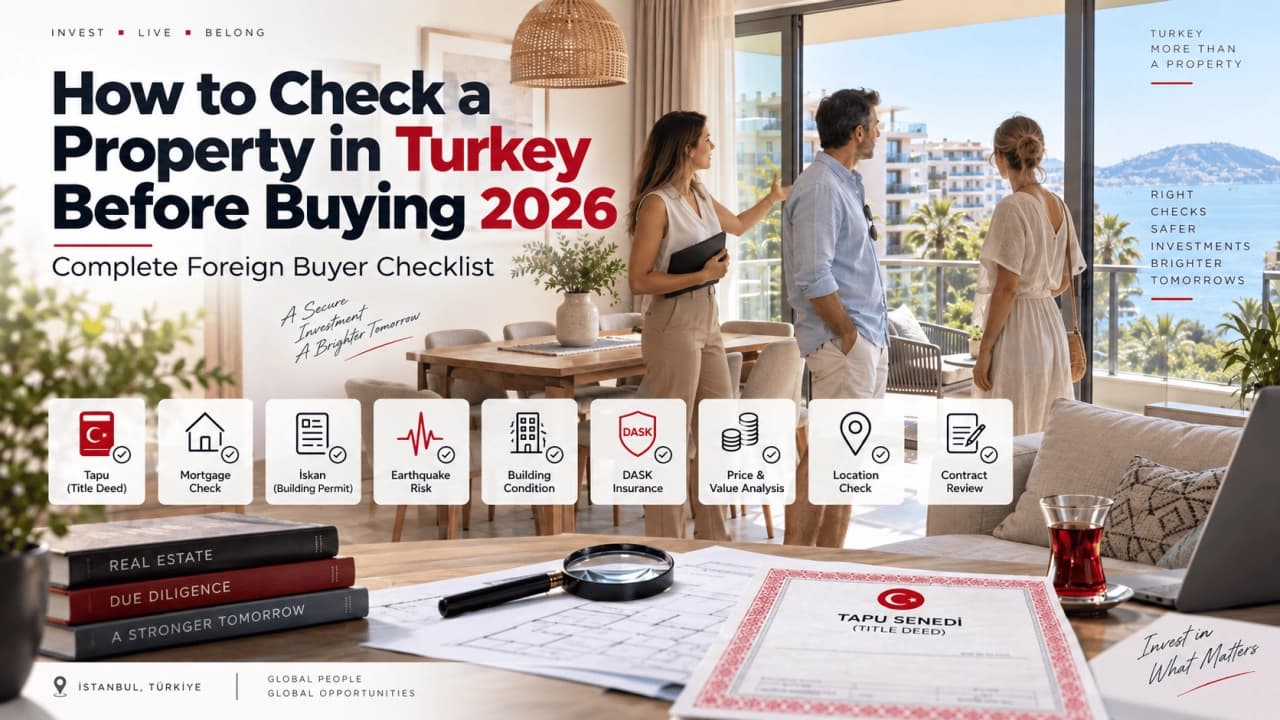
A strong pre-purchase review should examine:
- Legal ownership and Tapu
- Building and permit status
- Physical and technical condition
- Earthquake and structural risk
- Financial and investment quality
- Location and neighborhood
- Contract and payment structure
- Foreign-buyer and closing requirements
No single document answers all of these questions.
A valuation report is not a legal due-diligence report.
A Tapu is not a structural engineering report.
A DASK policy is not an earthquake-safety certificate.
A bank mortgage approval is not an investment recommendation.
A developer brochure is not an approved architectural project.
The objective of this guide is therefore to bring all major pre-purchase checks into one practical master checklist for foreign buyers in Turkey.
Important: This guide provides general information and does not replace transaction-specific legal, engineering, tax or valuation advice.
The 8-Layer Property Check
A simple way to structure the process is:
| Layer | Main Question |
|---|---|
| Legal | What exactly am I legally buying? |
| Ownership | Who owns it and can they sell it? |
| Building | Is the building properly documented? |
| Technical | What physical defects or structural concerns exist? |
| Financial | Is the price and total ownership cost reasonable? |
| Location | Does the neighborhood support my objective? |
| Contract | Are the payment and transfer conditions safe? |
| Closing | Can the property actually be transferred to me correctly? |
A property should not pass simply because one layer looks good.
Part 1 — Legal Checks
1. Verify the Registered Owner
The first question should always be:
Who legally owns the property?
Do not rely only on:
- seller statements;
- apartment keys;
- utility bills;
- old Tapu photographs;
- real estate listings.
The current land-registry position matters.
The seller should correspond with the registered owner or be able to demonstrate legally sufficient authority to act for that owner.
If someone signs through:
- Power of Attorney;
- corporate authority;
- inheritance;
- another representative arrangement,
that authority should be verified.
2. Identify the Exact Property
An Istanbul development can contain hundreds of similar apartments.
Your contract, viewing and Tapu must all refer to the same legal asset.
Check:
- province;
- district;
- neighborhood;
- ada;
- parsel;
- block;
- floor;
- independent section number;
- land share;
- registered property type.
Do not buy:
“The 2+1 apartment on the 12th floor.”
Buy an identifiable independent section.
Marketing Unit Number vs Tapu Number
Developers sometimes use sales-office unit numbers that differ from formal independent-section numbers.
For example:
Marketing unit: A-1207
Official independent section: 188
That may be completely normal.
But the relationship between them must be documented.
3. Review Current Tapu Information
An old Tapu copy shows historical information.
It does not guarantee the property remains unchanged today.
The buyer should verify the current registry before becoming materially committed and consider rechecking it before final transfer.
TKGM provides digital property and land-registry services through Web Tapu and confirms that foreign users can access the Foreign Portal for applicable procedures.
4. Check Takyidat
Do not ask only:
“Does the property have Tapu?”
Ask:
“What appears in the takyidat?”
Takyidat can include registered rights or restrictions affecting the property, such as:
- mortgage — ipotek;
- attachment — haciz;
- annotations — şerhler;
- declarations — beyanlar;
- easements — irtifak hakları;
- other registered rights or restrictions.
Every material record should be understood before purchase.
5. Check for Mortgage — İpotek
A mortgage is not automatically a reason to reject a property.
Many resale and developer properties can legitimately have mortgages.
But the buyer needs to know:
- who the creditor is;
- what mortgage is registered;
- whether it will remain;
- how it will be released;
- when it will be released;
- whether payment is conditional on release.
A seller saying:
“The loan has already been paid.”
does not necessarily mean:
“The mortgage has already been deleted from the land registry.”
Verify the registration itself.
6. Check for Attachments — Haciz
An attachment can create a major closing complication.
If one exists, determine:
- reason;
- amount where relevant;
- creditor;
- removal procedure;
- expected removal date.
Do not complete payment based only on:
“We will remove it after you pay.”
The payment and removal mechanism should be controlled contractually.
7. Review Annotations and Third-Party Rights
Registered annotations can affect the buyer's rights.
Examples can include certain:
- promises of sale;
- contractual rights;
- lease-related rights;
- family-home restrictions;
- other third-party claims.
The important question is not:
“Is there an annotation?”
It is:
“What does this annotation legally mean for my acquisition?”
Part 2 — Building and Permit Checks
8. Check Kat Mülkiyeti vs Kat İrtifakı
Two title concepts frequently appear in Turkish property purchases:
Kat Mülkiyeti
Condominium ownership associated with a completed building.
Kat İrtifakı
Condominium easement typically associated with a building that has not yet completed the transition into full condominium ownership.
TKGM confirms that where kat irtifakı exists and the relevant building-use permit has been obtained, the building can transition to kat mülkiyeti through the applicable process.
Neither term should be evaluated without context.
Is Kat İrtifakı Automatically Bad?
No.
Many legitimate properties can temporarily or historically remain under kat irtifakı.
However, for a physically completed apartment, ask:
- Why is it still kat irtifakı?
- Has İskan been obtained?
- What remains before conversion?
- Is the actual building consistent with the approved project?
Do not accept:
“Everybody in Turkey has this.”
as a substitute for a transaction-specific answer.
9. Check İskan — Yapı Kullanma İzin Belgesi
The building-use permit, commonly discussed as İskan, is an important check for completed property.
The relevant administration assesses whether the completed building corresponds with the permit and approved documentation before issuing a Yapı Kullanma İzin Belgesi.
Current Ministry information describes the process as confirming that a structure has been completed in compliance with the building permit and attached project documentation before the permit for use is issued.
For a completed apartment, determine:
- whether İskan exists;
- whether it covers the building;
- whether the building's current status is consistent with it.
10. Verify the Building Permit — Yapı Ruhsatı
For newer or off-plan property, obtain information regarding the Yapı Ruhsatı.
This is particularly important in prepaid developer transactions.
The Ministry of Trade's current March 2026 guidance explicitly states:
A prepaid housing contract cannot be concluded with a consumer before the building permit has been obtained.
If a developer says:
“The permit will arrive soon.”
treat that differently from:
“Here is the issued permit.”
11. Compare the Actual Apartment With the Approved Project
A property may have been physically altered.
Potential examples include:
- balcony enclosure;
- room extension;
- removed walls;
- combined apartments;
- incorporation of common areas;
- terrace enclosure;
- changed commercial/residential use.
The physical apartment should be compared with the relevant legal/project documentation where material.
A renovation can look attractive while still creating legal or structural questions.
12. Check the Registered Use
A property marketed as:
“Luxury residence apartment”
may legally be registered under another type of use.
Check whether the official character of the independent section corresponds with the intended use.
This can matter for:
- occupation;
- financing;
- utilities;
- rental strategy;
- resale.
Part 3 — New-Build and Off-Plan Checks
13. Review the Independent-Section Plan
For a developer property, confirm the exact apartment on the official or contractual plans.
The Ministry of Trade's 2026 prepaid-housing guidance tells consumers to review the:
- independent-section plan;
- site plan;
- floor plan;
- technical specification;
before entering into the relevant contract.
Compare:
sales brochure
against
contract documentation.
14. Check Net vs Gross Area
Do not compare Istanbul apartments using only headline gross square meters.
Ask for:
- net internal area;
- gross area;
- balcony;
- terrace;
- garden;
- common-area allocation.
The Ministry's current prepaid-housing guidance specifically tells consumers to evaluate both net and gross areas, location, orientation and promised internal characteristics against the contract.
15. Review the Technical Specification
For a new-build purchase, the technical specification can be more important than the brochure.
Check:
- floors;
- windows;
- doors;
- kitchen;
- bathroom;
- heating;
- cooling;
- insulation;
- appliances;
- façade;
- parking;
- storage;
- common facilities.
The developer should not be able to replace every promised feature merely by calling any substitute “equivalent.”
16. Check the Developer
A developer check should include:
- exact legal seller;
- MERSİS;
- corporate records;
- land relationship;
- contractor;
- building permit;
- previous projects;
- payment protection.
This subject is covered comprehensively in:
Developer Due Diligence in Turkey 2026 — Article 26.
17. Verify Land Ownership in an Off-Plan Project
The Ministry of Trade expressly advises prepaid-housing buyers to investigate who owns the land and to check the title record for annotations or declarations that could reduce the property's value.
The developer may:
- own the land;
- work with a separate landowner;
- operate through a development agreement.
Understand which structure applies.
Part 4 — Physical Apartment Inspection
18. Inspect the Apartment in Daylight
A physical viewing is best performed during daylight.
Natural light makes it easier to evaluate:
- cracks;
- wall repairs;
- moisture stains;
- window condition;
- flooring;
- view;
- natural lighting.
Even if you first see the apartment at night, arrange a daytime inspection before final commitment.
19. Check for Moisture and Water Damage
Look around:
- bathroom ceilings;
- kitchen;
- balconies;
- external walls;
- window edges;
- ceilings below terraces;
- basement;
- roof-level apartments.
Warning signs include:
- discoloration;
- peeling paint;
- mold;
- fresh localized repainting;
- unusual odor.
Fresh paint is not itself a problem.
Fresh paint covering one small wet corner deserves a question.
20. Check Cracks Carefully
Not every crack is structural.
Many are cosmetic.
But buyers should distinguish between:
- superficial plaster cracking;
- recurring wide cracks;
- cracks around columns/beams;
- diagonal cracking;
- obvious deformation.
If something appears significant, do not diagnose it yourself.
Use a structural engineer.
21. Check Windows and Exterior Doors
Test:
- every major window;
- balcony doors;
- seals;
- locks;
- frames;
- water tightness where visible.
Poorly installed windows can create:
- noise;
- heat loss;
- water ingress;
- condensation.
22. Check Plumbing
Turn on taps.
Test:
- water pressure;
- hot water;
- drainage;
- toilets;
- showers;
- visible leaks.
Look under:
- sinks;
- kitchen cabinets;
- bathroom vanities.
For older apartments, ask about:
- pipes;
- previous leaks;
- renovation history.
23. Check Electrical Systems
A buyer is not expected to perform an electrician's inspection.
But basic checks can include:
- electrical panel condition;
- sockets;
- lights;
- visible improvised wiring.
For an older or extensively renovated apartment, professional electrical inspection can be worthwhile.
24. Test Heating and Cooling
Depending on the building, determine whether the apartment uses:
- natural gas;
- central heating;
- individual boiler;
- heat pump;
- air conditioning;
- central cooling.
Ask:
- Who controls the temperature?
- How is consumption billed?
- Are there fixed central charges?
- How old is the equipment?
A modern-looking apartment can still have an expensive or inefficient heating system.
25. Inspect the Balcony and Terrace
For properties with large balconies or terraces, check:
- drainage;
- waterproofing;
- slope;
- railing;
- cracks;
- legal status.
A terrace advertised as:
“private 40 m² terrace”
should also be checked legally.
Is it part of the independent section?
An exclusive-use right?
Common area used informally?
Do not rely only on physical access.
Part 5 — Inspect the Entire Building
26. Do Not Inspect Only the Apartment
The building often tells you more than the renovated interior.
Walk through:
- entrance;
- basement;
- stairs;
- lifts;
- corridors;
- garage;
- roof area where accessible;
- common facilities.
Look for:
- maintenance;
- water damage;
- structural alteration;
- neglected systems.
A €50,000 interior renovation cannot fix a badly managed building.
27. Inspect the Basement
Basements can reveal problems hidden upstairs.
Check for:
- water;
- moisture;
- visible structural elements;
- poor maintenance;
- unusual modifications.
For earthquake-conscious buyers, obvious alterations to columns or structural elements warrant professional attention.
28. Check the Roof if Relevant
This matters especially for:
- top-floor apartments;
- older buildings;
- duplexes.
Ask:
- When was the roof last repaired?
- Has the apartment had leakage?
- Who pays roof expenses?
29. Check the Lift
Ask:
- number of lifts;
- maintenance status;
- age;
- capacity.
In high-rise projects, lift performance can directly affect daily living and rental desirability.
30. Inspect Parking
Confirm whether parking is:
- deeded;
- allocated;
- shared;
- first-come-first-served;
- mechanical;
- outdoor.
A salesperson saying:
“Parking included.”
is not specific enough.
Part 6 — Earthquake and Structural Checks
31. Do Not Judge Earthquake Safety by Appearance
A new kitchen tells you almost nothing about the structural performance of the building.
Earthquake analysis should consider factors such as:
- structural system;
- building design;
- construction period;
- alterations;
- materials;
- ground conditions;
- engineering performance.
Turkey's Building Earthquake Regulation provides the engineering framework for both new-building design and assessment of existing buildings under earthquake effects. The current regulation took effect in 2019.
32. Building Age Is Useful—but Not Enough
Construction date provides context.
But:
old = unsafe
and
new = safe
are both oversimplifications.
A building's actual risk depends on more than age.
For serious concerns, use engineering evidence rather than assumptions.
33. Ask for Technical Building Information
Potentially useful information can include:
- construction permit year;
- occupancy permit;
- approved structural project;
- building inspection records;
- renovation history;
- strengthening work;
- previous damage.
Availability varies by building.
34. Check the Bina Kimlik Sistemi Where Available
Turkey's Bina Kimlik Sistemi — BKS was introduced to create technical identity records for buildings completed within the applicable building-inspection system.
The Ministry explains that the system can store technical and general building information and is intended to improve access to building documentation and future inspection.
Not every older building will have the same level of BKS information.
Where available, it can be an additional information source—not a substitute for engineering assessment.
35. Use a Structural Engineer Where Risk Justifies It
If the building presents serious uncertainty, an engineer can perform a more professional assessment.
For formal riskli yapı determinations under Law No. 6306, the Ministry maintains authorized/licensed institutions and organizations for risk assessment.
A formal statutory risk assessment is different from an ordinary visual property inspection.
Do not confuse them.
DASK Is Not an Earthquake-Safety Certificate
This is a crucial distinction.
A property having Zorunlu Deprem Sigortası — DASK/ZDS does not prove that an engineer has certified the building as earthquake-safe.
DASK is insurance coverage against defined earthquake-related physical losses within its framework.
It is not a structural performance report.
DASK itself states that properties can in some circumstances be insured even without kat mülkiyeti, reinforcing the fact that an insurance policy should not be interpreted as a comprehensive legal or structural approval.
Important 2026 DASK Change for Buyers
There is a particularly important new rule for 2026.
For qualifying residential sales registered with the Land Registry on or after September 5, 2026, DASK states that:
- the seller's compulsory earthquake insurance ends on the day the title transaction is completed;
- the buyer must obtain their own valid policy before the title transfer;
- the policy is checked during the sale;
- the rule applies whether the transaction occurs at a Tapu office or through a notary.
This means a September 2026 buyer should not simply ask:
“Does the seller have DASK?”
They should prepare:
“Do I have the required policy in my own name before closing?”
Part 7 — Financial Checks
36. Compare the Asking Price With the Market
Never evaluate price only by asking:
“Is this cheaper than Dubai/London/Europe?”
The relevant comparison is:
similar properties in the same micro-market.
Compare:
- same district;
- same neighborhood;
- same building age;
- same title status;
- same size;
- similar floor;
- similar view;
- similar condition.
Price per Square Meter Can Mislead
A property can appear inexpensive per gross square meter but expensive per usable net square meter.
For example:
Apartment A
Gross: 150 m²
Net: 95 m²
Price: €300,000
Apartment B
Gross: 125 m²
Net: 105 m²
Price: €300,000
The identical purchase price creates a very different usable-space valuation.
Compare net area where possible.
37. Use an Independent Valuation
For relevant transactions involving a foreign natural-person buyer, TKGM maintains the formal valuation-report framework and valuation procedures.
But buyers should understand the purpose of the report.
A valuation is useful for assessing value.
It does not replace:
- legal due diligence;
- engineering inspection;
- contract review.
38. Investigate Large Price Gaps
Suppose:
Seller price: TRY 25 million
Independent valuation: TRY 18 million
That does not automatically mean the seller's price is unlawful.
But a large gap deserves explanation.
Possible reasons could include:
- furniture;
- unusual view;
- aggressive developer pricing;
- outdated comparable data;
- citizenship premium;
- marketing premium.
Understand what you are paying for.
39. Calculate the Full Acquisition Cost
Purchase price is not the only cost.
Consider:
- Tapu-related costs;
- valuation;
- DAB/banking;
- legal services;
- agency commission where applicable;
- insurance;
- furnishing;
- renovation;
- utility setup.
The full acquisition cost determines your real investment basis.
40. Check Monthly Aidat
In a large Istanbul residence, monthly aidat can materially affect investment returns.
Ask for:
- current aidat;
- what it includes;
- recent increases;
- anticipated increases;
- extraordinary expenses.
A building with:
- swimming pool;
- gym;
- 24-hour security;
- extensive landscaping;
- multiple lifts;
will normally have greater operating costs than a simple apartment block.
41. Ask About Extraordinary Building Expenses
The normal monthly aidat is only part of the story.
Ask building management whether there are approved or expected major works involving:
- façade;
- roof;
- lift;
- waterproofing;
- heating system;
- strengthening;
- common areas.
A low current monthly fee does not guarantee low future expenses.
42. Verify Rental Assumptions
If purchasing for investment, do not rely solely on:
“This apartment rents for $2,000.”
Ask for evidence.
Compare:
- current competing listings;
- actual local rents;
- furnished vs unfurnished;
- long-term vs short-term;
- vacancy.
Calculate:
annual gross rent ÷ total acquisition cost
then adjust for:
- vacancy;
- aidat;
- management;
- tax;
- maintenance;
- insurance.
Part 8 — Occupancy, Tenant and Handover Checks
43. Is the Property Vacant?
Do not assume.
A resale apartment may contain:
- tenant;
- seller;
- family member;
- informal occupant.
If you expect vacant possession, the contract should deal with it.
44. Check Any Existing Lease
If the property is occupied by a tenant, review the legal and commercial consequences before purchasing.
Understand:
- existing lease;
- rent;
- deposit;
- payment status;
- occupancy expectations.
Buying a rented property is different from buying an immediately vacant apartment.
45. Confirm What Furniture Is Included
For furnished purchases, prepare an inventory.
Include:
- refrigerator;
- oven;
- washing machine;
- air conditioners;
- furniture;
- televisions;
- lighting;
- curtains;
- fitted wardrobes.
“Furnished” is too vague for a significant purchase.
Part 9 — Location Checks
46. Visit the Neighborhood at Different Times
A street at:
11:00 Tuesday
may feel very different at:
22:00 Friday.
Visit where possible:
- weekday;
- weekend;
- daytime;
- evening.
Consider:
- noise;
- traffic;
- shops;
- safety perception;
- parking;
- pedestrian activity.
47. Verify Transport Claims
Do not accept:
“Five minutes to metro.”
Ask:
Five minutes walking or driving?
Check the actual walking route.
Consider:
- hills;
- highways;
- crossings;
- station entrance.
A 600-meter straight-line distance can become a difficult 15-minute walk.
48. Check Future Construction Around the Property
A premium view today may not remain open forever.
Investigate nearby:
- empty plots;
- active construction;
- zoning;
- redevelopment areas.
Never pay a permanent premium for a view based solely on:
“Nothing can ever be built there.”
Verify the claim.
49. Evaluate Micro-Location
Two apartments in the same district can have completely different investment characteristics.
Compare:
- street;
- transit;
- building quality;
- commercial environment;
- schools;
- hospitals;
- shopping;
- walkability;
- noise.
“Kadıköy” or “Şişli” alone is not enough to define property quality.
Part 10 — Contract and Payment Checks
50. Read the Purchase Contract Before Payment
The agreement should identify:
- buyer;
- seller;
- property;
- price;
- currency;
- payment schedule;
- title-transfer conditions;
- delivery;
- refund;
- default;
- penalties.
See:
Property Purchase Contract in Turkey 2026 — Article 20.
51. Protect the Reservation Deposit
Before paying Kapora, know:
- what the payment legally represents;
- whether it is refundable;
- what happens if due diligence fails;
- what happens if seller withdraws.
See:
Property Deposit in Turkey 2026 — Article 21.
52. Verify the Bank Beneficiary
If seller is:
ABC Gayrimenkul A.Ş.
but payment is requested to:
Mr. X's personal account
stop and verify.
The payment path should match the transaction.
53. Prepare Source-of-Funds Documentation
Foreign buyers sending substantial international amounts may face normal banking KYC/AML checks.
Prepare evidence explaining:
- source;
- sender;
- transaction purpose.
Do this before closing day.
54. Plan DAB Before Sending Funds
Foreign natural-person buyers must coordinate the applicable Döviz Alım Belgesi process.
Do not transfer or convert large amounts without first understanding:
- payment route;
- bank;
- conversion process;
- DAB documentation.
55. Recheck the Property Before Final Payment
A due-diligence report completed months earlier is not the final closing check.
Before paying the remaining balance, confirm:
- seller still owns property;
- expected mortgage has been removed or closing mechanism established;
- no unexpected new restriction has appeared;
- contract conditions have been satisfied.
Part 11 — Foreign-Buyer Checks
56. Confirm That You Can Legally Acquire the Property
Foreign natural persons purchase Turkish property subject to statutory restrictions.
TKGM's foreign-buyer guidance includes rules concerning:
- eligible foreign buyers;
- geographic restrictions;
- a nationwide 30-hectare limitation for foreign natural persons;
- a 10% limit relating to privately owned land within a district;
- prohibited/security zones.
For an ordinary Istanbul apartment, many buyers encounter no problem.
But eligibility should still be confirmed before irreversible payment.
57. Land Requires Additional Checks
Foreign buyers purchasing undeveloped land should investigate:
- zoning;
- project obligations;
- development rights;
- access;
- utilities.
Turkey's foreign-property framework creates additional requirements for certain undeveloped property acquired by foreign natural persons.
Land due diligence should be more extensive than an apartment purchase.
58. Citizenship Property Requires a Separate Checklist
A good property is not automatically a citizenship-eligible property.
Citizenship buyers should separately check:
- qualifying value;
- valuation / TTB;
- seller/property eligibility;
- payment trail;
- DAB;
- official Tapu value;
- required restriction/undertaking.
Do not combine:
good investment
and
citizenship eligibility
into one assumption.
Part 12 — Final Closing Checks
59. Confirm the Correct DASK Position
Because of the rule effective September 5, 2026, qualifying residential buyers now need to ensure the required compulsory earthquake policy exists in the buyer's own name before the title transaction.
Add this to the closing checklist.
60. Confirm Power of Attorney if Used
For remote purchases, verify:
- POA scope;
- identity;
- translation;
- Apostille/legalization where necessary;
- authority to buy the specific property.
See:
Power of Attorney in Turkey for Property Purchase — Article 19.
61. Confirm Final Payment Timing
The buyer should know:
Exactly when does the final money move relative to the official title transfer?
Do not improvise this at the Tapu office.
62. Verify the Tapu After Transfer
After the transaction, check:
- buyer name;
- exact property;
- ownership share;
- registration.
Do not rely only on:
“Congratulations, everything is done.”
Verify the official result.
Resale Apartment Checklist
For a resale apartment, prioritize:
- registered owner;
- current Tapu;
- takyidat;
- mortgage/attachment;
- kat mülkiyeti / kat irtifakı;
- İskan;
- tenant;
- building condition;
- earthquake/technical concerns;
- aidat;
- physical defects;
- market price;
- purchase contract;
- payment timing;
- vacant possession.
New-Build Completed Apartment Checklist
For a completed developer apartment, prioritize:
- developer/seller identity;
- title;
- mortgage release;
- exact independent section;
- İskan;
- kat mülkiyeti;
- technical specification;
- snagging;
- common-area completion;
- aidat;
- DASK;
- delivery record.
Off-Plan Property Checklist
For an off-plan purchase, prioritize:
- legal seller;
- land ownership;
- building permit;
- contractor;
- project plans;
- exact unit;
- net/gross area;
- technical specification;
- payment security;
- construction progress;
- binding delivery date;
- refund rights;
- project-change rights;
- mortgage-release procedure;
- future Tapu structure.
Turkey's March 2026 consumer guidance is particularly useful here because it expressly requires pre-contract information and directs consumers to review land ownership, title annotations, project plans, technical specifications and payment protection before a qualifying prepaid housing purchase.
Property Red Flags
| Red Flag | Why It Matters |
|---|---|
| Seller cannot be matched to current ownership | Authority/ownership risk |
| Only an old Tapu photo is provided | Current registry may have changed |
| Mortgage exists with no release mechanism | Buyer may receive encumbered title |
| Apartment number differs across documents | Wrong-asset risk |
| Completed building has unexplained permit/İskan issue | Legal/use questions |
| Developer says building permit is “coming soon” | Off-plan legal risk |
| Physical apartment differs materially from plans | Unauthorized alteration risk |
| Large cracks dismissed without technical review | Potential structural concern |
| Basement shows serious moisture or alteration | Building-level problem |
| Apartment has strong mold smell | Water/ventilation issue |
| Seller refuses daytime inspection | Condition may be obscured |
| Buyer is discouraged from independent engineer/lawyer | Major due-diligence concern |
| Asking price materially exceeds valuation without explanation | Pricing risk |
| Aidat is unknown in a completed luxury project | Ownership cost uncertain |
| Rental yield promised without evidence | Investment assumption weak |
| Deposit is “non-refundable under all circumstances” | Contract requires closer review |
| Seller payment goes to unrelated personal account | Payment/recovery risk |
| Buyer is told DASK proves earthquake safety | Incorrect interpretation |
| Buyer has not prepared own DASK for post-Sept. 5, 2026 closing | Closing issue |
| “Citizenship guaranteed” without transaction checks | Eligibility risk |
Green, Amber and Red Property Findings
Green
Examples:
- seller matches owner;
- property identity is consistent;
- no material unexpected restriction;
- building status understood;
- physical condition acceptable;
- price supported by market evidence.
Amber
Example:
A manageable mortgage exists, with documented removal at closing.
Or:
A completed property remains kat irtifakı, but İskan exists and the transition is clearly documented.
An amber issue means:
Understand and control it before closing.
Red
Examples:
- seller cannot prove ownership;
- attachment prevents expected transfer;
- building permit absent in a qualifying off-plan transaction;
- major structural concern ignored;
- payment demanded to unexplained third party.
A red issue should not be converted into green merely because the seller offers a discount.
Complete Pre-Purchase Checklist
Legal
Building
Developer / Off-Plan
Physical Apartment
Building Condition
Earthquake / Technical
Financial
Location
Contract
Banking / Closing
20 Questions to Answer Before Buying
Before saying yes to a Turkish property, you should be able to answer:
- Who legally owns it?
- Is the seller authorized?
- What exact independent section am I buying?
- What appears in the current Tapu record?
- Is there a mortgage?
- Is there an attachment?
- What other takyidat exists?
- Is it kat mülkiyeti or kat irtifakı?
- Does the building have the relevant İskan?
- Does the physical apartment match the legal plans?
- Are there technical or earthquake concerns?
- What is the real net area?
- Is the asking price supported by comparable property?
- What is the monthly aidat?
- Are major building expenses expected?
- Is the property occupied?
- What does my deposit agreement say?
- Where exactly will my money be sent?
- What must happen before I make final payment?
- What official evidence will prove the property has been registered in my name?
If several of those answers are:
“The agent said it is fine,”
the due-diligence process is not finished.
Common Mistakes Foreign Buyers Make
Mistake 1 — Falling in Love With the Apartment Before Checking the Title
Interior design can be changed.
A title problem is much more serious.
Mistake 2 — Looking Only Inside the Apartment
Inspect the entire building.
Mistake 3 — Using DASK as Proof of Earthquake Safety
DASK is insurance, not structural certification.
Mistake 4 — Believing New Means Risk-Free
New properties introduce developer, permit and delivery risk.
Mistake 5 — Believing Old Means Automatically Unsafe
Building age alone cannot determine engineering performance.
Mistake 6 — Comparing Only Gross Square Meters
Net usable space matters.
Mistake 7 — Ignoring Aidat
Operating costs affect both lifestyle and investment returns.
Mistake 8 — Checking the Property Only After Paying Kapora
Major risks should ideally be checked before a substantial non-refundable commitment.
Mistake 9 — Letting One Party Verify Everything
An agent or developer should not be the only source confirming:
- ownership;
- price;
- legal safety;
- technical condition.
Mistake 10 — Skipping the Final Registry Check
Conditions can change between initial review and closing.
FAQ: Checking Property Before Buying in Turkey
What should I check before buying property in Turkey?
At minimum, check:
- current ownership;
- exact property identity;
- Tapu/takyidat;
- mortgage and attachments;
- kat mülkiyeti / kat irtifakı;
- İskan;
- physical condition;
- structural concerns;
- market price;
- aidat;
- contract;
- payment structure;
- foreign-buyer eligibility.
How do I know if a Turkish property has a mortgage?
The current land-registry record should be reviewed for the relevant registered mortgage information.
Do not rely solely on the seller's old Tapu copy.
Is Tapu enough to prove a property is safe to buy?
No.
Tapu is central to ownership but does not independently establish:
- physical condition;
- earthquake safety;
- contract quality;
- market value;
- investment quality.
A comprehensive purchase check requires several separate workstreams.
Should I check İskan?
For a completed building, the building-use status should be understood.
TKGM confirms that a building with kat irtifakı and a Yapı Kullanma İzin Belgesi can proceed to kat mülkiyeti under the applicable process.
Is kat irtifakı a problem?
Not automatically.
But if the building is fully completed, investigate:
- why kat mülkiyeti has not been established;
- whether İskan exists;
- whether there are project discrepancies.
How can I check earthquake safety before buying?
Begin with:
- building history;
- permit/documentation;
- visible alterations;
- professional engineering review where warranted.
For formal riskli yapı assessments under Law No. 6306, licensed institutions are authorized to perform the relevant statutory risk determination.
Does DASK mean the building is earthquake-safe?
No.
DASK is compulsory earthquake insurance within its legal scope, not a structural engineering certificate.
Do I need DASK before buying property in September 2026?
For qualifying residential sales registered on or after September 5, 2026, DASK states that the buyer must obtain the required compulsory earthquake-insurance policy in their own name before the title transaction.
Should I have the apartment technically inspected?
For older, expensive, heavily renovated or suspicious properties, an independent technical inspection can be valuable.
The inspection can look at:
- moisture;
- electrical systems;
- plumbing;
- structural warning signs;
- building condition.
Should I get a valuation report?
An independent valuation can help assess whether the agreed price is supported by the market.
TKGM also operates a formal valuation-report framework for relevant foreign-buyer transactions.
What should I check in an off-plan property?
Check:
- developer;
- land ownership;
- building permit;
- contractor;
- exact unit;
- project plan;
- technical specification;
- buyer-payment protection;
- delivery date;
- contract;
- mortgage-release mechanism.
The Ministry of Trade's March 2026 guidance specifically identifies these areas as important for prepaid-housing buyers.
Can a developer sell before receiving a building permit?
For transactions governed by Turkey's prepaid-housing consumer framework, the Ministry of Trade states that a prepaid housing contract cannot be concluded before the relevant building permit is obtained.
Should I pay Kapora before checking the property?
A small reservation may sometimes precede full due diligence, but the agreement should protect the buyer if material checks fail.
Substantial non-refundable payments should not normally be made without understanding major property risks.
How do I check if the property price is fair?
Compare with similar properties in the same micro-location and consider:
- net area;
- building;
- floor;
- condition;
- view;
- title status.
Use an independent valuation where appropriate.
Should I buy if there is a mortgage on the property?
A mortgage does not automatically prevent a safe purchase.
But the removal process must be clear and coordinated with payment and title transfer.
Should I buy a property with a tenant?
You can, but understand the existing lease and possession situation first.
Do not assume that purchasing the Tapu means the tenant will immediately leave.
Is buying from a developer safer than buying from a private seller?
They involve different risks.
Developer purchases may involve:
- construction;
- delivery;
- permit;
- project financing.
Private resale purchases may involve:
- existing title;
- tenant;
- physical defects;
- older-building issues.
Article 30 will compare these two routes comprehensively.
Final Advice for Foreign Buyers
Learning how to check a property in Turkey before buying means learning to separate five different questions:
Is it legally transferable?
Is the building properly documented?
Is the property physically and structurally acceptable?
Is the price commercially reasonable?
Is the transaction structured safely?
A property can pass four and fail one.
For example:
A beautiful apartment at a good price can have a title restriction.
A legally clean apartment can have significant structural problems.
A technically excellent new development can be substantially overpriced.
A good property can still be purchased through a bad contract.
That is why a complete pre-purchase review should move in this order:
Property Identity
↓
Ownership & Tapu
↓
Building Documents
↓
Physical / Technical Inspection
↓
Earthquake Review
↓
Market Value
↓
Ownership Costs
↓
Contract
↓
Banking / DAB
↓
Final Registry Check
↓
Tapu Transfer
One important change should also be added to every buyer's 2026 closing checklist:
For qualifying residential sales registered from September 5, 2026 onward, the seller's compulsory earthquake-insurance policy ends with the transaction, and the buyer must have their own valid DASK/ZDS policy before the title transfer.
The central principle is simple:
Never let one green flag cancel several red flags.
A good view does not cancel a mortgage problem.
A famous developer does not cancel missing documentation.
A cheap price does not cancel structural concerns.
A DASK policy does not cancel the need for engineering judgment.
And a salesperson saying:
“Everything is fine.”
does not replace independent verification.
The right property is not merely a property you want to buy.
It is a property that still makes sense after every important question has been answered.