Introduction
Buying a home in Türkiye can do more than provide a place to live.
For qualifying foreign property owners, ownership of residential real estate can form the legal basis for applying for a short-term residence permit.
However, this route is frequently misunderstood.
Some foreign buyers assume:
“If I buy any apartment in Turkey, I automatically receive residence.”
Others confuse property-based residence with Turkish citizenship and assume:
“If I buy property, I eventually receive a Turkish passport.”
Neither statement accurately describes the current system.
Under Article 31 of Türkiye's Law No. 6458 on Foreigners and International Protection, foreigners who own immovable property in Türkiye are among the categories that may apply for a short-term residence permit. The law separately requires applicants to satisfy the relevant conditions and provide supporting documents for their reason for staying in Türkiye.
For the current property-owner application route, the official e-İkamet documentation adds several important practical requirements.
The property must:
- Be a residence
- Belong to the foreign applicant
- Have a value of at least the Turkish-lira equivalent of USD 200,000 as of the acquisition date
- Be used by the foreign owner as a residence
- Not be used for rental or similar income-generating purposes while relying on this application ground.
This means the correct strategy is not simply:
Buy Property → Get Residence
A better framework is:
Buy an Eligible Home + Meet the Property-Residence Conditions + Submit the Correct Application + Satisfy Migration Requirements → Potential Short-Term Residence Permit
The distinction matters before a buyer pays a reservation deposit.
Can Foreigners Get a Residence Permit by Buying Property in Turkey?
Yes.
Property ownership is expressly recognized as one of the grounds for a Turkish short-term residence permit.
Article 31 of Law No. 6458 lists a foreigner who owns immovable property in Türkiye among the categories that may be granted a short-term residence permit.
The Presidency of Migration Management also confirms this category in its current residence-permit guidance.
For property-owner applications, it states that the immovable property must be a house and must be used for that purpose.
Therefore, property ownership can create an important immigration basis for foreigners who want to:
- Buy a home in Istanbul
- Live in their own property
- Stay in Türkiye beyond ordinary visa or visa-exemption periods
But eligibility to apply and actual approval are not the same thing.
Buying Property Does Not Automatically Grant Residence
This is one of the most important principles of the entire guide.
The Tapu transaction and the residence-permit decision are separate procedures.
When the buyer becomes the registered property owner, they obtain real-estate ownership.
They do not automatically receive a residence card at the Land Registry office.
The Presidency of Migration Management explains that foreigners who need to stay beyond the permitted visa, visa-exemption, or 90-day period must apply through the e-Residence / e-İkamet system and satisfy the requirements of the relevant residence-permit category.
The legal conditions for short-term residence permits include:
- Supporting the stated reason for residence with documents
- Not falling within the relevant inadmissibility provisions
- Having appropriate accommodation
- Providing address information
- Providing additional documents where requested.
Therefore:
Property Ownership = Basis for Application
not:
Property Ownership = Automatic Approval
The USD 200,000 Property Requirement in 2026
For current property-owner residence applications, the official e-İkamet documentation states that the home must have a value of at least:
USD 200,000
equivalent in Turkish lira as of the date of acquisition.
This is the most important financial threshold for buyers considering this residence strategy.
A foreign buyer looking for an Istanbul apartment specifically to support a property-owner residence application should therefore not assume that an inexpensive apartment will qualify merely because they own it.
The Requirement Is Linked to the Acquisition Date
The official wording is particularly important.
The e-İkamet application documents state that the house must have a value of at least the Turkish-lira equivalent of USD 200,000:
as of the date of acquisition.
This means the analysis should be made when purchasing the property.
A buyer should not intentionally acquire a property below the applicable threshold while assuming:
“It may increase in value next year, so I can apply later.”
The current official requirement is framed around value at acquisition.
Do Not Buy Exactly at the Threshold Without Due Diligence
From an investment-risk perspective, targeting a property advertised at exactly:
$200,000
can create unnecessary uncertainty.
The buyer should first determine how the property's value and documentation will be treated for the residence application.
For example:
Property A
Advertised price:
$200,000
Property B
Purchase structured and documented at an amount clearly above the threshold.
Property B may provide more financial margin, assuming all other residence conditions are satisfied.
The practical lesson is:
Do not base an immigration-sensitive transaction solely on a marketing price displayed on a real-estate listing.
Verify the transaction structure before paying.
Advertised Price Is Not the Entire Residence Analysis
A developer may advertise:
“Residence Permit Eligible — $210,000”
That statement by itself does not grant eligibility.
The applicant must still satisfy the actual requirements applied by the migration authorities.
Those include not only value but also:
- Property ownership
- Residential status
- Use as a home
- Supporting documentation
- General short-term residence conditions.
Therefore:
Developer Claim ≠ Residence Approval
The final decision belongs to the competent Turkish authorities.
$200,000 Property Residence vs $400,000 Turkish Citizenship
Foreign buyers frequently confuse these two routes.
They are not the same program.
The property-owner residence route is a short-term residence permit category.
The citizenship-by-investment route is an exceptional citizenship investment framework.
Under the current property citizenship framework, qualifying foreign investors may pursue Turkish citizenship by purchasing real estate worth at least:
USD 400,000
or equivalent foreign currency, with the required restriction preventing resale for at least three years.
By contrast, the current e-İkamet property-owner residence documentation uses a minimum value of:
USD 200,000
equivalent in Turkish lira at the acquisition date for the residential property used as the applicant's home.
$200K Residence vs $400K Citizenship Comparison
| Factor | Property-Based Residence | Citizenship by Property |
|---|---|---|
| Current Property Threshold | USD 200,000 equivalent at acquisition | USD 400,000 or equivalent |
| Primary Result | Basis to apply for short-term residence | Basis to pursue exceptional citizenship |
| Property Use | Must be residential and used by applicant as residence | Different investment framework |
| Rental of Qualifying Home | Current property-residence documents prohibit rental/similar income use under this ground | Rental strategy is analyzed separately |
| Three-Year No-Sale Requirement | Not the same citizenship restriction | Yes |
| Automatic Approval | No | No |
| Government Application Required | Yes | Yes |
| Main Buyer Profile | Wants to live in Türkiye | Wants investment + citizenship route |
The most important takeaway is:
The $200K route is not a cheaper version of the citizenship program.
It is a different legal basis for a different immigration outcome.
Scenario A — Buyer With a $230,000 Budget
Suppose an investor purchases an Istanbul apartment for:
$230,000
and wants to live in the apartment personally.
If the property and applicant meet the current requirements, the buyer may use property ownership as the basis for a short-term residence-permit application.
But the purchase does not satisfy the current:
$400,000 citizenship property threshold.
Therefore:
Residence Strategy: Potentially Relevant
Citizenship-by-Property Strategy: Threshold Not Met
Scenario B — Buyer With a $430,000 Budget
Suppose another investor purchases:
$430,000
of qualifying real estate.
That investor may need to decide between different objectives.
Objective 1 — Live in the Home
The property-owner residence route may be relevant if the specific residence requirements are satisfied.
Objective 2 — Turkish Citizenship by Investment
The transaction must be structured according to the separate citizenship framework, including the current USD 400,000 threshold and three-year restriction.
These strategies should be identified before purchase, because the optimal property and legal structure may be different.
The Property Must Be Residential
The current residence guidance is clear on this point.
For the property-owner short-term residence category, the immovable property must be a:
house / residence
and must be used for that purpose.
Therefore, a buyer should not automatically expect the same residence basis from purchasing:
- A shop
- An office
- Commercial premises
- Raw land
- Agricultural land
even though foreigners may be legally able to acquire various categories of real estate under Türkiye's property-acquisition framework. Invest in Türkiye notes that eligible foreigners may acquire several forms of real estate, including residential and commercial property and land, subject to applicable restrictions.
This creates a critical distinction:
Property You Can Legally Buy ≠ Property That Necessarily Supports This Residence-Permit Category
Commercial Property and Residence Permit Are Not the Same Strategy
Consider two purchases.
Property A
Residential apartment:
$220,000
Property B
Commercial office:
$250,000
Both may represent real estate.
But the current property-owner residence documentation specifically requires the relevant property to be a residence.
Therefore, an investor whose primary objective is a property-owner residence permit should verify the title and legal nature of the property before signing.
Check the Tapu Property Type
A real estate advertisement may describe a unit as:
- Loft
- Residence
- Home office
- Hotel apartment
- Commercial residence
Marketing terminology does not necessarily determine the property's official legal status.
The buyer should investigate how the unit is recorded in the relevant title and project documentation.
For residence-permit purposes, this is especially important because the current requirement is based on a konut, or residential home.
The Property Must Be Used as Your Residence
The current e-İkamet documentation goes further than merely requiring ownership.
It states that:
- The property must be residential.
- The foreign applicant must use it for that purpose.
- The residence cannot be used for rent or similar income-generating purposes under this application ground.
This changes the investment strategy significantly.
A foreign buyer should not purchase an apartment expecting to use the same property simultaneously as:
the basis of a property-owner residence application
and:
a normal rental investment
without first understanding the immigration consequences.
Property Residence Strategy vs Buy-to-Let Strategy
These are fundamentally different objectives.
Property Residence Strategy
Primary objective:
Live in the apartment
Potential return:
- Personal accommodation
- Residence-permit basis
- Potential long-term appreciation
Buy-to-Let Strategy
Primary objective:
Rent the apartment to tenants
Potential return:
- Rental income
- Capital appreciation
Under the current property-owner residence documentation, the home used for that residence basis cannot be used for rent or similar income-generating purposes.
Therefore:
Property Residence Strategy ≠ Buy-to-Let Strategy
This should be decided before the property is purchased.
Example: The Wrong Property Strategy
Imagine a buyer purchases an apartment for:
$250,000
Their plan is:
- Apply for property-owner residence
- Immediately rent the apartment to another family
- Live elsewhere in Istanbul
This conflicts with the current official property-residence documentation, which requires the relevant home to be used by the foreigner as a residence and not for rental or similar income-generating purposes under this category.
The investor should therefore choose the residence basis and property strategy consistently.
Can You Buy Another Property for Investment?
The restriction described in the application documentation concerns the home used as the basis of this property-owner residence category.
A foreign investor may potentially own other real estate subject to general acquisition laws.
However, ownership of an additional investment property and the tax, rental, immigration, or licensing consequences of that strategy should be assessed separately.
The important point for this guide is:
Do not rent out the specific qualifying home while simultaneously relying on it as your residence under this ground without obtaining current professional immigration advice.
The Applicant Must Own the Residence
The official initial-application documentation requires an official document showing that the residence belongs to the foreign applicant, with a copy of the title deed identified as supporting documentation.
Therefore, simply living in:
- A friend's home
- A relative's apartment
- A developer's unsold unit
does not create the same property-owner basis.
The relevant ownership relationship must be documented.
Property Ownership Must Be Established Before Relying on This Category
This makes transaction timing important.
A foreign buyer should not assume that:
Reservation Agreement
or:
Developer Sales Contract
automatically equals completed property ownership for the property-owner residence category.
The current application documentation asks for evidence showing that the residence belongs to the applicant, including the Tapu copy.
For off-plan buyers, this issue should be investigated before selecting a project specifically for residence-permit purposes.
Family Members and Shared Ownership
The current e-İkamet documentation also addresses family situations.
Where family members hold the property through shared or joint ownership, the application documents request evidence showing the family relationship between the persons named on the title.
The Presidency of Migration Management also states that a house held in shared or cooperative ownership covering family members can provide a residence-permit application right to those family members.
This can be particularly relevant for:
- Spouses
- Families buying jointly
- Parents purchasing with children
However, buyers should structure ownership carefully rather than assuming any family relationship automatically creates the same application rights.
Shared Ownership Should Be Planned Before the Tapu Transfer
Suppose a married couple wants both names connected with the property-residence application strategy.
It may be important to consider:
- Who appears on the Tapu
- Ownership shares
- Family documentation
- Which residence category each person will use
before completing the title transfer.
Trying to restructure ownership afterward can create additional:
- Legal work
- Title transactions
- Fees
- Tax questions
Good planning should happen before acquisition.
Family Residence Permit Is a Separate Concept
Foreign buyers should also avoid confusing:
Family members benefiting from property ownership circumstances
with the separate legal category called:
Family Residence Permit
Law No. 6458 separately regulates family residence permits under Article 34.
Therefore, the correct route for a spouse or child can depend on:
- Ownership structure
- Sponsor's status
- Family relationship
- Residence category
The migration strategy should be designed for the whole family rather than only the principal buyer.
What If the Property Was Acquired by Inheritance or Gift?
The current e-İkamet documentation specifically identifies an additional requirement for a residence acquired through:
- Inheritance
- Donation / gift
In those cases, a current real-estate valuation report is listed among the property-owner application documents.
This demonstrates again that different acquisition methods can produce different documentation requirements.
A foreign heir should not assume the file will be identical to that of someone who purchased an apartment through an ordinary sale.
Address Documentation Matters
Residence-permit applications are not based only on property value.
The immigration authority also needs accurate information about where the applicant will live.
For initial property-owner applications, the current e-İkamet documentation lists a numarataj document from the municipality showing the address information of the property.
This is particularly important because address registration is a wider requirement within Türkiye's residence system.
The Presidency of Migration Management requires applicants to provide correct and complete information regarding their address in Türkiye.
The Exact Address Should Be Checked Before Buying
Foreign buyers sometimes focus on:
- District
- Project
- Apartment number
while ignoring official address documentation.
Before purchasing specifically for residence purposes, verify that the property has clear address records.
This is especially relevant for:
- New developments
- Recently completed buildings
- Newly numbered streets
- Urban-transformation projects
A beautiful apartment without properly organized administrative documentation can create unnecessary complications.
Property-Based Residence Is a Short-Term Residence Permit
Owning a qualifying home does not create permanent residence.
The relevant category falls within:
Short-Term Residence Permit
under Law No. 6458.
The Presidency of Migration Management states that, as a general rule, short-term residence permits under the ordinary categories can be issued for a maximum of two years at a time, except for specified categories with different limits.
This does not mean every property owner automatically receives a two-year permit.
It means the ordinary legal maximum for the category is up to two years per issuance.
Actual duration can depend on the application and administrative decision.
“Up to Two Years” Does Not Mean “Guaranteed Two Years”
This distinction matters.
A developer advertisement might claim:
“Buy this apartment and receive a two-year residence permit.”
The official framework does not support treating two years as an automatic entitlement.
A more accurate statement is:
A qualifying property owner may apply under the short-term residence category, which can generally be issued for up to two years at a time, subject to the applicable requirements and authority's decision.
General Short-Term Residence Conditions Still Apply
Buying the property does not remove the wider residence-permit rules.
Article 32 of Law No. 6458 requires short-term residence applicants to satisfy conditions including:
- Applying based on one or more recognized grounds
- Providing supporting information and documents
- Not falling within the relevant inadmissibility provisions
- Living in accommodation consistent with general health and safety standards
- Providing criminal-record documentation when requested
- Providing address information in Türkiye.
Therefore:
Eligible Apartment + Ineligible Applicant
does not automatically produce a permit.
Both the property and the applicant matter.
Health Insurance Is Part of Residence-Permit Planning
Current residence-permit guidance includes valid health insurance among the principal documents for short-term residence applications.
The Migration Management guidance states that the insurance coverage should cover the requested residence-permit period, subject to the recognized insurance alternatives.
This creates another cost beyond the apartment price.
Therefore:
$200,000 Property Threshold ≠ Total Residence-Permit Budget
The investor should separately budget for administrative and personal requirements.
Proof of Financial Means Also Matters
Invest in Türkiye's current residence-permit guidance lists proof of:
- Financial sufficiency
- Regular means of subsistence
among the initial application documents for short-term residence.
This reinforces an important point.
Buying a qualifying apartment does not necessarily replace the requirement to show the applicant can support themselves during the requested stay.
A buyer should therefore maintain enough liquidity for:
- Living expenses
- Insurance
- Residence fees
- Property costs
- Emergency reserves
rather than investing every available dollar into the apartment.
Buying a $200K Home Requires More Than a $200K Budget
Suppose an investor has exactly:
$200,000
in available capital.
Using the entire amount for the apartment could create problems because the investor may still need to cover:
- Title deed costs
- TKGM charges
- Lawyer
- Translation
- Insurance
- Residence-permit fees
- Furnishing
- Utilities
- Moving costs
- Living expenses
A safer budgeting model may therefore be:
Eligible Property
Purchase Costs
Residence Application Costs
Living Reserve
=
Actual Required Capital
Example Residence Buyer Budget
Consider an investor with:
$250,000 total available capital
A hypothetical structure might be:
Property
$215,000
Purchase and Legal Reserve
$10,000
Furnishing and Setup
$10,000
Personal / Residence Reserve
$15,000
Total:
$250,000
These are not statutory cost figures.
The example simply illustrates why a buyer should not spend the entire available budget on the headline apartment price.
Do You Need a Residence Permit Before Buying Property?
No.
Invest in Türkiye's current property-acquisition guidance states that foreign nationals do not need to have a residence permit as a precondition for acquiring real estate in Türkiye.
This is important because the normal sequence can be:
Buy Property First
then:
Apply for Property-Based Residence
rather than needing residence before becoming the owner.
Residence Status and Property Ownership Are Separate Legal Issues
Foreign property buyers should understand three distinct concepts.
Right to Buy Property
Governed by Türkiye's foreign property acquisition rules.
Right to Reside
Governed by immigration and residence-permit rules.
Right to Citizenship
Governed by Turkish citizenship law and, where relevant, the exceptional investment framework.
A person can therefore:
- Own Turkish property without being a Turkish citizen
- Own Turkish property without already having residence
- Apply for residence based on qualifying property ownership
- Pursue citizenship only where a separate citizenship route is satisfied
These rights should not be mixed together.
Does Property Residence Lead Automatically to Turkish Citizenship?
No.
A property-owner short-term residence permit is not the same as citizenship.
Buying a USD 200,000+ residence and obtaining short-term residence does not convert automatically into Turkish citizenship after a certain short period.
The citizenship-by-property investment route uses a separate current threshold of at least USD 400,000, together with its own transaction and three-year restriction requirements.
Therefore:
$200K Property Residence
should not be marketed as:
Future Guaranteed Citizenship
Property Residence vs Long-Term Residence
These concepts are also different.
A foreigner who owns property applies under a short-term residence ground.
Long-term residence is a separate residence category.
Invest in Türkiye states that long-term residence generally concerns foreigners who have continuously resided in Türkiye for at least eight years, subject to the applicable statutory conditions.
Therefore:
Buying a $200,000 property does not immediately create long-term residence.
The property-owner permit and long-term residence framework should be evaluated separately.
Residence Permit Is Not the Same as a Work Permit
Another important distinction is:
Residence Permission
versus:
Employment Permission
The Migration Management guidance explains that a valid work permit is itself considered a residence permit for the duration of the work permit.
But the reverse should not be assumed.
A property-owner residence permit should not automatically be treated as unrestricted permission to work in Türkiye.
Foreign buyers who intend to work or establish active employment should analyze the separate work-permit framework.
Who Is the Property-Based Residence Route Best For?
This strategy can be particularly relevant to foreign buyers whose primary objective is:
Living in Istanbul
They want their own home rather than renting.
Medium-Term Relocation
They expect to spend substantial time in Türkiye.
Family Lifestyle
They want access to:
- Schools
- Healthcare
- Daily amenities
- Transportation
Capital Preservation Through Home Ownership
They prefer owning the residence instead of paying rent.
Buyers Below the Citizenship Threshold
They may have more than USD 200,000 available for a home but do not want to commit USD 400,000+ to the citizenship-by-investment route.
Who Should Not Choose a Property Only for This Residence Route?
The strategy may be unsuitable where the buyer's real objective is different.
Pure Rental Investor
If the buyer wants to rent out the same apartment immediately, the current property-residence documentation conflicts with that strategy because the qualifying residence is required to be used by the foreign owner and not for rental or similar income-producing purposes.
Short-Term Property Flipper
A buyer who intends to own the apartment only briefly may not benefit from choosing the property primarily around residence considerations.
Citizenship-Focused Investor
If the real objective is Turkish citizenship, the separate USD 400,000 citizenship framework should be analyzed from the beginning rather than purchasing a $200,000 property and assuming it automatically contributes to a later citizenship strategy.
How to Choose an Istanbul Apartment for Property-Based Residence
A residence-focused buyer should evaluate the apartment differently from a pure rental investor.
Instead of maximizing:
Rental Yield
the buyer should emphasize:
- Quality of daily life
- Transportation
- Building quality
- Earthquake-conscious due diligence
- Hospital access
- Schools
- Shopping
- Neighborhood safety
- Apartment size
- Long-term resale demand
Transportation Still Matters
Even when the apartment will not be rented, metro accessibility can improve daily life.
Potential locations may therefore be compared based on access to:
- Metro
- Marmaray
- Metrobus
- Ferry
- Major road networks
A buyer expecting to live in Istanbul full-time may value a 10-minute metro walk more than an extra bedroom in a car-dependent location.
Building Quality Matters
Property-based residence buyers should not lower technical due-diligence standards just because the primary objective is immigration.
The apartment will be the buyer's home.
Consider:
- Construction year
- Building permit
- İskan
- Structural condition
- Maintenance
- Earthquake-related due diligence
The residence permit does not certify the quality or seismic safety of the property.
Neighborhood Quality Matters More Than Developer Marketing
The strongest residence property is usually one that works for actual daily life.
Investigate:
- Grocery stores
- Hospitals
- Pharmacies
- Schools
- Restaurants
- Parks
- Transport
- Walking environment
A project can be legally eligible but still be inconvenient to live in.
New Build vs Resale for Residence Buyers
Both can work.
New Build
Potential advantages:
- Modern construction
- New facilities
- Parking
- Security
- Modern layouts
Potential disadvantages:
- Higher price
- High aidat
- Developing neighborhood
- Smaller net area
Resale
Potential advantages:
- Established neighborhood
- Larger apartments
- Mature transport
- Existing community
Potential disadvantages:
- Older building
- Renovation
- Deeper structural due diligence
The best choice depends on the buyer's lifestyle and risk tolerance.
Do Not Buy Before Checking the Residence Strategy
The correct order is:
Step 1
Define the objective.
Residence or Investment?
Step 2
Confirm the current immigration requirements.
Step 3
Set the property budget above the relevant threshold with sufficient margin.
Step 4
Choose residential properties consistent with those requirements.
Step 5
Perform legal and technical due diligence.
Step 6
Complete the purchase.
Step 7
Proceed with the residence application.
This is much safer than:
Buy First → Ask Migration Questions Later
Common Property-Residence Mistakes
Assuming Any Property Qualifies
The current application documentation requires a residential home meeting the relevant criteria.
Buying Below USD 200,000
The current e-İkamet documentation sets the minimum value at the Turkish-lira equivalent of USD 200,000 as of acquisition.
Buying Commercial Property
A shop or office should not automatically be treated as qualifying for this property-owner residence ground.
Assuming Residence Is Automatic After Tapu
Property ownership provides a legal basis to apply; the residence application is separate.
Buying the Apartment Only to Rent It Out
The current e-İkamet documentation requires the property to be used by the foreigner as a residence and states that it cannot be used for rental or similar income-generating purposes under this ground.
Confusing $200K Residence With $400K Citizenship
These are different routes with different outcomes and conditions.
Spending the Entire Budget on the Property
Insurance, title costs, residence expenses, furnishing, and living costs remain.
Ignoring Address Documentation
Current initial-application documents include municipal numarataj documentation for the property address.
Assuming a Two-Year Permit Is Guaranteed
The ordinary legal framework allows short-term residence permits for up to two years at a time; it does not guarantee that every applicant receives the maximum duration.
Assuming Residence Automatically Gives Work Rights
Residence and work authorization should be analyzed separately.
A Better Property Residence Formula
Do not use:
$200K Apartment = Turkish Residence
Instead, use:
Residential Property + Minimum Acquisition Value + Personal Residential Use + Ownership Documentation + Address + Insurance + Financial Means + Successful Migration Application
This is a much more accurate framework.
From the property-investment side, add:
Good Location + Strong Building + Fair Price + Long-Term Resale Demand
The complete strategy becomes:
Residence Eligibility + Good Property = Better Property-Residence Decision
Key Takeaways
Türkiye's Law No. 6458 recognizes foreign ownership of immovable property as a basis for a short-term residence permit application.
For the current property-owner application route, the official e-İkamet documentation states that the home must be worth at least the Turkish-lira equivalent of:
USD 200,000
as of the acquisition date.
But the threshold is only one part of the requirement.
The property must also:
- Be residential
- Belong to the applicant
- Be used by the foreigner as a residence
- Not be used for rental or similar income-generating purposes while serving as the basis for this residence category.
Ownership does not automatically produce a residence permit.
The foreigner must still apply through the official residence system and satisfy the general short-term residence requirements, which include supporting the reason for stay and providing the required address and other documentation.
The property-owner route also should not be confused with Turkish citizenship by investment.
The current property citizenship threshold remains:
USD 400,000
with a title restriction preventing resale for at least three years under the qualifying citizenship framework.
Therefore:
$200K Property Residence ≠ $400K Citizenship by Investment
They serve different objectives.
The strongest residence-focused buyer should therefore select a property based on both:
Immigration Compliance
and:
Quality of Life / Property Quality
A useful final formula is:
Eligible Residential Property + Correct Value + Personal Use + Complete Application + Strong Location + Good Building = Better Residence Property Strategy
The objective should not simply be to buy the cheapest apartment that appears to cross the USD 200,000 threshold.
It should be to acquire a home that satisfies the current residence requirements and is genuinely suitable for living in Istanbul.
Step-by-Step Property Residence Permit Process
Once a foreign buyer has identified an appropriate Istanbul apartment, the next stage is to connect the property purchase with the residence-permit application correctly.
These are separate procedures.
The ownership transaction takes place through the Turkish Land Registry system.
The residence application is then made through Türkiye's official e-İkamet system and evaluated by the Presidency of Migration Management.
The general process can be summarized as:
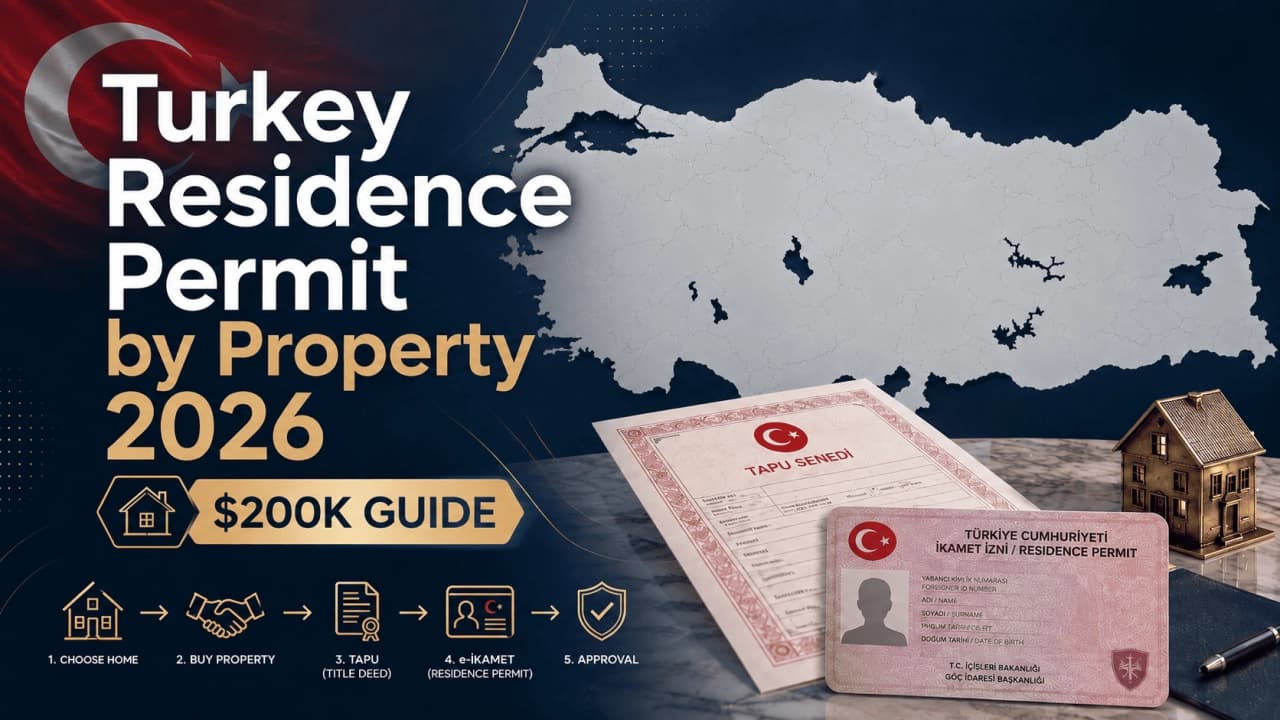
Choose Eligible Home → Verify Value and Title → Complete Purchase → Prepare Address Documents → Obtain Insurance → Apply Through e-İkamet → Attend Appointment → Submit Documents → Register Address → Receive Decision
Each stage should be prepared before the previous stage is completed.
A buyer should not assume that problems discovered after the Tapu transfer can always be repaired easily.
Step 1 — Confirm the Property Meets the Residence-Permit Strategy
Before signing a reservation agreement or paying a substantial deposit, confirm the basic property requirements.
For the current property-owner short-term residence category, the official e-İkamet documentation states that:
- The property must belong to the applicant.
- It must be a residential property.
- Its value at the acquisition date must be at least the Turkish-lira equivalent of USD 200,000.
- The foreign applicant must use the home as a residence.
- The home cannot be used for rental or similar income-generating purposes while being relied upon for this residence ground.
These requirements should form the initial property filter.
Do Not Start With the Apartment — Start With Eligibility
A common mistake is:
Find Apartment → Fall in Love With Apartment → Pay Deposit → Ask Whether It Qualifies
A safer sequence is:
Confirm Immigration Objective → Confirm Current Requirements → Search Only Compatible Properties
This is particularly important because a property can be:
- Legally purchasable
- Attractive as an investment
- Properly registered
and still be unsuitable for this specific property-owner residence basis.
Step 2 — Verify the Property Is Legally Residential
Do not rely only on the developer's description.
Marketing terms such as:
- Residence
- Home office
- Loft
- Hotel apartment
- Serviced apartment
do not necessarily determine the property's legal classification.
The official residence guidance requires the property relied upon for this route to be a house/residence and used as such.
Therefore, before purchase, review:
- Tapu
- Independent unit description
- Project documentation where necessary
- Actual permitted use
If the unit is legally commercial, do not assume that its interior appearance as an apartment makes it eligible.
Step 3 — Verify the USD 200,000 Requirement Before Purchase
The current e-İkamet documentation requires the residential property to have a value of at least the Turkish-lira equivalent of:
USD 200,000
as of the acquisition date.
This makes value verification one of the most important pre-purchase checks.
The buyer should establish how the transaction will be documented before paying the main purchase price.
Do Not Rely on the Online Listing Price
Suppose an apartment is advertised at:
$205,000
That does not mean the investor should automatically assume:
“The immigration requirement is safely satisfied.”
The buyer should verify the legal and transaction documentation used for the acquisition.
An immigration-sensitive property purchase should have sufficient documentary clarity and ideally a reasonable margin above the applicable minimum.
Buying Exactly at $200,000 Creates Less Margin
The immigration rule does not require the buyer to intentionally overpay.
However, from a risk-management perspective, a property sitting exactly at the threshold provides little room for:
- Documentation inconsistencies
- Currency-conversion issues
- Misunderstood pricing
- Transaction-value discrepancies
A buyer should focus on genuine market value and proper documentation rather than trying to hit the threshold to the exact dollar.
Property Acquired Through Inheritance or Gift
The residence documentation has a specific rule for homes acquired through:
- Inheritance
- Donation / gift
For such properties, the current official document list requests a current real-estate valuation report.
This illustrates why the method of acquisition matters.
A property purchased through a standard sale and a property inherited from a relative may require different supporting evidence.
Step 4 — Review the Tapu
The Tapu should be checked before final payment.
At minimum, verify:
- Name of owner
- Province
- District
- Neighborhood
- Block and parcel
- Independent-unit information
- Property type
- Ownership share
For the property-residence application itself, the current e-İkamet documentation requires official evidence that the residence belongs to the foreign applicant and specifically lists a copy of the title deed.
The residence strategy therefore depends on genuine legal ownership, not simply a contractual right to buy later.
Reservation Agreement Is Not the Same as Ownership
This is particularly important for off-plan property.
A buyer may have:
- Reservation form
- Developer contract
- Installment agreement
without yet having the ownership evidence requested for this property-owner residence route.
If the main purpose of the purchase is residence eligibility, clarify when the relevant Tapu ownership will exist before entering an off-plan transaction.
Do not assume:
Developer Contract = Property-Owner Residence Eligibility
Step 5 — Check Shared Ownership and Family Structure
Family planning should be done before the Tapu transaction.
The official Migration Management guidance states that where a residential property is held through shared or joint ownership covering family members, the family members may also have a right to apply under this property-related basis.
The current e-İkamet document list also requests proof of the family relationship where family members have shared or joint ownership rights and are named in the title documentation.
Therefore, before buying jointly, consider:
- Who will appear on the Tapu?
- What ownership share will each person hold?
- Which family documents will be needed?
- Will each person rely on property ownership or another residence category?
Shared Ownership Should Not Be Structured Casually
Adding names to the Tapu only because:
“It might help later”
is not a good strategy.
Ownership structure can also affect:
- Future sale
- Tax
- Inheritance
- Financing
- Decision-making
The residence objective should be considered alongside the wider legal consequences of co-ownership.
Step 6 — Obtain the Numarataj / Address Document
For an initial property-owner application, the current e-İkamet document list requires a municipality-issued numarataj document showing the property's address information.
This document is especially relevant to:
- New developments
- Recently completed buildings
- Newly created independent units
- Urban-transformation projects
The objective is to connect the residence application with a clear official address.
Why Numarataj Matters
A property can have a developer-facing address used in:
- Brochures
- Google Maps
- Sales contracts
while official administrative address records may differ.
For immigration purposes, the applicant needs accurate and complete official address information.
Migration Management requires residence applicants to provide correct address details in Türkiye and keep their address information current.
Check Address Documentation Before Closing
For new projects in particular, ask whether the building already has:
- Official numbering
- Municipality address record
- Independent-unit address
If the residence strategy depends on immediate application after purchase, missing address documentation can create an unnecessary delay in preparing the file.
Step 7 — Prepare the Common Residence-Permit Documents
The current e-İkamet documentation lists common supporting documents for short-term residence applications.
These include items such as:
- Residence Permit Application Form
- Passport or passport substitute documentation
- Biometric photographs
- Evidence/declaration of sufficient and regular financial means
- Residence-permit fee and card-fee receipts
- Valid health insurance
- Evidence of place of residence.
The property-owner documents are added to this common application file.
Residence Permit Application Form
The application begins through the official e-İkamet system.
Migration Management states that residence-permit applications are made through its official e-Residence system and warns applicants against unofficial commercial websites pretending to provide government residence applications.
Use only the official application channel.
Passport
For first and transfer applications, Migration Management requires the applicant to attend with the original passport together with the required application documents.
Passport validity should also be checked before starting the process.
A buyer whose passport is close to expiry should resolve that issue early rather than discovering it during the residence application.
Biometric Photographs
The official document list requires:
Four biometric photographs
taken within the previous six months, against a white background.
Do not use:
- Selfies
- Old photographs
- Casual passport-style crops
- Black-and-white photographs
when the official requirements specify biometric images.
Step 8 — Obtain Valid Health Insurance
Valid health insurance is generally part of the short-term residence application file.
The insurance must cover the requested residence-permit period.
Accepted evidence can include, depending on the applicant's situation:
- Coverage under an applicable bilateral social-security agreement
- SGK documentation
- General health-insurance documentation
- Qualifying private health insurance.
Insurance Duration Can Affect the Requested Permit Period
If the applicant requests a longer residence period, the health-insurance coverage should correspond to that period.
Migration Management specifically notes that an applicant requesting a two-year short-term residence permit must have insurance structured to cover the requested duration—for example through appropriate multi-year coverage.
Therefore:
Do not request a residence duration your insurance does not support.
Property Ownership Does Not Replace Health Insurance
An applicant may own a $300,000 apartment outright and still need to meet the applicable health-insurance requirement.
These are independent parts of the application.
Step 9 — Demonstrate Sufficient and Regular Financial Means
The residence documentation includes a declaration that the foreign applicant has sufficient and regular financial means throughout the requested stay.
The Directorate can request supporting documentation where necessary.
Property ownership alone should therefore not be treated as automatic evidence that the applicant can cover all living expenses.
Possible Financial Evidence
The exact documents requested can depend on the applicant and authority.
An applicant should be prepared to support their declared means where requested through appropriate evidence.
The central principle is:
The applicant should be financially capable of supporting the requested stay in Türkiye.
Do not invest every available dollar into the property while leaving no liquid reserve for:
- Daily expenses
- Insurance
- Tax
- Utilities
- Residence application
- Emergency costs
Step 10 — Apply Through e-İkamet
First-time applicants should make the residence-permit application through the official e-Residence system.
Migration Management states that applicants who complete an initial or transfer application must attend the Provincial or District Directorate of Migration Management on the appointment date with the required documentation.
The general process is:
- Complete the online application
- Select the correct residence basis
- Enter personal information
- Enter address information
- Complete insurance and financial information
- Obtain appointment details
- Prepare supporting documents
- Attend the appointment
Select the Correct Residence Reason
This article concerns the category for foreigners who:
Own immovable property in Türkiye
and use the qualifying residence as their home.
Do not choose a different residence basis simply because it appears easier.
Migration Management warns that the reason for stay must correspond with a legitimate residence category and that applications can be negatively assessed where the stated purpose cannot be properly supported.
Step 11 — Attend the Appointment
For an initial application, completing the online form is not enough.
Migration Management requires first and transfer applicants to be physically present at the relevant Provincial/District Directorate on the appointment date with the required documents.
If an applicant fails to attend without a valid reason, the application may be treated as if it was never made.
Therefore:
Online Submission ≠ Completed Initial Application
The appointment is a critical step.
Bring Complete Documentation
The current e-İkamet guidance states that documents related to the application need to be submitted completely on the appointment date and that the Provincial Directorate can request additional information or documents during evaluation.
A well-prepared property-owner file should therefore contain:
Identity
- Application form
- Passport
- Required copies
- Biometric photos
Property
- Tapu copy
- Property-residence supporting documentation
- Numarataj for initial application
- Family-relationship documents where shared ownership applies
Personal Eligibility
- Health insurance
- Financial-means documentation/declaration
Fees
- Required fee receipts
The authority can still request additional documentation depending on the case.
Residence Permit Fees in 2026
The residence-permit application involves more than one potential charge.
The first important distinction is:
Residence Permit Document Fee
and:
Residence Permit Fee
They are not the same thing.
2026 Residence Permit Card / Document Fee
The official residence-permit document fee effective from January 1, 2026 is:
964 TRY
Migration Management states that the residence permit document is a valuable paper subject to this annual fee and that there is no nationality-based exemption from the document fee itself.
This is the card/document cost.
Residence Permit Fee Is Separate
The actual residence-permit fee depends on nationality, reciprocity and the requested permit duration.
For countries subject to the standard 2026 schedule published by Migration Management, the authority lists:
- 348.10 TRY per day for up to one month
- Subject to a first-month minimum of 653.70 TRY
- First-month maximum of 3,359.90 TRY
- 2,232.30 TRY for each month after the first month.
However, these figures do not apply identically to every nationality.
Migration Management also lists country-specific exemptions and reciprocity arrangements.
Therefore:
Do not publish or budget one universal residence-permit fee for every foreign buyer.
The 964 TRY card fee is fixed for 2026, but the residence-permit fee itself depends on the applicant's nationality and duration.
Some Nationalities Are Exempt From the Residence Permit Fee
Migration Management's current 2026 fee guidance identifies certain nationalities as exempt from the residence-permit fee under reciprocity arrangements, while still requiring the document/card fee.
The applicant should therefore calculate fees based on:
- Nationality
- Requested permit duration
- Applicable exemptions
rather than using an amount quoted by another foreign property buyer.
Where Can Fees Be Paid?
Migration Management states that residence-permit and document fees can be paid through authorized channels including:
- e-İkamet online payment where available
- Tax offices
- Authorized Treasury/Finance payment points
- Designated banks.
Migration Management also warns applicants not to transfer residence-permit application fees to private personal or company bank accounts claiming to represent the government.
This is a useful fraud-prevention rule for foreign applicants.
Step 12 — Register Your Address After Approval
Address registration is not merely an administrative detail.
The current e-İkamet documentation states that, for initial applications, address registration must be completed within:
20 working days
after residence-permit approval.
Migration Management also states that foreigners who receive residence permits within Türkiye must register in the address-registration system within the applicable 20-working-day period following notification of the permit.
Why Address Registration Matters
The residence permit is based on the applicant actually residing at the declared location.
Keeping address information accurate is therefore part of maintaining compliance.
Migration Management also requires changes to residence address during the permit period to be reported within:
20 working days.
Moving Within the Same Province
If the foreigner changes address within the same province, Migration Management states that the new address should be notified within 20 working days.
A new residence card is not necessarily issued solely because of an address change within the same province.
Moving to Another Province
Moving from one province to another is more significant.
Migration Management states that the foreigner must apply in the new province within:
20 working days
and a new residence-permit document is issued where appropriate.
For a property-owner permit, moving away from the qualifying residence also raises an additional question:
Does the original basis of the permit still exist?
That issue should be reviewed before relocating.
How Long Does the Application Take?
Under the Law on Foreigners and International Protection, Migration Management states that residence-permit applications should be finalized no later than:
90 days
with the 90-day period beginning once the required information and documents have been fully submitted to the competent authority.
This is a statutory maximum framework, not a guaranteed processing estimate for every individual file.
Some cases can be completed sooner.
Where an extension of the evaluation period is necessary, the applicant is notified.
Do Not Plan Travel Based on an Assumed Approval Date
A buyer should not schedule:
- Permanent relocation
- School enrollment
- Employment
- International travel
based on an assumption that the residence card will be issued within a particular number of days.
The legal framework gives the administration time to evaluate the file.
Can You Leave Turkey While the Application Is Pending?
After completion of the applicable initial application process, the foreigner can receive a Residence Permit Application Document.
Migration Management states that this document, together with the approved fee receipt, can allow exit and re-entry provided the foreigner returns within:
15 days
under the applicable conditions.
If the person remains outside Türkiye longer than 15 days, ordinary visa rules can apply upon re-entry.
Travel during processing should therefore be planned carefully.
Initial Application vs Extension
These are different procedures.
Initial Application
For the first property-owner application:
- Apply through e-İkamet
- Attend the appointment
- Bring required documents
- Complete the application in person at the Directorate.
Extension Application
Current Migration Management guidance states that extension applications may be made within:
60 days before the existing residence permit expires
and in any event before the permit expires.
The property-owner residence should not be treated as automatically renewable.
The applicant must continue to satisfy the relevant residence basis and general conditions.
Renewal Is Not Guaranteed
Short-term residence can be refused, cancelled or not renewed where:
- The required conditions are no longer met
- The permit is used outside its stated purpose
- Other applicable legal grounds arise.
For property owners, this makes continued compliance particularly important.
If the qualifying home:
- Is sold
- Stops being the applicant's residence
- Is used in a way inconsistent with the property-residence basis
the original reason supporting the permit may no longer exist.
Can You Use a Lawyer or Representative?
The e-İkamet documentation allows the application form to be signed by:
- The foreign applicant
- Legal representative
- Lawyer holding an appropriate Power of Attorney.
However, representation should not be confused with the ability to avoid every personal attendance requirement.
Migration Management's current guidance states that first and transfer applicants are expected to attend the Provincial/District Migration Directorate on the appointment date.
A lawyer can be very useful for:
- Reviewing the property
- Checking ownership structure
- Preparing documents
- Reviewing Power of Attorney
- Coordinating application requirements
but the applicant should plan for their own participation where required.
Beware of Residence Permit Intermediary Scams
Migration Management has issued an explicit warning that residence applications are made through the official system and that the authority does not conduct residence-permit services through third-party brokers or unofficial websites.
Be cautious with websites or agents promising:
- Guaranteed permit
- Government appointment for a private fee
- Guaranteed residence without documents
- Special internal access to Migration Management
The official process should remain the reference point.
Can Family Members Apply Based on the Property?
Potentially, yes, where the ownership structure and family relationship satisfy the relevant rules.
Migration Management states that where family members hold shared or joint ownership rights in the qualifying residential property, those family members may also have an application right under this property basis.
However, this should not be interpreted as:
One person's sole property automatically gives independent property-owner residence to every relative.
The legal relationship and residence category for each family member must be reviewed.
Family Documentation
Where shared ownership involving family members is used, the current e-İkamet property-owner document list requires documents proving family relations between persons shown in the title records.
Depending on the family and document origin, this may involve:
- Marriage certificate
- Birth certificate
- Legalized or apostilled documents where applicable
- Turkish translation where required
Prepare family documentation early.
Can You Use a Mortgaged Property?
The current property-owner residence guidance focuses on:
- Ownership
- Residential character
- Required acquisition value
- Use as the applicant's home
It does not establish a simple general rule in the cited official material that every mortgaged property is automatically disqualified.
However, a buyer should still review:
- Whether they are legally registered as owner
- Mortgage terms
- Title restrictions
- Transaction value
- Any lender rights
before relying on the property for residence purposes.
This is an area where title due diligence is more appropriate than making a blanket assumption.
Can Multiple Properties Be Combined to Reach $200,000?
The official property-owner documentation cited here states that the home used for the application must have the required minimum value and be used by the foreign applicant as their residence.
It does not support assuming that several inexpensive unrelated apartments can simply be added together to meet the property-residence threshold.
Therefore:
Do not structure a residence application around multiple properties unless current Migration Management guidance specifically confirms that structure for your case.
For a conservative purchase strategy, choose one clearly qualifying residential home.
Can You Buy an Off-Plan Apartment?
An off-plan apartment may be a valid real estate investment.
But for the property-owner residence basis, the current application documents require evidence that the residence belongs to the applicant, including Tapu documentation.
Therefore, the critical question is not:
“Is off-plan property allowed?”
It is:
“At what stage will I legally own the qualifying residential property and have the documentation required for the application?”
If immediate residence eligibility is the goal, a completed property with clear title and address documentation can be administratively simpler.
Common Document Problems
Tapu Does Not Show the Correct Property Type
If the unit is legally commercial, the property-owner residential basis may not fit.
Property Value Is Too Close to the Threshold
Avoid depending on a vague marketing valuation.
Missing Numarataj
This can create problems in preparing the initial residence file for a newly completed building.
Passport Near Expiry
Check identity documents before beginning the purchase.
Insurance Does Not Cover Requested Residence Duration
The policy should support the requested period.
Incorrect Address Information
Migration Management requires correct and complete address information.
Family Names Do Not Match Across Documents
Differences in:
- Transliteration
- Surname
- Birth date
- Parent name
can complicate document review.
Missing Fee Receipts
Keep official proof of residence and document-fee payments.
Applicant Misses the Appointment
Failure to attend without a valid reason can result in the application being treated as not made.
What to Check Before Paying a Property Deposit
A foreign buyer purchasing specifically for residence should complete this mini due-diligence process before paying.
Immigration
Property Type
Value
Ownership
Address
Personal Application
Only after these questions are answered should the residence objective be treated as part of the property decision.
Property Residence Application Checklist
Before Purchase
After Purchase
Common Application Documents
e-İkamet
Appointment
After Approval
Key Takeaways
The property-based residence route should be approached as a coordinated real-estate + immigration process.
The current official e-İkamet documentation requires the qualifying home to:
- Belong to the foreign applicant
- Be residential
- Have an acquisition-date value of at least the Turkish-lira equivalent of USD 200,000
- Be used by the applicant as a residence
- Not be used for rental or similar income-producing purposes under this residence basis.
For first applications, the property file also includes municipality-issued address information through the numarataj document.
The residence application itself is submitted through the official e-İkamet system, after which first-time applicants attend the relevant Migration Management Directorate with their required documents.
Common documentation includes:
- Passport
- Biometric photographs
- Health insurance
- Evidence or declaration of sufficient financial means
- Proof of residence
- Fee receipts.
For 2026, the residence-permit document/card fee is 964 TRY. The separate residence-permit fee varies according to nationality, reciprocity and duration.
The ordinary short-term residence category can generally be issued for up to two years at a time, but the actual duration remains subject to the administration's evaluation.
The official framework also provides up to 90 days for finalization once all required information and documents have been fully submitted.
After approval, address-registration obligations must also be respected; current initial-application guidance requires address registration within 20 working days after approval.
The most important practical principle is:
Do not buy first and investigate residence eligibility later.
A stronger process is:
Confirm Requirements → Select Eligible Home → Verify Tapu + Value + Address → Purchase → Prepare Documents → Apply Through e-İkamet → Complete Appointment → Register Address
That sequence reduces the risk of committing substantial capital to an apartment that does not match the buyer's actual immigration objective.
How Long Can a Property-Based Residence Permit Last?
Buying a qualifying home does not give the foreign owner permanent residence.
The property-owner route falls under Türkiye's short-term residence permit system.
Under the current Migration Management framework, an ordinary short-term residence permit can generally be issued for a maximum of:
Up to Two Years at a Time
The actual duration remains at the discretion of the competent authority and depends on the circumstances of the application.
Therefore:
$200K+ Property ≠ Guaranteed Two-Year Residence Permit
A qualifying property gives the buyer a legal basis to apply.
It does not determine the exact duration of the permit automatically.
One-Year Permit vs Two-Year Permit
Two otherwise similar property owners may receive different permit durations.
The administration evaluates the individual file.
Factors relevant to the wider application can include:
- Requested residence period
- Passport validity
- Health-insurance duration
- Continued eligibility
- Supporting documents
- Administrative assessment
For example, Migration Management specifically notes that health insurance must cover the requested residence-permit period.
A foreigner requesting two years should therefore not arrive with insurance that supports only a shorter requested stay and assume the residence permit will automatically exceed the insurance period.
Is the Property Residence Permit Automatically Renewable?
No.
Renewal is possible, but it is not automatic.
Current Migration Management guidance states that extension applications can be made beginning:
60 days before the existing permit expires
and must in any event be made before expiration.
The applicant must continue to satisfy the conditions relevant to the residence category.
For a property owner, this means the residence strategy should not be thought of as:
Buy Once → Residence Forever
A more accurate model is:
Own Qualifying Home → Obtain Permit → Continue Meeting Conditions → Apply for Extension
What Does Migration Management Check at Renewal?
The most important question is whether the original residence basis still exists.
Migration Management states that a short-term residence permit can be refused, cancelled, or not renewed when:
- One or more required conditions are no longer satisfied
- The residence permit is being used outside the purpose for which it was issued
- Other statutory grounds such as a current removal decision or entry ban apply.
For property owners, this makes consistency especially important.
If you received residence on the basis that:
“I own and live in this qualifying residential property.”
your actual circumstances should continue to correspond with that basis.
What Happens If You Sell the Property?
This is one of the most important questions property-residence holders should consider.
The residence category exists because the foreigner:
- Owns qualifying immovable property
- Uses the qualifying property as a residence
If the owner sells that home, the factual basis supporting the property-owner residence category can disappear.
Migration Management's current rules state that short-term residence may be cancelled or not renewed when the conditions for the permit no longer apply.
Therefore:
Selling the qualifying residence can jeopardize the legal basis of the property-owner permit.
This should not be simplified into a claim that the residence card necessarily becomes invalid at the exact second the Tapu is transferred.
Instead, the correct approach is to review the immigration consequences before selling.
Do Not Sell First and Ask About Residence Later
A safer sequence is:
Current Property Residence
→
Decide to Sell
→
Identify New Residence Basis
→
Confirm Required Procedure
→
Complete Sale / Residence Transition
rather than:
Sell Property
→
Discover Residence Problem
If the foreigner qualifies for another residence category, Migration Management allows transitions between residence-permit categories when the relevant conditions are met.
Possible circumstances could involve:
- Another qualifying property
- Family residence
- Student residence
- Another short-term residence ground
- A work permit
depending on the individual case.
What Happens If You Buy Another Property?
Suppose a property owner wants to sell Apartment A and move into Apartment B.
The critical question is whether:
Apartment B itself satisfies the current property-owner residence requirements.
Under current e-İkamet documentation, the relevant home must:
- Belong to the applicant
- Be residential
- Meet the applicable USD 200,000-equivalent acquisition-value condition
- Be used by the applicant as a residence.
Therefore, buying another apartment does not automatically preserve the original residence basis unless the new situation satisfies the current requirements and the relevant residence/address procedures are completed.
What Happens If You Rent Out the Property?
This issue requires particular attention because it separates the property-residence strategy from a normal real-estate investment strategy.
The current e-İkamet documentation for foreign property owners states that the qualifying property:
- Must be a residence
- Must be used by the foreign owner for that purpose
- Cannot be used for rent or similar income-generating purposes while relied upon under this residence ground.
Therefore:
Property Residence ≠ Buy-to-Let Strategy
If your primary plan is to buy an apartment and immediately rent it to another person, the property-owner residence category is not designed around that use of the same home.
Can You Live Somewhere Else and Rent the Qualifying Property?
This creates an obvious conflict with the current basis.
If the residence permit was granted because you own and personally use Apartment A as your residence, but you:
- Rent Apartment A to a tenant
- Move to Apartment B
then the factual conditions underpinning the original residence application have changed.
Because short-term permits can be cancelled or not renewed when their conditions no longer exist or they are used outside their stated purpose, the issue should be addressed before changing the property's use.
Do not rely on:
“I still own the Tapu, so nothing else matters.”
Ownership is only one part of the current property-residence requirement.
Property Residence vs Rental Investment
A foreign buyer should choose between two strategies early.
Strategy A — Residence-Focused Property
Primary objective:
Live in Istanbul
Property priorities:
- Comfortable apartment
- Strong neighborhood
- Transport
- Schools
- Healthcare
- Building quality
- Long-term personal use
Immigration objective:
Property-owner residence application
Strategy B — Investment-Focused Property
Primary objective:
Rental income
Property priorities:
- Rental demand
- Tenant profile
- Yield
- Aidat
- Management
- Vacancy
- Resale
Immigration status:
Should be established through an appropriate separate basis if the owner does not personally use the investment apartment as the qualifying residence.
Why This Decision Matters Financially
Suppose two apartments each cost:
$230,000
Apartment A
Large 2+1 in a residential neighborhood.
Excellent for the owner to live in.
Moderate rental yield.
Apartment B
Compact 1+1 near a major employment corridor.
Excellent rental demand.
Less suitable for the buyer's family.
The best choice depends on the objective.
A property-residence buyer may rationally choose Apartment A even if Apartment B has better rental economics.
Residence-focused property selection should optimize:
Quality of Life + Immigration Suitability + Long-Term Property Value
not maximum yield.
Changing Your Address
Foreign residence holders must keep their official address information current.
Migration Management states that changes in address during the residence-permit period must be reported to the relevant Migration Management and Civil Registration authorities within:
20 Working Days
This is not merely a postal issue.
The registered address forms part of the residence administration system.
Moving Within Istanbul
If a foreigner moves from one Istanbul address to another, the change should be reported within the required period.
For example:
Old Address: Kağıthane
New Address: Üsküdar
Because both are within Istanbul Province, this is an address change within the same province.
The updated information still needs to be properly registered.
For a property-owner residence holder, there is an additional issue:
Does the new home still satisfy the property-based residence requirements?
If the new address is merely a rented apartment while the original qualifying home is being rented out, the original residence basis may no longer match the applicant's circumstances.
Moving to Another Province
Moving from Istanbul to another province has more significant residence consequences.
Migration Management states that foreigners who change residence from one province to another must apply for a new residence permit in the province they move to within:
20 Working Days
Where the residence-permit type remains the same, a new residence document can be issued under the applicable procedure.
For example:
Istanbul → Antalya
is not simply an address update.
The foreigner should follow the inter-provincial residence procedure.
Residence Permit vs Work Permit
Owning a qualifying home and receiving a residence permit does not automatically give a foreigner the right to work in Türkiye.
The Ministry of Labour and Social Security is explicit:
A residence permit, by itself, does not give an ordinary foreign holder the right to work.
Foreigners within the scope of the International Labour Force Law must obtain:
- A work permit
or:
- A valid work-permit exemption
before legally working, unless another specific legal exemption applies.
Therefore:
Residence Permit ≠ Work Permit
Work Permit Can Replace Residence Permission — Not the Other Way Around
The distinction works in one direction.
A valid work permit generally also gives the foreigner a right to reside during its validity under the applicable legal framework.
But:
Having a property residence permit does not itself authorize employment.
This is particularly important for foreigners planning to:
- Take employment in Türkiye
- Work for a Turkish company
- Operate professionally in Türkiye
Their work authorization should be planned separately.
Buying a Home Does Not Give an Automatic Right to Run a Business
Owning an apartment is also different from having permission to perform economic activity.
A foreigner can potentially:
- Own property
- Own company shares
- Establish a business
under applicable Turkish law.
But actual employment and work activities can still require appropriate work authorization.
Residence status should not be used as a substitute for labour-law compliance.
Property Residence vs Long-Term Residence
A property-owner short-term permit should also not be confused with:
Long-Term Residence Permit
Long-term residence is a separate legal category.
Under Article 43 of Law No. 6458, one of the main requirements is at least:
Eight Years of Continuous Residence in Türkiye
along with additional conditions including:
- No qualifying social assistance during the previous three years
- Sufficient and stable income
- Valid medical insurance
- No public-order or public-security obstacle.
Long-term residence is therefore not obtained simply by buying a more expensive property.
Can Property Residence Help Toward Long-Term Residence?
Potentially, lawful residence periods can be relevant when calculating continuous residence.
Migration Management's current guidance states that for continuous residence calculations:
- Half of student-residence periods are counted
- Full periods of other qualifying residence permits are generally taken into account
- Work-permit periods can also be included.
A property-owner short-term residence can therefore be part of a longer legal-residence history, provided the statutory continuity and other conditions are satisfied.
However:
Eight Years of Residence ≠ Automatic Long-Term Residence
The other statutory criteria must still be satisfied and an application must still be approved.
Long-Term Residence Is Not Citizenship
Long-term residence provides significant residence rights, but it is not a Turkish passport.
Migration Management states that long-term residence holders receive many rights comparable to Turkish citizens, subject to important exclusions including:
- Voting and election rights
- Certain public-service rights
- Military-service rules
- Specific customs-related rights.
Therefore, foreign buyers should distinguish:
Short-Term Property Residence
Long-Term Residence
and:
Turkish Citizenship
as three separate legal statuses.
Does Property Residence Automatically Lead to Turkish Citizenship?
No.
There is no automatic sequence saying:
Buy $200K Home → Renew Residence → Automatically Become Turkish Citizen
The direct real-estate investment route to exceptional Turkish citizenship remains a separate framework.
Current official investment guidance continues to identify qualifying real-estate investment of at least:
USD 400,000
with a restriction preventing resale for at least:
Three Years
as the relevant citizenship-by-property investment route.
Therefore:
$200K Residence Permit ≠ $400K Citizenship by Investment
What About Citizenship After Living in Turkey for Five Years?
Türkiye also has a separate general naturalization route.
Under Article 11 of the Turkish Citizenship Law, an applicant for citizenship under the general rules must satisfy multiple requirements, including having resided continuously in Türkiye for:
Five Years Before the Application
along with conditions concerning:
- Intention to settle
- Public health
- Good character
- Sufficient Turkish-language ability
- Income or profession sufficient for the applicant and dependants
- National security and public order.
NVI guidance also identifies ownership of immovable property as one factor that can help demonstrate an intention to settle in Türkiye.
But this requires an important warning:
Five years of residence does not create an automatic right to citizenship.
The Turkish Citizenship Law expressly states that satisfying the conditions does not give the applicant an absolute right to citizenship.
Three Different Property and Immigration Strategies
Foreign buyers should therefore understand three completely different paths.
Strategy 1 — Property-Based Short-Term Residence
Typical property objective:
$200,000+ qualifying residence
Main objective:
Live in your own home in Türkiye
Result:
Basis to apply for short-term residence
Strategy 2 — Citizenship by Property Investment
Typical investment objective:
$400,000+ qualifying real estate
Main objective:
Exceptional citizenship application
Additional core requirement:
Three-year disposal restriction
Result:
Basis to pursue citizenship, subject to official approval.
Strategy 3 — Long-Term Life in Türkiye
Objective:
Establish a genuine long-term residence history
Potential future routes can include:
- Long-term residence after satisfying the relevant eight-year framework
- General citizenship application where the separate five-year and other citizenship requirements are satisfied
Neither result is automatic merely because property is owned.
$200K Residence vs $400K Citizenship Strategy
This is one of the most important investment decisions for a foreign buyer.
| Factor | $200K+ Property Residence | $400K+ Citizenship Property |
|---|---|---|
| Main Objective | Live in Türkiye | Citizenship investment |
| Current Minimum | $200,000 equivalent at acquisition | $400,000 qualifying investment |
| Result | Residence-permit application basis | Citizenship application route |
| Property Use | Must be qualifying residence used by applicant | Investment framework differs |
| Rent Qualifying Property? | Current residence basis says no | Can be assessed as investment/rental property separately |
| 3-Year Sale Restriction | Not citizenship-style restriction | Yes |
| Automatic Approval | No | No |
| Work Rights | No automatic work right | Citizenship, once actually granted, changes legal status |
| Investment Focus | Lifestyle + home | Investment + citizenship compliance |
The investor should choose based on the actual objective, not merely the lower threshold.
Scenario A — $250,000 Buyer Who Wants to Live in Istanbul
The investor has:
$250,000 total capital
Main objective:
Live in Istanbul for several years
The property-owner strategy may be more rational.
The investor might choose:
Apartment: approximately $215,000–$225,000
and preserve additional funds for:
- Tapu costs
- Legal expenses
- Furniture
- Insurance
- Residence fees
- Emergency liquidity
The best apartment might be a comfortable:
- 2+1
- Metro-connected family apartment
- Established residential unit
rather than a yield-optimized studio.
Scenario B — $450,000 Investor Seeking Citizenship
Investor capital:
$450,000+
Primary objective:
Turkish citizenship by investment
In this situation, buying a $220,000 property solely to obtain short-term residence first may not be the most efficient strategy if the real objective is the separate citizenship program.
The buyer should instead analyze the qualifying $400,000+ citizenship transaction from the beginning.
This is why objective definition should come before property search.
Scenario C — Investor Wants Both Residence and Rental Income
This requires more planning.
The buyer wants:
- A home in Istanbul
- A rental investment
A more coherent strategy could involve:
Property A
Qualifying personal residence
used as the owner's home.
Property B
Separate investment property
used for rental income.
This separates:
Immigration Function
from:
Investment Function
rather than forcing one apartment to perform two legally conflicting roles.
The tax and ownership implications of the second property should of course be analyzed separately.
Best Property Types for Residence Buyers
A residence-focused foreign buyer should select property primarily for daily usability.
2+1 Apartments
For many couples and small families, a 2+1 apartment provides a strong balance between:
- Space
- Resale demand
- Home-office flexibility
- Family use
It is often more practical for long-term living than a compact investment-focused 1+1.
3+1 Family Apartments
A 3+1 may be appropriate where the buyer has:
- Children
- Frequent guests
- Long-term relocation plans
The buyer should balance additional space against:
- Higher purchase price
- Higher aidat
- Heating and maintenance costs
1+1 Apartments
A high-quality 1+1 can work for:
- Single professionals
- Couples
- Part-time residents
The most important factors become:
- Layout
- Storage
- Building quality
- Transportation
- Neighborhood services
Residence buyers should avoid purchasing an extremely small unit merely because it crosses the immigration-value threshold.
What Makes a Good Istanbul Residence Property?
The strongest residence property combines:
Daily Transportation
Metro, Marmaray, ferry, or practical road access.
Healthcare
Easy access to hospitals, clinics and pharmacies.
Shopping
Supermarkets and everyday retail within practical distance.
Walkability
The area should function outside a car.
Building Quality
Construction history and earthquake-conscious due diligence matter.
Reasonable Aidat
A residence occupied personally still creates monthly ownership costs.
Resale Demand
The buyer may eventually relocate or change immigration strategy.
Istanbul Areas to Compare for Residence Buyers
The right district depends on lifestyle rather than a universal ranking.
Potential categories include:
Central Professional Lifestyle
Areas such as:
- Şişli
- Kağıthane
- Selected Beşiktaş-area neighborhoods
can be relevant where proximity to employment and central transportation matters.
Asian-Side Urban Lifestyle
Areas such as:
- Kadıköy
- Üsküdar
- Kozyatağı
can appeal to buyers prioritizing established neighborhoods and strong public transport.
Family-Oriented Residential Strategy
Locations such as:
- Başakşehir
- Maltepe
- Selected Ümraniye neighborhoods
may provide larger housing options and a more residential environment.
However:
Choose the exact neighborhood and building—not only the district name.
Districts in Istanbul can contain very different micro-locations.
New Build vs Resale for Property Residence
Both can work.
The best choice depends on the buyer.
New Build Advantages
Potential benefits include:
- Newer construction
- Modern elevators
- Parking
- Security
- Better insulation
- New facilities
For foreigners moving to Türkiye for the first time, new developments can also offer easier move-in conditions.
New Build Disadvantages
Potential issues include:
- High aidat
- Smaller net areas
- Developer premiums
- Less established neighborhood
- Ongoing surrounding construction
A new apartment is not automatically the better residence simply because it is newer.
Resale Advantages
Established resale apartments can provide:
- Mature neighborhoods
- Existing services
- Larger layouts
- Known building-management history
- Immediate inspection
Resale Disadvantages
They can require greater attention to:
- Building age
- Structural condition
- Renovation
- İskan
- Building documentation
- Earthquake-related due diligence
The buyer should connect this decision with the separate Earthquake-Safe Apartments in Istanbul guide.
Family Strategy
A family moving to Türkiye should structure the residence plan before purchasing.
Questions include:
- Whose name will appear on Tapu?
- Will spouses be co-owners?
- What residence basis applies to children?
- Are family documents ready?
- Is the apartment large enough for actual family life?
Migration Management confirms that family members who hold shared or joint ownership rights in the qualifying real estate can also apply within the property-owner framework.
If the property is held only by one person, other family members may need a different residence analysis rather than assuming the same property-owner ground automatically applies to everyone.
Total Budget Example
Suppose a family has:
$280,000 total capital
A hypothetical residence-oriented allocation could be:
| Category | Example |
| Residential Property | $230,000 |
| Purchase / Legal Costs | $12,000 |
| Furniture / Setup | $15,000 |
| Insurance / Residence / Administration | $3,000 |
| Emergency / Living Reserve | $20,000 |
| Total | $280,000 |
These figures are illustrative rather than statutory costs.
The point is:
Do not measure affordability using only the $200,000 immigration threshold.
What Happens If the Property Value Falls Later?
The current e-İkamet property requirement is framed around the home's value at:
the date of acquisition.
A later market fluctuation should therefore not simply be treated as though the original acquisition transaction never occurred.
However, renewal still requires the broader residence conditions to remain satisfied.
Buyers should retain complete purchase documentation so the original acquisition circumstances can be demonstrated when necessary.
Can You Buy a More Expensive Property and Still Use the Residence Route?
Yes.
The USD 200,000 figure is a minimum threshold under the current property-owner documentation.
A person purchasing:
- $250,000
- $300,000
- $350,000
residential property is not required to pursue citizenship simply because the property is more valuable.
The buyer can still choose a residence-focused strategy where the relevant conditions are met.
The key distinction is that exceptional citizenship requires the separate qualifying USD 400,000+ investment framework and related requirements.
Common Residence Property Mistakes
Buying Only for the Residence Permit
The property should still be a good home and a rational real-estate purchase.
Assuming Renewal Is Automatic
The applicant must continue to satisfy the relevant residence conditions.
Selling Without Planning a New Residence Basis
The property-owner basis can disappear when the qualifying property is sold.
Renting Out the Qualifying Home
The current e-İkamet documentation requires it to be used as the applicant's residence and not as rental-income property under this basis.
Moving Without Updating the Address
Address changes must be reported within the applicable 20-working-day period.
Moving to Another Province Without a New Application
Inter-provincial relocation requires the applicable new residence procedure within 20 working days.
Working With Only a Residence Permit
Ordinary residence permission does not itself create a right to work.
Assuming Eight Years Automatically Creates Permanent Residence
Long-term residence has multiple statutory conditions beyond duration.
Assuming Five Years Automatically Creates Citizenship
The general citizenship route has several additional conditions and does not create an absolute right to citizenship.
Confusing $200K Residence With $400K Citizenship
They are separate legal strategies.
Choosing an Investment Apartment Instead of a Home
A high-yield studio may be a poor choice for a family who actually needs to live there.
Ignoring Building Quality
Residence eligibility does not certify construction quality or earthquake resistance.
Frequently Asked Questions About Residence Permit by Property
How much property do I need to buy for a Turkish residence permit in 2026?
Current e-İkamet documentation requires the qualifying residential property to have a value of at least the Turkish-lira equivalent of:
USD 200,000
as of the acquisition date.
Does any apartment over $200,000 qualify?
Not automatically.
The property must satisfy the applicable requirements, including:
- Ownership by the applicant
- Residential status
- Personal residential use
- Supporting documentation
and the applicant must satisfy the broader short-term residence conditions.
Does buying property automatically give residence?
No.
Property ownership provides a basis to apply for a short-term residence permit.
Approval is a separate Migration Management process.
Can I buy a shop for property-based residence?
The property-owner residence ground requires the relevant immovable property to be a house/residence and used for that purpose.
A commercial unit should not automatically be treated as qualifying.
Can I buy land?
Land ownership should not be confused with the residential-property basis used for this residence category.
The current property-owner residence guidance requires a house used as a residence.
Can I rent out my property?
The current e-İkamet documentation states that the qualifying residence cannot be used for rent or similar income-generating purposes while relied upon under this property-owner residence basis.
How long can my residence permit last?
The ordinary short-term residence permit can currently be issued for a maximum of two years at a time, with the actual duration determined by the administration.
Can I renew the permit?
Yes, extension applications are possible if the applicant continues to qualify.
They can generally be initiated within 60 days before expiration and must be submitted before the current permit expires.
What happens if I sell the property?
Selling can remove the property-ownership basis on which the permit was granted.
Because short-term residence permits may be cancelled or not renewed when their conditions no longer apply, the immigration consequences should be reviewed before sale.
Can I change my address?
Yes, but the change must be officially reported.
Current Migration Management guidance requires relevant address changes to be notified within 20 working days.
Can I move from Istanbul to Antalya?
Yes, but moving to another province requires a new residence application in the new province within the applicable 20-working-day period.
Can I work with a property residence permit?
Not merely because you hold the residence permit.
The Ministry of Labour states that ordinary residence permission does not give a foreigner the legal right to work; a work permit or valid exemption is generally required.
Does a work permit replace residence?
For ordinary work-permit categories, a valid work permit generally also functions as residence authorization during its validity.
Can property residence lead to long-term residence?
Lawful residence can contribute to the residence history, but long-term residence generally requires at least eight years of continuous residence plus other conditions concerning income, health insurance, social assistance, and public order.
Does property residence lead to citizenship after five years?
Not automatically.
A separate general citizenship route includes a five-year continuous-residence condition plus several other statutory requirements, and meeting those requirements does not create an absolute right to citizenship.
What is the difference between the $200K and $400K routes?
The USD 200,000 property threshold relates to the current property-owner short-term residence route.
The USD 400,000 qualifying real-estate investment relates to the separate citizenship-by-investment route, including its three-year restriction.
Can my spouse and children get residence?
Where family members have shared or joint ownership rights in the qualifying residential property, Migration Management states that family members may also apply within the property-owner framework.
Other family structures may require separate residence analysis.
Is residence guaranteed if the apartment costs $250,000?
No.
Crossing the minimum property-value threshold satisfies only one part of the current framework.
The property and applicant must satisfy all relevant conditions.
Final Property Residence Checklist
Immigration Objective
Property
Lifestyle
Application
During Residence
Renewal
Before Selling
Final Decision Framework
Before buying an apartment for property-based residence, ask five questions.
1. Does the Property Qualify?
Is it:
- Residential?
- Correctly owned?
- Above the applicable acquisition-value threshold?
- Suitable for personal residence?
2. Is It Actually a Good Home?
Would you want to live there even without the residence-permit benefit?
3. Can You Afford It Beyond the Purchase Price?
Include:
- Acquisition costs
- Aidat
- Insurance
- Taxes
- Furnishing
- Residence expenses
- Living reserve
4. Does the Immigration Strategy Match Your Real Objective?
Are you trying to:
- Live in Istanbul?
- Earn rental income?
- Work in Türkiye?
- Obtain citizenship?
These goals may require different legal strategies.
5. What Is Your Exit Plan?
If you later:
- Sell
- Rent the home
- Move province
- Leave Türkiye
understand how that change affects your residence status.
Conclusion
Buying property can provide a practical route for foreigners who genuinely want to live in Türkiye in their own home.
Under the current 2026 property-owner residence framework, the qualifying home must have an acquisition-date value of at least the Turkish-lira equivalent of:
USD 200,000
and must be:
- Residential
- Owned by the applicant
- Used by the applicant as a residence
- Not used for rent or similar income-generating purposes while relied upon under this residence category.
But ownership alone does not create automatic residence.
The foreign owner must still satisfy the short-term residence conditions and successfully complete the official application process.
A short-term residence permit can currently be granted for up to two years at a time, but the actual duration is determined by the administration.
Renewal is also not automatic.
If the conditions no longer apply—or if the permit is used outside its stated purpose—the permit can be cancelled or not renewed.
That means foreign property owners should think carefully before:
- Selling the qualifying property
- Renting it out
- Moving to another address
- Changing province
Address changes must also be reported within the applicable 20-working-day period.
Property residence also does not provide an automatic right to work.
Türkiye's Ministry of Labour confirms that residence permission alone does not authorize ordinary foreign employment; the appropriate work permit or exemption is generally required.
Nor should property residence be confused with permanent status.
Long-term residence generally requires at least eight years of continuous residence plus additional statutory conditions.
Turkish citizenship is another separate issue.
The current direct property-investment citizenship route remains based on at least USD 400,000 of qualifying real estate with the required three-year disposal restriction.
A separate general citizenship route also exists with a five-year continuous-residence requirement and several additional conditions, but even satisfying those conditions does not create an absolute right to citizenship.
Therefore, the key distinction is:
$200K+ Property → Potential Property-Owner Residence Application
while:
$400K+ Qualifying Investment → Separate Citizenship-by-Investment Route
For buyers who genuinely want to relocate to Istanbul, the strongest strategy is not to search for the cheapest apartment that crosses the residence threshold.
Instead, look for a property that works simultaneously as:
An Eligible Residence + A Comfortable Home + A Strong Building + A Rational Real Estate Purchase
The complete formula is:
Eligible Property + Personal Residential Use + Correct Application + Continued Compliance + Good Property Fundamentals = Better Residence Strategy
That approach protects both sides of the decision:
your immigration objective
and:
your real-estate investment.