Introduction
When buying an apartment in Istanbul, foreign buyers quickly encounter several Turkish property terms:
Tapu
Kat Mülkiyeti
Kat İrtifakı
Yapı Ruhsatı
İskan
Yapı Kayıt Belgesi
They are related, but they do not mean the same thing.
One of the most common mistakes is to assume:
“The apartment has a Tapu, so the building must have İskan.”
Another is:
“The building has İskan, so it must be structurally safe and completely problem-free.”
Neither conclusion should be made automatically.
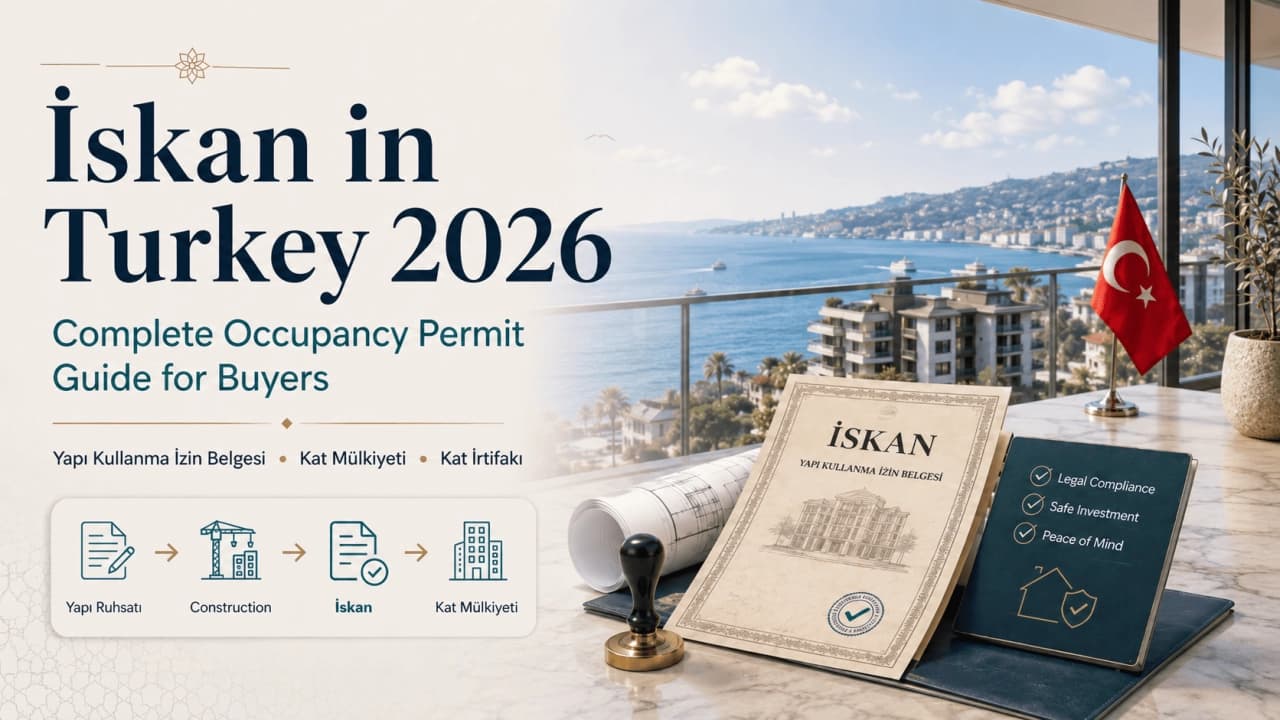
İskan is the common real-estate term generally used for the official:
Yapı Kullanma İzin Belgesi
or:
Building Use / Occupancy Permit
The Ministry's current guidance describes the process as relating to a building that has been completed in accordance with its building permit and approved project documentation and is being authorized for use. The authority to issue building permits and building-use permits primarily belongs to the relevant municipality or other competent local authority.
For a property buyer, this means İskan answers a different question from Tapu.
A useful starting formula is:
Tapu asks: “Who owns the property?”
while:
İskan asks: “Has the building reached the administrative stage at which its use has been officially authorized under the applicable building-permit process?”
Understanding that distinction is essential before buying a:
New-build apartment
Resale apartment
Off-plan property
Kat İrtifakı property
in Istanbul.
What Is İskan in Turkey?
İskan is the term commonly used in the Turkish property market for:
Yapı Kullanma İzin Belgesi
The official English concept is commonly translated as:
Building Use Permit
or:
Occupancy Permit
Its purpose is connected with the completion and lawful use of the building under the approved construction framework.
The Ministry's building-regulation guidance describes the Yapı Kullanma İzin Belgesi as the document issued where the building has been completed in accordance with its permit and approved project documentation and is suitable to proceed into authorized use.
Therefore, İskan is fundamentally a:
building / planning / occupancy document
rather than an ownership deed.
İskan Is About the Building, Not Simply the Buyer
This distinction is important.
Suppose you buy Apartment 24 in a large residential project.
Your Tapu concerns your ownership of the registered property.
But İskan concerns the administrative status of the building or the relevant completed part of the development.
Therefore:
Buyer A
and:
Buyer B
may own separate apartments in the same building while relying on the same building-use permit framework.
The İskan is not simply a private certificate issued individually because one foreigner bought one apartment.
Who Issues İskan?
Under the ordinary system, responsibility for issuing:
Yapı Ruhsatı
Yapı Kullanma İzin Belgesi
Relevant business opening/use permits
primarily belongs to the competent local authority, normally the relevant municipality or other legally authorized administration. The Ministry confirms this allocation of responsibility in its current guidance.
For an Istanbul apartment, the practical due-diligence process will therefore often involve checking records connected with the relevant:
municipality
in addition to checking:
TKGM / Land Registry records.
This is another reason title due diligence and building due diligence should not be treated as the same investigation.
İskan vs Tapu
The difference between Tapu and İskan is fundamental.
Tapu
Primarily concerns:
Registered owner
Registered property
Independent section
Ownership share
Kat Mülkiyeti / Kat İrtifakı
Registered encumbrances
İskan
Primarily concerns:
Building completion under the permit framework
Conformity with the building permit and approved project for the purpose of use authorization
Authorization for the building or relevant completed part to be used
A property buyer should therefore think:
Tapu = Ownershipİskan = Occupancy / Building-Use Authorization
These are connected systems, but they answer different legal and administrative questions.
Example: Valid Tapu but İskan Still Needs Investigation
Imagine an apartment has:
Registered Tapu
Defined independent section
Kat İrtifakı
The building is physically complete and families are already living there.
A buyer may assume:
“People live here, so İskan must exist.”
That is not a safe assumption.
The correct questions are:
Has Yapı Kullanma İzin Belgesi been issued?
Does it cover the relevant building?
Why does the title still show Kat İrtifakı?
Is the building awaiting conversion to Kat Mülkiyeti?
Is there another historical legal structure involved?
The fact that people physically occupy a building does not replace documentary verification.
Tapu Does Not Automatically Prove İskan
This should be one of the core rules of Turkish property due diligence.
A Tapu tells the buyer about registered ownership.
The buyer should not use it as a substitute for checking the building's occupancy documentation.
Even where the title shows:
Kat Mülkiyeti
it is still prudent to verify the actual building documentation if the presence and history of İskan are important to the purchase.
This becomes especially relevant because Türkiye has had exceptional legal regimes under which certain title changes could occur through Yapı Kayıt Belgesi procedures without the ordinary Yapı Kullanma İzin Belgesi being required in the same way. TKGM's İmar Barışı rules expressly allowed, under qualifying historical circumstances, cins değişikliği and Kat Mülkiyeti procedures without requiring the normal occupancy permit.
Therefore:
Do not infer the entire building history from one word on the Tapu.
What Is Yapı Ruhsatı?
Before understanding İskan fully, foreign buyers need to understand:
Yapı Ruhsatı
This is the building permit.
In simplified terms:
Yapı Ruhsatı comes before construction/use completion
while:
Yapı Kullanma İzin Belgesi comes after the building reaches the required completion and compliance stage for use.
The competent authority issues the building permit based on the applicable planning and project documentation, while the later occupancy/use-permit process examines whether the completed building corresponds with the permit and its supporting approved documents. Current Ministry service guidance separately lists the requirements for Yapı Ruhsatı and Yapı Kullanma İzin Belgesi, confirming that they are distinct administrative stages.
İskan vs Yapı Ruhsatı
A simple comparison:
| Issue | Yapı Ruhsatı | İskan / Yapı Kullanma İzin Belgesi |
|---|---|---|
| Main Stage | Before / during lawful construction | After qualifying completion |
| Main Function | Authorizes construction under approved framework | Authorizes use after applicable completion checks |
| Connected With Project | Yes | Yes |
| Same as Tapu? | No | No |
| Proves Ownership? | No | No |
| Should Buyer Check It? | Yes, where relevant | Yes, especially for completed buildings |
The easiest way to remember the distinction is:
Ruhsat = Permission to Build
İskan = Permission to Use the Completed Building
This is simplified for buyers, but it captures the practical distinction.
Why Yapı Ruhsatı Matters to a Buyer
A building permit is not merely a developer document.
It establishes an important part of the project's approved construction framework.
It can help answer questions such as:
What building was legally authorized?
What project was approved?
What uses were authorized?
What structure was supposed to be constructed?
This becomes especially important where the physical building differs from what was originally approved.
Example: Apartment Looks Different From Approved Project
Suppose a buyer visits an apartment with:
Large enclosed balcony
Additional bedroom
Enlarged living room
The seller says:
“It was renovated years ago.”
That may be harmless.
But the buyer should still ask whether the physical layout corresponds with:
Approved architectural project
Registered independent section
Building documentation
The existence of Tapu does not automatically legalize every later physical alteration.
Why İskan Matters After Yapı Ruhsatı
The building permit establishes the approved construction framework.
The İskan stage asks whether the building has reached the appropriate state for authorized use under that framework.
The Ministry's current guidance notes that where the building has been completed in accordance with its permit and attached projects, the competent authority can proceed with the building-use permit process.
The important phrase for buyers is:
completed in accordance with the permit and its approved project documentation
because this connects the physical building to its legal construction file.
İskan Is Not Just “Construction Finished”
Foreign buyers sometimes ask:
“The building is finished. Why wouldn't it have İskan?”
Physical completion and administrative completion are not necessarily identical.
A building may look finished from the outside while:
Documentation is incomplete
Common areas are unfinished
Project inconsistencies remain
Administrative procedures have not been completed
Therefore:
Finished Appearance ≠ Confirmed İskan
Always verify.
What Is Kat İrtifakı?
As explained in the Tapu guide, Kat İrtifakı is the registered structure commonly used for planned or not-yet-fully-completed independent sections.
It is particularly common during:
Construction
New development
Off-plan purchasing
The important connection with İskan is what happens when the building becomes complete.
TKGM's current guidance states that where a property has Kat İrtifakı and a Yapı Kullanma İzin Belgesi has been obtained, conversion to Kat Mülkiyeti can proceed, including through the administrative mechanisms specified by TKGM.
Kat İrtifakı + İskan = Important Question
Suppose you are buying a completed apartment and the title still says:
Kat İrtifakı
The building may nevertheless already have İskan.
If it does, the buyer should ask:
Why has the title not yet been converted to Kat Mülkiyeti?
TKGM currently states that where Kat İrtifakı exists and the Yapı Kullanma İzin Belgesi has been obtained, conversion to Kat Mülkiyeti may occur following an application by a relevant owner or transmission of the occupancy permit by the competent authority under the applicable framework.
Therefore:
Completed Building + Kat İrtifakı does not automatically mean “No İskan.”
Check the actual records.
Does Kat İrtifakı Mean the Building Has No İskan?
No.
Kat İrtifakı and İskan describe different aspects of the property.
A building may historically remain in Kat İrtifakı status even though the occupancy permit has been obtained and the conversion process has not yet been reflected or completed.
The correct sequence is:
Check Tapu status
Check İskan
Check why Kat Mülkiyeti has or has not been established
Do not use one document as a substitute for the other.
What Is Kat Mülkiyeti?
Kat Mülkiyeti is the completed condominium ownership structure for independently registered units in the building.
In the normal framework, İskan has a direct relationship with conversion from:
Kat İrtifakı
to:
Kat Mülkiyeti
TKGM's current FAQ states that for Kat Mülkiyeti procedures the building-use permit for the independent sections is part of the normal framework and that a Kat İrtifakı property with a building-use permit can be converted to Kat Mülkiyeti under the applicable procedure.
This is why many buyers reasonably view Kat Mülkiyeti as a positive indicator for a completed apartment.
But it must be interpreted correctly.
Does Kat Mülkiyeti Always Mean Normal İskan Exists?
This requires a careful answer.
In the Ordinary Framework
Kat Mülkiyeti for a completed building is connected with the building-use permit process.
TKGM currently confirms the use of Yapı Kullanma İzin Belgesi in ordinary Kat Mülkiyeti procedures.
But Historical Exceptions Exist
Türkiye's İmar Barışı / Yapı Kayıt Belgesi regime created exceptional procedures.
TKGM's official rules expressly provided that, for qualifying structures holding a Yapı Kayıt Belgesi, certain:
Cins değişikliği
Kat Mülkiyeti
transactions could be completed without requiring an ordinary Yapı Kullanma İzin Belgesi, provided the specified conditions were met.
Therefore:
Kat Mülkiyeti Does Not Always Prove the Building Followed the Normal İskan Route
That distinction is particularly important for older properties.
What Is Yapı Kayıt Belgesi?
Yapı Kayıt Belgesi is a separate concept.
It was associated with the historical:
İmar Barışı
or building-registration/regularization regime.
It should not be confused with an ordinary:
Yapı Kullanma İzin Belgesi
TKGM describes İmar Barışı as a framework aimed at registering certain buildings with ownership/planning problems and bringing qualifying structures into a recognized administrative status.
Yapı Kayıt Belgesi Is Not the Same as İskan
This distinction is extremely important for resale buyers.
Yapı Kullanma İzin Belgesi
Connected with the ordinary building-permit/completion/use process.
Yapı Kayıt Belgesi
Connected with the historical İmar Barışı regularization framework for qualifying structures.
Therefore:
YKB ≠ Normal İskan
A seller saying:
“Don't worry, the building has Yapı Kayıt Belgesi.”
should not be interpreted as:
“The building has the ordinary occupancy permit.”
They are different legal documents arising from different frameworks.
Why Yapı Kayıt Belgesi Matters to a 2026 Buyer
You are not necessarily dealing with a new application for İmar Barışı.
You may instead be buying an older building whose present legal/title history was shaped by an existing Yapı Kayıt Belgesi.
TKGM's official rules allowed qualifying buildings holding that document to access certain registration procedures, including cins değişikliği and Kat Mülkiyeti under specified conditions, without requiring the normal occupancy permit in the ordinary way.
Therefore, when buying an older apartment, ask:
Does the building have normal İskan, or does its current status rely partly on a historical Yapı Kayıt Belgesi?
That is a much more precise due-diligence question.
Do Not Assume Yapı Kayıt Belgesi Means the Building Is Structurally Safe
The historical regularization process should not be treated as a substitute for engineering analysis.
TKGM's İmar Barışı material addresses registration and administrative consequences.
It is not a structural earthquake-performance certification system.
Therefore:
Yapı Kayıt Belgesi ≠ Earthquake-Safety Certificate
and likewise:
İskan ≠ Earthquake-Safety Certificate
Technical due diligence remains separate.
Does İskan Prove Earthquake Safety?
No.
This is another major misconception.
İskan indicates that the building reached the relevant administrative use-permit stage in relation to its permitted project and construction framework.
It is not a current structural engineering assessment of the building's earthquake performance.
A building can have İskan and still require investigation of:
Construction age
Applicable earthquake-code era
Structural modifications
Concrete condition
Corrosion
Foundation issues
Current building condition
The proper formula is:
İskan Check + Structural Due Diligence
not:
İskan = Earthquake SafeExample: Old Building With İskan
Suppose a building:
Has İskan
Has Kat Mülkiyeti
Was built decades ago
That documentation is relevant and positive from an administrative perspective.
But it does not tell the buyer how the building performs against modern seismic expectations.
The buyer should separately review:
Building age
Structural history
Engineering concerns
Major alterations
This is why the separate Earthquake-Safe Apartments in Istanbul guide remains necessary.
Example: New Building Without Final İskan Yet
Now consider a completely different scenario.
A newly completed development:
Has valid Yapı Ruhsatı
Construction is nearly complete
Kat İrtifakı is established
Developer says İskan application is in progress
This is not necessarily comparable to:
a 20-year-old occupied building that never completed the normal occupancy process.
Both may be described casually as:
“No İskan yet.”
But their risk profiles can be very different.
The buyer must investigate the reason.
“No İskan” Is Not a Complete Diagnosis
When someone tells you:
“The property has no İskan.”
ask:
Why?
Possible situations can include:
New project still completing procedures
Building not fully completed
Documentation incomplete
Differences from approved project
Historical administrative issue
Existing Yapı Kayıt Belgesi framework
These circumstances should not be treated as equivalent.
A Better Question Than “Does It Have İskan?”
Instead of asking only:
Does the building have İskan?
ask:
What is the Yapı Ruhsatı status?
Has Yapı Kullanma İzin Belgesi been issued?
Does it cover the whole relevant building?
Is the Tapu Kat İrtifakı or Kat Mülkiyeti?
Does the physical building match the approved project?
Is there a Yapı Kayıt Belgesi history?
Why does the present title/building status exist?
That creates a much stronger due-diligence picture.
Can a Building Have Partial İskan?
Yes, Turkish planning rules recognize the possibility of a:
Kısmi Kullanma İzni
or partial use permit in appropriate circumstances.
Current Ministry guidance confirms that a building-use permit can be issued partially, but explains an important limitation: the process is not simply about approving an isolated apartment while necessary shared/common areas remain unusable. The relevant completed independent sections and required common-use areas need to be ready for use under the applicable framework.
This is particularly relevant to:
Large developments
Multi-block projects
Phased construction
Partial İskan vs Full Building İskan
Suppose a project contains:
Block A
Block B
Block C
and construction proceeds in stages.
The fact that one part is ready does not automatically mean the entire development has reached the same administrative stage.
A foreign buyer should therefore ask:
Does the occupancy authorization cover my block and the relevant common areas?
rather than merely:
Does the project have İskan?
This will be covered in more detail in Part 2.
Why Common Areas Matter
A building is more than the internal apartment.
For authorized use, relevant common infrastructure can matter as part of the completion analysis.
Current Ministry guidance on partial use permits explicitly notes that the concept is not limited to an isolated independent section; the associated common-use areas required for the completed sections must also be ready.
This is especially relevant in projects where the apartment itself looks complete but:
Entrances
Fire systems
Elevators
Common circulation
Site infrastructure
are still unfinished.
İskan and Utilities
Foreign property marketing often links İskan with:
Electricity
Water
Gas
But buyers should avoid blanket claims such as:
“No İskan always means you cannot have electricity.”
Historical and exceptional frameworks can create different situations.
For example, TKGM's İmar Barışı rules explicitly allowed qualifying Yapı Kayıt Belgesi buildings to obtain temporary utility connections under that special regime.
Therefore, actual utility status should be checked directly rather than inferred solely from one document.
İskan and DASK Are Different
DASK is compulsory earthquake insurance for relevant residential buildings.
It is not the same as:
İskan
Structural inspection
Building permit
A buyer should not interpret:
DASK exists
as proof that:
İskan exists
or that:
the building is earthquake safe.
Each document serves a different function.
İskan and Energy Performance Are Different
Modern property files can contain other documents such as:
Enerji Kimlik Belgesi
or Energy Performance Certificate.
Again:
Energy Certificate ≠ İskan
The current Ministry service framework lists different supporting documentation within the building-use permit process, reinforcing that the property file contains several separate administrative documents.
Is İskan Required Only for Apartments?
No.
The building-use permit concept applies more broadly to buildings subject to the relevant construction/use-permit framework.
For a foreign real-estate investor, it can therefore matter when buying:
Residence
Office
Shop
Other completed building unit
However, the detailed requirements and intended use of the property can differ.
This guide focuses primarily on residential apartments in Istanbul.
Does a New Building Need İskan?
A newly constructed building should ultimately progress through the applicable building-completion and use-authorization framework.
But timing matters.
A buyer purchasing:
during construction
may be buying before İskan exists.
That does not automatically mean something is wrong.
The building may simply not yet be complete enough for the use-permit stage.
The key is understanding:
Current construction stage
Building permit
Approved project
Developer obligation
Expected occupancy process
Future Kat Mülkiyeti conversion
Off-Plan Property and İskan
Off-plan investors should consider İskan before signing the purchase contract, even though the permit may not yet exist.
The contract and due diligence should establish:
What has been permitted?
What is being constructed?
Who is responsible for obtaining occupancy authorization?
What happens if the process is delayed?
When is Kat Mülkiyeti expected?
This makes İskan part of:
future-delivery due diligence
rather than merely a document to check after construction.
Completed New Build With Kat İrtifakı
A common Istanbul scenario is:
Building appears completed
Apartments have been delivered
Tapu still shows Kat İrtifakı
The buyer should not immediately conclude that the property is defective.
Instead:
Check 1
Has Yapı Kullanma İzin Belgesi been issued?
Check 2
If yes, why has Kat Mülkiyeti not yet been reflected?
Check 3
Is conversion already in process?
TKGM's current guidance confirms that where Kat İrtifakı exists and the occupancy permit has been obtained, conversion into Kat Mülkiyeti can proceed under the current Land Registry framework.
2026 Update: Digital Building Models
Turkish building and Land Registry administration continues to become more digital.
On February 26, 2026, TKGM announced an amendment to its 2025/2 Circular concerning the use of:
Three-Dimensional Digital Building Models
in Kat İrtifakı and Kat Mülkiyeti procedures.
This matters because buyers researching property in 2026 should not assume that procedures described in older articles accurately represent the current technical/administrative workflow.
2026 Planning Regulation Update
Türkiye also amended the Planlı Alanlar İmar Yönetmeliği on:
July 1, 2026
with changes covering several building-regulation issues, including matters related to permits and modifications to existing buildings.
For buyers, the practical lesson is:
Use current official records and current municipal interpretation—not an old developer FAQ from several years ago.
İskan and the Approved Architectural Project
A strong property investigation connects three layers:
Physical Property
What you see.
Approved Project
What was authorized.
Tapu
What is registered.
İskan forms part of the bridge between the completed building and the approved permit/project framework.
This creates a useful due-diligence formula:
Physical Apartment ↔ Approved Project ↔ Building Permit ↔ İskan ↔ Tapu
The closer these elements correspond, the easier the legal picture is to understand.
Example: Enclosed Balcony
Suppose an apartment originally had:
open balcony
but the owner later converted it into:
indoor living space.
The building may still have an original İskan.
That does not automatically mean the later modification forms part of the approved project.
Therefore:
Building Has İskan ≠ Every Current Physical Alteration Is Approved
This is particularly important for resale apartments.
Example: Two Apartments Combined
Suppose two neighboring apartments have been physically combined into one large unit.
The buyer sees:
one 4+1 home
but Land Registry still shows:
Independent Section 12
Independent Section 13
or another registration structure.
İskan does not remove the need to check whether the current configuration corresponds with:
Approved project
Tapu
Registered independent sections
Always verify the actual legal structure.
What İskan Can Tell You
A verified normal Yapı Kullanma İzin Belgesi is useful because it helps establish that the building reached the official occupancy/use stage under its relevant permitted construction process.
For a buyer, this can provide important administrative clarity.
But it is only one component of the property file.
What İskan Cannot Tell You
İskan alone does not tell you:
Whether the property is fairly priced
Whether there is an İpotek
Whether there is Haciz
Whether the current owner has authority to sell
Whether the building is earthquake safe today
Whether every later alteration is approved
Whether the apartment is a good rental investment
Whether the property qualifies for citizenship
Whether the property qualifies for residence
Those questions require separate analysis.
İskan and Property Residence Permit
Foreign buyers seeking a property-based residence permit should not confuse building documentation with immigration eligibility.
The residence-permit framework separately evaluates matters including:
Property ownership
Residential status
Required property value
Actual residential use
Applicant documentation
Therefore:
İskan ≠ Residence Permit
A building can have proper occupancy documentation while the buyer still fails to satisfy immigration requirements.
İskan and Turkish Citizenship
The same principle applies to Turkish citizenship by property investment.
A building's İskan status is part of property due diligence.
Citizenship eligibility separately depends on the citizenship-investment framework, including matters such as:
Qualifying investment amount
Eligible transaction
Payment evidence
TTB
Three-year restriction
Therefore:
İskan ≠ Citizenship Eligibility
A property can have normal İskan but still fail a separate citizenship condition.
İskan and Mortgage Financing
Banks perform their own lending and collateral assessments.
A buyer should therefore avoid absolute statements such as:
“No İskan means no bank can ever finance the property.”
Actual financing eligibility can depend on:
Bank
Property
Title status
Valuation
Building documents
Borrower
From a buyer's perspective, the safer approach is:
If financing or future mortgage resale matters to you, check the bankability of the specific property before purchase.
İskan and Resale Value
Even where a property without normal İskan can legally be transferred under its existing title structure, unclear building documentation may affect buyer perception.
Future buyers may ask the same questions you are asking today:
Why is there no normal İskan?
Why is the property still Kat İrtifakı?
Is there a Yapı Kayıt Belgesi?
Can it convert to Kat Mülkiyeti?
Therefore, administrative uncertainty can become a:
resale-liquidity issue
even where the apartment itself appears attractive.
A Cheaper Apartment Without Clear İskan Is Not Automatically a Bargain
Suppose:
Apartment A
Price:
$250,000
Building documentation clear.
Apartment B
Price:
$225,000
Similar size and location.
Seller says:
“No İskan, but everybody lives here.”
The $25,000 discount may be:
An opportunity
or:
Compensation for legal/administrative uncertainty.
You cannot know until you investigate the reason.
İskan Should Be Checked Before Price Negotiation Is Finished
A buyer should ideally know the building-document status before agreeing the final price.
If:
İskan is missing
Kat Mülkiyeti is not established
Yapı Kayıt history exists
Project inconsistencies are identified
those facts may materially change:
Whether you buy
What price you pay
What contract protections you require
Due diligence is therefore part of valuation.
Common İskan Misconceptions
“The Property Has Tapu, So It Has İskan”
Not necessarily.
Check building-use documentation separately.
“Kat Mülkiyeti Always Proves Normal İskan”
The ordinary framework links Kat Mülkiyeti with Yapı Kullanma İzin Belgesi, but historical Yapı Kayıt Belgesi exceptions mean this should not be assumed universally.
“Kat İrtifakı Means No İskan”
Incorrect.
A building can have Kat İrtifakı and already have a use permit while conversion is pending or incomplete.
“Yapı Ruhsatı Is the Same as İskan”
No.
One concerns authorization to construct under the approved framework; the other concerns authorization to use following the applicable completion stage.
“Yapı Kayıt Belgesi Is İskan”
No.
Yapı Kayıt Belgesi belongs to a different historical regularization framework.
“İskan Means Earthquake Safe”
No.
Structural safety requires separate technical due diligence.
“People Live There, So İskan Must Exist”
Physical occupancy is not documentary proof.
“New Buildings Always Already Have İskan”
A project still completing construction/administration may not yet have reached the use-permit stage.
“No İskan Means Never Buy”
Too simplistic.
The reason, project status, building history, title structure and risk must be investigated.
Preliminary İskan Checklist for Foreign Buyers
Before committing to a completed Istanbul apartment, determine:
Title
Kat Mülkiyeti or Kat İrtifakı?
Correct independent section?
Residential classification confirmed?
Building Permit
Yapı Ruhsatı exists where applicable?
Approved project identified?
Physical property generally corresponds with the project?
Occupancy
Yapı Kullanma İzin Belgesi confirmed?
Full or partial permit?
Does it cover the relevant building/block?
Historical Status
Any Yapı Kayıt Belgesi?
Any İmar Barışı history?
Why does current title status exist?
Technical
Building age checked?
Structural due diligence considered?
Major later modifications identified?
Part 2 will turn this into a detailed verification workflow.
The Correct İskan Due-Diligence Mindset
Do not ask only:
“İskan var mı?” — “Does it have İskan?”
Ask:
“What exact occupancy document exists, what building does it cover, how does it relate to the Yapı Ruhsatı and approved project, and does the current physical building correspond with that documentation?”
That is a much stronger buyer question.
A Better Building-Document Formula
A weak buyer analysis is:
Tapu Exists → Buy
A stronger analysis is:
Tapu
Yapı Ruhsatı
Approved Project
Yapı Kullanma İzin Belgesi
Current Physical Condition
Technical Due Diligence
= Better Building Due Diligence
None of these elements should automatically substitute for the others.
Key Takeaways
İskan is the common property-market term for the:
Yapı Kullanma İzin Belgesi
It concerns the building's use/occupancy authorization following the applicable construction-permit and approved-project process.
The Ministry's current guidance treats Yapı Ruhsatı and Yapı Kullanma İzin Belgesi as separate stages and confirms that the competent municipality or other authorized local authority is normally responsible for those procedures.
The most important distinction for foreign buyers is:
Tapu = Registered Ownership
while:
İskan = Building Use / Occupancy Authorization
A buyer should verify both.
Kat İrtifakı should also not be interpreted automatically as proof that İskan is missing. TKGM currently states that where Kat İrtifakı exists and a Yapı Kullanma İzin Belgesi has been obtained, conversion to Kat Mülkiyeti can proceed under the applicable Land Registry process.
Likewise, Kat Mülkiyeti should not be used blindly as proof that a building necessarily followed the ordinary İskan route.
Türkiye's historical Yapı Kayıt Belgesi / İmar Barışı framework allowed qualifying structures, under specified conditions, to complete certain property-type and Kat Mülkiyeti registrations without requiring the normal Yapı Kullanma İzin Belgesi.
Therefore:
Yapı Kayıt Belgesi ≠ Normal İskan
and:
Kat Mülkiyeti ≠ Automatic Proof of the Entire Building History
Partial occupancy authorization is also possible under the planning framework. Current Ministry guidance confirms that partial use permits can be issued where relevant, while the completed independent sections and necessary common areas must be ready for use rather than treating an isolated apartment as the only consideration.
Finally, neither İskan nor Tapu should be treated as a structural earthquake-safety certificate.
The correct foreign-buyer approach is:
Ownership Check + Building Documentation + Technical Check + Investment Analysis
For a completed apartment, the key question should therefore not simply be:
“Does this apartment have Tapu?”
or even:
“Does this building have İskan?”
The better question is:
“Do the Tapu, Yapı Ruhsatı, approved project, occupancy documentation and physical building all tell a consistent legal story?”
That is the foundation of stronger property due diligence in Türkiye.
How to Check İskan Before Buying Property in Turkey
Knowing what İskan means is not enough.
Before buying an apartment in Istanbul, the buyer needs to answer a much more practical question:
How can I verify that the building actually has the occupancy documentation the seller claims it has?
The safest approach is not to rely on a single document.
Instead, connect:
Tapu
Yapı Ruhsatı
Approved Architectural Project
Yapı Kullanma İzin Belgesi
Physical Apartment
A consistent property file should tell the same story across all of these records.
Under the Planlı Alanlar İmar Yönetmeliği, the Yapı Kullanma İzin Belgesi is the approved document showing that a building has been completed in accordance with its permit and approved project documentation and authorizing its use.
For a foreign buyer, this means İskan verification is really a document-matching exercise.
The objective is not merely to obtain a photocopy with the words:
Yapı Kullanma İzin Belgesi
on it.
The objective is to establish that the permit:
Is genuine
Relates to the correct parcel
Relates to the correct building or block
Covers the property being purchased
Fits the current Tapu status
Fits the approved project
Fits the building that physically exists today
Step 1 — Start With the Tapu
Begin with the title deed information.
Record:
İl — Province
İlçe — District
Mahalle — Neighborhood
Ada
Parsel
Block/building information
Independent-section number
Kat Mülkiyeti or Kat İrtifakı status
Property classification
These identifiers will help you connect the apartment with the municipality's building file.
Do not begin with:
“The seller says this building has İskan.”
Begin with:
“Which officially registered property am I investigating?”
Why Ada and Parsel Matter
A municipality does not investigate a building based only on its commercial project name.
A development may be marketed as:
Sky Residence Istanbul
but official records are connected with cadastral identifiers such as:
Ada 1521 / Parsel 7
The project name can change.
The parcel identification is much more important for due diligence.
Step 2 — Identify the Competent Municipality or Authority
For most ordinary urban properties, building-permit and occupancy records are maintained through the relevant municipality or other legally competent local authority.
Therefore, the buyer should identify the authority responsible for:
Yapı Ruhsatı
Approved architectural project
Yapı Kullanma İzin Belgesi
Relevant later amendment permits
This is normally connected with the municipality where the building is located.
Do not assume that:
TKGM / Tapu Office
and:
Municipality
hold exactly the same categories of information.
They serve different functions.
Land Registry vs Municipality
A useful distinction is:
TKGM / Land Registry
Primarily investigate:
Ownership
Independent section
Kat Mülkiyeti
Kat İrtifakı
Mortgage
Haciz
Şerh
Municipality / Competent Building Authority
Primarily investigate:
Yapı Ruhsatı
Approved project
Yapı Kullanma İzin Belgesi
Building amendments
Certain planning records
This is why proper property due diligence often requires information from both systems.
Step 3 — Ask for the Yapı Kullanma İzin Belgesi
If the seller claims the building has İskan, request the relevant:
Yapı Kullanma İzin Belgesi
Do not accept only:
“Yes, it has İskan.”
Ask to see the document or obtain confirmation from the competent authority.
The permit should then be matched against the property.
What Should You Match on the İskan?
Depending on the format and age of the permit, relevant identifiers can include information such as:
Building address
Parcel details
Building permit information
Building/block information
Use
Construction information
Independent sections or applicable building coverage
The exact format can differ depending on the period in which the permit was issued.
The important point is not to memorize the visual layout.
It is to establish:
Does this occupancy permit actually belong to the building containing my apartment?
Do Not Accept İskan From Another Block
Large Istanbul projects can contain:
Block A
Block B
Block C
Commercial block
Residence block
Multiple construction phases
Imagine the sales office tells you:
“The project has İskan.”
But only:
Block A
has completed the occupancy process.
You are buying in:
Block C.
The statement:
“The project has İskan.”
may therefore be misleading.
Ask instead:
“Does the occupancy authorization cover my exact block?”
Project-Level Marketing vs Building-Level Documentation
This distinction is particularly important in developments containing:
5 towers
Shopping center
Hotel
Residence buildings
Office buildings
Different portions of the development can reach completion at different times.
The administrative status of one building should not automatically be assigned to another building merely because they share the same project name.
Step 4 — Determine Whether the İskan Is Full or Partial
Turkish planning rules recognize circumstances where occupancy authorization can relate to a completed portion of a larger development rather than requiring every element of a complex to become operational simultaneously.
This is often referred to in practice as:
Kısmi Yapı Kullanma İzni
or:
Partial Occupancy / Use Permit
The distinction can matter significantly in large developments.
What Is a Partial Occupancy Permit?
A partial occupancy approach can allow qualifying completed portions of a project to enter use while other portions remain unfinished.
However, it should not be understood as:
“My apartment is finished, so the municipality can ignore everything else.”
The usability of the relevant completed parts and necessary common areas also matters within the applicable building-use framework.
Example: Multi-Block Development
Consider:
Block A
Completed.
Block B
Completed.
Block C
Still under construction.
A buyer in Block A should determine:
Whether Block A is included in an occupancy permit
Whether necessary common facilities serving Block A are covered
Whether unfinished Block C creates any issue for the buyer's specific building
Do not simply ask:
“Is the whole project finished?”
The more useful question is:
“What exact portion of the project has legally reached occupancy status?”
Partial İskan Is Not Automatically a Red Flag
A partial occupancy permit can be perfectly logical in a large phased development.
The issue is not the word:
partial
by itself.
The buyer needs to understand:
What is complete
What remains incomplete
Which common facilities remain unfinished
Whether their apartment is within the authorized portion
Whether future construction will materially affect living conditions
Step 5 — Check the Yapı Ruhsatı
Next, verify the:
Yapı Ruhsatı
or building permit.
As explained in Part 1:
Yapı Ruhsatı
and:
Yapı Kullanma İzin Belgesi
are separate documents.
The building permit establishes the approved construction framework.
The occupancy permit concerns completion and authorization for use under that framework.
Why Check the Yapı Ruhsatı if İskan Already Exists?
Because the buyer wants to understand the complete administrative history.
Questions include:
When was the building permitted?
What use was approved?
Which building was authorized?
Were later permits or amendments issued?
Does the current building correspond with the authorized structure?
A single occupancy document should not stop the investigation if there are obvious differences between the physical building and the legal file.
Step 6 — Check the Approved Architectural Project
One of the strongest due-diligence checks is comparing the actual apartment with the:
Onaylı Mimari Proje
or:
Approved Architectural Project
The 2026 TKGM digital-building framework continues to require approved architectural project information in Kat İrtifakı and Kat Mülkiyeti procedures. Under the current system, authorized building-permit institutions check and approve project information and transmit relevant documentation electronically into the cadastral/title workflow.
This makes the approved project one of the most important links between:
the building you see
and:
the property registered in the legal system.
What Should You Compare?
Depending on the apartment, compare:
Position in building
Floor
Independent-section number
Layout
Balconies
Terraces
External walls
Internal distribution where material
Storage
Parking structure
Common areas
The buyer does not necessarily need to perform this analysis personally.
An architect, engineer, surveyor, or lawyer working with technical specialists can assist where the property is complex.
Physical Apartment vs Approved Apartment
The essential question is:
“Is what I am buying physically the same legal apartment shown in the approved documentation?”
This matters especially in resale apartments where owners may have renovated over many years.
Common Types of Physical Changes
Examples include:
Enclosed balcony
Converted terrace
Removed wall
Added room
Combined kitchen/living room
Incorporated common hallway
Expanded apartment into storage area
Combined two apartments
Split one apartment into two
Changed shop into residence
Changed residence into office
Not every alteration necessarily creates the same legal problem.
But material differences should be investigated.
İskan Does Not Automatically Approve Later Alterations
Suppose the building obtained İskan in:
2012
and the apartment owner made major modifications in:
2021.
The existence of the original 2012 İskan does not automatically prove that the 2021 alteration was legally approved.
The buyer should therefore distinguish:
Original Building Compliance
from:
Later Apartment Modifications
This is especially important when buying heavily renovated properties.
A 2026 Buyer Should Check Current Modification Rules
Türkiye's Planlı Alanlar İmar Yönetmeliği was amended again on July 1, 2026, including provisions concerning licensing and modifications in existing buildings.
Therefore, when a building or apartment has undergone substantial recent modification, the safest approach is to check its actual current municipal file rather than relying on an old explanation of permit rules found online.
Step 7 — Check Whether the Property Use Matches the Documentation
An apartment's legal use matters.
For example:
Residential apartment
and:
commercial office
should not automatically be treated as interchangeable because they physically look similar.
The Ministry's official guidance emphasizes that buildings and premises are expected to be used in accordance with the use shown in their building permit and building-use documentation; where the intended use changes materially, additional amendment/licensing procedures may be required.
Example: Office Used as an Apartment
Imagine a unit:
Has a kitchen
Has a bedroom
Looks exactly like a normal apartment
but its approved legal use is:
office
The buyer should not assume that furnishing determines its legal status.
Check:
Tapu classification
Yapı Ruhsatı
Approved project
Yapı Kullanma İzin Belgesi
This becomes especially important if the buyer intends to use the property for:
Property-based residence permit
Normal residential living
Short-term accommodation
Commercial-to-Residential Conversions
If a property's intended use has changed, ask:
Was a tadilat ruhsatı obtained?
Was the approved project changed?
Does the new occupancy/use documentation reflect the change?
Does the Tapu classification need updating?
Do not accept:
“Everybody uses these offices as apartments.”
as legal due diligence.
Step 8 — Completed Building With Kat İrtifakı
This is one of the most common buyer questions.
You inspect a building that:
Looks complete
Has residents
Has elevators
Has utilities
but the Tapu says:
Kat İrtifakı
What should you do?
Do not immediately reject the property.
Instead, identify the reason.
Question 1 — Does the Building Have Yapı Kullanma İzin Belgesi?
This is the first major check.
If the answer is:
No
you need to understand why.
If the answer is:
Yes
the next question is:
Why has Kat Mülkiyeti not yet been reflected?
Kat İrtifakı With İskan Can Be Converted
TKGM's current guidance is clear.
For a property where:
Kat İrtifakı has been established
and:
Yapı Kullanma İzin Belgesi has been obtained
conversion to Kat Mülkiyeti can occur based on a request by one of the owners or transmission of the occupancy permit by the competent authority. TKGM states that under this process the transition can be completed ex officio without requiring additional documentation such as a new DASK policy for the conversion itself.
Therefore:
Kat İrtifakı + İskan ≠ Automatically Problematic
But it requires explanation.
Example
Suppose:
Building completion: 2025
İskan: issued 2026
Tapu: still Kat İrtifakı
The property may simply be in the administrative transition stage.
That is very different from:
Building completion: 2008
No ordinary İskan
Tapu: Kat İrtifakı
Both show the same two words on Tapu:
Kat İrtifakı
but their risk profiles are completely different.
Ask How Long the Building Has Been Complete
This question adds context.
A newly finished building awaiting conversion is one scenario.
A building occupied for:
15 years
without clear normal occupancy documentation is another.
Time does not prove legality or illegality by itself.
But it helps identify which questions to ask.
Step 9 — Why Has Kat Mülkiyeti Not Been Established?
If a completed building remains Kat İrtifakı, possible questions include:
Has İskan been issued?
Was it only recently issued?
Is conversion pending?
Is the building partially completed?
Does a Yapı Kayıt Belgesi history exist?
Are there project inconsistencies?
Are there multiple blocks at different stages?
Do not let the agent answer all of these with:
“It's normal.”
Ask for documentation.
Step 10 — Understand the Kat Mülkiyeti Conversion Process
TKGM's ordinary current framework links full condominium ownership with occupancy documentation.
Its current guidance states that where Kat İrtifakı has been established and Yapı Kullanma İzin Belgesi obtained, the registry can transition the structure to Kat Mülkiyeti through the applicable procedure.
TKGM's condominium circular also specifies that, in the ordinary Kat Mülkiyeti establishment procedure, a Yapı Kullanma İzin Belgesi covering all independent sections is part of the required documentation.
This creates a useful buyer rule:
For a completed Kat İrtifakı building, İskan status should be one of the first things you investigate.
2026 Digital Kat Mülkiyeti Procedures
The transition and establishment process is increasingly digital.
In February 2026, TKGM amended its circular concerning:
Three-Dimensional Digital Building Models
used in Kat İrtifakı and Kat Mülkiyeti transactions.
Under the updated framework:
Approved architectural projects are checked by the authority responsible for building permits
Three-dimensional building models are based on the approved architectural project
Information is electronically transmitted and validated within the cadastral/registry workflow.
For buyers, the practical lesson is not that they need to understand 3D cadastral software.
It is that:
2026 title/building procedures increasingly rely on integrated digital project records, so old assumptions about paperwork should be verified against the current file.
Step 11 — Check for Yapı Kayıt Belgesi History
For older buildings, one of the most important questions is whether the current legal status involves:
Yapı Kayıt Belgesi
under the historical:
İmar Barışı
framework.
As explained in Part 1:
Yapı Kayıt Belgesi is not the same as normal İskan.
Why Does This Matter?
Under the historical İmar Barışı regime, TKGM allowed qualifying structures with a Yapı Kayıt Belgesi to complete certain:
Cins değişikliği
Kat Mülkiyeti
transactions without requiring the ordinary Yapı Kullanma İzin Belgesi, provided the applicable conditions were satisfied.
Therefore, a building can potentially have:
Kat Mülkiyeti
while its history is not identical to a building that went through the normal Yapı Ruhsatı → completion → Yapı Kullanma İzin Belgesi route.
How Can You Identify İmar Barışı History?
Ask directly:
Is there a Yapı Kayıt Belgesi?
Was the building or part of the building regularized through İmar Barışı?
Was Kat Mülkiyeti established using that route?
Were only certain floors/sections covered?
Does the municipality file identify additional historical irregularities?
Documentary review is essential.
A Building Can Have Mixed History
This is especially important.
TKGM's own İmar Barışı FAQ recognizes cases where:
Part of a building had Yapı Kullanma İzin Belgesi
Another part had Yapı Kayıt Belgesi
and provides separate registration treatment for those mixed situations.
Therefore, do not assume that every building has one simple legal history.
Example
Imagine a building with:
Floors 1–5
Covered by normal building/use documentation.
Floor 6
Added later and regularized under Yapı Kayıt Belgesi.
A buyer purchasing on Floor 6 should understand that the building's:
original licensed portion
and:
later regularized portion
may have different histories.
Yapı Kayıt Belgesi Should Trigger More Questions, Not Immediate Rejection
A historical Yapı Kayıt Belgesi does not automatically mean:
“Never buy.”
But it should trigger further investigation.
Questions include:
What exactly was regularized?
Does it relate to my unit?
Does the current physical building match the registered structure?
What municipality records remain?
How does it affect future redevelopment?
Is there a current structural concern?
The buyer should understand the history before assigning a price to the property.
Step 12 — Check Later Alterations
A building may have had perfect documentation when it was first completed.
Later owners can still change individual units.
Common changes include:
Balcony closure
Terrace enclosure
Room addition
Common-area incorporation
Unit combination
Unit separation
These alterations should be compared with:
Current approved project
Amendment permits
Tapu structure
where material.
Balcony Enclosure
Balcony changes are extremely common.
Imagine:
Approved apartment: 90 m² + open balcony
Current apartment: 100 m² enclosed living space
The buyer should ask:
Was the balcony enclosure legally incorporated into the approved project?
Do not simply value the property as a 100 m² legal apartment because the extra area is physically usable.
Terrace Enclosure
Terraces can create even larger discrepancies.
A penthouse may be advertised as:
200 m²
but official/project documentation may identify:
150 m² apartment
50 m² terrace
If the terrace has later been enclosed, investigate whether that alteration was authorized.
The difference can matter for:
Legal area
Resale
Renovation
Future building disputes
Common Area Incorporated Into Apartment
This deserves special caution.
Suppose an owner has physically taken over:
Corridor
Roof section
Storage
Stairwell area
Garden space
The fact that the area has been used privately for many years does not necessarily mean it forms part of the registered independent section.
Check the project and condominium records.
Step 13 — Check Combined Apartments
Another common scenario is:
Apartment 12 + Apartment 13
physically combined into one residence.
Before buying, determine whether:
They remain two separate Tapu units
A legal combination was registered
Approved project was amended
One or two independent sections are being sold
This affects the transaction structure.
Two Physical Units vs One Legal Unit
There are two opposite risks.
Situation A
Two legal apartments physically combined.
Situation B
One legal apartment physically divided into two rentable units.
Neither should automatically be treated as matching its physical appearance.
Verify the registered independent-section structure.
Step 14 — Check Additions to the Building
For older buildings, investigate obvious additions such as:
Extra roof floor
Closed rooftop
New basement use
Added room
Enlarged commercial frontage
A current Ministry opinion concerning buildings that hold an occupancy permit but were later constructed contrary to the approved project confirms that subsequent project violations remain relevant; an existing Yapı Kullanma İzin Belgesi does not make later non-compliant construction irrelevant.
Therefore:
Original İskan does not legalize every later addition.
Step 15 — New-Build İskan Due Diligence
New-build buyers face different questions.
If the building is not yet completed, the İskan may legitimately not exist.
The buyer should instead investigate the path toward obtaining it.
Ask the Developer
Questions should include:
Is the Yapı Ruhsatı issued?
What is the permit number/date?
Is Kat İrtifakı established?
Does the approved project match the apartment being sold?
When is construction expected to reach completion?
Who is responsible for obtaining Yapı Kullanma İzin Belgesi?
Is İskan included in the developer's contractual obligations?
When is Kat Mülkiyeti expected?
“İskan Will Come Later” Is Not Enough
Most off-plan projects necessarily expect İskan later.
The phrase itself provides very little information.
The buyer should ask:
What contractual obligation does the developer have to obtain it?
and:
What happens if the permit is delayed?
Put Important Developer Promises in the Contract
If İskan and Kat Mülkiyeti are important to the purchase decision, do not rely solely on verbal promises.
The contract should be reviewed for provisions concerning:
Completion
Delivery
Building documentation
Occupancy permit
Title-transfer stage
Kat Mülkiyeti conversion
Delay/default consequences
The exact drafting should be reviewed by independent legal counsel where appropriate.
Step 16 — Off-Plan Property: Check the Yapı Ruhsatı Before İskan
Because İskan comes later, off-plan due diligence begins with the building permit.
Check:
Permit exists
Project corresponds with the marketed development
Unit corresponds with approved project
Developer has legal authority connected with the land/project
The investor should not buy based only on:
Renderings
Brochure
Show apartment
Step 17 — Compare the Sales Plan With the Approved Project
A developer may advertise:
Unit B-1205
with:
2 bedrooms
2 bathrooms
110 m²
Verify that the project's approved documentation supports the unit being sold.
The marketing floor plan should not be the only source.
Step 18 — Check Whether Delivery Means Physical Delivery or Legal Completion
These are not always the same thing.
A developer may say:
“Your apartment will be delivered in December.”
Ask what delivery means.
Does it mean:
Physical Delivery
Keys are handed over.
or:
Administrative Completion
Yapı Kullanma İzin Belgesi obtained.
or:
Title Completion
Kat Mülkiyeti established.
These milestones can occur at different times.
Key Handover ≠ İskan
Receiving keys does not itself prove that the occupancy permit has been issued.
Likewise:
Furniture installed
does not prove:
building administration completed.
This distinction should be included in the purchase contract and buyer expectations.
Step 19 — Check Utilities, But Do Not Use Them as Proof of İskan
A functioning:
Electricity meter
Water connection
Gas connection
can provide practical information.
But it should not replace checking the actual occupancy documentation.
Historical frameworks, temporary connections, and project-specific conditions mean:
Utilities Working ≠ Automatic Proof of Normal İskan
Check the actual document.
Step 20 — Do Not Use DASK as Proof of İskan
Similarly:
DASK exists
does not prove:
normal İskan exists.
DASK concerns compulsory earthquake insurance.
Building-use permission is a separate issue.
Step 21 — Check the Management Plan and Common Areas
For a condominium property, buyers should also understand the:
Yönetim Planı
and common-area structure where relevant.
This is not the same as İskan.
However, it helps establish:
Common areas
Building management
Usage framework
Shared facilities
This becomes particularly useful in projects where a buyer believes that:
Parking
Terrace
Storage
Garden
belongs exclusively to the apartment.
Step 22 — Check Parking and Storage Against the Legal Structure
An agent may say:
“You get two parking spaces.”
Ask:
Are they independent sections?
Eklenti?
Allocated common-area use?
Merely management practice?
İskan does not by itself answer ownership questions about those spaces.
Refer back to the Tapu and approved project.
Step 23 — Check Building Age Against the Documentation
The dates of:
Yapı Ruhsatı
Occupancy permit
Title structure
can help build a timeline.
This can be useful in evaluating:
Construction era
Applicable regulatory context
Why conversion took many years
Whether later construction occurred
But remember:
Administrative date ≠ Structural engineering conclusion.
Step 24 — İskan Is Not an Earthquake Inspection
Even after confirming everything above, the buyer still needs a separate technical risk assessment where appropriate.
A complete building due-diligence workflow is:
Legal / Administrative
Tapu + Ruhsat + İskan + Project
Technical
Building age + structure + engineering condition
Do not stop after the municipality file.
Before Paying a Reservation Deposit
If İskan is important to your decision, complete at least a preliminary building-document review before paying a large non-refundable reservation amount.
Completed Resale Property
Before deposit, try to establish:
Tapu status
Kat Mülkiyeti or Kat İrtifakı
Yapı Kullanma İzin Belgesi status
Yapı Ruhsatı status
Major obvious project discrepancies
Yapı Kayıt Belgesi history if relevant
Completed New-Build Property
Check:
Is İskan already issued?
If not, why?
Has the application been made?
Is the building physically finished?
What remains outstanding?
When will Kat Mülkiyeti be established?
Off-Plan Property
Check:
Yapı Ruhsatı
Approved project
Kat İrtifakı status
Developer authority
Contractual İskan obligation
Expected title-conversion process
Before Paying the Full Purchase Price
A stronger final check should establish:
Ownership
Correct Tapu
Correct independent section
Seller authority
Building Documentation
Yapı Ruhsatı checked
Yapı Kullanma İzin Belgesi checked
Full/partial coverage understood
Correct block confirmed
Approved Project
Apartment matches project
Major alterations investigated
Terrace/balcony issues understood
Combined/split units investigated
Historical Status
Yapı Kayıt Belgesi identified where relevant
İmar Barışı history understood
Kat Mülkiyeti
Current title status understood
If Kat İrtifakı + İskan, conversion status checked
Technical
Separate structural due diligence completed where appropriate
Example 1 — Low-Risk Completed Apartment
Assume:
Building completed in 2023
Yapı Ruhsatı confirmed
Normal Yapı Kullanma İzin Belgesi confirmed
Kat Mülkiyeti established
Apartment matches approved project
No material later changes
From an administrative-document perspective, this is relatively straightforward.
Technical and financial due diligence are still required.
Example 2 — New Building Waiting for Kat Mülkiyeti
Assume:
Building completed in 2026
İskan issued recently
Tapu remains Kat İrtifakı
Developer says conversion is processing
TKGM confirms that Kat İrtifakı property with Yapı Kullanma İzin Belgesi can transition to Kat Mülkiyeti through the current procedure.
This may be an administrative timing issue rather than a fundamental building problem.
Verify the actual status.
Example 3 — Old Building With No Normal İskan
Assume:
Building occupied since 2005
Kat İrtifakı
No clear normal Yapı Kullanma İzin Belgesi
Seller says “everybody lives here”
This requires much deeper investigation.
Questions include:
Why was İskan never obtained?
Is there Yapı Kayıt Belgesi?
Does building match project?
Can current status be regularized or converted?
What does municipality file show?
Do not price this property as though it had the same administrative risk as Example 1.
Example 4 — Kat Mülkiyeti Through İmar Barışı History
Assume:
Tapu shows Kat Mülkiyeti
Seller claims this proves normal İskan
Municipality file reveals Yapı Kayıt Belgesi history
TKGM's historical rules allowed qualifying Yapı Kayıt Belgesi properties to establish Kat Mülkiyeti without ordinary Yapı Kullanma İzin Belgesi under specified conditions.
Therefore:
Kat Mülkiyeti alone did not answer the question.
The building history mattered.
Example 5 — Apartment With Later Illegal-Looking Extension
Assume:
Normal İskan exists
Kat Mülkiyeti exists
Seller enclosed a large terrace years later
Current layout does not appear to match project
Do not say:
“İskan exists, therefore terrace is legal.”
The later modification requires separate investigation.
The Ministry's current approach confirms that buildings holding an occupancy permit can still contain later construction inconsistent with their permit and project documentation; the existence of the original permit does not remove that issue.
Common İskan Verification Mistakes
Asking Only the Agent
Use documentary evidence.
Checking Only the Tapu
Tapu and İskan answer different questions.
Checking Only Whether “İskan Exists”
Confirm which building/block it covers.
Ignoring Partial Occupancy
Large projects can have different completion stages.
Ignoring the Yapı Ruhsatı
The construction permit provides important project context.
Not Comparing the Physical Apartment With the Approved Project
Later alterations can matter.
Assuming Kat İrtifakı Means No İskan
TKGM confirms that Kat İrtifakı property with occupancy permission can exist before conversion to Kat Mülkiyeti is completed.
Assuming Kat Mülkiyeti Always Means Normal İskan
Historical Yapı Kayıt Belgesi exceptions make that assumption unsafe.
Treating Yapı Kayıt Belgesi as İskan
They belong to different legal frameworks.
Ignoring Mixed Building History
Some portions of a structure may have different documentation histories.
Assuming Keys Mean Legal Completion
Physical delivery and occupancy authorization are distinct milestones.
Assuming Utilities Prove İskan
Verify the actual document.
Assuming DASK Proves İskan
Insurance and occupancy permission are separate.
Assuming İskan Proves Structural Safety
It does not replace engineering due diligence.
İskan Verification Checklist
Identify the Property
İl
İlçe
Mahalle
Ada
Parsel
Block
Independent section
Tapu
Kat Mülkiyeti?
Kat İrtifakı?
Property type correct?
Municipality / Building Authority
Yapı Ruhsatı located
Yapı Kullanma İzin Belgesi located
Permit date confirmed
Correct building/block confirmed
Full vs partial coverage understood
Approved Project
Correct apartment identified
Layout broadly matches
Balcony/terrace checked
Storage checked
Parking structure checked
Major later alterations reviewed
Historical Records
Yapı Kayıt Belgesi?
İmar Barışı history?
Mixed normal İskan/YKB history?
Kat İrtifakı Property
Is building complete?
Does İskan exist?
Why no Kat Mülkiyeti?
Is conversion pending?
New Build
Building permit confirmed
Project approved
İskan responsibility included in contract
Expected Kat Mülkiyeti stage understood
Technical Review
İskan not treated as earthquake certificate
Structural inspection considered separately
Red Flags Before Purchase
Pause and investigate if the seller says:
“We don't have İskan, but everybody lives here.”
That is not an explanation.
“Kat Mülkiyeti means you don't need to see the İskan.”
Not always.
“It's Kat İrtifakı, but that doesn't matter.”
It may or may not matter. Find out why.
“The project has İskan.”
Ask which block.
“The keys are ready, therefore all permits are complete.”
Physical delivery does not prove administrative completion.
“The extra terrace isn't on the plan, but nobody checks.”
That should increase—not reduce—your due diligence.
“This is Yapı Kayıt Belgesi; it's exactly the same as İskan.”
It is not.
The Correct Verification Sequence
A foreign buyer can use the following workflow:
1. Identify the Tapu
Determine exactly what is registered.
2. Identify the Municipality File
Find the building's permit records.
3. Verify Yapı Ruhsatı
Understand the approved construction basis.
4. Verify İskan
Confirm whether and what occupancy permit exists.
5. Check Full vs Partial Coverage
Especially in large projects.
6. Compare Approved Project
Make sure the property you see corresponds with the legal project.
7. Check Historical Regularization
Identify Yapı Kayıt Belgesi / İmar Barışı where relevant.
8. Explain Kat İrtifakı
If the building is completed, determine why Kat Mülkiyeti has not yet been established.
9. Perform Technical Due Diligence
Separate from permit review.
10. Decide the Price
Only after the legal and administrative risks are understood.
A Better Due-Diligence Formula
Do not use:
Seller Says İskan Exists → Safe to Buy
Use:
Current Tapu
Municipality File
Yapı Ruhsatı
Verified İskan
Approved Project
Physical Match
Historical Status
Technical Review
= Better Building Due Diligence
This is especially important for foreign buyers who may not be familiar with Turkish building terminology.
Key Takeaways
Verifying İskan means more than asking whether the building has an occupancy permit.
A buyer should establish:
Which building the document relates to
Whether it covers the relevant block
Whether the permit is full or partial
How it corresponds with the Yapı Ruhsatı
Whether the physical apartment matches the approved project
Whether historical Yapı Kayıt Belgesi procedures were involved
The approved project remains a critical part of this analysis. TKGM's updated 2026 digital building framework continues to connect Kat İrtifakı and Kat Mülkiyeti procedures with approved architectural projects and three-dimensional digital building models transmitted and validated through the relevant authorities.
A completed building still showing Kat İrtifakı should not automatically be rejected.
TKGM currently confirms that where Kat İrtifakı exists and Yapı Kullanma İzin Belgesi has been obtained, conversion to Kat Mülkiyeti can proceed under the current registry framework.
However:
Kat İrtifakı + Completed Building = Ask Why
The age of the building, occupancy-permit status, conversion process, and project history should all be examined.
Likewise:
Kat Mülkiyeti = Do Not Automatically Assume Normal İskan History
because the historical Yapı Kayıt Belgesi / İmar Barışı rules allowed qualifying properties to establish Kat Mülkiyeti without an ordinary Yapı Kullanma İzin Belgesi in specified circumstances.
Older buildings can also have mixed documentation histories. TKGM's own guidance recognizes situations where parts of a structure had normal occupancy documentation while another part was processed through Yapı Kayıt Belgesi.
Finally, an original İskan does not automatically approve every later physical modification.
The Ministry's guidance confirms that a building holding a use permit can still contain later construction contrary to its approved permit/project, meaning later alterations must be assessed separately.
The strongest buyer therefore asks not:
“Does this property have İskan?”
but:
“Do the current Tapu, Yapı Ruhsatı, occupancy permit, approved architectural project and physical apartment all correspond—and if they do not, why?”
That question turns a superficial document check into genuine property due diligence.
Can You Buy an Apartment Without İskan in Turkey?
This is the question many foreign buyers eventually reach:
“The apartment does not have normal İskan. Should I still buy it?”
There is no responsible universal yes or no.
The first task is to identify exactly what “no İskan” means in that particular building.
A newly completed project waiting for the final occupancy procedure is very different from a building that has been occupied for twenty years without a normal Yapı Kullanma İzin Belgesi.
A third property may have a historical:
Yapı Kayıt Belgesi
under the İmar Barışı framework.
A fourth may already have:
Yapı Kullanma İzin Belgesi
but the Tapu still shows:
Kat İrtifakı
because the Kat Mülkiyeti conversion has not yet been reflected.
These situations should not be grouped together.
The correct question is therefore:
Why does this particular property not show the normal İskan / Kat Mülkiyeti structure I expected?
Only after answering that question can the buyer evaluate the risk.
Is a Property Without İskan Automatically Illegal?
Not every situation described in the market as:
“İskansız”
has the same legal meaning.
For example, TKGM currently confirms that a property can have:
Kat İrtifakı
A valid Yapı Kullanma İzin Belgesi
and still be awaiting or requiring the administrative transition to Kat Mülkiyeti. Once the use permit exists, the current framework allows conversion to Kat Mülkiyeti through the relevant Land Registry procedure.
That is fundamentally different from a building where no normal use permit has ever been obtained.
Türkiye's historical Yapı Kayıt Belgesi framework creates another category. Under those rules, qualifying buildings could complete certain cins değişikliği and Kat Mülkiyeti procedures without the ordinary Yapı Kullanma İzin Belgesi being required in the normal way.
Therefore:
“No normal İskan” is a fact that requires investigation—not a complete legal diagnosis by itself.
Four Common No-İskan Scenarios
A practical buyer can classify the property into one of four broad scenarios.
Scenario 1 — New Building Still Completing the İskan Process
Example:
Yapı Ruhsatı exists
Approved project exists
Construction is substantially complete
Kat İrtifakı exists
Developer is completing the occupancy procedure
This can be a normal development-stage situation.
The key questions are:
Has the developer actually applied?
What remains incomplete?
Are there project deviations?
Is the obligation to obtain İskan written into the contract?
What happens if the process is delayed?
The risk is mainly:
completion and execution risk.
Scenario 2 — Building Has İskan but Tapu Still Says Kat İrtifakı
This may be much less concerning.
TKGM's current guidance states that when Kat İrtifakı exists and the Yapı Kullanma İzin Belgesi has been obtained, conversion to Kat Mülkiyeti can proceed on the application of one owner or transmission of the occupancy permit by the competent authority.
Therefore:
Kat İrtifakı does not automatically prove missing İskan.
The correct action is to verify the occupancy permit and understand why the registry conversion remains pending.
Scenario 3 — Older Building Never Obtained Normal İskan
This requires much more caution.
Questions include:
Why was İskan not obtained?
Was construction contrary to the approved project?
Were common areas incomplete?
Did later alterations prevent normal completion?
What does the municipality file show?
Is there any Yapı Kayıt Belgesi history?
This is a materially different risk from a new development whose administrative process is still finishing.
Scenario 4 — Building Uses Yapı Kayıt Belgesi / İmar Barışı History
This also needs separate treatment.
TKGM's official İmar Barışı rules permitted qualifying Yapı Kayıt Belgesi buildings to complete certain title and condominium procedures without normal İskan under specified historical conditions.
The document also has an important limitation:
TKGM states that the Yapı Kayıt Belgesi remains valid until the structure is rebuilt or becomes subject to urban-transformation redevelopment, after which current planning rules apply. It also expressly places responsibility concerning earthquake resistance and technical conformity on the building owners.
Therefore:
Yapı Kayıt Belgesi should not be treated as the equivalent of a normal İskan or a structural-safety certificate.
A Risk Matrix for Buyers
A simplified risk framework can help.
| Situation | Administrative Clarity | Buyer Action |
|---|---|---|
| Kat Mülkiyeti + verified normal İskan + physical match | Higher | Standard wider due diligence |
| Kat İrtifakı + verified İskan + conversion pending | Medium / often explainable | Verify conversion status |
| New build + valid Ruhsat + no final İskan yet | Development risk | Review developer and contract |
| Old building + no normal İskan + unclear reason | Lower clarity | Deep municipality/legal review |
| Yapı Kayıt Belgesi history | Special historical framework | Understand exactly what was regularized |
| Physical property differs materially from approved project | Elevated | Technical/legal review before purchase |
This is not a legal ranking.
It is a practical way to decide how much investigation is needed.
Should You Reject Every Property Without Normal İskan?
No.
But you should reject the idea of buying it without understanding why.
For example:
Property A
A new development where İskan is expected after completion.
Property B
A 25-year-old building with no normal İskan and unclear municipal history.
The phrase:
“No İskan”
applies to both.
But they are not comparable transactions.
When Should Missing İskan Become a Serious Red Flag?
Risk increases when:
Nobody can explain why İskan is missing
Seller refuses municipality checks
Developer promises İskan but will not put it in writing
Physical building differs materially from approved project
Old building has remained Kat İrtifakı for many years without explanation
Additional floors or enclosed areas appear inconsistent with approved documentation
Yapı Kayıt Belgesi history is concealed
Seller insists the documentation “does not matter”
The problem is often not merely the missing document.
It is the absence of a credible explanation.
İskan and Property Financing
Foreign buyers frequently ask:
“Can I get a mortgage if the apartment has no İskan?”
There is no single rule that allows a responsible article to say:
“Every bank will refuse.”
or:
“Every bank will finance it.”
Banks conduct their own:
Credit assessment
Property valuation
Collateral assessment
Legal-document review
A bank can therefore treat the property's documentation as part of its individual lending decision.
If financing matters to your purchase, obtain confirmation for the specific property before paying a non-refundable deposit.
Bankability Also Matters Even if You Are a Cash Buyer
A buyer paying cash may think:
“I do not need a bank, so I don't care.”
But future buyers may need financing.
If unclear building documentation makes lenders or valuers more cautious in a future sale, that can potentially reduce:
Buyer pool
Resale speed
Negotiating power
Therefore, financing should sometimes be considered as a:
future liquidity issue
rather than only today's borrowing issue.
Do Not Assume Bank Approval Proves the Property Is Risk-Free
The reverse mistake is also common.
If a bank accepts a property as collateral, that does not mean:
Every building document is perfect
Property is earthquake safe
Price is attractive
Every modification is approved
Bank underwriting and independent buyer due diligence serve different purposes.
İskan and Property Valuation
Missing or unusual building documentation can also affect valuation analysis.
The reason is straightforward:
A professional valuer is assessing a real property asset, not merely the interior decoration.
Relevant considerations can include:
Title structure
Legal use
Project documentation
Physical/legal consistency
Marketability
The effect will depend on the particular property.
Therefore:
Do not assume two physically identical apartments must have equal market value if their legal/building documentation differs materially.
Example: Same Building, Different Legal Clarity
Imagine two otherwise similar apartments.
Apartment A
Normal İskan verified
Kat Mülkiyeti
Approved project matches
Price:
$260,000
Apartment B
Kat İrtifakı
No clear İskan evidence
Seller says “it will be solved”
Price:
$245,000
The $15,000 discount should not automatically be considered a bargain.
It may be compensation for administrative uncertainty.
The correct question is:
How much risk am I accepting for that discount?
Missing İskan Should Affect Negotiation Only After the Problem Is Understood
Do not negotiate by simply saying:
“No İskan, give me 10% discount.”
First identify the issue.
If the building:
Already has İskan
Is merely awaiting Kat Mülkiyeti conversion
the risk may be limited.
If the building:
Has major project deviations
Never completed the normal process
a small discount may not compensate for the risk.
Due diligence should come before price negotiation.
İskan and Utilities
A common property-market claim is:
“Without İskan, electricity and water are impossible.”
That is too broad.
Historical and exceptional rules complicate the picture.
For example, TKGM's official Yapı Kayıt Belgesi rules expressly allowed temporary water, electricity and natural-gas connections for qualifying registered structures upon request.
Therefore:
Working utilities do not prove normal İskan, and missing normal İskan does not by itself tell you the exact utility status.
Check the actual subscriptions and documentation for the specific building.
Utility Connection Should Not Replace Building Due Diligence
An agent may say:
“There is electricity, water and gas, so everything is legal.”
That does not follow.
Utility service answers:
Is the service connected?
İskan answers a different administrative question.
The approved project answers another.
Tapu answers another.
Do not collapse these systems into one.
İskan and Resale Risk
Foreign investors should think about the next buyer before purchasing.
A future buyer may ask:
Does the building have İskan?
Why is the Tapu still Kat İrtifakı?
Does Yapı Kayıt Belgesi exist?
Can I finance it?
Does the physical apartment match the project?
If these questions are difficult to answer today, they may still be difficult when you sell.
Therefore:
Documentation Clarity = Part of Resale LiquidityEasier Property to Explain Can Be Easier Property to Sell
Compare:
Property A
Buyer can immediately verify:
Kat Mülkiyeti
İskan
Approved project
Clean title
Property B
Selling requires a 30-minute explanation of:
Old Kat İrtifakı
Historical Yapı Kayıt Belgesi
Enclosed terrace
Municipality history
Property B may still be legally purchasable and economically attractive.
But its resale process may be more complex.
Complexity itself has value implications.
İskan and Turkish Citizenship by Property Investment
Another frequent question is:
“Does the property need İskan for citizenship?”
İskan and Turkish citizenship are separate legal concepts.
The current official citizenship-by-property framework requires a qualifying real-estate investment of at least:
USD 400,000
or equivalent foreign currency, with a Land Registry restriction preventing resale for at least:
Three Years
among the applicable investment requirements.
The citizenship analysis therefore focuses on the separate investment and transaction requirements.
İskan Does Not Automatically Make a Property Citizenship-Eligible
A property can have:
Perfect normal İskan
Kat Mülkiyeti
Clean Tapu
and still fail a different citizenship requirement.
For example:
Insufficient qualifying value
Incorrect transaction structure
Other citizenship eligibility issue
Therefore:
İskan ≠ Citizenship Eligibility
Citizenship Eligibility Does Not Replace İskan Due Diligence Either
The opposite is also true.
A transaction may be structured to meet citizenship investment requirements.
That does not mean the investor should ignore:
Building documentation
İskan
Structural condition
Project compliance
Citizenship approval is not a property-quality warranty.
Citizenship Investor Formula
A citizenship buyer needs two parallel checks.
Investment Eligibility
USD 400,000+ qualifying investment
Correct transaction
Three-year restriction
Required official verification
Property Due Diligence
Tapu
İskan
Yapı Ruhsatı
Approved project
Encumbrances
Building quality
The correct formula is:
Citizenship Compliance + Property Due Diligence
not:
Citizenship Compliance = Safe Propertyİskan and Property-Based Residence Permit
Property-based residence is another separate framework.
Current e-İkamet documentation for foreigners relying on property ownership requires the qualifying home to:
Belong to the applicant
Be residential
Have an acquisition-date value of at least the Turkish-lira equivalent of USD 200,000
Be used by the foreigner as their residence
Not be used for rent or similar income-generating purposes under that residence basis.
Migration Management likewise states that the immovable property used for the property-owner short-term residence category must be a house and must be used for that purpose.
İskan Does Not Automatically Give Residence
A building can have normal İskan.
That does not mean:
“Any foreign buyer automatically gets residence.”
The immigration authority still evaluates the separate property-residence conditions.
Therefore:
İskan ≠ Residence PermitBut Building Documentation Still Matters to Residence Buyers
Although immigration eligibility is separate, a foreign buyer purchasing the apartment specifically to live in should still investigate the building carefully.
For example:
Is the property legally residential?
Does the physical unit correspond with its approved use?
Is building occupancy documentation clear?
Is the address administratively usable?
Residence-focused buyers should be even more careful because the apartment is intended to become their actual home.
İskan and Earthquake Safety
This distinction must remain explicit throughout the guide.
İskan Is Not an Earthquake-Safety Certificate
A building-use permit concerns the administrative construction/use process.
It does not provide a current structural performance assessment.
TKGM's Yapı Kayıt Belgesi framework is even more explicit in the historical regularization context: responsibility for the building's earthquake resistance and compliance with technical standards rests with the property owners.
Therefore, neither:
İskan
Kat Mülkiyeti
Yapı Kayıt Belgesi
should replace earthquake-conscious technical due diligence.
Example: Two Buildings With İskan
Building A
Built recently.
Normal İskan.
Modern construction.
Building B
Built decades ago.
Normal İskan.
Substantial age and modifications.
Both have İskan.
That does not mean they have the same seismic risk.
The buyer still needs to investigate:
Construction date
Applicable earthquake regulation era
Structural condition
Alterations
Soil/location considerations where relevant
Example: Yapı Kayıt Belgesi Building
A building obtained Yapı Kayıt Belgesi through the historical regularization framework.
The document may help explain its current legal/administrative status.
But TKGM expressly states that responsibility for earthquake resistance remains with property owners.
Therefore:
Regularized ≠ Structurally Certified
Should a Foreign Buyer Prefer Kat Mülkiyeti + Normal İskan?
For a typical buyer looking for administrative simplicity, a completed apartment with:
Kat Mülkiyeti
Verified normal İskan
Physical/project consistency
Clear title
is generally easier to understand than a property with unresolved administrative history.
But that does not mean it is automatically:
Better located
Safer structurally
Better priced
Higher yielding
Legal clarity is one investment factor.
It is not the entire investment decision.
New Build Without İskan: When Can It Be Acceptable?
A new-build purchase can be reasonable before final İskan where the project is legitimately still under construction or completing administrative procedures.
But the investor should control the risk contractually.
Contract Protections for New Builds
Where İskan does not yet exist, the purchase agreement should be reviewed for issues such as:
Developer Obligation
Does the developer commit to obtaining:
Yapı Kullanma İzin Belgesi?
Deadline
Is there a target or contractual completion date?
Kat Mülkiyeti
Does the agreement address transition from:
Kat İrtifakı → Kat Mülkiyeti?
Delay
What happens if the developer fails to complete the required documentation?
Final Payment
Is part of the purchase price linked to meaningful completion milestones?
The exact protections depend on the transaction and should be reviewed by independent counsel.
Avoid Vague Contract Language
Weak wording:
“The developer will obtain necessary permits when possible.”
Stronger commercial drafting should clearly identify:
Which permit
Whose responsibility
Expected timing
Consequence of failure
Do not rely on a salesperson's verbal statement that:
“İskan always comes later.”
Final Payment and İskan
For an off-plan or newly completed property, the buyer should understand what documentation must exist before:
Final installment
Key handover
Tapu transfer
Final acceptance
These milestones do not necessarily have to occur on the same date.
But they should be intentionally structured.
Do Not Confuse Key Delivery With Legal Completion
A developer may hand over the apartment while:
İskan is still pending
Kat Mülkiyeti conversion is pending
This may be contemplated in the contract.
The buyer simply needs to understand the difference.
Ask:
“What remains legally or administratively incomplete after I receive the keys?”
Should You Hold Back Part of the Payment?
Whether a retention or milestone payment is commercially possible depends on the contract and bargaining position.
But buyers should at least consider whether final payment should occur only after specified:
Construction
Documentation
Title
milestones.
Independent legal advice is appropriate for high-value or off-plan transactions.
Buying Resale Without İskan Requires a Different Contract Strategy
For resale, the seller may not have the same ability as a developer to fix a building-wide problem.
Therefore, if normal İskan is missing, ask:
Can this individual seller actually deliver the solution being promised?
If obtaining the permit requires:
Municipality action
All owners
Building-level corrections
Developer involvement
a promise from one apartment owner may have limited practical value.
“Seller Will Get İskan After Sale” Is a Weak Promise
Once you purchase, the economic incentive may change.
If the property is important enough to require resolution, consider resolving or documenting the issue before closing rather than relying on future goodwill.
Buyer Decision Matrix
Use this simplified framework.
Green — Lower Administrative Complexity
Kat Mülkiyeti
Normal İskan verified
Ruhsat/project consistent
Physical unit matches
No unusual historical issue
Proceed to normal:
Title
Technical
Financial
due diligence.
Yellow — Investigate
Examples:
Kat İrtifakı + verified İskan
New build awaiting final conversion
Partial occupancy permit
Minor documented project changes
Yapı Kayıt Belgesi history fully understood
These do not automatically require rejection.
They require explanation.
Red — Pause
Examples:
Seller cannot produce or verify any building records
Municipality information contradicts seller
Major physical additions do not match project
Old building has no clear occupancy history
Developer refuses contractual responsibility for promised İskan
Seller insists buyer must pay first and investigate later
Do not proceed until the discrepancy is resolved.
İskan Due-Diligence Scorecard
A buyer can score the property across five dimensions.
1. Documentation
Are the relevant documents available and consistent?
2. Building Status
Is it completed and lawfully in use under the expected framework?
3. Title Status
Kat Mülkiyeti or explained Kat İrtifakı?
4. Physical Match
Does reality match the approved project?
5. Future Marketability
Will another buyer understand and accept the same structure?
The weakest category can determine the real risk.
Property A vs Property B
Consider two options.
Property A
Price:
$275,000
Kat Mülkiyeti
Verified normal İskan
Approved project matches
Strong location
Property B
Price:
$250,000
Kat İrtifakı
No verified normal İskan
Old building
Enclosed terrace not shown clearly in project
The cheaper property is not automatically the better deal.
The buyer should compare:
Price Discount
against:
Administrative + Technical + Resale Risk
Property C — Different Kind of Kat İrtifakı
Now consider:
$255,000
Brand-new building
İskan issued last month
Kat İrtifakı still shown
Conversion pending
TKGM's current rules provide a clear path from Kat İrtifakı plus Yapı Kullanma İzin Belgesi to Kat Mülkiyeti.
Property C therefore should not automatically be placed in the same risk category as Property B.
Context changes everything.
Common Buyer Mistakes
Rejecting Every Kat İrtifakı Property
Too simplistic.
First check whether İskan exists.
Accepting Every Kat Mülkiyeti Property Without Further Review
Also too simplistic.
Historical Yapı Kayıt Belgesi procedures mean title status does not always describe the entire building history.
Asking Only “İskan Var mı?”
Ask what exact permit exists and what it covers.
Relying on the Agent's PDF
Verify the document against the competent authority records.
Confusing Yapı Kayıt Belgesi With Normal İskan
They are separate frameworks.
Treating Working Utilities as Proof of İskan
Historical rules allow circumstances where utility connections exist without normal İskan.
Treating İskan as Earthquake Certification
It is not.
Ignoring Later Alterations
The original building may have been compliant while the apartment was later modified.
Paying the Full Price Before Understanding the Problem
Due diligence should happen before your leverage disappears.
Trusting “Everyone in the Building Bought Like This”
Other owners accepting the risk does not explain the legal structure.
Assuming Citizenship Makes İskan Irrelevant
Citizenship compliance and building due diligence are separate.
Assuming Residence Permit Eligibility Proves Building Quality
Immigration approval is not building certification.
Frequently Asked Questions About İskan in Turkey
What is İskan in Turkey?
İskan is the common real-estate term for the Yapı Kullanma İzin Belgesi, the building-use or occupancy permit associated with the completed building's authorization for use under the applicable construction framework.
Is İskan the same as Tapu?
No.
Tapu concerns registered ownership.
İskan concerns building-use authorization.
Is İskan the same as Yapı Ruhsatı?
No.
A simplified distinction is:
Yapı Ruhsatı = Permission to Construct
İskan = Permission to Use After Qualifying Completion
Can I buy property without İskan?
Potentially, depending on the property's current title and legal circumstances.
But you should identify exactly why normal İskan is absent before buying.
Is a property without İskan automatically illegal?
That statement is too broad.
A new building waiting for its permit, a Kat İrtifakı building that already has İskan but has not converted, and an older Yapı Kayıt Belgesi property are different legal situations.
Does Kat İrtifakı mean there is no İskan?
No.
TKGM confirms that a building with Kat İrtifakı can already have Yapı Kullanma İzin Belgesi and then transition to Kat Mülkiyeti.
How does Kat İrtifakı become Kat Mülkiyeti?
For a building with Kat İrtifakı and a valid Yapı Kullanma İzin Belgesi, TKGM states that conversion can occur after an owner's application or transmission of the permit by the competent authority under the applicable procedure.
Does Kat Mülkiyeti always prove normal İskan exists?
Do not make that assumption universally.
The historical Yapı Kayıt Belgesi regime allowed qualifying properties to establish Kat Mülkiyeti without normal Yapı Kullanma İzin Belgesi in specified circumstances.
What is Yapı Kayıt Belgesi?
It is a document associated with the historical İmar Barışı building-regularization regime.
It is not the same as normal İskan.
How long is Yapı Kayıt Belgesi valid?
TKGM's official rules state that it remains valid until the building is rebuilt or enters urban-transformation redevelopment, after which current planning rules apply.
Does Yapı Kayıt Belgesi prove earthquake safety?
No.
TKGM expressly places responsibility for earthquake resistance and compliance with technical standards on the property owners under that framework.
Does İskan prove earthquake safety?
No.
A current structural assessment is a separate technical issue.
Can a building have partial İskan?
Yes, the building-use framework can permit qualifying completed portions of a project to enter use under applicable partial-use rules.
For a large development, verify that your specific block and necessary common areas are covered.
Can I get a mortgage without İskan?
This depends on the bank, property, valuation and borrower.
Do not assume approval or rejection universally.
Ask the lender about the specific property before committing.
Does İskan affect resale?
Clear building documentation can make a property easier for future buyers to understand and evaluate.
Unclear status can create additional questions during resale.
Does İskan affect property value?
It can be relevant to legal/documentary clarity and marketability, but the impact depends on the specific property and reason for the missing or unusual documentation.
Does İskan make a property eligible for Turkish citizenship?
No.
Citizenship is a separate investment framework.
The current property route requires at least USD 400,000 of qualifying real estate with a three-year resale restriction, among other requirements.
Can a property without normal İskan be used for citizenship?
Do not answer this from İskan status alone.
The citizenship transaction and the building's legal status must be reviewed separately under the current TKGM/citizenship framework.
Does İskan automatically qualify a foreigner for a residence permit?
No.
The current property-owner residence route separately requires a qualifying residential property owned and used by the applicant and, under the current e-İkamet document list, a value of at least USD 200,000 equivalent at acquisition.
Should I buy a new apartment before İskan is issued?
That can be normal in an off-plan or newly completing project.
But review:
Yapı Ruhsatı
Approved project
Contract
Developer obligation
İskan timeline
Kat Mülkiyeti process
before buying.
Should I buy an old apartment without normal İskan?
Only after understanding why it lacks normal İskan and reviewing the municipal, title, project and technical implications.
Older unresolved cases generally require deeper due diligence than a newly completed project awaiting administrative completion.
Final İskan Checklist for Foreign Buyers
Tapu
Registered owner confirmed
Correct independent section
Residential/commercial status understood
Kat Mülkiyeti or Kat İrtifakı identified
Yapı Ruhsatı
Building permit exists where applicable
Permit details correspond with building
Later amendments identified
İskan
Yapı Kullanma İzin Belgesi verified
Correct parcel confirmed
Correct block confirmed
Full vs partial permit understood
Date checked
Approved Project
Apartment location matches
Layout materially matches
Balcony status checked
Terrace status checked
Common-area additions investigated
Combined/split units investigated
Kat İrtifakı
If applicable:
Building completion checked
İskan existence checked
Reason for no Kat Mülkiyeti established
Conversion process investigated
Historical Status
Yapı Kayıt Belgesi checked
İmar Barışı history understood
Normal İskan vs YKB distinction understood
Mixed building history checked
New Build
Developer owns or controls development rights
Yapı Ruhsatı checked
İskan obligation appears in contract
Completion deadline reviewed
Kat Mülkiyeti obligation reviewed
Delay/default consequences understood
Resale
Later alterations identified
Original İskan not assumed to approve modifications
Current physical condition compared with project
Technical
İskan not treated as earthquake certificate
Structural review performed where necessary
Building age considered
Investment
Financing implications checked if relevant
Resale implications considered
Price reflects documentation risk
Future buyer concerns anticipated
Final Red Flags
Reconsider or pause the transaction when:
Seller Refuses Municipality Verification
There is rarely a good reason to discourage reasonable due diligence.
Developer Will Not Put İskan Obligation in Writing
A verbal promise has much less value than a clear contractual obligation.
Old Building Has No İskan and Nobody Knows Why
Unexplained history is the problem.
Large Physical Differences Exist
Especially:
Extra floor
Enclosed terrace
Common-area expansion
Combined units
Kat İrtifakı Has Existed for Many Years Without Explanation
Investigate the cause.
Yapı Kayıt Belgesi Is Described as “Exactly the Same as İskan”
It is not.
Citizenship Is Used to Distract From Building Problems
Citizenship eligibility does not replace due diligence.
“Everyone Lives Here” Is the Only Evidence
Occupancy by neighbors is not a substitute for documentation.
The Ultimate Buyer Decision Framework
Before signing, answer seven questions.
1. What Is the Tapu Status?
Kat Mülkiyeti or Kat İrtifakı?
2. Does Yapı Ruhsatı Exist?
What project was legally authorized?
3. Does İskan Exist?
What exact building/block does it cover?
4. Does Reality Match the Approved Project?
Are there significant later changes?
5. Is There Yapı Kayıt Belgesi History?
If yes, what exactly was regularized?
6. Is the Building Technically Acceptable?
Administrative documentation is not structural certification.
7. Does the Price Compensate for Any Remaining Risk?
A documentation problem should be reflected in the investment decision.
A Complete Property-Document Formula
The weakest approach is:
Tapu Exists → Apartment Looks Good → Buy
A stronger framework is:
Tapu
Yapı Ruhsatı
İskan
Approved Project
Physical Match
Structural Due Diligence
Market Analysis
= Better Property Decision
For unusual buildings, add:
Yapı Kayıt Belgesi / Historical ReviewConclusion
İskan is one of the most misunderstood concepts in Turkish real estate.
For foreign buyers, the biggest mistake is treating it as a simple checkbox:
İskan: Yes / No
The real analysis is more nuanced.
A newly completed project waiting for final occupancy procedures is not the same as an old building that never obtained normal İskan.
A building with:
Kat İrtifakı + verified Yapı Kullanma İzin Belgesi
is also not the same as a building with no occupancy documentation at all.
TKGM currently confirms that where Kat İrtifakı exists and the building has received Yapı Kullanma İzin Belgesi, conversion to Kat Mülkiyeti can proceed under the Land Registry framework.
At the same time, buyers should not assume:
Kat Mülkiyeti always means ordinary İskan history.
Türkiye's historical Yapı Kayıt Belgesi regime allowed qualifying buildings to establish cins değişikliği and Kat Mülkiyeti without the ordinary Yapı Kullanma İzin Belgesi in specified circumstances.
This is why older apartment due diligence should distinguish:
Normal İskan
from:
Yapı Kayıt Belgesi / İmar Barışı
The two are not interchangeable.
Yapı Kayıt Belgesi also should never be treated as an earthquake-safety certificate. TKGM expressly states that responsibility for earthquake resistance and compliance with technical standards remains with building owners under that framework.
The same broader principle applies to ordinary İskan:
Building-use authorization is not a substitute for a current structural assessment.
Foreign investors purchasing for Turkish citizenship should also keep the systems separate.
The current citizenship-by-property route requires at least USD 400,000 of qualifying real estate together with a three-year resale restriction, among its applicable conditions.
Therefore:
İskan ≠ Citizenship Eligibility
Likewise, property-based residence is a separate immigration process.
Current e-İkamet documentation requires the residence used under the property-owner route to belong to the foreign applicant, be residential, have an acquisition-date value of at least the Turkish-lira equivalent of USD 200,000, and be used by that applicant as a residence rather than for rental or similar income-generating use under that ground.
Thus:
İskan ≠ Residence Permit Eligibility
Ultimately, the safest buyer does not ask only:
“Does this building have İskan?”
The stronger question is:
“What exact legal and administrative route produced this building's current status, and do its Tapu, Yapı Ruhsatı, İskan, approved project and physical condition all tell a consistent story?”
That is the question that turns a superficial property inspection into genuine building due diligence.
The final formula is:
Clear Ownership + Clear Building Permit + Clear Occupancy Status + Project Consistency + Technical Safety Review + Fair Price = Safer Istanbul Property Purchase