

Legal due diligence for property in Turkey is the process of verifying that the property, seller, title records, contracts and transaction structure are legally consistent before a buyer becomes financially committed.
For foreign buyers, it is one of the most important stages of purchasing an apartment, villa, commercial unit or land in Turkey.
A property can look completely normal during a viewing and still have legal issues involving:
- ownership;
- mortgages;
- attachments;
- annotations;
- third-party rights;
- building status;
- occupancy documentation;
- developer authority;
- foreign ownership restrictions;
- contractual obligations; or
- inconsistencies between the property being marketed and the property registered in the land registry.
The purpose of due diligence is therefore not simply to ask:
“Does this apartment have a Tapu?”
The correct questions are:
What exactly is registered?
Who owns it?
What rights or restrictions affect it?
Can this buyer legally acquire it?
Does the contract match the registered property?
And what must happen before the buyer sends the money?
Turkey's General Directorate of Land Registry and Cadastre, Tapu ve Kadastro Genel Müdürlüğü (TKGM), defines takyidat broadly as annotations, declarations, easements, real-estate obligations, foundation indications and mortgages that may restrict or affect ownership rights. These records are therefore a central part of legal property due diligence.
For a foreign investor buying Istanbul property, an independent legal review should ideally take place before a substantial non-refundable payment, before signing binding purchase documents and certainly before final title transfer.
This 2026 guide explains what a property lawyer can check, which documents matter, how Tapu and encumbrance checks work, what foreign buyers should investigate in developer and resale transactions, and which legal red flags should stop a buyer from proceeding until they are resolved.
Important: This guide is general educational information and does not constitute legal advice for a particular Turkish property transaction. The required checks depend on the property, seller, buyer nationality, transaction structure and intended use.
What Is Property Legal Due Diligence in Turkey?
Legal due diligence is a structured investigation carried out before completing a property transaction.
Its purpose is to identify legal risks that may affect:
- ownership;
- transferability;
- use of the property;
- contractual rights;
- financing;
- citizenship eligibility;
- future resale;
- rental operation; or
- the buyer's ability to register ownership.
A proper review is not limited to one document.
It normally compares information across:
- land-registry records;
- seller documents;
- contracts;
- company records where applicable;
- municipal or building documentation;
- foreign-buyer requirements;
- payment documents;
- and transaction-specific conditions.
The important word is compare.
A document can appear valid on its own while conflicting with another part of the transaction.
For example:
The sales contract says Apartment 82.
The developer brochure says Apartment B-82.
The Tapu record refers to Independent Section 76.
That discrepancy must be explained before closing.
Is Legal Due Diligence Mandatory When Buying Property in Turkey?
A foreign buyer should distinguish between:
what the land registry formally requires to process the transaction
and
what a prudent buyer should independently verify before agreeing to the transaction.
TKGM's published foreign-buyer transaction documentation includes matters such as property/title information, identification, valuation documentation where applicable, municipal value documentation, compulsory earthquake insurance for relevant buildings, interpreter requirements and representation documents when a Power of Attorney is used. Hiring a separate private lawyer is not listed as a universal documentary prerequisite for the foreign buyer's land-registry application.
That does not make legal due diligence unnecessary.
The land registry processes the official transaction.
It does not replace the buyer's own commercial and legal investigation into whether the deal is a good or safe one.
Do Foreign Buyers Need a Lawyer to Buy Property in Turkey?
Foreign buyers are not generally required simply by virtue of being foreign to retain an independent private lawyer for every property purchase.
However, whether a lawyer is mandatory and whether obtaining independent legal advice is sensible are different questions.
A buyer may be preparing to transfer:
€150,000,
€300,000,
$400,000,
or significantly more.
At that scale, independent legal review can be a relatively small component of overall transaction risk.
This is particularly important when:
- the buyer does not speak Turkish;
- the property is off-plan;
- the seller is a company;
- the property has a mortgage;
- title will transfer later;
- the buyer is purchasing remotely;
- a Power of Attorney will be used;
- citizenship is part of the investment objective;
- substantial money is being paid before Tapu;
- or the contract is heavily drafted in favor of the seller.
Independent Lawyer vs Seller's Lawyer
Independence matters.
The developer's lawyer normally represents the developer's interests.
The seller's lawyer represents the seller.
A real estate agent represents a commercial transaction in which the agency may receive a commission.
A notary performs a formal legal function.
A land-registry officer performs the official registration function.
None of these roles is automatically equivalent to:
an independent legal adviser whose duty is to protect the buyer's position.
A foreign buyer should know who each professional represents before relying on their advice.
Lawyer vs Real Estate Agent vs Notary vs Tapu Office
These roles should not be confused.
| Professional / Authority | Main Role |
|---|---|
| Buyer's Lawyer | Reviews legal risk and protects buyer's contractual position |
| Real Estate Agent | Facilitates property marketing and transaction |
| Seller's Lawyer | Protects seller's legal interests |
| Notary | Performs notarial functions and formal transactions authorized by law |
| Tapu Müdürlüğü | Handles land-registry procedures and registration |
| Valuation Company | Determines value under applicable valuation methodology |
| Engineer / Technical Expert | Reviews physical or structural matters |
One person or institution should not be expected to perform every form of due diligence.
Legal Due Diligence Is Not the Same as Technical Due Diligence
This distinction is critical.
A lawyer may identify:
- ownership issues;
- mortgages;
- liens;
- contractual risks;
- transfer restrictions;
- company authority;
- legal documentation issues.
A lawyer does not normally determine whether:
- concrete is structurally sound;
- reinforcement is adequate;
- earthquake performance is satisfactory;
- waterproofing has failed;
- electrical systems are defective;
- a retaining wall is unstable.
Those are technical questions.
Likewise, a lawyer is not automatically the person who determines the property's true market value.
For major acquisitions, buyers may need three separate workstreams:
Legal review
Technical review
Valuation
These should complement each other.
When Should Legal Due Diligence Be Done?
The ideal sequence is:
Before the buyer becomes materially exposed.
That does not necessarily mean every investigation must be completed before a small reservation payment.
But if a reservation deposit is paid first, the reservation agreement should ideally make the transaction conditional on satisfactory legal checks.
The safest sequence is generally:
Property selected
↓
Basic seller/property verification
↓
Reservation only if appropriate and properly documented
↓
Legal due diligence
↓
Contract finalized
↓
Required valuation / banking / foreign-buyer procedures
↓
Final closing verification
↓
Payment + official title transfer
The exact order depends on the deal.
What matters is preventing the buyer from becoming financially trapped before important risks are known.
1. Verify the Registered Owner
The first fundamental legal question is:
Who owns the property?
Do not rely solely on:
- the salesperson;
- seller's statement;
- utility bill;
- apartment keys;
- building manager;
- old photocopy of a Tapu;
- WhatsApp message.
The current land-registry position matters.
The lawyer should verify whether the seller corresponds with the registered owner and whether the ownership structure matches what the buyer has been told.
Joint Ownership and Ownership Shares
A property may belong to:
- one owner;
- several co-owners;
- a company;
- heirs;
- another ownership structure.
If there are multiple registered owners, the transaction must account for all relevant ownership interests.
A buyer should not assume that one person who physically occupies the property has authority to sell the entire property.
The exact ownership share matters.
2. Confirm the Property Identity
A lawyer should verify that the apartment being marketed corresponds to the land-registry record.
Relevant information may include:
- province;
- district;
- neighborhood;
- ada;
- parsel;
- block/building;
- floor;
- independent section number;
- property type;
- land share.
This sounds basic.
In practice, it is one of the most important checks.
The buyer must purchase the same legal property they inspected and negotiated.
Marketing Apartment Number vs Official Independent Section
Large developments sometimes use internal marketing numbers that differ from formal land-registry identifiers.
For example:
Sales-office number: B2-1407
Official independent section: 268
That difference may be completely legitimate.
But it must be reconciled.
The contract, payment documents and eventual title transaction should all clearly identify the same asset.
3. Obtain and Review the Current Tapu Record
Do not treat an old Tapu copy as final evidence of the property's current legal status.
A property's registry position can change.
A current record should be reviewed as part of due diligence and updated again where appropriate before closing.
TKGM states that title-record copies can be requested through the Web Tapu system without necessarily visiting the land-registry office.
The review should confirm:
- registered owner;
- property characteristics;
- ownership share;
- independent section;
- annotations;
- declarations;
- easements;
- mortgages;
- relevant restrictions.
4. Check Takyidat
Takyidat is one of the most important Turkish terms foreign property buyers should know.
TKGM defines it as a general category covering records that can restrict or affect ownership, including:
- annotations;
- declarations;
- easements;
- real-estate obligations;
- foundation indications;
- mortgages.
A Tapu should therefore not be described simply as:
“clean”
without understanding what records actually appear in the registry.
5. Check for Mortgages — İpotek
A property can be sold while a mortgage exists, depending on the transaction structure.
But a buyer should never discover the mortgage accidentally on closing day.
The review should determine:
- whether a mortgage exists;
- creditor identity;
- rank/degree where relevant;
- mortgage amount or limit shown in the registry;
- whether it will remain;
- whether it must be released before or during closing;
- how release will be coordinated with payment.
TKGM's electronic mortgage information services specifically include information about mortgage amount, degree, creditor institution and release status.
If the seller says:
“The mortgage has already been paid.”
that is not the same as:
The mortgage has been removed from the registry.
Verify the current registration.
6. Check for Attachments — Haciz
An attachment or similar enforcement-related restriction can materially affect the transaction.
The legal review should identify whether the registry contains records that may obstruct or complicate transfer.
If an attachment must be removed before closing, the contract should establish:
- who removes it;
- by what date;
- whether payment is conditional on removal;
- what happens if removal fails.
Do not rely on:
“It will definitely disappear next week.”
Closing conditions should be documented.
7. Review Annotations — Şerhler
Not every important registry entry is a mortgage.
Annotations may reflect legal rights or restrictions affecting the property.
Depending on the case, records can concern matters such as:
- sale promises;
- family-home rights;
- leases where registrable;
- contractual rights;
- restrictions;
- other legal claims.
The relevant question is not simply:
“Is there a şerh?”
It is:
“What legal effect does this specific annotation have on this acquisition?”
8. Review Easements and Third-Party Rights
Properties may also be affected by irtifak hakları, or easement rights.
These may benefit or burden:
- another property;
- an infrastructure provider;
- a person;
- another legal interest.
Many easements are normal.
Some can materially affect development or use.
For example, an easement crossing land may matter much more when buying a development parcel than when buying an apartment on the 15th floor of an established condominium.
Context matters.
9. Check Kat Mülkiyeti vs Kat İrtifakı
Foreign buyers frequently see these two terms:
Kat Mülkiyeti
and
Kat İrtifakı
They should not be treated as interchangeable.
TKGM's condominium guidance explains that kat mülkiyeti is established over a completed building, whereas kat irtifakı can be established on land where the building is not yet built or not yet completed.
This distinction is particularly important for:
- completed developer units;
- older apartments;
- off-plan property;
- recently finished projects.
A buyer purchasing what is marketed as a fully completed apartment should understand why the title still has kat irtifakı status if that is the case.
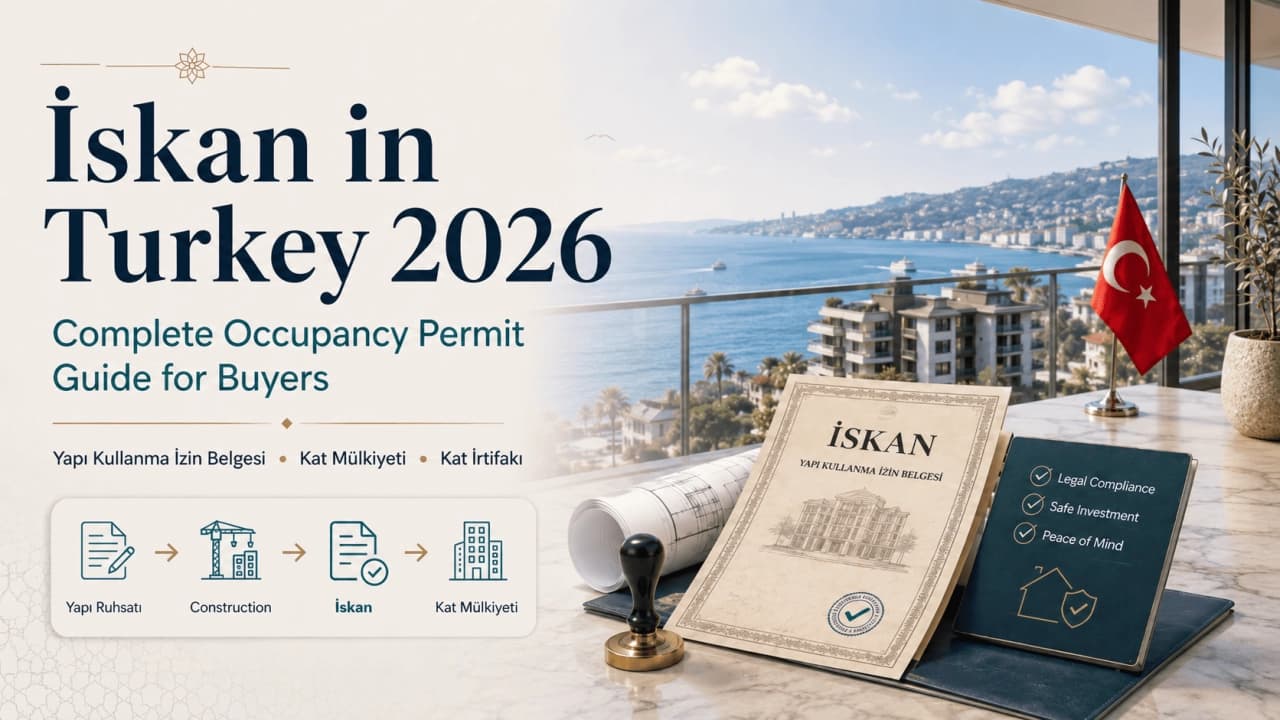
10. Check the İskan / Yapı Kullanma İzin Belgesi
İskan, formally associated with the building-use permit or Yapı Kullanma İzin Belgesi, is another important part of property due diligence.
TKGM confirms that where a property has kat irtifakı and the building-use permit has been obtained, conversion to kat mülkiyeti can proceed through the applicable process.
Government guidance also links establishment of kat mülkiyeti to the approved architectural project, building-use permit and management plan.
The buyer should therefore determine:
- whether the building is complete;
- whether İskan exists;
- whether it covers the relevant structure;
- what title status currently applies;
- whether a transition to kat mülkiyeti remains outstanding.
Does Missing İskan Automatically Mean You Should Never Buy?
Not necessarily.
But it requires investigation.
A property could have a legitimate explanation for its current documentation status.
The important questions are:
- Why is the document missing?
- Is the building legally capable of obtaining it?
- What remains incomplete?
- Who is responsible?
- What risks does the buyer assume?
- Does it affect utilities, financing, resale or intended use?
Do not reduce a complex building-status issue to a simple yes/no rule.
11. Compare the Registered Property Type With Actual Use
A unit being used as an apartment should be checked against its registered/legal character.
Similarly, property marketed as:
- residence;
- home office;
- commercial unit;
- hotel residence;
- shop;
- warehouse;
may have legal characteristics that affect its intended use.
The buyer should understand what the property legally is, not merely what it looks like during a viewing.
12. Check Approved Project and Building Documentation
For some transactions, particularly newer developments, legal due diligence should compare the actual unit with relevant approved project documentation where available.
Potential issues include:
- balconies enclosed without approval;
- rooms added;
- walls removed;
- common areas incorporated into the apartment;
- terraces occupied exclusively without legal basis;
- merged units;
- commercial areas used residentially;
- other deviations.
Not every physical alteration produces the same legal consequence.
But a significant mismatch should not be ignored.
13. Check Building Permit Status for Off-Plan Property
For qualifying prepaid residential sales, the building permit is particularly important.
The Turkish Ministry of Trade's updated March 5, 2026 guidance states that prepaid housing contracts with consumers cannot be concluded before the relevant yapı ruhsatı, or building permit, has been obtained.
This should be checked before a buyer commits money to a qualifying off-plan project.
14. Check the Seller's Identity
If the seller is an individual, verify that:
- identity corresponds to ownership records;
- the person signing is the owner or valid representative;
- identification documents are consistent.
A person holding keys to an apartment is not necessarily its legal owner.
15. Check the Seller's Authority When a Representative Signs
The seller may act through:
- Power of Attorney;
- company representative;
- another legally authorized person.
The buyer should verify the authority itself.
Does the Power of Attorney authorize the relevant action?
Does the person have authority to:
- sign the contract?
- receive money?
- complete the sale?
- make declarations?
- transfer title?
An authorization document should be reviewed for the transaction it is actually being used for.
16. Check a Corporate Seller
Where a property is sold by a developer or another company, legal due diligence should identify the actual legal entity.
The brand used in advertising may not be the legal seller.
For example:
Marketing brand: Istanbul Luxury Homes
but
Contracting company: ABC Gayrimenkul Geliştirme A.Ş.
The buyer should verify:
- legal company name;
- company registration;
- MERSİS information where relevant;
- registered address;
- authorized signatories;
- relationship to the property/project.
The buyer needs to know exactly which legal entity owes the contractual obligations.
17. Who Owns the Developer's Land?
A common assumption is:
“The developer is building the project, so the developer owns the land.”
That may be true.
It may also be wrong.
Project structures can involve:
- developer-owned land;
- landowner/developer agreements;
- revenue-sharing structures;
- joint development;
- other arrangements.
For a major off-plan purchase, the legal relationship between:
developer → land → apartment → buyer
should make sense.
The deeper corporate and project-level investigation belongs to:
Developer Due Diligence in Turkey — Article 26.
18. Review the Property Purchase Contract
Legal due diligence also means checking whether the contract accurately reflects the transaction.
Important provisions include:
- parties;
- exact property;
- price;
- currency;
- payment schedule;
- title-transfer date;
- delivery;
- seller obligations;
- buyer obligations;
- default;
- penalties;
- refunds;
- force majeure;
- dispute resolution;
- technical annexes.
A contract should not be reviewed independently from the property records.
If the Tapu says one thing and the contract says another, the discrepancy must be resolved.
For a detailed contract guide, see:
Property Purchase Contract in Turkey 2026 — Article 20.
19. Review the Reservation Deposit
A foreign buyer may already have paid Kapora before full legal due diligence begins.
If so, review:
- legal characterization of payment;
- amount;
- refund conditions;
- deadline;
- seller default;
- due-diligence condition;
- legal-acquisition condition.
The key question becomes:
Can the buyer recover the deposit if a material legal problem is discovered?
This is covered in detail in:
Property Deposit in Turkey 2026 — Article 21.
20. Verify Foreign-Buyer Eligibility
Foreign buyers are subject to specific Turkish property-acquisition rules.
Under TKGM's published guidance relating to Article 35 of the Land Registry Law, foreign natural persons acquire property subject to legal restrictions.
Current official guidance identifies restrictions including:
- nationality eligibility;
- a nationwide acquisition limit generally capped at 30 hectares for foreign natural persons;
- a district-level limit of 10% of the area where private ownership is permitted;
- restrictions concerning military forbidden zones and certain security/strategic areas.
Therefore, due diligence should consider not only:
“Is the property legally transferable?”
but also:
“Is it legally transferable to this particular foreign buyer?”
Foreign Buyers Do Not Automatically Need a Residence Permit to Buy
Property acquisition and residence permission are different legal matters.
TKGM's foreign-buyer guidance confirms that eligible foreign natural persons do not need to hold a Turkish residence permit simply to acquire property under the applicable acquisition framework.
Buying property also does not mean that every residence-permit application will automatically be approved.
The two topics should be evaluated separately.
21. Special Due Diligence for Land
Buying undeveloped land requires additional investigation.
TKGM guidance states that a foreign person acquiring unbuilt real estate must develop a project and submit it to the relevant ministry for approval within the applicable two-year period.
Therefore, due diligence for land should consider:
- zoning;
- permitted development;
- access;
- parcel status;
- foreign-buyer restrictions;
- project obligations;
- easements;
- infrastructure;
- development feasibility.
A cheap plot is not necessarily a usable development plot.
22. Check Municipal and Planning Status
Land-registry ownership is only one layer.
Depending on the property type, the buyer may also need to understand municipal planning and building status.
Questions may include:
- What is the zoning designation?
- What development is legally permitted?
- Is there an approved building project?
- Are there unresolved municipal issues?
- Is the actual property consistent with permits?
- Is urban transformation relevant?
- Are future public works or planning decisions material?
These questions are particularly important for:
- land;
- redevelopment properties;
- older buildings;
- properties with significant alterations.
23. Do Not Confuse Yapı Kayıt Belgesi With Full Building Compliance
Some Turkish properties may have a Yapı Kayıt Belgesi associated with the historical İmar Barışı framework.
This should not automatically be treated as the same thing as ordinary full compliance with building-permit and occupancy procedures.
Official rules regarding Yapı Kayıt Belgesi expressly address structures with missing or non-compliant permit/use situations and also state that responsibility for earthquake resistance and compliance with technical standards remains with property owners under that framework.
If a seller says:
“There is no problem because we have Yapı Kayıt Belgesi.”
the buyer should investigate exactly what the document does and does not establish.
24. Review the Management Plan
Apartment ownership often includes rights and obligations extending beyond the interior of the apartment.
The yönetim planı, or management plan, can govern important matters concerning the condominium/site.
Government guidance identifies the management plan as part of the documentation involved in establishment of condominium ownership.
Depending on the development, a buyer may want to understand:
- use of common facilities;
- management structure;
- owner obligations;
- shared areas;
- restrictions;
- voting/management arrangements.
This can matter particularly in large Istanbul residential compounds.
25. Check Aidat and Site Liabilities
The monthly aidat may not be a title encumbrance, but it can materially affect the investment.
Before closing, establish:
- current monthly aidat;
- outstanding amounts relating to the unit;
- major extraordinary assessments;
- planned building expenses;
- whether parking/storage carries additional charges.
The purchase contract should clarify which liabilities belong to the seller and which begin with the buyer.
26. Check Tenant and Occupancy Status
A property advertised as:
“ready to move in”
may actually be occupied.
Verify whether there is:
- tenant;
- existing lease;
- informal occupant;
- seller remaining temporarily after closing.
If the buyer expects vacant possession, this should be documented.
A tenant problem can transform a simple investment acquisition into a possession dispute.
27. Furniture and Fixtures
For furnished resale properties, identify what is included.
A listing photo does not necessarily form a precise inventory.
If items materially affect value, the agreement should identify them.
Examples:
- appliances;
- fitted wardrobes;
- air-conditioning units;
- furniture;
- lighting;
- electronics.
This is less significant than title ownership but still part of transaction certainty.
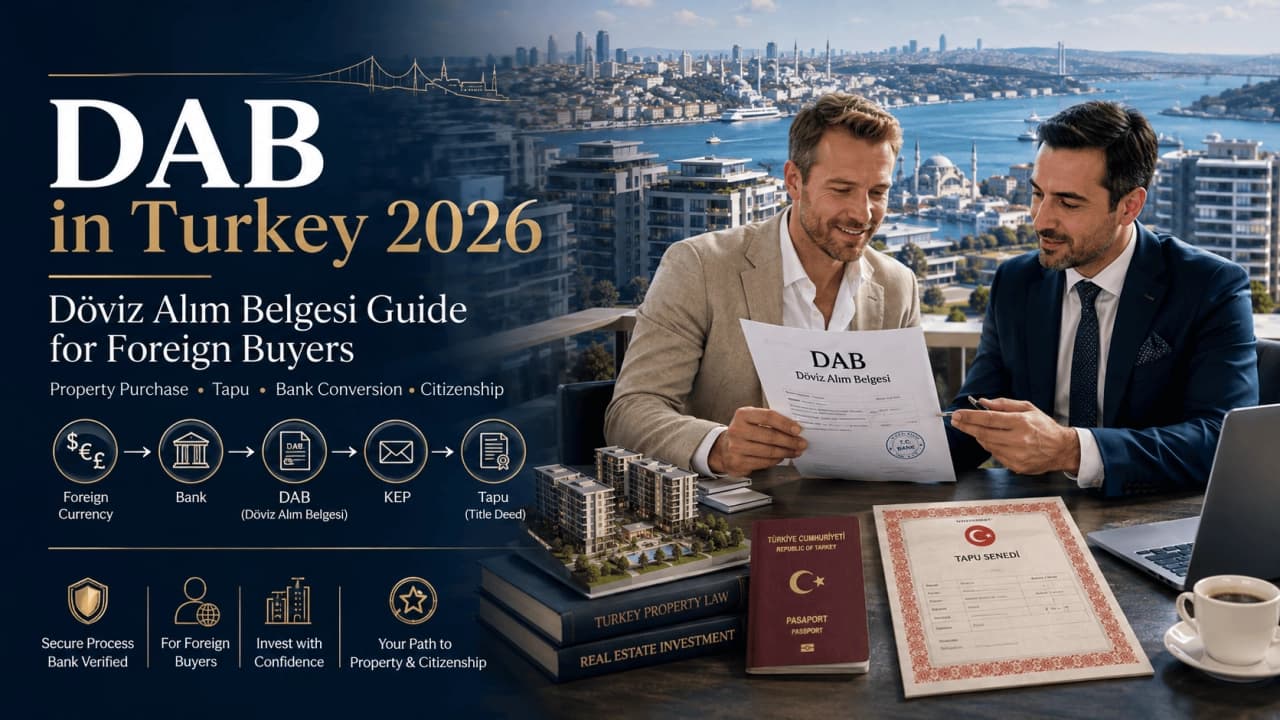
28. Check DAB and Payment Compliance
Foreign natural persons buying Turkish property are subject to the applicable foreign-exchange documentation process.
The transaction's payment structure should therefore be consistent with:
- purchase price;
- contract;
- bank transfer;
- DAB;
- official title procedure;
- valuation documentation where applicable.
This should be planned before final payment.
For the detailed process, see:
DAB in Turkey for Foreign Property Buyers 2026.
29. Check the Property Valuation Process
A valuation report should not be treated as a substitute for legal due diligence.
It answers a different set of questions.
TKGM continues to maintain specific valuation-report procedures relating to relevant foreign-buyer transactions.
A valuation report may assist with:
- value;
- comparable analysis;
- property characteristics;
- applicable official transaction requirements.
But it does not automatically prove:
- clean title;
- valid seller authority;
- enforceable contract;
- absence of every legal restriction.
Think of valuation and legal due diligence as separate control systems.
30. Citizenship Property Requires Additional Legal Due Diligence
A property may be perfectly suitable for ordinary ownership but unsuitable for a particular citizenship-by-investment structure.
If citizenship is the investment objective, legal due diligence should be expanded.
Important checks can include:
- required investment threshold;
- property type;
- seller/property eligibility;
- previous ownership or transfer history where relevant;
- valuation requirements;
- payment documentation;
- DAB;
- official transaction amount;
- citizenship annotation/undertaking;
- required holding period.
The buyer should perform these checks before the financial structure becomes irreversible.
A salesperson saying:
“This apartment is citizenship eligible.”
is not legal due diligence.
31. Verify the Power of Attorney
Remote buyers often use a Vekaletname, or Power of Attorney.
The document should be checked for:
- authenticity/form;
- scope;
- identity details;
- required translation/legalization where applicable;
- powers granted;
- expiry or limitation where relevant.
TKGM's foreign-buyer guidance expressly includes representation documents where transactions are completed through a representative.
A narrowly drafted Power of Attorney may not authorize every transaction the buyer expects.
For a complete guide, see:
Power of Attorney in Turkey for Property Purchase 2026 — Article 19.
32. Off-Plan Due Diligence Requires Additional Protection
Off-plan property has a different risk profile because:
money may move before the finished asset exists.
For qualifying prepaid housing transactions, the Ministry of Trade's March 2026 guidance states that:
- the consumer must receive prescribed pre-contract information at least one day before contracting;
- the building permit must exist before the prepaid housing contract is concluded;
- the contract must satisfy formal legal requirements;
- relevant project documentation and technical specifications should be provided;
- consumers have statutory withdrawal protections.
The Ministry also specifically recommends investigation of land ownership and checking the land-registry record for annotations or declarations that could reduce the property's value.
This is effectively due diligence embedded directly into official consumer guidance.
Formal Requirements Matter in Prepaid Housing
The Ministry's current guidance states that qualifying prepaid housing transactions are subject to formal requirements.
They may be structured through:
- transfer/registration of the relevant condominium easement together with the required written contract; or
- a promise-of-sale contract executed in the legally prescribed notarial form.
The Ministry further states that a seller cannot demand payment from the consumer under any name before a valid contract satisfying the required form exists.
For off-plan buyers, this should be checked before substantial payment.
33. Check Developer Security Mechanisms
For qualifying prepaid housing projects above the applicable regulatory threshold, consumer legislation provides for security mechanisms intended to protect payments.
The Ministry's current guidance identifies mechanisms such as:
- building completion insurance;
- bank guarantee;
- progress-payment mechanisms;
- qualifying linked-credit structures,
depending on the applicable arrangement.
The buyer should understand:
What protects my money if the developer fails before completing the project?
That question deserves an actual answer.
34. Check the Delivery Obligation
Developer due diligence should establish:
- contractual delivery date;
- legal form of delivery;
- title status at delivery;
- required completion documents;
- delay consequences.
Current Ministry guidance for qualifying prepaid housing also emphasizes that merely handing over a key is not necessarily equivalent to legally completing delivery under the statutory regime.
Physical possession and legal completion should not be confused.
35. Review Cancellation and Refund Rights
A lawyer should identify what happens if:
The buyer withdraws
The seller defaults
Legal due diligence fails
Financing fails
Citizenship eligibility fails
Construction is delayed
A required document cannot be obtained
Title cannot be transferred
The answer should come from:
- contract;
- applicable law;
- transaction structure;
not from a salesperson's verbal promise.
36. Do Not Rely on “Guaranteed Refund”
If money is described as refundable, ask:
Under which conditions?
Then:
Within how many days?
Then:
In which currency?
Then:
Who is legally obligated to make the refund?
A promise becomes materially stronger when all four questions have written answers.
37. Review Penalty Clauses
Contracts often impose penalties for:
- buyer late payment;
- cancellation;
- missed installments.
Due diligence should also examine remedies against the seller.
What happens if the seller:
- refuses to transfer title?
- sells to another person?
- misses delivery?
- cannot remove an encumbrance?
- materially changes the project?
A highly asymmetric contract deserves closer review.
38. Check the Payment Recipient
One of the simplest but most important checks is:
Who receives the money?
If the seller is:
ABC Gayrimenkul A.Ş.
but payment instructions show:
an unrelated individual
the buyer should establish why.
The payment chain should connect logically to:
Buyer → Contract → Seller → Property
Unexplained third-party accounts create avoidable risk.
39. Keep the Payment Trail Traceable
For significant property payments, documentation matters.
Maintain evidence showing:
- sender;
- recipient;
- date;
- amount;
- currency;
- transaction purpose;
- relevant property.
Payment descriptions should be meaningful where possible.
For citizenship purchases, clean documentary consistency becomes even more important.
40. Recheck the Title Before Closing
Due diligence performed three months earlier does not guarantee the registry remains unchanged.
Before final transfer, the buyer should consider whether a fresh/current review is needed.
Potential new records might include:
- mortgage;
- attachment;
- annotation;
- restriction.
TKGM's Web Tapu framework allows current title information and relevant registered restrictions to be reviewed through the applicable procedures.
The final check should answer:
Is the property still in the condition on which I agreed to buy it?
What Should a Lawyer's Property Due Diligence Report Cover?
A useful written legal due-diligence report should not merely say:
“Property is okay.”
It should explain:
| Area | What Should Be Reported |
|---|---|
| Property | Exact legal identification |
| Ownership | Registered owner and ownership share |
| Takyidat | Mortgages, annotations, easements and relevant restrictions |
| Seller | Identity and authority |
| Building Status | Relevant title/permit/occupancy status |
| Contract | Material buyer obligations and risks |
| Foreign Buyer | Acquisition eligibility and relevant restrictions |
| Payment | Legal/payment conditions requiring coordination |
| Citizenship | Additional conditions if applicable |
| Outstanding Issues | Documents or removals required before closing |
| Recommendation | Proceed, proceed conditionally, renegotiate or stop |
The report should identify unresolved issues rather than hide uncertainty.
Green, Amber and Red Due Diligence Findings
A practical approach is to classify issues.
Green
No material issue identified based on reviewed documentation.
Example:
Registered owner matches seller and no material encumbrance is identified.
Amber
Issue exists but may be manageable before closing.
Example:
A bank mortgage exists, but the transaction contains a clear documented process for discharge before or simultaneously with transfer.
Red
Issue materially threatens ownership, legality, transfer or buyer's core objective.
Example:
The person taking payment cannot establish ownership or authority to sell the apartment.
A red finding does not mean:
“Negotiate a discount and ignore it.”
It means resolve the risk before proceeding.
Legal Due Diligence Red Flags
| Red Flag | Why It Matters |
|---|---|
| Seller refuses to provide current property information | Ownership/restrictions cannot be properly verified |
| Name on contract differs from registered owner without explanation | Authority risk |
| Unexplained mortgage | Buyer may receive encumbered property |
| Attachment or transfer restriction | Closing may be blocked or complicated |
| Contract unit does not match title unit | Risk of buying the wrong legal asset |
| Completed apartment still has unexplained title/building-status issues | Further investigation required |
| Developer cannot establish relationship to land | Project ownership risk |
| Building permit unclear in qualifying off-plan sale | Major legal/consumer-law issue |
| Buyer asked to pay before legally required contract structure exists | Payment risk |
| Payment requested to unrelated personal account | Recovery/documentation risk |
| “Citizenship guaranteed” without legal review | Eligibility may fail |
| Seller refuses due-diligence condition | Buyer assumes unknown risk |
| Large payment required before title review | Buyer becomes exposed too early |
| Old Tapu copy presented as sufficient | Current status may have changed |
| Verbal promises conflict with written contract | Written obligations may prevail in a dispute |
Resale Property Legal Due Diligence
For an existing Istanbul apartment, prioritize:
Ownership
Who is registered owner?
Takyidat
Any mortgage, attachment or annotation?
Title Status
Kat mülkiyeti or kat irtifakı?
Building Status
Is İskan relevant and available?
Occupancy
Tenant or vacant?
Seller
Owner or representative?
Contract
Does it match the registered property?
Payment
When is money transferred relative to Tapu?
Possession
When are keys and vacant possession delivered?
Outstanding Property Issues
Any material site or administrative matters disclosed?
Resale due diligence is often simpler than a complex off-plan transaction—but it should never be skipped merely because the apartment is physically complete.
New-Build Property Legal Due Diligence
For a completed developer property, examine:
- developer/seller identity;
- land ownership;
- title status;
- independent section;
- mortgages;
- İskan;
- kat mülkiyeti / kat irtifakı;
- management plan;
- contract;
- delivery conditions;
- payment structure.
A brand-new apartment can still have title or project-level legal complexity.
“New” does not mean “risk-free.”
Off-Plan Property Legal Due Diligence
Off-plan review should place more emphasis on:
- developer's legal identity;
- land relationship;
- building permit;
- formal sales structure;
- exact independent unit;
- technical annexes;
- delivery deadline;
- consumer-law protections;
- developer security mechanism;
- refund rights;
- project-change clauses;
- future title-transfer structure.
The buyer is not merely purchasing real estate.
The buyer is also assuming developer performance risk.
Citizenship Property Legal Due Diligence
For citizenship-oriented purchases, due diligence has two simultaneous objectives:
Objective 1
Ensure the property transaction itself is legally sound.
Objective 2
Ensure the transaction can meet the current citizenship-investment conditions.
A property can pass Objective 1 and fail Objective 2.
That distinction should be understood before deposit and payment.
What Legal Due Diligence Cannot Guarantee
No professional review can guarantee that nothing will ever go wrong.
Due diligence reduces identifiable risk based on available evidence.
It cannot guarantee:
- future market value;
- future currency performance;
- rental returns;
- structural earthquake performance;
- completion of unrelated future infrastructure;
- future changes in law;
- future changes in taxation;
- future immigration policy.
A good due-diligence report distinguishes legal facts from commercial predictions.
Property Due Diligence Checklist for Foreign Buyers
Buyer Eligibility
Ownership
Property Identification
Takyidat
Building Status
Seller / Developer
Contract
Money
Final Closing
15 Questions to Ask Your Property Lawyer
Before approving the purchase, a foreign buyer should receive clear answers to:
- Who is the registered owner?
- Does the seller have full authority to sell?
- What exactly is the property's official land-registry identity?
- Are there mortgages?
- Are there attachments?
- What other takyidat affects the property?
- Is the property kat mülkiyeti or kat irtifakı?
- What is the İskan status?
- Does the property appear consistent with the approved legal documentation?
- Can I legally acquire this property as a foreign national?
- Does the purchase contract match the registry?
- What must the seller fix before closing?
- At what point should I make the final payment?
- Are there unresolved legal issues I am accepting?
- Would you proceed with this transaction under the current documentation?
The final question forces the analysis to become decision-oriented.
Common Mistakes Foreign Buyers Make
Relying Only on the Real Estate Agent
Agents can be extremely useful for:
- property discovery;
- negotiation;
- viewing;
- transaction coordination.
But independent legal risk analysis is a different professional function.
Looking Only at a Tapu Photograph
A Tapu photograph is not the same as a current review of the land-registry position.
Assuming “No Mortgage” Means “No Legal Problem”
Mortgage is only one category.
Review the entire relevant takyidat.
Checking After Paying
Due diligence loses much of its protective value when performed only after the buyer has paid a large non-refundable amount.
Believing a New Building Needs Less Legal Review
New buildings introduce different risks:
- developer;
- construction status;
- land ownership;
- title formation;
- delivery;
- off-plan consumer protections.
Treating İskan as an Administrative Detail
Occupancy and condominium status can have practical implications for use, financing and resale.
Assuming the Developer Owns the Land
Verify the legal relationship.
Using the Seller's Lawyer as the Buyer's Lawyer
Know who the lawyer represents.
Assuming Citizenship Eligibility Because the Price Exceeds $400,000
Price alone does not establish citizenship eligibility.
Failing to Recheck Before Transfer
Legal status can change between initial investigation and closing.
FAQ: Legal Due Diligence for Property in Turkey
What is legal due diligence when buying property in Turkey?
Legal due diligence is a pre-purchase review of the property's ownership, title records, encumbrances, building/legal status, seller authority, contracts and buyer-specific acquisition requirements.
Its purpose is to identify legal problems before the buyer becomes fully committed.
Do foreigners need a lawyer to buy property in Turkey?
A private lawyer is not listed by TKGM as a universal formal document requirement simply because the buyer is foreign. However, independent legal review may be valuable because the land-registry process itself is not a substitute for the buyer's own contract and risk analysis.
What should a property lawyer check in Turkey?
The review can include:
- ownership;
- Tapu;
- takyidat;
- mortgages;
- attachments;
- annotations;
- easements;
- seller authority;
- building status;
- contract;
- foreign-buyer eligibility;
- payment conditions;
- citizenship requirements where applicable.
The exact scope depends on the transaction.
What is takyidat?
TKGM uses takyidat as a general term covering registered matters affecting ownership, including annotations, declarations, easements, real-estate obligations, certain foundation indications and mortgages.
How can I check whether a Turkish property has a mortgage?
The current land-registry record should be reviewed.
TKGM's systems contain registered mortgage information including creditor, degree and relevant mortgage data, and Web Tapu provides mechanisms for obtaining and reviewing title information.
What is the difference between kat irtifakı and kat mülkiyeti?
TKGM explains that kat mülkiyeti relates to completed buildings, while kat irtifakı may be established over land where construction has not yet been built or fully completed.
A buyer should investigate the reason when a completed property remains under kat irtifakı.
Should I check İskan before buying?
For relevant completed buildings, occupancy documentation and condominium status should be reviewed. TKGM links building-use permission with the process of moving from kat irtifakı to kat mülkiyeti.
Can a foreigner buy any property in Turkey?
No.
Foreign natural persons acquire property subject to statutory nationality, geographic and quantitative restrictions. TKGM's published guidance includes the nationwide 30-hectare limit, the 10% district private-property limit and restrictions relating to prohibited/security areas.
Do foreigners need a residence permit to buy Turkish property?
Not necessarily. TKGM confirms that an eligible foreign natural person does not need to hold a residence permit simply in order to acquire property under Article 35 procedures.
Is a valuation report the same as legal due diligence?
No.
A valuation report primarily addresses property value and related valuation matters.
Legal due diligence investigates ownership, restrictions, contracts, authority and transfer risk.
Both may be necessary.
Can I do legal due diligence after paying Kapora?
You can still perform due diligence, but the buyer is usually better protected if material checks occur before a substantial non-refundable payment.
If a reservation payment must be made first, consider making completion conditional on satisfactory legal review.
Is a clean Tapu enough?
Not necessarily.
A legal review should consider not only the visible title deed document but also current registry information, takyidat, building status, seller authority, contract terms and buyer-specific acquisition requirements.
What should happen if a mortgage exists?
The buyer should establish whether it will remain or be discharged.
If discharge is required, the transaction should document how and when removal occurs and how it interacts with payment and closing.
Can I buy an apartment with kat irtifakı?
Such properties can be acquired, but the buyer should understand the building's completion and occupancy status and why kat mülkiyeti has not been established.
The risk depends on the facts.
What should I check in an off-plan project?
Key legal checks include:
- developer identity;
- land ownership;
- building permit;
- formal contract structure;
- title structure;
- exact apartment;
- project documents;
- security mechanism;
- payment;
- delivery;
- consumer rights.
For qualifying prepaid housing, the Ministry of Trade imposes specific formal requirements and statutory protections.
Can a developer ask for money before signing a valid prepaid housing contract?
For transactions falling within the statutory prepaid-housing consumer framework, the Ministry of Trade states that the seller may not demand payment under any name before a valid contract satisfying the applicable formal requirements has been established.
Should the title be checked again on closing day?
A current or sufficiently recent final review is sensible because title conditions can change between initial due diligence and transfer.
The buyer should confirm that required restrictions have been removed and that no unexpected new records have appeared.
Final Advice for Foreign Buyers
Legal due diligence for property in Turkey should answer a simple question before the buyer sends substantial money:
Is the legal asset I am buying actually the asset I think I am buying—and can it be transferred to me under the conditions I have agreed?
That requires more than seeing an apartment.
It requires more than seeing a photocopy of a Tapu.
And it requires more than being told:
“Everything is clean.”
A proper review connects:
Seller
↓
Ownership
↓
Property identity
↓
Takyidat
↓
Building status
↓
Contract
↓
Payment
↓
Foreign-buyer eligibility
↓
Official transfer
For foreign buyers purchasing Istanbul property, the most important checks are usually:
- confirm the registered owner;
- identify the exact property;
- review current Tapu information;
- inspect mortgages, attachments, annotations and other takyidat;
- understand kat mülkiyeti / kat irtifakı and İskan status;
- verify seller or developer authority;
- confirm foreign-buyer eligibility;
- compare the contract with the legal property;
- make payments conditional on the correct transaction milestones;
- recheck material title conditions before closing.
The purpose is not to make a property transaction unnecessarily complicated.
The purpose is to discover complications before they become the buyer's problem.
A strong due-diligence process should end with one of four conclusions:
Proceed.
Proceed only after specified conditions are satisfied.
Renegotiate the transaction.
or
Do not proceed.
That decision-oriented approach is far more useful than simply collecting documents.