
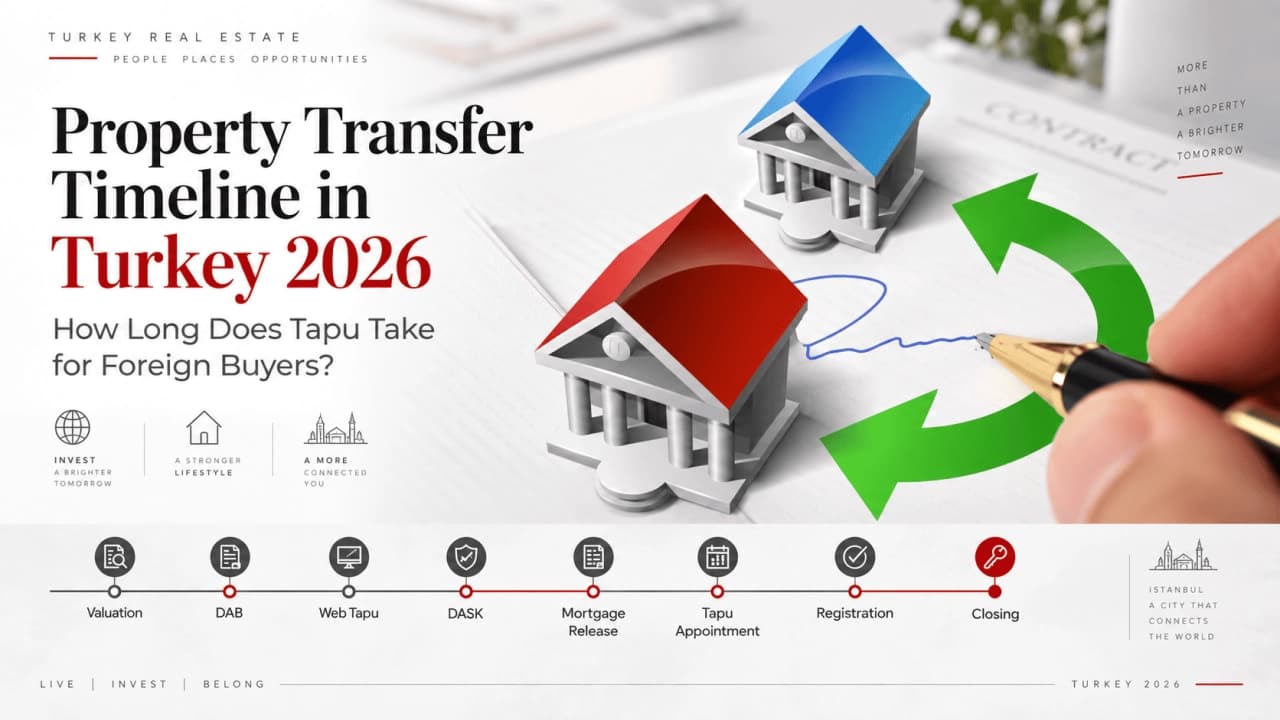
The property transfer timeline in Turkey can be surprisingly short when the property, buyer, seller and documents are all ready.
But there is an important distinction foreign buyers should understand:
The Tapu signing itself is usually not the longest part of the transaction.
Most delays happen before the official title transfer.
They can arise from:
legal due diligence;
property valuation;
international bank transfers;
source-of-funds checks;
DAB preparation;
Power of Attorney;
mortgage release;
missing documents;
foreign-buyer eligibility checks;
citizenship documentation.
Once the file is complete and the official appointment has been scheduled, the final sale can move very quickly.
TKGM's published service standards list the sale transaction itself at up to 45 minutes from the scheduled appointment time for a prepared file. That figure does not include the days spent preparing documents or waiting for the file to become ready.
That distinction explains why two buyers can report completely different experiences:
“My Tapu took less than an hour.”
and
“My purchase took two weeks.”
Both can be correct.
The first buyer may be describing only the final Land Registry appointment.
The second may be describing the entire journey from agreed property to registered ownership.
For planning purposes, a straightforward cash purchase of a ready resale apartment can often be organized within roughly one to two working weeks once the property and commercial terms are agreed.
That is a practical planning range—not a statutory government deadline.
A mortgage, foreign-issued Power of Attorney, unresolved mortgage on the property, citizenship transaction or incomplete documentation can extend the process substantially.
This guide breaks down each stage so foreign buyers can understand where the time actually goes.
Quick Answer: How Long Does Property Transfer Take in Turkey?
For a simple cash purchase with complete documents, buyers should generally plan around:
Property checks and contract preparation
Several business days
Valuation and foreign-buyer documentation
Several business days
Banking and DAB
Potentially same day once funds and compliance are ready, but bank-dependent
Web Tapu review and appointment
Depends on office workload and file completeness
Final Tapu signing and registration
Potentially completed during the scheduled appointment once the file is ready
TKGM's current application-tracking service allows applicants to see:
whether the application is under review;
whether documents are missing;
appointment date and time;
fee-payment codes;
whether the file has reached the registration stage.
The practical rule is:
Measure the transaction from “documents ready” rather than from “property selected.”
Typical 2026 Planning Timeline
The following is a practical planning guide, not an official statutory timetable.
| Stage | Practical Planning Range |
|---|---|
| Initial seller/property verification | Same day–2 business days |
| Reservation and commercial terms | Same day–1 business day |
| Legal due diligence | 1–3+ business days |
| Valuation process | Several business days |
| Banking / source-of-funds clearance | 1–5+ business days |
| DAB once funds are ready | Often same day or next banking day |
| Web Tapu file review / appointment | 1–3+ business days depending on workload/documentation |
| Final sale appointment | TKGM service standard: up to 45 minutes for prepared sale file |
| Physical handover | Same day or contractually agreed later |
A straightforward transaction can therefore fit comfortably inside a 5–10 business-day planning window.
Complex transactions should be given more time.
Property Transfer Timeline vs Property Purchase Timeline
These terms are often used interchangeably, but they refer to different things.
Property Purchase Timeline
Starts when the buyer:
selects property;
negotiates;
pays reservation;
performs due diligence;
arranges payment;
completes closing.
This may take days, weeks or—in an off-plan development—much longer.
Property Transfer Timeline
Usually refers more narrowly to the period leading into:
Web Tapu application;
document approval;
fees;
appointment;
official sale;
registration.
A buyer asking:
“How long does Tapu take?”
should therefore specify whether they mean:
the official title-registration stage
or
the entire purchase from offer to ownership.
Timeline Stage 1 — Agreeing the Property and Price
Typical planning time:
Same day to several days
Once the buyer has identified a property, the parties normally negotiate:
price;
currency;
deposit;
payment schedule;
furniture;
delivery;
Tapu date.
This stage can happen very quickly.
But speed is not always an advantage.
The buyer should not allow a fast commercial agreement to force legal checks into an unrealistic schedule.
Timeline Stage 2 — Reservation / Kapora
Typical planning time:
Same day
Where the buyer needs the property temporarily removed from the market, a reservation agreement may be used.
This stage itself can be completed quickly.
The more important question is whether the deposit terms are clear.
Before transferring Kapora, establish:
whether it is refundable;
what happens if due diligence fails;
what happens if financing fails;
what happens if the seller withdraws;
how long the property is reserved.
A badly structured deposit can turn a one-day stage into a weeks-long dispute.
See:
Property Deposit in Turkey 2026 — Article 21.
Timeline Stage 3 — Legal Due Diligence
Typical planning time:
1–3 business days for a straightforward property
Complex property can take longer.
The buyer should allow enough time to verify:
registered owner;
exact independent section;
Tapu;
mortgage;
attachment;
annotations;
other takyidat;
seller authority;
building/title status.
A clean resale apartment may be relatively quick.
A project involving:
corporate seller;
project mortgage;
separate landowner;
unusual annotations;
inheritance;
unresolved title matters;
may require significantly more review.
The correct objective is not:
“Finish the lawyer's review today.”
It is:
“Finish the review before I become irreversibly committed.”
Can Legal Due Diligence and Valuation Run at the Same Time?
Yes, in many transactions.
This is one of the easiest ways to shorten the overall closing timeline.
For example:
Day 1
Legal title review starts.
At the same time:
Valuation application begins.
Meanwhile:
Buyer prepares banking documents.
Parallel processing is far more efficient than waiting for each stage to finish before starting the next one.
Timeline Stage 4 — Property Valuation
Typical planning time:
Several business days
Foreign-buyer transactions may require the applicable valuation process under TKGM's rules.
Valuation reports are processed through the official system and transmitted through the applicable electronic infrastructure. TKGM's valuation framework integrates the report with TAKBİS/Web Tapu rather than relying simply on a paper report carried by the buyer.
The precise turnaround depends on:
location;
valuation-company workload;
property access;
document availability;
complexity.
Do not schedule Tapu based on an assumption that a valuer can always inspect and finalize the property immediately.
Property Access Can Delay the Valuation
The valuer may need access to the actual property.
That can create delays if:
tenant is unavailable;
seller is abroad;
keys are with another agent;
construction site access is restricted.
A basic coordination failure can therefore delay the entire closing.
Arrange property access before requesting the report.
How Long Is the Valuation / TTB Valid?
This matters where the process runs longer than expected.
TKGM states that Tutar Tespit Belgeleri issued after December 9, 2024 have a six-month validity period.
That gives citizenship-related buyers more planning flexibility than a transaction that assumes every valuation-related document must be recreated after a few weeks.
Timeline Stage 5 — Banking and International Transfer
Typical planning time:
1–5+ business days
Banking is often the biggest hidden source of delay for foreign buyers.
The buyer may need to:
transfer money internationally;
wait for correspondent-bank processing;
satisfy source-of-funds checks;
ensure funds are credited;
arrange currency conversion;
obtain DAB;
transfer funds to the seller at the correct closing stage.
A buyer who already has cleared funds in a Turkish bank can move far faster than a buyer attempting to send €500,000 internationally on the morning of Tapu.
International Transfer Can Be the Real Bottleneck
Do not assume:
SWIFT sent = funds immediately available.
Timing can depend on:
sending bank;
correspondent bank;
receiving bank;
currency;
compliance review;
transaction size;
weekends and holidays.
For a high-value property transaction, tell the receiving bank in advance.
Source-of-Funds Checks Can Add Time
A large incoming transfer may trigger ordinary bank compliance questions.
The bank might request:
previous bank statements;
property-sale agreement from another country;
business-income documentation;
investment statements;
inheritance records.
Prepare these documents before the transfer arrives.
Do not wait for the bank to freeze the transaction workflow before looking for evidence.
Timeline Stage 6 — DAB
Typical planning time:
Potentially same day once the money and documentation are ready
Foreign natural persons buying real estate in Turkey are required to complete the Döviz Alım Belgesi — DAB procedure.
TKGM confirms that the relevant foreign currency must first be sold through a bank into the Central Bank framework and that the DAB must be submitted for the title transaction.
The important point for timeline planning is:
DAB is usually not the stage that should consume a week if the money is already in the correct banking structure.
Problems normally occur because:
money has not arrived;
conversion was done incorrectly;
transaction details are incomplete;
buyer/seller information is inconsistent.
Prepare the banking structure first.
Citizenship Buyers Need Additional Payment Evidence
For a normal foreign-buyer purchase, TKGM identifies DAB as the key foreign-currency document.
For citizenship-related property acquisition, TKGM additionally requires evidence of the transfer from buyer to seller.
This additional reconciliation can make citizenship closings less forgiving of last-minute banking errors.
Timeline Stage 7 — Power of Attorney
If already prepared:
No significant extra delay
If it must be created abroad:
Several additional days or longer may be required
Remote buyers should prepare the POA early.
A foreign-issued POA can involve:
notary;
Apostille/legalization;
Turkish translation;
physical courier of original/certified document.
The timeline depends heavily on the country.
For this reason, a buyer purchasing remotely should not wait until all other documents are ready before beginning the POA process.
Fastest Remote-Buyer Strategy
If remote purchase is planned from the beginning:
Start POA first
while simultaneously:
conducting due diligence;
arranging valuation;
preparing bank funds.
This avoids turning the POA into the final bottleneck.
Timeline Stage 8 — Mortgage Approval
Typical planning time:
Longer than a cash purchase
A mortgage purchase should not use the same timeline as a cash sale.
The lender may need to complete:
borrower underwriting;
income review;
property appraisal;
legal collateral review;
final loan approval;
mortgage registration preparation.
A financed transaction should generally be planned in weeks rather than days, especially for a foreign applicant.
The exact timeframe is bank-specific.
See:
Mortgage in Turkey for Foreigners 2026 — Article 23.
Seller Mortgage Can Also Delay a Cash Purchase
Even if the buyer is paying cash, the seller may have an existing mortgage.
Then the parties may need to coordinate:
Seller debt payoff
↓
Bank release
↓
Mortgage deletion / release process
↓
Buyer registration
TKGM's electronic mortgage infrastructure supports digital establishment and release procedures between financial institutions and the land registry, but the commercial coordination still needs to be completed correctly.
A seller promising:
“It will be removed later.”
is not enough.
Timeline Stage 9 — DASK
Typical planning time:
Usually quick when property information is ready
For qualifying residential transfers, DASK must be handled before the official sale.
There is a major timing change in 2026.
For sales registered on or after September 5, 2026, the seller's policy terminates on the transfer date and the buyer must have their own valid Compulsory Earthquake Insurance policy before Tapu. The policy is checked as part of the sale.
Therefore:
Do not leave DASK until you are already sitting at the Tapu office.
This is a small task that can create an unnecessary same-day delay.
Timeline Stage 10 — Web Tapu Application
Typical planning time:
Application itself can be submitted online quickly
TKGM's current system allows sale applications to be initiated digitally through Web Tapu.
However, submitting the application is not the same as the application being ready for signature.
The Land Registry must still review:
documents;
parties;
property;
restrictions;
required foreign-buyer documents.
Important 2025–2026 Application Change
Foreign buyers should avoid old guides telling them simply to book an e-Randevu.
TKGM's July 23, 2025 instruction states that the e-Randevu application has been discontinued.
For Tapu offices in groups 1–3, applications are taken through Web Tapu or ALO 181 rather than in-person application; group 4 offices may also accept in-person applications alongside those channels.
This remains relevant to the 2026 transaction timeline.
Timeline Stage 11 — File Review
Typical planning time:
Often one or several business days, but not guaranteed
Once the application enters the system, the file may move through stages such as:
review;
approval;
missing-document request;
fee generation;
appointment.
TKGM's Application Inquiry system allows users to see these stages digitally, including whether there are missing documents and whether the applicant has been called for signature.
The single best way to accelerate this stage is:
Submit a complete file.
Missing Documents Reset the Practical Timeline
A one-day Tapu application can become a one-week transaction when the office asks for:
corrected POA;
translation;
DAB;
valuation;
missing identity information;
DASK;
seller documentation.
The delay is not necessarily caused by the Land Registry.
It is often caused by incomplete transaction preparation.
Timeline Stage 12 — Fees and Appointment
Once the file is ready, the system communicates the applicable payment and appointment information.
TKGM's e-Tahsilat system allows Tapu harcı and revolving-fund/service charges to be paid digitally, with the payment reflected electronically in the system.
This part should not normally create a long delay if funds and payment information are ready.
Never Pay an Unofficial Fee Account
A common scam risk occurs when someone sends:
“Tapu fee IBAN”
through WhatsApp.
Official fee-payment information should correspond with the official transaction system.
Do not transfer supposed government fees to an agent's personal bank account.
Timeline Stage 13 — Final Tapu Appointment
Official service standard:
Up to 45 minutes from appointment time for the prepared sale transaction
This is where buyers often misunderstand the timeline.
TKGM's published service standards list:
Sale — 45 minutes from appointment time
for the formal service once the transaction is prepared.
That does not mean:
“Every Turkish property can be purchased in 45 minutes.”
It means:
Once the file is ready and the parties reach the official appointment, the actual formal sale can be very fast.
What Happens During the Final Appointment?
The final stage generally involves:
identity verification;
representative authority where applicable;
interpreter where necessary;
official sale declarations;
document confirmation;
signatures;
registration.
The buyer should verify:
name;
property;
ownership share;
price/transaction details;
before signing.
When Does the Buyer Become the Legal Owner?
Not when:
Kapora is paid;
the purchase agreement is signed;
the buyer transfers money;
keys are handed over.
Registered ownership passes through the official land-registry registration.
Therefore, the most important time marker is:
Registration completed.
TKGM's tracking system can show when the file has reached completion/registration.
Timeline Stage 14 — Seller Payment
Timing:
Depends on the chosen closing mechanism
Payment timing should be synchronized with title registration.
One available Turkish infrastructure is Güvenilir Hesap, operated within the TKGM/Takasbank framework.
Under this system, the buyer's funds are blocked until registration and then released to the seller after the system receives registration confirmation. TKGM states that once registration is completed, the blocked amount is transferred to the seller within seconds.
However, current published eligibility requires specific Turkish identity/IBAN information, so foreign buyers should confirm whether their transaction can use the system rather than assuming universal access.
Timeline Stage 15 — Handover
Typical timing:
Same day to several days after Tapu
Legal ownership and physical possession do not always happen at the exact same moment.
For an empty resale apartment, keys may be delivered immediately after closing.
But the contract may provide later handover where:
seller needs to vacate;
tenant remains;
furniture needs to be removed;
developer completion is still pending.
The handover date should be written into the contract.
Same-Day Tapu: Is It Possible?
Yes, potentially.
But only under the right circumstances.
A same-day or very fast official transfer becomes realistic where:
due diligence is already finished;
valuation is complete;
money is cleared;
DAB is ready;
DASK is ready;
POA/interpreter issues are solved;
title is clean;
seller is ready;
application reaches approval.
The mistake is trying to compress preparation and transfer into the same day.
Can You Buy a Property in Turkey in 24 Hours?
Technically, certain extremely prepared transactions might move very quickly.
But foreign buyers should not build a transaction strategy around a 24-hour promise.
If someone says:
“Send the full money today and Tapu tomorrow.”
ask whether the following are already complete:
title review;
valuation;
DAB;
DASK;
banking;
seller authority;
foreign-buyer checks.
Speed is useful only after risk controls are finished.
Cash Resale Property Timeline
For a straightforward resale apartment:
Day 1
Property agreed and initial documents collected
Days 1–3
Legal due diligence
Days 1–4
Valuation initiated/completed
Days 2–5
Buyer money prepared / banking checks
Days 3–6
DAB and closing documentation
Days 4–8
Web Tapu review and appointment
Closing Day
Fees + final check + official registration
Same day / next day
Keys and handover
This is an illustrative workflow, not an official deadline.
Example: Clean Cash Purchase
Suppose a foreign buyer selects a completed Istanbul apartment.
The seller:
is registered owner;
has no mortgage;
has complete documents.
The buyer:
already has funds in Turkey;
has tax/identity documentation ready;
uses no mortgage;
attends personally.
In that situation, the main variables become:
due diligence;
valuation;
DAB;
Tapu-office processing.
This type of transaction can often fit into a relatively short one-to-two-week planning window.
Mortgage Purchase Timeline
A mortgage changes the schedule materially.
Additional stages include:
borrower application;
income verification;
credit assessment;
bank appraisal;
loan committee/approval;
mortgage documentation;
loan disbursement;
mortgage registration.
A foreign buyer should generally budget several weeks rather than trying to force a mortgage purchase into a cash-sale schedule.
The exact time is lender-specific.
Example: Why Mortgage Buyers Need a Longer Reservation
Suppose a cash buyer requests:
7-day reservation
That may be reasonable.
A mortgage buyer may require significantly more time because bank approval cannot always be completed within one week.
The reservation agreement should reflect the real financing timeline.
Remote Property Purchase Timeline
Remote buyers add:
POA preparation;
Apostille/legalization;
translation;
courier;
representative coordination.
If the Power of Attorney already exists and is accepted, the transaction can proceed almost like a local represented purchase.
If the POA must be created from scratch abroad, add additional time before closing.
See:
Buying Property in Turkey Remotely 2026 — Article 25.
Citizenship Property Timeline
Citizenship-related property purchases normally require tighter document coordination.
The property-closing phase includes:
eligibility review;
valuation / TTB;
DAB;
buyer-to-seller payment evidence;
Tapu;
required citizenship undertaking/restriction.
The property purchase itself may still be completed within a relatively short period when everything is ready.
But:
Property closing time is not the same as citizenship-processing time.
Receiving the Tapu does not mean citizenship is issued immediately afterward.
Keep the two timelines separate.
TTB Timing for Citizenship Buyers
For citizenship-related transactions, document validity matters if closing is delayed.
TKGM currently states that TTB documents issued after December 9, 2024 are valid for six months.
That means a short closing delay does not automatically require the buyer to restart that valuation-related stage.
Off-Plan Property Timeline
Off-plan transactions operate on a completely different clock.
The buyer may sign the agreement today but receive the final property:
months;
or years;
later.
For qualifying prepaid housing transactions, the Ministry of Trade's updated March 5, 2026 guidance states that the legal delivery period cannot exceed 48 months from the contract date. If the parties agree a shorter contractual period, the seller is bound by that shorter timeline.
Therefore:
off-plan contract date ≠ Tapu completion date.
Key Handover Is Not the Same as Legal Delivery
The Ministry's 2026 prepaid-housing guidance also confirms that simply handing the buyer keys does not necessarily constitute formal delivery.
Under the qualifying regime, delivery involves the legally prescribed title/possession structure.
A developer saying:
“Your unit will be handed over in June.”
should therefore be asked:
Keys in June?
İskan in June?
Tapu in June?
Kat mülkiyeti in June?
Those are not always the same date.
Developer Completed Property Timeline
Buying a completed unit directly from a developer can be relatively fast if:
independent section exists;
title is ready;
project mortgage release is arranged;
İskan/title status is clear;
seller company has signatory authority.
The main delay often comes from:
corporate + mortgage + title-release mechanics
rather than physical construction.
Property With Existing Mortgage
An existing mortgage can add time.
The parties may need:
seller obtains payoff figure;
funds are coordinated;
bank confirms debt settlement;
mortgage-release instruction is transmitted;
registry position is rechecked;
sale proceeds.
Do not set a rigid closing date before understanding the bank's release process.
Property With Haciz / Attachment
An attachment can create a much more uncertain timeline.
Do not estimate:
“It will take two days.”
until the underlying issue is understood.
Removal can depend on:
creditor;
enforcement process;
payment;
court/administrative documentation.
A sale timeline should not begin until the resolution mechanism is clear.
Foreign-Issued Power of Attorney Timeline
The POA stage can become a hidden delay because several organizations may be involved.
Possible chain:
Local Notary
↓
Apostille / Legalization
↓
Turkish Translation
↓
Notarization
↓
Delivery to Representative
↓
Tapu Acceptance
A buyer should build this process before the target closing week.
Does the Buyer Need to Be in Turkey the Entire Time?
No.
A foreign buyer can travel for only the final part, or complete the transaction through a properly authorized representative.
For a buyer who wants to attend personally, a better strategy is:
Complete most preparation before booking the trip.
Ideally, before flying:
due diligence complete;
valuation ready;
funds cleared;
DAB plan confirmed;
application underway.
Then the trip is used for closing—not waiting.
Can a Buyer Fly to Istanbul for Two Days and Complete Everything?
Sometimes.
But only when the transaction is already substantially prepared.
A two-day visit should not be used to begin:
property search;
due diligence;
bank onboarding;
source-of-funds clearance;
valuation;
Tapu application;
all from zero.
That creates unnecessary risk and scheduling pressure.
Best Timeline for an Overseas Buyer
A better structure can be:
Week Before Travel
title check;
contract;
valuation;
bank funds;
DAB preparation;
Web Tapu application.
Travel Period
final physical inspection;
final title check;
signing;
registration;
handover.
This keeps administrative uncertainty away from the travel window.
2026 Web Tapu Timeline Changes
A useful 2026 update is that TKGM is actively testing ATİAS — Akıllı Tapu İşlem Asistanı, an automated infrastructure designed to prepare Web Tapu sale applications and carry out system-based checks before the file reaches staff.
As of TKGM's August 5, 2026 update, the system was still being piloted for sale applications in five Land Registry offices:
Yenimahalle;
Keçiören;
Selçuklu;
Pınarhisar;
Süleymanpaşa.
TKGM says nationwide rollout is planned after testing.
Therefore:
Do not assume automated Web Tapu processing is already identical nationwide.
Office workload and local implementation can still affect timing.
How to Track Your Tapu Application
The buyer does not need to rely only on the agent saying:
“It is still processing.”
TKGM's Başvuru Sorgulama service can display:
application stage;
missing documents;
appointment;
payment codes;
officer information;
signature call;
registration result.
This is especially useful for remote foreign buyers.
What Causes Property Transfer Delays?
The most common causes are not necessarily “slow government.”
They include:
1. Incomplete Documents
Missing:
passport translation;
POA;
DAB;
valuation;
DASK.
2. Bank Funds Not Cleared
International transfer still under review.
3. Mortgage Release
Seller's bank has not completed release.
4. Incorrect Power of Attorney
Representative lacks required authority.
5. Valuation Access Problem
Valuer cannot inspect the property.
6. Seller Authority Problem
Company signatory or representative not properly documented.
7. New Title Restriction
Mortgage, attachment or annotation appears before closing.
8. Foreign-Buyer Eligibility Issue
Additional review required.
9. Citizenship Documentation Mismatch
Price, DAB, TTB and payment evidence do not reconcile.
10. Office Workload
Web Tapu application waits for review.
The Fastest Way to Shorten the Timeline
Do not try to make the Tapu office work faster.
Instead:
Prepare everything before submitting the final file.
The best speed strategy is parallel processing.
For example:
Track A — Legal
Tapu;
takyidat;
seller;
contract.
Track B — Valuation
application;
inspection;
report.
Track C — Banking
incoming funds;
source of funds;
DAB.
Track D — Closing
DASK;
POA;
interpreter.
When all four tracks converge, the final transfer can happen quickly.
What Not to Do
Do not process the transaction sequentially like this:
First due diligence
wait
↓
Then valuation
wait
↓
Then open bank account
wait
↓
Then send money
wait
↓
Then arrange DAB
wait
↓
Then prepare POA
wait
↓
Then apply to Tapu
This creates an unnecessarily long transaction.
Example 7-Day Prepared Transaction
A well-prepared cash transaction could theoretically be organized like this:
Day 1
Price agreed, initial title review, valuation application, bank notified.
Day 2
Due diligence continues, valuation inspection, contract finalization.
Day 3
Valuation processing, funds confirmed, closing documentation checked.
Day 4
DAB prepared, DASK prepared, Web Tapu application submitted.
Day 5–6
Application reviewed, any minor deficiency resolved, fees generated.
Day 7
Appointment, final title check, official sale, registration and handover.
This is an illustrative planning model.
It is not a guarantee that every property can or should close in seven days.
Example Delayed Transaction
Now consider:
Day 1
Buyer pays deposit.
Day 3
Lawyer discovers seller mortgage.
Day 5
Buyer sends funds internationally.
Day 8
Bank asks for source-of-funds documents.
Day 11
Valuation delayed because tenant refused entry.
Day 14
Foreign POA rejected because authority is incomplete.
Day 20
Corrected POA arrives.
Day 23
Mortgage release finally coordinated.
Day 25
Tapu application proceeds.
The property itself may have been perfectly transferable.
The delay came from poor sequencing.
How Much Buffer Should a Buyer Allow?
For a standard foreign cash purchase:
Do not book international travel, accommodation or flight changes around an exact Tapu date until the file has substantially progressed.
A few days of contingency can prevent expensive rebooking.
For a mortgage or complex title situation, use a much larger buffer.
Do Weekends and Public Holidays Matter?
Yes.
Banks, valuation operations, government offices and formal transaction steps operate primarily on business days.
An international transfer initiated:
Friday evening
is not equivalent to one initiated:
Monday morning.
Similarly, a holiday week can compress working days.
Build the timeline in business days, not calendar days.
Can a Seller Force Completion Before Documents Are Ready?
Only to the extent the buyer has already agreed contractual deadlines and consequences.
This is why purchase/reservation contracts should contain realistic completion dates.
A foreign buyer should not agree:
“Tapu must be completed within three days”
when:
valuation has not started;
money is overseas;
POA has not been prepared.
A deadline should reflect the actual transaction.
Include a Long-Stop Date
For more complex transactions, consider defining a final date by which specific conditions must be satisfied.
Examples:
mortgage must be removed;
financing approved;
DAB ready;
title transfer completed.
The contract can then specify what happens if that date is missed.
This is better than leaving the transaction open indefinitely.
Transfer Timeline for Resale vs Developer
| Issue | Resale | Completed Developer Unit |
|---|---|---|
| Seller | Individual/company | Company |
| Title Check | Usually straightforward | May involve project-level records |
| Mortgage | Personal bank mortgage possible | Project finance mortgage possible |
| Valuation | Required where applicable | Required where applicable |
| Corporate Authority | Usually not relevant for individual | Important |
| Release Process | Seller-bank coordination | Developer-bank/unit release |
| Handover | Often immediate | Can be separate |
| Typical Complexity | Moderate | Moderate |
Neither is automatically faster.
Timeline for Off-Plan vs Ready Property
| Issue | Ready Property | Off-Plan |
|---|---|---|
| Physical Apartment | Exists | May not exist |
| Initial Contract | Purchase/transfer focused | Prepaid/off-plan |
| Construction Period | None | Months/years |
| Final Delivery | Near-term | Future |
| Tapu | Often near closing | May be future |
| Maximum qualifying prepaid delivery period | Not relevant | Up to 48 months under current consumer guidance |
Property Transfer Timeline for Turkish Citizenship
A citizenship purchase should not be rushed simply to reach the statutory minimum investment.
Before Tapu, confirm:
qualifying amount;
TTB;
seller eligibility;
payment evidence;
DAB;
required property undertaking.
A failed citizenship structure can be difficult to repair after an incorrectly completed transaction.
The safer strategy is:
Citizenship review before closing
not:
Citizenship review after receiving Tapu.
Tapu Transfer vs Citizenship Application Timeline
These are separate processes.
Property timeline ends with:
Registered ownership + required property restriction/undertaking where applicable.
Citizenship timeline continues with:
Eligibility documentation and immigration/citizenship procedures.
Do not advertise or plan around a statement such as:
“Get citizenship in the same week as Tapu.”
The title transfer and citizenship decision are not the same administrative process.
Same-Day Handover Checklist
If physical possession occurs immediately after Tapu:
keys received
parking remote received
access cards received
meter readings recorded
furniture inventory checked
apartment condition photographed
building manager informed
seller belongings removed
tenant status resolved
A fast title transfer should not result in a careless handover.
Timeline Checklist: 7 Days Before Closing
Valuation complete / on track
Buyer funds cleared
Source of funds approved
DAB planned
POA accepted
Seller authority verified
Mortgage release scheduled
Property title reviewed
Timeline Checklist: 48 Hours Before Closing
DAB complete
DASK in buyer's name where required
Web Tapu application progressing
Seller IBAN reverified
Fees/payment codes monitored
Interpreter confirmed
Final payment mechanism ready
Buyer/representative availability confirmed
Timeline Checklist: Closing Day
Current title checked
Mortgage/restriction status confirmed
Fees paid
Identity documents ready
Official details checked before signature
Purchase funds controlled
Registration confirmed
Payment completion confirmed
Tapu/result verified
Keys/handover documented
Timeline Checklist: Day After Closing
transaction file archived
bank receipts saved
DAB saved
Tapu information saved
building management informed
utility process started
property manager contacted if required
15 Questions to Ask About the Timeline
Before fixing the closing date, ask:
Is legal due diligence complete?
Is valuation already ordered?
When can the valuer access the property?
Are my funds already in Turkey?
Has the bank cleared my source of funds?
Who will arrange DAB?
Is the seller's property mortgaged?
If yes, when will it be released?
Is my POA already accepted?
Do I need a sworn interpreter?
Is buyer-side DASK ready?
Has the Web Tapu application been submitted?
Is the Land Registry requesting any missing document?
When does the seller expect final payment?
When exactly will I receive possession and keys?
A closing date should be the result of these answers—not a guess.
FAQ: Property Transfer Timeline in Turkey
How long does property transfer take in Turkey?
There is no single guaranteed end-to-end timeframe.
For a straightforward, fully prepared cash purchase, buyers can often plan around approximately one to two working weeks from finalized deal preparation to registration.
Complex transactions can take longer.
How long does the actual Tapu appointment take?
TKGM's published service standards list a prepared property sale transaction at up to 45 minutes from the appointment time.
This does not include document preparation, valuation, banking or application review.
Can Tapu be transferred on the same day?
Potentially, once the file has already been fully prepared and approved.
The main challenge is completing the pre-closing requirements before that day.
Can a foreigner buy property in Turkey in one week?
A straightforward cash transaction may be capable of being organized within that timeframe if:
title is clean;
valuation moves quickly;
money is already available;
DAB is ready;
documentation is complete.
It should not be treated as a guaranteed deadline.
Why does some Turkish property take several weeks to transfer?
Common causes include:
mortgage release;
bank compliance;
foreign-issued POA;
incomplete documents;
valuation delays;
foreign-buyer eligibility review;
citizenship documentation.
How long does Web Tapu take?
TKGM does not provide one universal end-to-end number applicable to every office and transaction.
Timing depends on file completeness and workload.
Applicants can track review status, missing documents, appointment information and registration through the official application-tracking system.
Is e-Randevu still used for Tapu applications?
TKGM's July 2025 instruction ended the e-Randevu application. In group 1–3 offices, applications are taken through Web Tapu or ALO 181; group 4 offices also allow in-person application.
How long does DAB take?
Once the foreign currency, banking relationship and transaction information are ready, DAB can normally be handled as a banking-stage transaction rather than a long administrative procedure.
Exact timing depends on the bank and compliance status.
Must DAB be ready before Tapu?
Yes.
TKGM states that foreign natural-person buyers must sell the relevant foreign currency through the bank/Central Bank framework and submit the DAB for the property acquisition transaction.
How long does property valuation take?
There is no single guaranteed nationwide turnaround for every property.
Allow several business days and arrange property access in advance.
Can the valuation expire if closing is delayed?
Current TKGM guidance states that TTB documents issued after December 9, 2024 are valid for six months.
The exact valuation document applicable to your transaction should be checked.
Does a mortgage make the transfer slower?
Usually yes because lender underwriting, appraisal, loan approval and mortgage registration must be coordinated.
A foreign mortgage purchase should generally be scheduled in weeks rather than the shorter cash-sale timeline.
Does an existing seller mortgage delay Tapu?
It can.
The parties must coordinate payoff and mortgage release.
Do not finalize closing until the release mechanism is understood.
Do I need DASK before Tapu in 2026?
For qualifying residential sales registered on or after September 5, 2026, the buyer must have a valid DASK/ZDS policy in their own name before the transfer.
How long does an off-plan transfer take?
It depends on project completion and the contract.
For qualifying prepaid housing, the current Ministry of Trade guidance states that the statutory delivery period cannot exceed 48 months from the contract date, and a shorter contractual deadline binds the seller.
Can I track my Tapu application online?
Yes.
TKGM's application inquiry system displays the current stage, missing documents, fee codes, appointment information and registration completion.
When should I book my flight for Tapu?
Ideally after the file is substantially prepared.
Before relying on a fixed travel date, confirm:
valuation;
funds;
DAB;
DASK;
POA;
application status.
Can I complete the transaction without coming to Turkey?
Yes, where a valid representative under an appropriate Power of Attorney handles the necessary procedures or another available official route is used.
Remote purchase usually adds document-preparation time if the POA has not already been created.
Final Advice for Foreign Buyers
The property transfer timeline in Turkey is easiest to manage when you separate:
Preparation time
from
official Tapu time.
The final Land Registry appointment can be fast.
TKGM's own service standard lists a prepared sale transaction at up to 45 minutes from the appointment.
But before reaching that point, the buyer may need to complete:
Due Diligence
↓
Valuation
↓
Banking
↓
DAB
↓
POA / Interpreter
↓
DASK
↓
Web Tapu Review
↓
Mortgage Release
↓
Fees
↓
Final Registry Check
Only then does the final signature become straightforward.
For a clean cash purchase, a foreign buyer can reasonably use one to two working weeks as a planning framework once the property has been selected and the transaction begins in earnest.
But that figure should never be treated as a promise.
A better way to plan is:
Fast transaction
Clean resale + cash + funds ready + complete documents
Medium transaction
Remote buyer / corporate seller / project mortgage
Longer transaction
Mortgage finance / complex restriction / incomplete foreign documents
Long-term transaction
Off-plan project awaiting construction and delivery
The key to speed is therefore not pressure.
It is preparation.
A buyer who tries to complete everything in 48 hours may create unnecessary risk.
A buyer who prepares the legal, banking, valuation and closing tracks in parallel can often reach the same Tapu office quickly without sacrificing transaction control.
The final principle is:
Do not ask “How fast can I get the Tapu?” before asking “What still needs to be completed before the Tapu is safe to sign?”
Once that second question has a clear answer, the Turkish title-transfer stage itself can be remarkably efficient.