Introduction
For many international buyers, purchasing property in Istanbul is not only a real estate investment.
It can also form the basis of an application for Turkish citizenship through property investment.
Türkiye currently allows qualifying foreign investors to apply for citizenship through real estate acquisition when the applicable legal and financial conditions are satisfied.
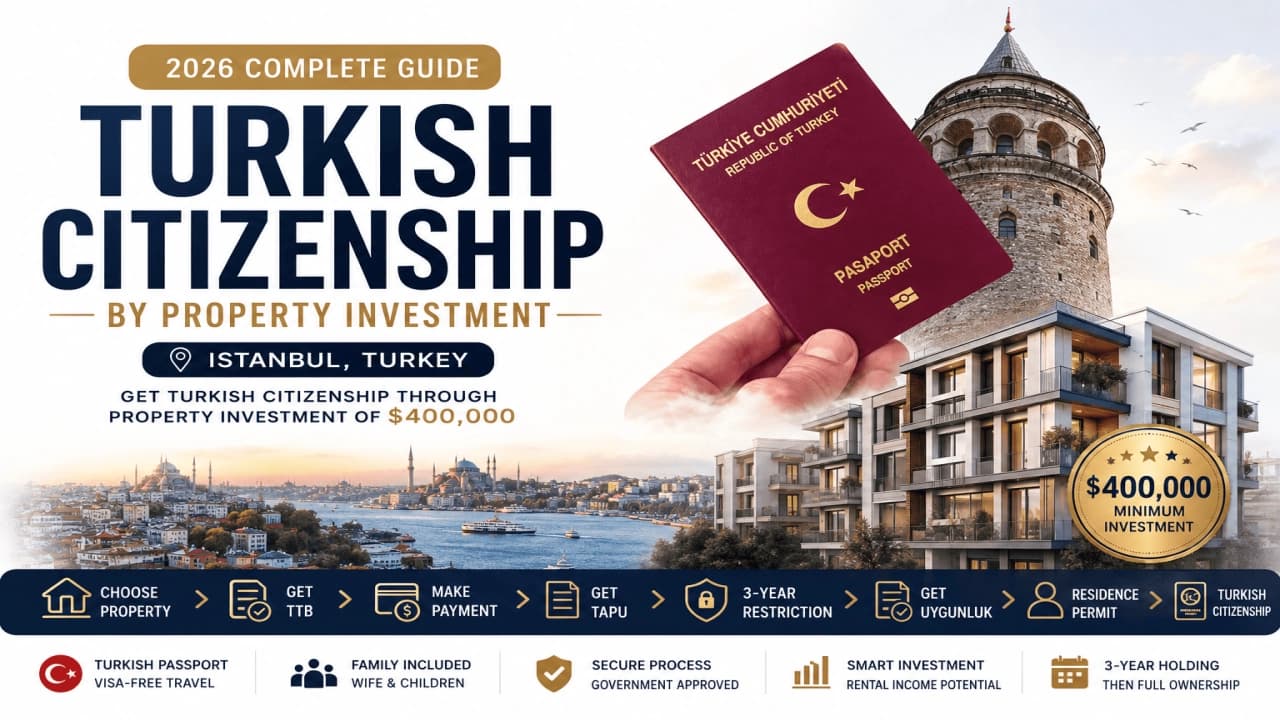
Under the current 2026 framework, a foreign investor may qualify through the purchase of eligible real estate worth at least:
USD 400,000 or the equivalent in foreign currency
provided that the required restriction preventing disposal of the property for at least three years is registered in the title deed records.
At first glance, this can sound simple:
Buy a $400,000 apartment → receive Turkish citizenship.
In practice, the process is more technical.
A property advertised at $400,000 is not automatically a citizenship-eligible property.
The transaction must satisfy several different requirements involving:
- Property eligibility
- Investment amount
- Title deed structure
- Payment records
- Bank transfers
- Foreign-exchange documentation
- Investment-value verification
- Three-year restriction
- Compliance with current TKGM rules
- Citizenship application procedures
This is why foreign investors should evaluate a citizenship purchase differently from an ordinary property investment.
The correct objective is not simply to find:
A $400,000 apartment in Istanbul
but rather:
A legally eligible property that satisfies the citizenship rules while also making sense as a real estate investment.
This guide explains how to approach that decision.
What Is Turkish Citizenship by Property Investment?
Turkish Citizenship by Investment is an exceptional citizenship route available to qualifying foreign investors who meet one of several investment criteria.
Real estate is one of those routes.
The current official framework allows a foreign investor to qualify by acquiring eligible real estate worth at least USD 400,000 or equivalent foreign currency, with a restriction entered in the Land Registry preventing resale for at least three years.
Other investment routes exist, such as:
- Bank deposits
- Fixed capital investment
- Government debt instruments
- Investment funds
- Employment creation
but those operate under different thresholds and rules.
For property buyers, the real-estate route is especially attractive because the investor receives a tangible asset in addition to pursuing citizenship.
That property may potentially provide:
- Rental income
- Capital appreciation
- Personal use
- Portfolio diversification
- Resale value after the restriction period
However, the quality of the citizenship application and the quality of the property investment should be evaluated separately.
Citizenship Eligibility Does Not Automatically Mean Good Investment
A property can technically satisfy citizenship requirements and still be a poor investment.
For example, an apartment may:
- Be overpriced
- Have weak rental demand
- Carry excessive aidat
- Be difficult to resell
- Be located in an oversupplied project
- Have poor layout
- Have weak construction quality
The fact that it may qualify for citizenship does not automatically make it good real estate.
This creates two separate questions.
Question 1 — Is the Property Citizenship Eligible?
This concerns:
- Legal eligibility
- Investment amount
- Transaction structure
- Payment records
- Title deed restriction
Question 2 — Is the Property a Good Investment?
This concerns:
- Purchase price
- Location
- Rental demand
- Building quality
- Resale liquidity
- Operating costs
A successful citizenship investor should answer yes to both.
The $400,000 Minimum Investment Requirement
The central threshold is currently:
At least USD 400,000 or equivalent foreign currency in qualifying real estate.
The official Invest in Türkiye guidance confirms this threshold, together with the required three-year resale restriction.
However, the $400,000 requirement should not be interpreted merely as an asking price.
Current TKGM rules require the citizenship investment amount to be verified through the applicable Taşınmaz Edinim Sureti ile Vatandaşlık Kazanımına Esas Tutar Tespit Belgesi, commonly referred to as TTB.
Under the current framework, the relevant amounts include both:
- The amount declared in the official sale deed or qualifying sale-promise agreement
- The amount reflected through payment transfers
and these amounts must separately satisfy the applicable USD 400,000 threshold for post-September 2018 transactions, subject to the current rules.
This is one of the most important rules for buyers to understand.
Advertised Price vs Citizenship Investment Value
Suppose a developer advertises:
Apartment Price: $420,000
This does not automatically mean that the transaction will satisfy the citizenship investment requirement.
The relevant amount must be supported through the official citizenship property process.
The investor therefore needs to verify:
- Official transaction price
- Payment documentation
- TTB result
- Bank records
- Title deed procedure
before assuming eligibility.
A useful principle is:
Marketing Price ≠ Verified Citizenship Investment Amount
Why Buying Exactly at $400,000 Can Be Risky
Foreign buyers sometimes search specifically for a property priced at:
$400,000 exactly
This can create unnecessary risk.
If the investor has no financial margin, any issue affecting the recognized investment amount can complicate the application.
For example, a buyer should not assume that an asking price of $400,000 automatically means the official citizenship amount will also be recognized at exactly $400,000.
The safer investment strategy is to evaluate the transaction through the official process before completion and avoid relying purely on advertising.
$400,000 Is Not the Total Cash Budget
Another major mistake is assuming:
Citizenship budget = $400,000 total
The $400,000 figure refers to the qualifying real-estate investment threshold.
Additional acquisition costs can still apply.
Depending on the transaction, these may include:
- Title deed fees
- Land Registry service charges
- Lawyer
- Translation
- Notary
- Banking expenses
- Currency conversion
- DASK
- Furniture
- VAT where applicable
- Property management
Therefore:
$400,000 Citizenship Threshold ≠ $400,000 Total Purchase Budget
A buyer should maintain a separate reserve for transaction and setup expenses.
The Three-Year No-Sale Requirement
Another core requirement is the three-year restriction.
The foreign investor must commit not to sell the qualifying property for at least:
Three years
and the appropriate restriction is entered in the Land Registry records.
This requirement has important investment consequences.
A citizenship investor is not investing with full short-term liquidity.
You Cannot Treat the Property as a Short-Term Flip
Suppose an investor purchases a qualifying apartment and receives an attractive resale offer after 18 months.
The citizenship structure means the property cannot simply be treated like a normal unrestricted speculative asset if the investor wants to preserve compliance with the citizenship commitment.
TKGM explains that after the three-year period expires, the restriction can be removed through the Land Registry. It also states that if removal is requested before the three-year period ends, the relevant citizenship and migration authorities are notified in connection with potential cancellation consequences.
Therefore, citizenship property should generally be evaluated with at least a medium-term holding strategy.
What Happens After the Three Years?
Once the required three-year period is completed, the restriction can be removed through the applicable Land Registry procedure.
The investor may then decide whether to:
- Continue holding
- Rent
- Sell
- Reinvest
This is why the resale quality of the apartment should be considered before purchase, not three years later.
The Best Citizenship Property Should Still Be Attractive After Three Years
A common investment mistake is buying solely for eligibility.
Imagine two properties.
Property A
- Price: $410,000
- Strong Istanbul district
- Metro access
- Good layout
- Broad local buyer market
- Strong rental demand
Property B
- Price: $405,000
- Weak micro-location
- High aidat
- Oversupplied project
- Mostly marketed to citizenship buyers
Both may appear similar from a citizenship perspective.
But after the three-year restriction period ends, Property A may have a much stronger resale market.
This creates an important rule:
Buy the apartment you would still want to own even if citizenship were not part of the transaction.
What Types of Property Can Be Used?
Current TKGM guidance places specific conditions on the nature of property that can be used.
For a completed purchase transaction with the citizenship restriction, the property must fall within the applicable categories, such as property with:
- Kat Mülkiyeti — condominium ownership
- Kat İrtifakı — construction servitude
or, under the applicable purchase rules, qualifying land with an existing building.
For notarized sale-promise transactions, current TKGM guidance requires the relevant property to have:
- Kat Mülkiyeti
or:
- Kat İrtifakı.
This is important for off-plan buyers.
Ready Apartment vs Off-Plan Property for Citizenship
Foreign investors can approach citizenship through different property structures.
Ready Property
A completed property may offer:
- Existing title deed
- Immediate physical inspection
- Existing rental market
- Easier assessment of the neighborhood
Off-Plan / Under-Construction Property
Certain qualifying projects may be structured through a notarized sale-promise agreement, subject to the applicable rules.
The property status and contract structure become critical.
A simple:
Reservation Form
or:
Developer Booking Agreement
should not automatically be assumed to satisfy citizenship rules.
The transaction must fit the legally recognized framework.
Sale Promise Is Not the Same as a Reservation
This distinction is extremely important.
A developer may ask a buyer to sign:
- Reservation agreement
- Booking form
- Preliminary offer
These commercial documents may help reserve a unit.
But they should not be confused with the legally structured notarized real-estate sale-promise agreement used where the citizenship rules permit that route.
For citizenship investment, the legal form matters.
Can You Buy More Than One Property?
Yes.
TKGM states that there is no general limit on the number of properties that can be acquired for the qualifying investment, provided the applicable required value is satisfied.
For example, an investor might potentially use:
- Apartment A: $250,000
- Apartment B: $175,000
Total:
$425,000
subject to the complete rules governing the specific transaction.
This can create useful portfolio flexibility.
One Property vs Multiple Properties
The decision should be based on investment strategy rather than citizenship alone.
One Higher-Value Property
Potential advantages:
- Simpler management
- One transaction
- Easier rental administration
- Premium location possible
Potential disadvantages:
- Concentrated risk
- Smaller tenant pool if luxury
- High aidat possible
Multiple Properties
Potential advantages:
- Diversification
- Different tenant profiles
- Potentially broader resale options
Potential disadvantages:
- Multiple transaction costs
- More management
- More due diligence
Neither strategy is automatically superior.
Special Rule for Sale-Promise Transactions
The rules are more restrictive when the investment is based on a sale-promise contract rather than completed title transfer.
TKGM currently states that the qualifying amount must be satisfied through one sale-promise agreement.
Several properties may be included within that single agreement, but separate sale-promise agreements cannot simply be aggregated to satisfy the threshold.
This is an important distinction for off-plan buyers.
You Cannot Always Mix Purchase and Sale-Promise Amounts
TKGM also states that where already purchased properties fail to reach the required citizenship amount, the missing balance cannot simply be completed using a separate sale-promise agreement under that mechanism.
For investors, this reinforces a broader rule:
Structure the citizenship transaction correctly from the beginning.
Do not assume multiple unrelated transaction types can always be combined later.
The Importance of TTB in 2026
The current citizenship property framework introduced an important verification document:
Taşınmaz Edinim Sureti ile Vatandaşlık Kazanımına Esas Tutar Tespit Belgesi — TTB
TKGM's 2024/4 Circular states that citizenship-related real-estate investment values are verified through the TTB framework.
This replaced the older tendency to think only in terms of a normal market valuation report.
For citizenship transactions, buyers should understand that the amount required for the citizenship investment is subject to specific official verification.
TTB Is Not Just the Developer's Price List
A developer brochure might say:
Citizenship Eligible — $450,000
The TTB process is independent of that advertising claim.
The citizenship value must be handled through the official system.
TKGM explains that post-December 9, 2024 TTB documents are produced after system-based evaluation and comparison and are then used directly according to the value stated in the document.
The practical lesson is simple:
Do not rely on the brochure. Rely on the official transaction process.
Payment Records Matter
Citizenship property transactions require documented payment trails.
TKGM's current purchase-document guidance lists items including:
- Foreign Exchange Purchase Certificate (Döviz Alım Belgesi)
- Bank-approved payment receipt for citizenship transactions.
This means the investor should avoid informal or undocumented payment arrangements.
Every payment should be structured so that it can be properly traced and supported.
Installment Payments Can Be Possible
TKGM states that separate Foreign Exchange Purchase Certificates can be issued for individual installment payments under the relevant framework.
This can make installment-based developer transactions possible from a documentation perspective, provided the overall transaction complies with the citizenship rules.
However:
Installment Plan ≠ Automatic Citizenship Eligibility
The legal property structure, payments, contract, and investment-value verification must still comply.
Why Bank Transfers Are So Important
A buyer may think the only important fact is:
“I paid the developer $400,000.”
But the citizenship process needs verifiable evidence.
This is why buyers should preserve:
- Bank receipts
- Payment references
- Currency conversion documentation
- Seller information
- Contract information
The payment chain should match the legal transaction.
Citizenship Property Is Different From an Ordinary Property Purchase
An ordinary foreign buyer may focus primarily on:
- Title deed
- Price
- Legal ownership
A citizenship investor has an additional compliance layer.
The transaction must support:
Ownership + Investment Verification + Citizenship Eligibility
That is why a property suitable for an ordinary foreign buyer may not necessarily be suitable for a citizenship application.
Not Every Seller Structure Is Automatically Acceptable
Current TKGM rules also contain restrictions relating to the parties involved in citizenship transactions.
For example, TKGM states that property used in a citizenship sale or sale-promise transaction must not be registered to a company in which the applicant or certain first-degree relatives are partners or managers, subject to the detailed rules.
This demonstrates why due diligence must include:
Who is selling the property?
not only:
What property is being sold?
Can Every Foreigner Buy Property for Citizenship?
Foreign property ownership in Türkiye remains subject to the general legal rules governing foreign acquisition.
Nüfus ve Vatandaşlık İşleri notes that Türkiye allows citizens of a large number of countries to acquire property without a reciprocity requirement, while specific nationality-related restrictions can still exist.
Therefore, nationality should be verified early in the purchasing process rather than after the investor pays a reservation deposit.
Does Buying the Property Automatically Grant Citizenship?
No.
This is another important misconception.
Meeting the property-investment requirement allows the investor to proceed through the exceptional citizenship process.
It does not mean that the investor automatically becomes a Turkish citizen at the moment the title deed is issued.
The official process includes:
- Meeting the qualifying investment requirement
- Obtaining the applicable Uygunluk Belgesi
- Obtaining the relevant investment residence permit
- Submitting the citizenship application
- Government evaluation and final decision.
Nüfus ve Vatandaşlık İşleri confirms that the final citizenship decision is subject to official evaluation and ultimately presidential approval.
Therefore:
Qualifying Investment = Eligibility to Proceed
not:
Automatic Citizenship
What Is the Uygunluk Belgesi?
The Uygunluk Belgesi, or Certificate of Conformity, confirms that the relevant qualifying investment condition has been satisfied for the citizenship process.
Nüfus ve Vatandaşlık İşleri describes it as the document issued by the relevant authority to confirm that the minimum investment requirement under the citizenship regulation has been met.
For real-estate investments, the relevant property transaction is handled through the Land Registry / Ministry framework.
What Happens After the Property Transaction?
TKGM explains that after the three-year no-sale commitment is taken, the Land Registry communicates the transaction information to the authority responsible for issuing the conformity document.
Once the Uygunluk Belgesi is issued, the process continues through:
- Migration authority for the citizenship-related residence permit
- Provincial Population and Citizenship Directorate for the citizenship application.
This means the property purchase is only one stage of a wider procedure.
Why Istanbul Is Popular for Citizenship Property Investment
Istanbul is particularly attractive for citizenship-focused buyers because it offers a much larger and more diverse real estate market than most Turkish cities.
Investors can choose among:
- Central apartments
- Luxury residences
- Family developments
- Metro-connected apartments
- New-build projects
- Urban transformation developments
- Asian-side investment apartments
- European-side business-district properties
This diversity allows investors to build a strategy around both:
Citizenship Eligibility
and:
Long-Term Property Performance
The Best Citizenship Property Is Not Necessarily Luxury
A foreign buyer with a $400,000+ budget may assume that the safest strategy is to purchase one luxury apartment.
That is not always true.
A premium apartment can provide:
- Strong prestige
- High-quality building
- Desirable location
but it can also carry:
- High aidat
- Narrower tenant pool
- Higher entry price per square meter
- Slower resale
A well-located mid-market apartment or multiple apartments can sometimes offer stronger investment characteristics.
The correct decision depends on:
- Tenant market
- District
- Property type
- Resale demand
- Total cost
Do Not Buy a Citizenship-Only Project Without Investment Analysis
Some developments are marketed almost entirely toward foreign citizenship buyers.
That can create potential risks.
If the project's sales market depends heavily on one international investor segment, future resale demand may be narrower than expected.
Before buying, ask:
Who will buy this apartment from me after the three-year restriction ends?
Potential future buyers should include more than the next citizenship applicant.
Ideally, the property should appeal to:
- Local buyers
- International buyers
- Tenants
- Families
- Professionals
depending on the property type.
Citizenship Property Should Have a Real Tenant Market
For investors planning to rent the apartment during the holding period, rental fundamentals matter.
Evaluate:
- Metro access
- Employment centers
- Schools
- Hospitals
- Shopping
- Apartment layout
- Furnishing requirements
- Aidat
A citizenship apartment should not sit empty simply because it satisfied the legal threshold.
Citizenship Property Should Have a Real Resale Market
Three years can pass quickly.
When the restriction ends, the investor may want flexibility.
The apartment should ideally remain attractive based on:
- Location
- Building quality
- Price
- Rental performance
- Market demand
rather than citizenship eligibility alone.
How to Think About Your $400,000+ Budget
A strong investor should divide the decision into four layers.
Layer 1 — Citizenship Compliance
Can the property legally support the citizenship application?
Layer 2 — Property Quality
Is the apartment actually desirable?
Layer 3 — Investment Performance
Can it generate rent and retain resale demand?
Layer 4 — Total Cost
Can the investor comfortably cover all acquisition and ownership expenses?
Only after all four layers are satisfactory should the investor proceed.
Citizenship Investment Example
Consider a hypothetical investor with:
Total capital: $450,000
Instead of automatically choosing the first apartment advertised at $400,000, the investor might structure the budget as:
Property Investment: $415,000
Transaction / Legal / Banking Reserve: $15,000
Furniture / Setup Reserve: $10,000
Initial Ownership Reserve: $10,000
This is not a fixed cost recommendation.
It simply demonstrates a more responsible budgeting approach.
The investor maintains a margin rather than committing 100% of available capital to the advertised purchase price.
What Should You Verify Before Paying a Reservation Deposit?
Before transferring even a small deposit for a citizenship property, confirm:
The Property
- Property type
- Title status
- Citizenship eligibility structure
- Developer / seller
The Investment
- Purchase price
- How the investment value will be verified
- Payment schedule
- Currency
The Contract
- Refund conditions
- Delivery terms
- Citizenship-related representations
The Process
- TTB requirements
- Title restriction
- Bank payment structure
- Uygunluk Belgesi process
A reservation deposit should not be used as a substitute for due diligence.
Common Citizenship Marketing Claims to Treat Carefully
“Guaranteed Citizenship”
The investment can qualify an applicant to proceed through the citizenship process, but official citizenship is subject to government evaluation and final decision.
“Any $400K Property Qualifies”
Incorrect.
The legal transaction and current TKGM conditions matter.
“No Need for Official Value Verification”
Current citizenship real-estate transactions use the TTB investment-value verification framework.
“You Can Sell Anytime”
The qualifying property carries a three-year no-sale commitment.
“Reservation Agreement Is Enough”
A normal reservation agreement should not be confused with a qualifying notarized sale-promise structure.
A Better Citizenship Property Investment Formula
Instead of:
$400,000 Property = Citizenship
use:
Eligible Property + Verified Investment Amount + Correct Payment Trail + Title Restriction + Conformity Approval + Citizenship Application
From the investment perspective, add:
Strong Location + Good Building + Rental Demand + Resale Liquidity
The complete formula becomes:
Citizenship Compliance + Investment Quality = Better Citizenship Property Strategy
Key Takeaways
Türkiye's current real-estate citizenship route allows qualifying foreign investors to proceed through the exceptional citizenship process by acquiring eligible property worth at least USD 400,000 or equivalent foreign currency, with a Land Registry restriction preventing resale for at least three years.
But the $400,000 figure should never be interpreted as simply an advertised property price.
Current TKGM procedures use the TTB framework to verify the citizenship investment amount, and the applicable official sale or sale-promise amounts and documented payments must satisfy the required threshold under the current rules.
Buyers should also understand that:
- One or more properties may potentially be used in a qualifying purchase structure.
- Sale-promise transactions have specific rules, including the requirement to satisfy the qualifying amount through one sale-promise agreement.
- The nature and title status of the property matter.
- Bank payment evidence and foreign-exchange documentation form part of the citizenship property process.
- The three-year restriction limits short-term resale flexibility.
- Completing the property investment does not itself mean citizenship has automatically been granted; the investor must continue through conformity, residence, citizenship application, and official approval.
The most important investment principle is therefore:
Do not choose an apartment because it is advertised as citizenship eligible. Choose it because both the legal transaction and the property itself are strong.
A successful citizenship-focused purchase should ideally satisfy:
Legal Eligibility + Verified Investment Amount + Correct Payment Structure + Strong Location + Rental Demand + Resale Potential
This allows the investor to pursue Turkish citizenship while still acquiring a property that can make sense as a long-term real estate asset.
Step-by-Step Citizenship Property Purchase Process
A Turkish citizenship property purchase should be structured correctly before money is transferred, not repaired after the transaction is completed.
The process is more demanding than an ordinary foreign property purchase because the investor must satisfy two objectives at the same time:
Acquire the property legally
and:
Create a transaction that satisfies the citizenship investment rules
Under the current framework, the real-estate route requires qualifying property investment of at least USD 400,000 or equivalent foreign currency, together with a three-year restriction on resale.
A practical transaction flow can therefore be organized as:
Property Selection → Citizenship Eligibility Check → Legal Due Diligence → Seller Review → TTB Process → Payment Structure → Döviz Alım Belgesi → Tapu / Sale Promise → Three-Year Restriction → Uygunluk Belgesi → Investment Residence Permit → Citizenship Application
Each stage matters.
Skipping one can create problems even when the apartment itself appears suitable.
Step 1 — Select the Property Based on Investment Quality
Before analyzing citizenship eligibility, determine whether the property deserves to be purchased at all.
Evaluate:
- District
- Micro-location
- Metro access
- Building quality
- Apartment layout
- Rental demand
- Aidat
- Resale potential
- Earthquake-conscious due diligence
- Purchase price compared with similar apartments
Do not allow the citizenship objective to lower ordinary investment standards.
The apartment should ideally still make sense if the citizenship program did not exist.
A useful rule is:
First identify a good property. Then verify whether it can be structured correctly for citizenship.
Step 2 — Check Whether the Property Type Is Eligible
Not every real estate asset can automatically be used in the same way for citizenship purposes.
Under current TKGM guidance, a property acquired through a completed purchase for citizenship must generally fall into one of the relevant categories:
- Property with Kat Mülkiyeti
- Property with Kat İrtifakı
- Land classified as arsa where there is an existing building on it
For a citizenship transaction based on a notarized real-estate sale-promise agreement, the property must have either:
- Kat Mülkiyeti
- Kat İrtifakı.
This distinction is particularly important for off-plan purchases.
Kat Mülkiyeti vs Kat İrtifakı
Foreign buyers frequently encounter these terms.
Kat Mülkiyeti
This generally refers to condominium ownership established for an independent section of a completed building.
For example:
Apartment No. 24 in Building A
may have its own condominium title.
Kat İrtifakı
This is construction servitude established for independent units within a project and is commonly encountered in properties that are still under construction or have not yet transitioned to full condominium ownership.
Both can be relevant to citizenship transactions under the current rules, depending on transaction structure.
Step 3 — Verify the Seller
Citizenship due diligence should investigate not only the apartment but also:
Who legally owns and sells it?
Current TKGM guidance contains specific restrictions relating to the seller and companies connected to the citizenship applicant.
For example, the property used in the citizenship transaction cannot be registered to a company in which the applicant or certain first-degree relatives are partners or managers under the circumstances addressed by the citizenship rules.
This means a citizenship transaction should not be treated as a simple transfer between related entities without examining the applicable restrictions.
Developer Sales Require Seller Due Diligence Too
If purchasing from a developer, verify:
- Legal company name
- Company registration details
- Whether the company owns the property
- Whether another entity owns the land or unit
- Who is authorized to sign
- Whether the contract seller matches the title owner
Marketing brand and legal seller may not always be identical.
For example:
Marketing Brand: Istanbul Prime Residences
may be different from:
Legal Seller: XYZ İnşaat Sanayi ve Ticaret A.Ş.
The legal entity matters.
Step 4 — Review the Tapu Before Paying the Full Purchase Price
The title deed should be reviewed before the buyer commits the main investment amount.
Important information can include:
- Owner
- Province
- District
- Neighborhood
- Block
- Parcel
- Independent unit
- Property type
- Ownership structure
For citizenship purchases, title status must also correspond with the legal structure being used.
TKGM lists the title deed or title information among the documents required for foreign purchase applications.
Check Mortgages, Liens and Restrictions
A buyer should not assume that a clean-looking apartment has a clean title.
The Land Registry can contain legal restrictions or encumbrances such as:
- Mortgage
- Attachment
- Annotation
- Other registered rights or limitations
For example, TKGM's current systems handle mortgage registration and mortgage cancellation electronically through the Land Registry framework.
For citizenship investors, legal counsel should review title restrictions before the transaction.
The key question is:
What exactly will remain on the title after I become the owner?
A Mortgage Is Not Automatically the Same as an Invalid Property
Some developer properties may be subject to financing-related mortgages during construction.
The existence of a mortgage does not automatically mean the property cannot be purchased.
But the buyer should understand:
- Amount
- Beneficiary
- Release procedure
- Timing of cancellation
- Whether transfer can occur cleanly
Never rely solely on:
“The developer will remove it later.”
The release mechanism should be legally clear.
Step 5 — Check the Official Purchase Value
This is where citizenship transactions differ significantly from normal purchases.
A developer may advertise:
Citizenship Eligible: $450,000
But citizenship eligibility does not rely only on advertising.
Under TKGM's current 2024/4 Circular, citizenship-related property investments are verified through the:
Taşınmaz Edinim Sureti ile Vatandaşlık Kazanımına Esas Tutar Tespit Belgesi — TTB.
The investor should understand this before final payment.
What Is TTB?
TTB is the current investment-amount verification document used in real-estate citizenship transactions.
TKGM's 2024/4 Circular states that citizenship-related property transactions are confirmed through this framework.
In practical terms, it answers one of the most important citizenship questions:
Does the transaction satisfy the required investment amount under the official citizenship framework?
Which Amounts Must Reach the Required Threshold?
This is a critical rule.
TKGM states that the values used for investment-amount determination must meet the applicable threshold, including the relevant:
- Official sale value stated in the deed, or sale-promise value
- Payment / transfer totals
and those amounts must be confirmed through the TTB process.
For post-September 18, 2018 purchases, the relevant citizenship threshold is currently USD 400,000.
This means:
One strong value cannot necessarily compensate for another deficient value.
Example: Why the Official Amount Matters
Suppose:
Developer Price: $430,000
but the official transaction documentation shows:
$390,000
That can create a citizenship problem because the amount required under the official process must independently satisfy the relevant threshold.
Likewise, claiming a $430,000 official value while only documenting $380,000 of payment would create a different problem.
The citizenship file should therefore be structured so that:
Contract / Official Sale Amount
and:
Documented Payments
both support the qualifying investment.
Do Not Artificially Inflate the Transaction Price
A property should not simply be declared at a higher number to manufacture citizenship eligibility.
The TTB framework is specifically designed to verify the investment amount through the official system.
A buyer should therefore avoid any strategy based on:
- Artificial price declarations
- Unrecorded side payments
- Cash without supporting evidence
- Inflated developer invoices
Citizenship transactions require a coherent financial trail.
Step 6 — Structure the Payment Correctly
Payment documentation is central to citizenship eligibility.
TKGM's current purchase guidance specifically requires a bank-approved payment receipt for Turkish citizenship property transactions.
This means an investor should maintain a clear payment trail from buyer to seller.
Avoid Informal Cash Payments
For an ordinary private transaction, parties may sometimes discuss cash.
For a citizenship investment, that is particularly problematic because the applicant needs documented payments that support the required investment.
A clean citizenship payment file should clearly show:
- Payer
- Recipient
- Amount
- Currency
- Transaction date
- Relevant property or contract reference where appropriate
The goal is traceability.
Payment Recipient Should Match the Transaction Structure
Suppose the legal seller is:
ABC İnşaat A.Ş.
but the buyer is instructed to transfer funds to:
XYZ Marketing Ltd.
That discrepancy requires explanation before payment.
The investor should verify:
- Why the third party is receiving funds
- Whether the structure is recognized for the transaction
- Whether payment can be properly documented for citizenship purposes
Do not assume that any payment associated with the project automatically counts.
Step 7 — Obtain the Döviz Alım Belgesi
Foreign buyers must also understand the Döviz Alım Belgesi, often abbreviated as DAB.
Under TKGM's foreign-buyer foreign-exchange framework, foreign currency used for the property transaction is sold through a Turkish bank into the Central Bank system, and the bank issues the Döviz Alım Belgesi for the Land Registry transaction.
TKGM lists this document among the required foreign-purchase documents.
What Does the Döviz Alım Belgesi Do?
The DAB provides an official banking record related to the foreign-currency conversion used in the property acquisition process.
For buyers, this means:
Do not independently convert all funds without first understanding the required banking structure.
The timing and documentation of currency conversion should be coordinated before the Tapu transaction.
The Bank Sends DAB Information Electronically
TKGM's current guidance notes that the Döviz Alım Belgesi is transmitted by the bank through the relevant electronic system for the Land Registry procedure.
The investor should still keep copies of all financial documents in the transaction file.
Step 8 — Coordinate DAB, Payment Receipts and TTB
These documents should not be treated as unrelated paperwork.
They form part of the same citizenship investment trail.
A well-organized transaction should align:
Contract / Official Sale Value
Bank Transfers
Döviz Alım Belgesi
TTB Investment Verification
When figures, parties, or documentation contradict each other, problems become much more likely.
Installment Payments
Some citizenship investors buy new developments through installment plans.
This can be possible, but payment documentation must still satisfy the applicable rules.
TKGM's citizenship guidance allows separate foreign-exchange purchase documentation to be produced in connection with separate installment payments under the relevant framework.
However:
Being allowed to pay in installments does not mean citizenship eligibility is automatic before the qualifying investment conditions are met.
The complete structure should be checked before committing to the plan.
Example: Installment Citizenship Purchase
Suppose an apartment costs:
$450,000
with:
- $200,000 initial payment
- $100,000 second payment
- $100,000 third payment
- $50,000 final payment
The investor needs to consider:
- When the qualifying amount is recognized
- How each transfer is documented
- How the DAB documentation is structured
- When the title or sale-promise restriction is registered
- When the Uygunluk Belgesi process can begin
A developer saying:
“You can apply after the first installment.”
should not be accepted without verifying that the current legal requirements are actually satisfied.
Step 9 — Complete the Tapu Transaction
For a ready property purchased through completed title transfer, the ownership transfer is carried out through the Land Registry.
TKGM's foreign purchase checklist currently includes documents such as:
- Tapu information
- Passport / nationality document
- Citizenship valuation documentation
- Municipal tax value
- DASK for qualifying buildings
- Identity declaration and photograph
- Foreign identification or tax-related information where applicable
- Döviz Alım Belgesi
- Bank-approved payment receipt for citizenship transactions
- Sworn translator where required
- Representation document if acting through an authorized representative.
The exact file depends on the buyer and transaction.
Sworn Translator
If a party does not understand Turkish, TKGM requires an authorized sworn translator for the Land Registry procedure.
This is important because the buyer is signing legally binding declarations, including citizenship-related commitments.
Do not rely on the property salesperson to translate the transaction informally.
Step 10 — Register the Three-Year Restriction
The three-year no-sale commitment is not merely a private promise between buyer and seller.
It is entered into the Land Registry records as part of the citizenship transaction.
The current official citizenship framework requires a restriction preventing resale for at least three years.
This is one of the defining features of the program.
What Does the Three-Year Restriction Mean for the Investor?
It means that the buyer should plan for a minimum holding period.
During that period, the property should ideally remain useful as:
- Rental investment
- Residence
- Family property
- Long-term asset
The investor should not purchase on the assumption of an immediate exit.
Can the Three-Year Restriction Be Removed Early?
TKGM guidance warns that requesting removal of the citizenship-related restriction before the required period expires can trigger notification to the relevant citizenship and migration authorities in connection with citizenship consequences.
Therefore, buyers should treat the three-year commitment seriously.
Step 11 — Obtain the Uygunluk Belgesi
After the qualifying property process is completed, the next major document is the:
Uygunluk Belgesi — Certificate of Conformity
Nüfus ve Vatandaşlık İşleri defines this as the document issued by the relevant authority confirming that the minimum investment requirement under the citizenship regulation has been satisfied.
For property investment, the relevant conformity process is handled through the Ministry / TKGM framework.
What Does Uygunluk Belgesi Confirm?
It confirms that the qualifying investment condition has been met for the purpose of proceeding with the citizenship process.
It should not be confused with:
- Title deed
- TTB
- Residence permit
- Citizenship approval
Each document serves a different role.
TTB vs Uygunluk Belgesi
This distinction is important.
TTB
Verifies the relevant citizenship real-estate investment amount within the property transaction framework.
Uygunluk Belgesi
Confirms that the applicable qualifying investment requirement has been satisfied so the investor can proceed through the citizenship route.
They are not interchangeable.
Step 12 — Apply for the Investment Residence Permit
After obtaining the conformity document, the investor proceeds to the relevant residence-permit stage.
Nüfus ve Vatandaşlık İşleri states that investment applicants proceed under Article 31/1(j) of Law No. 6458 for a short-term residence permit before submitting the citizenship application.
Invest in Türkiye likewise identifies qualifying real-estate acquisition of at least USD 400,000 with the required three-year restriction as one of the investment bases for the relevant residence-permit route.
Residence Permit and Citizenship Are Separate Steps
A common misconception is:
“Once the property is purchased, I go directly to the passport stage.”
The official sequence is more structured:
- Qualifying investment
- Uygunluk Belgesi
- Investment-related residence permit
- Citizenship application.
This should be reflected in the investor's timeline.
Step 13 — Submit the Citizenship Application
After the conformity and residence stages, the applicant submits the exceptional citizenship application through the relevant Nüfus ve Vatandaşlık process.
NVI states that the application is made to the relevant Provincial Population and Citizenship Directorate, with special common offices also available in Istanbul and Ankara for the investment process.
Citizenship Is Still Subject to Government Review
The property transaction creates eligibility to proceed through the exceptional investment route.
It does not create an unconditional right to citizenship.
The citizenship application remains subject to official review and final government decision.
This distinction should appear clearly in any responsible property marketing.
Avoid language such as:
Guaranteed Passport
A more accurate description is:
Property structured to satisfy the real-estate investment requirement for the citizenship application, subject to official approval.
Can a Lawyer Complete Everything for the Buyer?
A lawyer can play an important role in:
- Property due diligence
- Contract review
- Tapu procedure
- Power of Attorney
- Document coordination
TKGM accepts representation documentation such as a valid Power of Attorney for property procedures where applicable.
However, NVI currently states that certain stages—including the conformity, investment residence-permit and citizenship process—require the foreign applicant's personal application under its stated procedures.
Therefore, buyers should not assume that issuing a Power of Attorney means they will never need to participate personally.
Using a Power of Attorney
A Power of Attorney can still be extremely useful where the investor cannot remain in Türkiye for every property-related procedure.
It may allow an authorized representative to handle specifically granted powers such as:
- Title procedures
- Signing defined documents
- Collecting documents
- Certain transaction steps
But the authority should be carefully drafted.
Do not sign an unnecessarily broad Power of Attorney without understanding its scope.
TKGM also applies specific requirements to powers of attorney issued outside Türkiye.
Off-Plan Property for Citizenship
Off-plan property can be used under the citizenship framework when the transaction is structured correctly.
The relevant route may involve a notarized:
Gayrimenkul Satış Vaadi Sözleşmesi — Real Estate Sale Promise Agreement
rather than immediate completed title transfer.
However, current TKGM rules require the property subject to this structure to have:
- Kat Mülkiyeti
or:
- Kat İrtifakı.
Reservation Agreement vs Sale Promise Agreement
This distinction cannot be overstated.
Reservation Agreement
Usually a commercial document used to:
- Hold the unit
- Confirm initial price
- Collect a deposit
It does not automatically satisfy citizenship requirements.
Notarized Sale Promise Agreement
This is the legally relevant form that may be used for citizenship when the current statutory conditions are met.
Therefore:
Reservation ≠ Citizenship Sale Promise
Never allow a developer to use those terms interchangeably.
Multiple Off-Plan Properties
Current TKGM guidance allows multiple properties to be included in a citizenship sale-promise structure, but the required amount must be satisfied through one sale-promise agreement.
For example:
Property A: $220,000
Property B: $210,000
may potentially be included under one qualifying sale-promise agreement if the complete legal requirements are satisfied.
But:
Sale Promise Agreement A: $220,000
plus:
Separate Sale Promise Agreement B: $210,000
cannot simply be aggregated under the current rule.
Purchase + Sale Promise Cannot Simply Be Combined to Fill the Gap
Another important TKGM rule is that where completed property purchases fall below the required citizenship amount, the remaining shortfall cannot simply be completed with a separate sale-promise agreement.
For example:
Completed Purchase: $300,000
then:
Sale Promise: $120,000
should not automatically be assumed to create a qualifying $420,000 combined structure.
The citizenship investment should be structured correctly before transactions are executed.
Can Multiple Completed Properties Be Combined?
Yes, under the applicable completed-purchase rules, TKGM states that there is no general limit on the number of properties used, provided the required investment totals are satisfied.
The properties may also have been purchased at different times and in different locations, subject to the applicable rules and required threshold.
This provides flexibility for investors who prefer a portfolio strategy.
Shared Ownership Is a Major Problem for New Citizenship Purchases
Current TKGM guidance states that, for acquisitions made after the relevant 2023 rule change, citizenship applications based on a shared-interest property purchase are not accepted under the current framework.
Therefore, buyers should not assume that purchasing:
50% of an $800,000 apartment
automatically creates a $400,000 citizenship investment.
Property ownership structure must be checked before signing.
Property Due Diligence Still Matters for Off-Plan Projects
Even when the citizenship structure is legally possible, an off-plan investor should investigate:
- Land title
- Developer
- Contractor
- Building permit
- Kat İrtifakı
- Project plans
- Construction stage
- Delivery date
- Delay clauses
- Payment schedule
- Refund conditions
Citizenship eligibility should never replace normal off-plan due diligence.
Developer Promises About Citizenship Must Be Written Carefully
Some developers market projects with phrases such as:
Guaranteed Citizenship
or:
Passport Included
These descriptions oversimplify the actual legal process.
The developer can sell property and help structure a qualifying investment.
But the final citizenship decision belongs to the Turkish authorities.
Therefore, contracts should separate:
Developer obligations
from:
Government citizenship decision
Documents Foreign Buyers Should Prepare for the Property Stage
According to current TKGM guidance, foreign property-purchase documentation can include:
- Tapu or property information
- Passport or national identity document
- Translation where required
- Citizenship-related valuation documentation
- Municipal property-tax value
- DASK for qualifying buildings
- Identity Information Declaration Form
- Photograph
- Foreign identification / tax information where applicable
- Döviz Alım Belgesi
- Bank-approved payment receipt for citizenship applications
- Sworn translator where required
- Power of Attorney or representation document where applicable.
The exact documentation should be confirmed for the applicant's specific transaction.
Documents for the Citizenship File
NVI's current citizenship guidance requires identity and civil-status documentation for exceptional citizenship applications.
Depending on the applicant, this can include:
- Passport or equivalent nationality document
- Official documents showing identity information
- Family relationship documents
- Marriage documentation
- Other civil-status records
- Relevant application forms.
Foreign-issued documents may also require the appropriate legalization, certification and Turkish translation depending on their country of origin and document type.
Include Family Documents Early
Applicants planning to include eligible family members should prepare family documents early rather than after the investment transaction.
Typical issues include:
- Marriage certificate
- Birth certificates
- Custody
- Parental consent where relevant
- Name differences between documents
Small inconsistencies can create administrative delays.
Check:
Name spelling
Date of birth
Place of birth
Parent names
across all documents before submission.
A Practical Citizenship Property Transaction Example
Consider an investor buying a ready Istanbul apartment for:
$430,000
A properly structured process might look like:
Stage 1 — Due Diligence
- Property selected
- Seller verified
- Tapu checked
- Citizenship property type verified
- Legal restrictions reviewed
Stage 2 — Investment Verification
- Official sale structure confirmed
- TTB process coordinated
- Required citizenship amount confirmed
Stage 3 — Banking
- Payment instructions verified
- Foreign currency processed through the required banking route
- Döviz Alım Belgesi produced
- Bank payment receipts retained
Stage 4 — Tapu
- Transfer application prepared
- Required documents submitted
- Sworn translator used if necessary
- Citizenship purpose declared
- Three-year resale restriction registered
Stage 5 — Citizenship Process
- Uygunluk Belgesi obtained
- Investment residence permit processed
- Citizenship application submitted
The key is that every stage supports the next one.
What Should Be Completed Before Paying a Large Deposit?
Before paying a substantial deposit, confirm:
Property Eligibility
- Correct title structure
- Seller eligibility
- Citizenship structure possible
Investment Amount
- Price sufficient
- TTB strategy understood
- No dependence on artificial valuation
Payments
- Correct seller account
- Bank transfer route
- DAB requirements
- Payment evidence
Contract
- Unit clearly identified
- Total price
- Payment schedule
- Refund rules
- Delivery terms if off-plan
- Citizenship-related obligations
Exit Risk
- Three-year restriction understood
- Rental strategy considered
- Resale market analyzed
A deposit should come after initial due diligence, not before it.
What Should Be Completed Before the Tapu Appointment?
Before final transfer:
- TTB / value process coordinated
- Required payment amount transferred
- Bank receipts available
- Döviz Alım Belgesi completed
- Tapu information verified
- Seller authority confirmed
- Mortgage / restrictions reviewed
- DASK ready if applicable
- Translator arranged if required
- Citizenship three-year restriction instructions confirmed
This greatly reduces the risk of discovering a major problem at the Land Registry office.
Do Not Let the Sales Team Control the Entire Citizenship File
A project sales office may assist with:
- Apartment selection
- Pricing
- Contract coordination
- Developer documentation
But the investor should maintain independent control over:
- Legal review
- Payment evidence
- Citizenship documentation
- TTB verification
- Title due diligence
The party selling the apartment should not be the only party deciding whether the transaction is safe for the buyer.
The Role of an Independent Lawyer
A lawyer can be particularly useful for reviewing:
- Seller
- Title
- Contract
- Power of Attorney
- Developer obligations
- Property restrictions
- Citizenship-related clauses
The lawyer's role should be independent from the developer wherever possible.
That reduces conflicts of interest.
Common Citizenship Transaction Mistakes
Paying Before Eligibility Is Checked
Do not transfer large amounts before confirming the property structure.
Trusting the Advertising Price
The TTB and official transaction process matter more than the brochure.
Sending Money to the Wrong Entity
Payment recipient should be consistent with the legal transaction.
Using Undocumented Cash
Citizenship investment requires traceable payments.
Converting Currency Without Planning the DAB Process
Coordinate the banking procedure first.
Buying a Shared Property Interest
Current rules restrict the use of newly acquired shared-interest property for the citizenship route.
Using Multiple Sale-Promise Contracts
The qualifying sale-promise amount must currently be satisfied through one contract.
Mixing Purchase and Sale-Promise Transactions to Reach $400,000
The current TKGM guidance does not allow the shortfall from completed purchases simply to be filled using a separate sale-promise agreement.
Treating a Reservation Form as a Citizenship Contract
A commercial reservation is not the same as a qualifying notarized real-estate sale promise.
Forgetting the Three-Year Restriction
Citizenship property is not a short-term flip.
Assuming the Lawyer Can Replace the Applicant Everywhere
Representation can help with property procedures, but NVI still requires personal participation at specified citizenship-related stages.
Citizenship Property Due-Diligence Checklist
Before completing a citizenship-focused property purchase, confirm the following.
Property
Seller
Title
Citizenship Value
Banking
Tapu
Off-Plan
Post-Purchase
Key Takeaways
A Turkish citizenship property purchase should be treated as a structured legal and financial process, not simply as a real estate sale.
The current real-estate route still requires qualifying property investment of at least USD 400,000 or equivalent foreign currency, together with a three-year restriction on resale.
For citizenship property transactions, TKGM's current 2024/4 Circular uses the TTB framework to confirm the investment amount, while the relevant official sale or sale-promise values and payment totals must satisfy the applicable threshold.
Foreign buyers must also comply with the banking and foreign-exchange documentation framework, including the Döviz Alım Belgesi, and citizenship property transactions require bank-approved payment evidence.
The type of property matters.
Completed purchases can use qualifying property under the applicable title rules, while sale-promise transactions require property with Kat Mülkiyeti or Kat İrtifakı.
Multiple completed properties may potentially be combined under the applicable rules, but sale-promise transactions must satisfy the qualifying amount through one agreement; separate sale-promise agreements cannot simply be added together.
After the property stage, the process continues through:
Uygunluk Belgesi → Investment Residence Permit → Citizenship Application.
The most important principle is:
Citizenship eligibility must be designed into the transaction before payment—not assumed after the property has been purchased.
A strong transaction therefore combines:
Eligible Property + Clean Title + Eligible Seller + Verified TTB Amount + Traceable Banking + Correct DAB + Three-Year Restriction + Uygunluk Belgesi + Proper Citizenship Application
Only after these compliance requirements are satisfied should the investor evaluate the second question:
Is this also a good long-term Istanbul property investment?
Best Property Types for Turkish Citizenship Investment
Once the legal structure of the transaction has been confirmed, the next question is not simply:
Which property qualifies for Turkish citizenship?
The more important investment question is:
Which qualifying property should I actually buy?
A citizenship-focused investor normally has at least $400,000 of capital committed to real estate for a minimum three-year holding period under the current framework.
That makes property selection extremely important.
During those three years, the apartment may need to:
- Generate rental income
- Preserve capital
- Remain attractive to future buyers
- Avoid excessive maintenance costs
- Maintain good physical condition
- Compete with new supply
The strongest citizenship investment is therefore not merely a property that passes the legal threshold.
It should also function as a good piece of Istanbul real estate.
1+1 Apartments for Citizenship Investment
A high-quality 1+1 apartment can be particularly attractive for investors focused on rental income and future liquidity.
Potential advantages include:
- Broad professional tenant pool
- Lower furnishing cost
- Easier property management
- Strong demand in business-oriented districts
- Potentially faster resale than very large luxury units
Suitable locations may include areas connected with:
- Business districts
- Metro lines
- Universities
- Hospitals
- Major employment centers
Examples can include selected properties in:
- Kağıthane
- Şişli
- Maslak
- Ataşehir
- Kartal
However, reaching the citizenship threshold through a single 1+1 apartment may require purchasing in a premium project or location.
Investors should therefore check whether the high price reflects real market value rather than simply a citizenship-oriented sales premium.
2+1 Apartments: Often the Balanced Option
For many foreign investors, a well-located 2+1 apartment offers one of the strongest balances between:
- Rental demand
- Family appeal
- Professional tenants
- Resale liquidity
- Property size
A 2+1 can attract a much wider future buyer pool than a highly specialized luxury apartment.
Potential tenants can include:
- Couples
- Small families
- Corporate professionals
- Expat families
- Long-term residents
This makes 2+1 apartments particularly interesting when the investment objective combines citizenship with long-term property ownership.
3+1 and Larger Family Apartments
Larger apartments may work well for investors targeting:
- Families
- Long-term residents
- Higher-income tenants
- Lifestyle buyers
Potential areas include:
- Başakşehir
- Üsküdar
- Bakırköy
- Bostancı
- Selected premium family developments
The advantages include:
- Longer tenant stays
- Larger local buyer market in family-oriented districts
- Strong lifestyle appeal
However, larger apartments may involve:
- Higher furnishing costs
- Higher aidat
- Lower rental yield relative to capital
- Longer resale periods
The property should therefore be selected based on the local family market rather than simply its size.
Luxury Apartments for Citizenship
Luxury property is a common choice among citizenship investors because a single unit can easily exceed the qualifying threshold.
Popular categories include:
- Bosphorus-view apartments
- Branded residences
- High-rise apartments
- Premium penthouses
- Serviced residences
Luxury property can offer:
- Prestigious location
- High building quality
- Premium amenities
- International tenant appeal
But luxury does not automatically mean superior investment performance.
High-end residences can also have:
- Very high aidat
- Expensive furnishing requirements
- Narrower tenant pools
- Slower resale
- High price per square meter
Citizenship investors should therefore separate:
Luxury Value
from:
Investment Value
One $400K+ Property vs Multiple Apartments
One of the most important strategic choices is whether to place the required capital into:
One property
or:
Multiple properties
where the transaction structure satisfies the applicable citizenship rules.
Both strategies can work.
They serve different investment objectives.
Strategy A — One Higher-Value Property
Suppose the investor purchases:
One apartment: $430,000
Potential Advantages
The investor deals with:
- One title
- One tenant
- One building
- One aidat
- One property-management relationship
Administration is simpler.
A single higher-quality apartment may also allow access to:
- Premium districts
- Better buildings
- Stronger locations
Potential Disadvantages
All capital is concentrated in one asset.
If that property has:
- Weak rental demand
- High maintenance
- Building problems
- Poor resale liquidity
the entire citizenship real-estate investment is exposed to the same issue.
Strategy B — Multiple Apartments
Consider:
Apartment A: $230,000
Apartment B: $200,000
Total real estate:
$430,000
where structured in a way permitted under the applicable completed-purchase citizenship rules.
Potential Advantages
Multiple apartments may provide:
- Diversification
- Two rental-income streams
- Different tenant profiles
- Greater future sale flexibility
- Reduced dependence on one building
For example:
Apartment A
could target young professionals.
Apartment B
could target families.
Potential Disadvantages
The investor now manages:
- Multiple title transactions
- Multiple tenants
- Multiple buildings
- Multiple maintenance budgets
- More furnishing
Total transaction and management complexity increases.
Which Strategy Is Better?
The answer depends on the investor.
One Property May Be Better If:
- Simplicity is important
- The investor wants premium property
- Personal use is likely
- Property management should be minimal
Multiple Properties May Be Better If:
- Rental diversification matters
- The investor wants several tenant markets
- Portfolio flexibility is important
- The investor has professional management
Do not choose multiple properties solely because it sounds more diversified.
Two poor apartments are not better than one excellent apartment.
Best Istanbul Strategies for Citizenship Buyers
There is no single “best district for citizenship.”
A better approach is to match the property with the investment objective.
Strategy 1 — Corporate Rental Investment
This strategy targets:
- Executives
- Professionals
- International employees
- Business travelers
Potential areas include:
- Levent
- Maslak
- Şişli
- Kağıthane
- Kozyatağı
The investor should prioritize:
- Metro access
- Modern building
- 1+1 or compact 2+1
- Professional property management
- Reasonable aidat
The objective is:
Citizenship + Rental Income + Professional Tenant Demand
Strategy 2 — Family Rental Investment
Potential areas can include:
- Başakşehir
- Bakırköy
- Üsküdar
- Bostancı
- Maltepe
The investor should prioritize:
- 2+1 or 3+1 layouts
- Schools
- Hospitals
- Parks
- Metro access
- Parking
- Secure compounds
This strategy can suit investors who prefer:
- Longer tenant duration
- Lower tenant turnover
- Strong local resale demand
Strategy 3 — Capital Preservation
Some buyers prioritize protecting their capital rather than maximizing rental yield.
They may prefer established locations with:
- Limited supply
- Strong local demand
- Good transportation
- High-quality buildings
Potential markets might include selected properties in:
- Kadıköy
- Üsküdar
- Şişli
- Bakırköy
- Central premium areas
The investor may accept lower percentage yield in exchange for stronger perceived resale quality.
Strategy 4 — Growth-Oriented Investment
Other citizenship buyers may target developing locations where:
- Infrastructure is improving
- New metro access exists
- Modern residential development is expanding
Potential examples may include selected properties in:
- Kağıthane
- Kartal
- Pendik
- Başakşehir
The objective is:
Citizenship + Rental Income + Potential Long-Term Appreciation
But future growth should never be treated as guaranteed.
Premium vs Mid-Market Citizenship Property
One of the biggest mistakes in citizenship investing is assuming that because the investor must spend at least $400,000, the property should automatically be luxury.
That is not necessarily correct.
Premium Strategy
A premium investment might involve:
- One high-value apartment
- Central district
- Luxury amenities
- Branded development
Potential advantages:
- Prestige
- Building quality
- International appeal
- Personal use
Potential disadvantages:
- Higher aidat
- Lower yield
- Narrower tenant pool
Mid-Market Portfolio Strategy
Instead, the investor might purchase multiple well-located mid-market units where legally structured appropriately.
Potential advantages:
- Broader rental demand
- Diversification
- Potentially better total yield
The most expensive property is not automatically the strongest investment.
New Build vs Resale for Citizenship
Both can be suitable.
The choice should depend on the investor's priorities.
New-Build Citizenship Property
Potential advantages include:
- Modern construction
- Modern apartment layouts
- New amenities
- Easier furnishing
- Developer payment plans
- Potential eligibility for qualifying VAT treatment where all statutory conditions are met
New buildings can also be easier to market to international buyers.
Potential Risks
- Developer premium
- High aidat
- Oversupply
- Citizenship-focused pricing
- Limited building history
New-build investors should compare the project against nearby completed properties.
Resale Citizenship Property
A resale apartment may provide:
- Established market price
- Existing rental history
- Existing building-management history
- Immediate occupancy
- Mature neighborhood
Potential risks include:
- Older construction
- Renovation
- Structural due diligence
- Existing tenant issues
- Seller transaction complexity
For resale purchases, earthquake-conscious building due diligence becomes especially important.
Which Is Better?
A citizenship buyer should not use:
New vs Old
as the primary decision.
A better comparison is:
All-In Cost + Building Quality + Location + Rental Demand + Resale Potential
Ready Property vs Off-Plan Citizenship Investment
The same principle applies to ready and off-plan apartments.
Ready Property
Potential advantages:
- Immediate inspection
- Existing neighborhood
- Immediate rental potential
- Existing title information
- No construction waiting period
A rental investor may begin generating income relatively quickly after setup.
Off-Plan Property
Potential advantages:
- New construction
- Payment plans
- Potentially earlier entry price
- New facilities
But the buyer must consider:
- Delivery risk
- Developer risk
- Construction delays
- No rental income before delivery
- Future aidat uncertainty
- Contract structure
For citizenship purposes, the legal structure of a qualifying sale-promise transaction must also meet the applicable requirements discussed in Part 2.
Citizenship Should Not Make You Ignore Off-Plan Risk
A developer may say:
“You will receive citizenship before the project is completed.”
That statement should not distract the buyer from asking:
- Will the project actually be completed on time?
- Is the developer financially strong?
- What happens if construction is delayed?
- What exactly am I buying?
- What does the contract protect?
Citizenship and property delivery are separate risks.
Rental Strategy During the Three-Year Holding Period
Because the qualifying property is normally subject to a minimum three-year no-sale commitment, many investors choose to rent it during that period.
This can convert a legally restricted holding period into an income-producing period.
A simplified strategy is:
Buy → Complete Citizenship Process → Rent → Hold 3 Years → Review Sell/Hold Decision
Long-Term Rental
For many foreign investors, long-term rental is the simplest strategy.
Potential advantages:
- More predictable occupancy
- Lower turnover
- Lower management intensity
- Easier remote ownership
Suitable properties may include:
- 1+1 professional apartments
- 2+1 family units
- Corporate residences
Short-Term Rental Requires Separate Legal Analysis
Investors should not assume that every Istanbul apartment can automatically be operated as a holiday rental.
Türkiye regulates short-term tourism rentals, and applicable permitting and building requirements should be checked before buying a property specifically for that strategy.
For citizenship investors, the safest approach is:
Do not purchase based on projected Airbnb-style income unless the legal ability to operate that model has been verified for the specific property.
Furnished vs Unfurnished Rental
Furnished
Can be attractive to:
- Expats
- Corporate tenants
- International professionals
But requires greater initial capital.
Unfurnished
May suit:
- Families
- Long-term local tenants
and can reduce:
- Furniture replacement
- Setup costs
The appropriate model depends on the neighborhood.
Citizenship Property and Aidat
Aidat deserves particular attention because many citizenship properties are sold in modern residential developments.
Facilities may include:
- Security
- Pools
- Gyms
- Reception
- Landscaping
- Concierge services
These amenities can improve lifestyle.
But they also cost money.
High Rent Does Not Cancel High Aidat
Consider:
Apartment A
Monthly rent:
$2,000
Monthly aidat:
$400
Apartment B
Monthly rent:
$1,750
Monthly aidat:
$120
Before other expenses:
Apartment A:
$24,000 annual rent − $4,800 aidat = $19,200
Apartment B:
$21,000 annual rent − $1,440 aidat = $19,560
Apartment B produces slightly more income after this single operating cost despite lower rent.
Citizenship investors should therefore calculate:
Net Return
not:
Headline Rent
Hidden Costs Beyond the $400,000 Threshold
The citizenship threshold represents the qualifying property investment.
It does not represent the complete cash requirement.
Potential additional costs can include:
- Title deed fees
- Land Registry service charges
- Lawyer
- Sworn translator
- Notary
- Power of Attorney
- Banking fees
- Currency conversion
- DASK
- Private insurance
- VAT where applicable
- Furniture
- Utility setup
- Property management
This is why an investor with exactly $400,000 total available capital may be underfunded.
Example: $450,000 Total Capital
Suppose the investor has:
$450,000
A responsible approach may be to avoid selecting a property that consumes the full $450,000.
An illustrative structure might be:
| Category | Example Budget |
|---|---|
| Citizenship Property | $415,000 |
| Acquisition / Legal Reserve | $12,000 |
| Furnishing / Setup | $13,000 |
| Ownership / Emergency Reserve | $10,000 |
| Total | $450,000 |
These figures are illustrative rather than statutory fixed costs.
The principle is to maintain liquidity beyond the qualifying investment.
Example: $500,000 Citizenship Investor
With:
$500,000 total capital
the investor could potentially compare:
Option A
One premium apartment:
$455,000
plus reserves.
Option B
Multiple apartments totaling:
$430,000–$450,000
plus setup and ownership reserves, where the citizenship transaction is structured in accordance with the applicable rules.
The investor should compare:
- Total rent
- Total aidat
- Management complexity
- Resale potential
- Diversification
not just acquisition price.
Example: One Luxury Unit vs Two Mid-Market Units
Luxury Strategy
Property:
$450,000
Annual rent:
$24,000
Gross yield:
5.33%
before acquisition and operating costs.
Two-Unit Strategy
Apartment A:
$230,000
Apartment B:
$220,000
Combined:
$450,000
Suppose combined annual rent is:
$29,000
Gross yield:
6.44%
Again, these are hypothetical numbers.
The example demonstrates that portfolio structure can materially affect investment performance.
But the two-property strategy also creates:
- More management
- More furnishing
- More tenant turnover
- Potentially more transaction costs
Yield alone should not determine the decision.
How to Avoid Overpriced Citizenship Projects
This is one of the most important sections of the entire guide.
Citizenship buyers can be vulnerable to inflated pricing because they have a legally defined minimum investment target.
A seller knows the investor needs to cross the qualifying threshold.
That can distort negotiations.
Compare Local Market Price
Before buying, compare the citizenship property with similar apartments based on:
- District
- Building age
- Net area
- Floor
- View
- Amenities
If similar apartments sell for:
$300,000
and the citizenship-marketed apartment costs:
$420,000
the investor needs a clear explanation for the difference.
Compare Price per Square Meter
Suppose:
Citizenship Project
Price:
$420,000
Net area:
85 m²
Effective price:
$4,941/m²
Nearby Comparable
Price:
$330,000
Net area:
90 m²
Effective price:
$3,667/m²
The investor should investigate whether the difference is justified by:
- Better construction
- Superior location
- View
- Amenities
- Brand
If not, the citizenship buyer may be paying a substantial program premium.
Compare Net Area, Not Marketing Area Alone
Developer marketing may emphasize:
Gross Area
while the buyer actually occupies a smaller:
Net Usable Area
When comparing projects, use consistent measurement.
Otherwise, one property can appear cheaper per square meter simply because it uses a larger gross-area definition.
Compare With Local Buyers
Ask:
Would a Turkish buyer with no citizenship objective pay approximately the same price for this apartment?
This is an extremely useful test.
If the property's market exists only among foreigners pursuing citizenship, future resale can become more difficult.
Avoid “Citizenship Package” Pricing Without Breakdown
Some developments combine:
- Apartment
- Furniture
- Legal services
- Citizenship support
into one package price.
For example:
Citizenship Package: $430,000
Ask for a breakdown:
- Apartment price
- Furniture value
- Services
- Fees
The qualifying real-estate investment should not be confused with unrelated service costs.
Do Not Confuse Discount With Value
A developer may advertise:
Original Price: $500,000
Citizenship Price: $420,000
The relevant comparison is not the developer's original price.
It is:
What are comparable apartments actually worth today?
Resale Strategy After Three Years
Citizenship investors should think about resale before purchasing.
The three-year holding period eventually ends.
At that point, the investor may decide to:
- Sell
- Continue renting
- Move into the property
- Keep it as part of a portfolio
A strong investment should preserve these options.
Who Is the Future Buyer?
Before buying today, identify the likely future buyer.
Possible buyers include:
- Turkish family
- Local investor
- Foreign buyer
- Corporate professional
- Lifestyle buyer
- Another international investor
If the only answer is:
“Another citizenship buyer.”
the resale strategy may be weak.
Resale-Friendly Property Characteristics
Properties with stronger potential liquidity often combine several factors.
Good Location
Near:
- Metro
- Employment
- Schools
- Hospitals
- Daily amenities
Practical Apartment Size
Mainstream 1+1, 2+1, and 3+1 layouts can appeal to broader markets.
Reasonable Aidat
High recurring fees can reduce buyer demand.
Quality Building
Construction quality and maintenance influence future confidence.
Rational Purchase Price
Overpaying at entry makes future returns much harder.
Should You Sell Immediately After Three Years?
Not necessarily.
The fact that the restriction period has ended does not mean selling is automatically optimal.
Evaluate:
- Current market price
- Rental yield
- Vacancy
- Tax consequences
- Alternative investments
- Property condition
The correct strategy may be:
Hold longer
if the property remains productive.
Common Citizenship Investment Mistakes
Buying Exactly at the Minimum Threshold
Leaving no margin increases transaction risk.
Spending the Entire Capital Budget on the Property
Transaction and ownership costs remain.
Paying a Citizenship Premium
Compare the property with the local market.
Buying Only From Citizenship-Focused Developers
Look for genuine local demand.
Ignoring Rental Demand
Three years is a meaningful holding period.
Ignoring Aidat
Luxury facilities can materially reduce net return.
Buying the Wrong Apartment Size
A huge apartment may be harder to rent or sell.
Ignoring Metro and Transportation
Daily accessibility influences tenant demand.
Ignoring Earthquake Due Diligence
Citizenship eligibility says nothing about structural quality.
Ignoring Hidden Costs
A $400,000+ property involves more capital than the property price alone.
Trusting Guaranteed-Citizenship Marketing
Citizenship remains subject to the official process.
Treating Reservation as Legal Eligibility
Off-plan citizenship transactions need the correct legal structure.
Using an Incorrect Payment Structure
Banking and documentation are fundamental.
Ignoring the Three-Year Holding Restriction
The investment should work during the lock-up period.
Forgetting the Exit Strategy
The future resale market should be evaluated before purchase.
Frequently Asked Questions About Turkish Citizenship Property Investment
How much property do I need to buy for Turkish citizenship in 2026?
Under the current real-estate investment route, the qualifying minimum remains USD 400,000 or equivalent foreign currency, subject to the complete legal requirements and three-year disposal restriction.
Is a $400,000 advertised apartment automatically eligible?
No.
The property, transaction structure, verified investment amount, documented payments, title procedure, and other applicable requirements must satisfy the official citizenship framework.
Should I buy exactly $400,000 of property?
It may be more prudent to maintain a margin above the minimum rather than depend on a transaction sitting exactly at the threshold.
Can I buy multiple apartments?
Multiple properties can potentially be used under the applicable completed-purchase framework when properly structured and when the required investment conditions are satisfied.
Sale-promise transactions have additional restrictions discussed in Part 2.
Is one luxury apartment better than two smaller apartments?
Not necessarily.
One luxury apartment provides simpler management.
Multiple units can provide diversification and potentially broader rental demand.
Investment fundamentals should determine the choice.
Can I rent my citizenship property?
The citizenship-related three-year restriction concerns disposal of the qualifying property, not ordinary rental use. The investor should still comply with the legal rules applicable to the chosen rental model.
Can I use the property as my own home?
Yes, a citizenship-focused property can also serve as a residence if the property and buyer's plans are suitable.
Should I buy a new build?
New construction can provide modern standards and easier setup, but it should still be evaluated for:
- Developer quality
- Price
- Aidat
- Rental demand
- Construction quality
Can I buy a resale apartment?
A properly structured qualifying resale transaction can potentially form part of the citizenship strategy, subject to the applicable citizenship rules.
The seller, title, property history, transaction value, and payment structure require careful due diligence.
Is off-plan property good for citizenship?
It can be, particularly where the legally recognized sale-promise framework is available.
But investors also carry:
- Developer risk
- Delay risk
- Construction risk
Citizenship eligibility does not eliminate those risks.
Can I sell the apartment before three years?
The qualifying real-estate citizenship route includes a three-year restriction preventing disposal of the property.
Early removal of that restriction can create citizenship consequences and should not be treated as an ordinary investment exit.
What happens after three years?
After the required period has been completed and the applicable restriction is removed through the proper procedure, the investor may decide whether to continue holding or sell.
Does the $400,000 include legal and transaction fees?
The threshold relates to qualifying real-estate investment.
Legal, transaction, furnishing, banking, insurance, and other costs should be budgeted separately.
Is DASK included?
DASK is a separate compulsory earthquake-insurance consideration for covered property and should be treated as part of ownership expenses rather than as part of the citizenship investment strategy itself.
Is citizenship guaranteed after buying the property?
No.
The qualifying property investment allows the applicant to proceed through the exceptional citizenship process, which remains subject to the relevant official reviews and final approval.
What is the biggest citizenship property investment mistake?
The biggest conceptual mistake is:
Buying citizenship instead of buying good real estate.
The strongest investment should achieve both objectives.
Final Turkish Citizenship Property Checklist
Before completing the investment, confirm every major category.
Citizenship Eligibility
Property Quality
Pricing
Rental
Legal
Banking
Off-Plan
Ownership Costs
Exit Strategy
Final Investment Decision Framework
Before proceeding, score the property across five areas.
Citizenship Compliance
Can the transaction clearly satisfy the current program requirements?
Property Quality
Would you want to own this apartment even without citizenship?
Rental Potential
Can it attract genuine tenants during the holding period?
Resale Potential
Will local and international buyers still want it later?
Price
Are you paying approximately fair market value?
A strong citizenship property should perform well across all five categories.
Conclusion
Buying property in Istanbul for Turkish citizenship can combine two important objectives:
Acquiring Turkish real estate
and:
Pursuing citizenship through investment
But the citizenship requirement should never become an excuse to abandon ordinary investment discipline.
The minimum investment threshold is only the beginning.
A successful buyer must also consider:
- Legal eligibility
- TTB investment-value verification
- Seller
- Payment documentation
- Döviz Alım Belgesi
- Tapu
- Three-year restriction
- Uygunluk Belgesi
- Citizenship application
At the same time, the investor is acquiring an asset that may remain in the portfolio for many years.
That means ordinary property fundamentals still matter:
- Location
- Metro access
- Building quality
- Earthquake-conscious due diligence
- Apartment layout
- Rental demand
- Aidat
- Purchase price
- Resale liquidity
The strongest citizenship property is not necessarily the apartment that costs exactly $400,000.
It is the property that satisfies the citizenship framework without sacrificing investment quality.
The central principle of this guide is therefore:
Do not buy a $400,000 apartment simply because you need $400,000 of real estate. Buy strong Istanbul real estate and structure the transaction correctly for citizenship.
A responsible citizenship investment can be summarized as:
Eligible Property + Verified Investment + Clean Legal Structure + Correct Payment Trail + Strong Location + Rental Demand + Resale Liquidity
When these factors work together, the property can serve not only as the basis of a citizenship application but also as a genuine long-term real estate asset.