Introduction
One of the most common budgeting mistakes foreign buyers make when purchasing an apartment in Istanbul is assuming that the advertised property price represents the total amount of money required to complete the investment.
It does not.
If an apartment is advertised for $250,000, the buyer should not necessarily plan a budget of exactly $250,000.
A real property acquisition can involve additional expenses before, during, and after the title transfer.
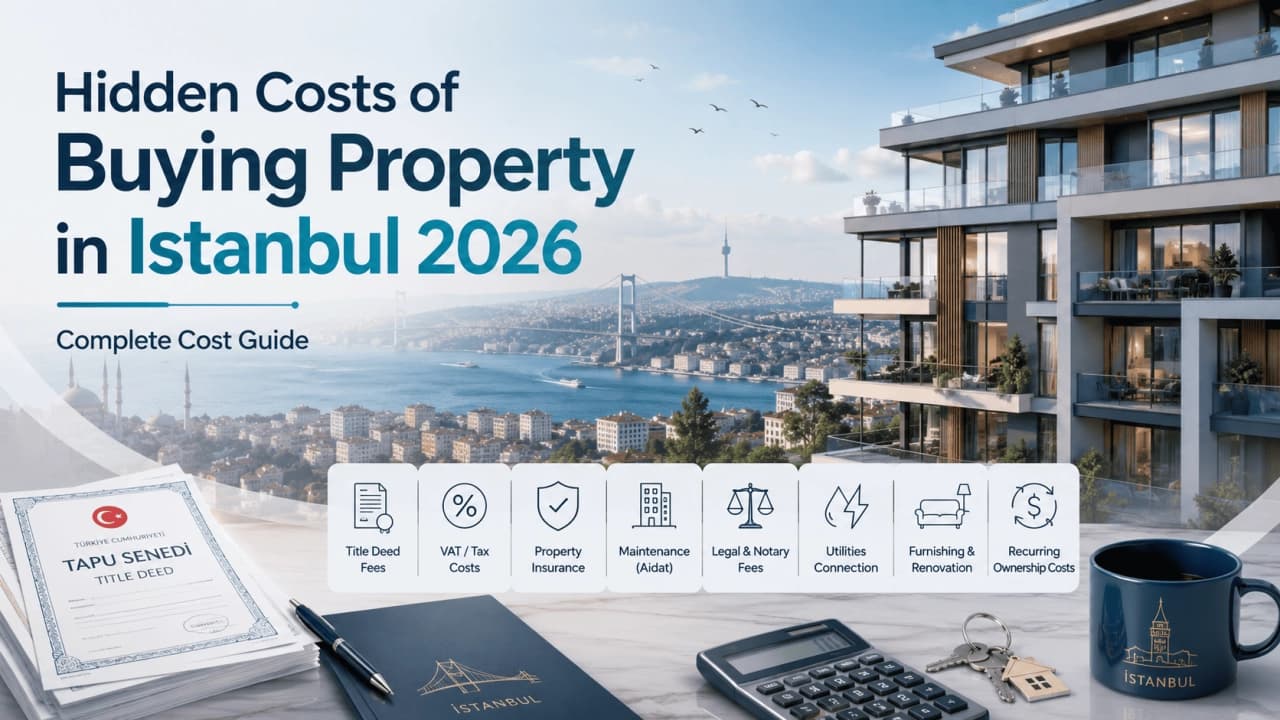
These may include:
- Title deed transfer fees
- Land Registry service charges
- Mandatory property valuation
- Currency conversion and banking expenses
- Legal services
- Translation
- Notary expenses
- Real estate agency fees
- DASK compulsory earthquake insurance
- VAT where applicable
- Furnishing
- Utility setup
- Renovation
- Monthly maintenance fees
- Annual property tax
- Property management
- Rental-related expenses
Some costs are mandatory.
Others depend on:
- Whether the property is new or resale
- Whether it is completed or off-plan
- Whether an estate agency is involved
- Whether the buyer uses a lawyer
- Whether the buyer speaks Turkish
- Whether a Power of Attorney is required
- Whether VAT applies
- Whether the apartment will be rented
- Whether Turkish citizenship is part of the investment strategy
For this reason, foreign buyers should think about property budgeting using a broader formula:
Property Price + Acquisition Costs + Setup Costs + Ownership Costs = Real Property Cost
This guide explains the hidden costs of buying property in Istanbul in 2026, starting with the expenses buyers may encounter before and during the purchase.
Part 2 will examine costs after acquisition, including VAT, DASK, utilities, furnishing, renovation, aidat, annual property tax, and rental-property expenses.
Property Price Is Not Your Total Investment
The purchase price is only one component of the capital required to acquire an apartment.
Consider a buyer with a total investment budget of:
$300,000
It may be risky to search exclusively for apartments priced at exactly $300,000.
Doing so leaves no financial room for:
- Transaction expenses
- Professional services
- Furniture
- Insurance
- Utility setup
- Unexpected repairs
- Currency conversion
- Initial ownership costs
A better approach is to determine the total available capital first and then calculate the maximum appropriate purchase price.
A simplified framework is:
Maximum Property Price = Total Available Capital − Acquisition Costs − Setup Budget − Financial Reserve
This approach is particularly important for investors because every additional acquisition cost affects the property's real return on investment.
If an apartment costs $200,000 but requires another $20,000 before it can generate rental income, the investor has effectively committed:
$220,000
The rental yield should therefore ultimately be evaluated against the total capital invested, not simply the headline property price.
What Costs Should Foreign Buyers Expect?
Before examining individual fees, it helps to divide property costs into four categories.
Acquisition Costs
These arise directly from completing the purchase.
They can include:
- Title deed fees
- Land Registry service charges
- Property valuation
- Real estate agency commission
- Legal services
- Translation
- Notary expenses
Financial and Banking Costs
International buyers may also incur expenses associated with moving and converting funds.
These can include:
- International bank transfer charges
- Currency conversion spreads
- Correspondent-bank fees
- Banking service charges
For foreign natural persons purchasing real estate in Türkiye, the Land Registry authority currently requires a Döviz Alım Belgesi — Foreign Exchange Purchase Certificate as part of the acquisition process. TKGM explains that the foreign currency is sold through a bank to the Central Bank framework and the bank-issued certificate is submitted for the title transaction.
This makes banking and currency planning an important part of the purchase process rather than an afterthought.
Property Setup Costs
After acquisition, the apartment may require:
- Furniture
- Appliances
- Internet
- Utilities
- Renovation
- Interior improvements
- Insurance
These expenses vary dramatically between a ready furnished resale apartment and an empty new-build unit.
Ongoing Ownership Costs
Long-term ownership can involve:
- Aidat
- Property tax
- Insurance
- Repairs
- Property management
- Rental expenses
These costs will be examined in detail in Part 2.
Title Deed Transfer Fee in Turkey
One of the most important acquisition expenses is the Tapu Harcı, or title deed transfer fee.
Under the current Land Registry guidance, a standard sale is subject to a title deed fee calculated separately for the buyer and seller at 20 per thousand, equivalent to 2%, for each party. The declared sale value used for the transaction cannot be below the applicable real-estate tax value.
In statutory terms, this means:
Buyer: 2%
Seller: 2%
Combined statutory charge: 4%
Example
Suppose an apartment is transferred at an applicable declared value of:
5,000,000 TRY
The basic title deed fee calculation would be:
Buyer
5,000,000 × 2% = 100,000 TRY
Seller
5,000,000 × 2% = 100,000 TRY
Combined:
200,000 TRY
This example illustrates the statutory calculation only.
The exact amount depends on the legally applicable transaction value at the time of transfer.
Who Actually Pays the Title Deed Fee?
The statutory calculation assigns a separate 2% charge to each side.
However, buyers should make sure that the commercial agreement with the seller clearly states how transaction expenses will actually be handled.
Do not wait until the title-transfer appointment to discover that the parties have different expectations regarding fees.
Before paying a deposit, ask:
- What fees are legally assigned to the buyer?
- What fees are legally assigned to the seller?
- Has either party agreed to bear additional costs?
- Is that agreement written into the transaction documents?
Never Budget Using an Artificially Low Declared Value
Foreign buyers should avoid strategies based on declaring a value that does not accurately reflect the legally required transaction basis.
The title deed fee is calculated using the declared transfer value subject to the statutory minimum based on the property's real-estate tax value.
For foreign buyers there is another important factor: TKGM states that the Turkish-lira amount generated through the Foreign Exchange Purchase Certificate is reflected in the official deed as the value relevant to the title-fee basis.
Transaction values and payment documentation should therefore be planned correctly from the beginning.
Land Registry Revolving Fund and Service Charges
The title deed fee is not necessarily the only amount payable to the Land Registry system.
TKGM also charges Döner Sermaye, or revolving-fund/service fees, according to its official tariff. The authority published a new 2026 tariff effective from January 1, 2026.
This charge should be treated separately from the percentage-based Tapu Harcı.
The exact amount can depend on the nature and structure of the transaction and the applicable tariff.
Foreign buyers should therefore avoid creating a budget based only on:
Property Price + 2% Tapu
A more complete title-transfer budget should include:
Tapu Harcı + Applicable TKGM Service Charges
Because the tariff can be updated, the current amount should be confirmed close to the transfer date.
Mandatory Property Valuation for Foreign Buyers
A property valuation report is another important cost for foreign purchasers.
TKGM's current property-sale guidance lists a real estate valuation report among the required documents when a foreign party is involved in the purchase, and the report must be prepared through an appropriately authorized valuation organization.
The dedicated TKGM valuation framework also confirms the valuation-report process for transactions in which a foreign natural person is the buyer. Requests are handled through the TADEBİS/Web Tapu system, and the applicant receives information about the applicable service fee and payment process.
Why Is the Valuation Important?
The valuation provides an independent professional assessment of the property.
Depending on the transaction, the report can be relevant to:
- Land Registry procedures
- Market-value assessment
- Citizenship-related value verification
- Transaction documentation
The buyer should not confuse the valuation report with the seller's asking price.
For example:
Seller Asking Price: $300,000
Developer Price List: $300,000
Independent Appraised Value: potentially different
These figures serve different purposes.
A developer or owner can ask any commercially chosen price.
An independent valuation aims to assess the property's value under the relevant professional methodology.
Who Determines the Valuation Fee?
The buyer should not assume a fixed dollar amount applies to every property.
Under the official system, the valuation request is processed electronically and TKGM communicates the applicable fee and payment information to the relevant applicant.
For budgeting purposes, therefore, treat valuation as:
a required variable transaction expense
rather than using an outdated fixed amount from an old blog or property advertisement.
Lawyer Fees
Using an independent lawyer is an additional cost, but for many foreign buyers it can be one of the most important professional expenses in the transaction.
A real estate lawyer may assist with matters such as:
- Title deed review
- Ownership verification
- Mortgage checks
- Lien checks
- Legal restrictions
- Contract review
- Developer agreements
- Off-plan purchase documents
- Power of Attorney
- Citizenship-related transaction review
The Land Registry itself requires the appropriate documentation to complete the transfer, but a lawyer serves a different purpose: protecting the buyer's legal interests before the transaction is completed.
Are Lawyer Fees Fixed?
No universal property-purchase legal fee should be assumed for every transaction.
The cost can depend on:
- Property value
- Transaction complexity
- New build vs resale
- Off-plan vs completed property
- Citizenship work
- Contract negotiation
- Scope of due diligence
Foreign buyers should request a written description of:
- Services included
- Professional fee
- Additional costs
- Whether translation or notary costs are separate
Developer Lawyer vs Independent Lawyer
A developer may have lawyers preparing project documentation.
That does not make them the buyer's independent lawyer.
Their professional role may primarily be to represent the seller or developer.
Foreign buyers who want independent legal advice should use a professional whose responsibility is specifically to review the transaction from the buyer's perspective.
Sworn Translator Costs
Language can create another transaction expense.
TKGM identifies a sworn translator among the requirements where a party does not speak Turkish.
This can become relevant during formal Land Registry procedures.
Why Translation Matters
Property transactions involve legally significant information such as:
- Buyer identity
- Seller identity
- Property description
- Sale amount
- Ownership rights
- Restrictions
- Declarations
A buyer should fully understand what is being signed.
Translation should therefore be treated as part of legal transaction accuracy rather than simply a convenience.
Translation Costs Can Extend Beyond the Tapu Appointment
Depending on the transaction, buyers may also require translation of:
- Power of Attorney
- Contracts
- Passport documents
- Citizenship documents
- Notarial documents
The final cost depends on the number and nature of documents and services required.
Notary and Power of Attorney Costs
Foreign buyers do not always need to be physically present for every stage of a real estate purchase.
A properly prepared Power of Attorney may allow an authorized representative to complete specific procedures on the buyer's behalf.
TKGM's standard sale documentation recognizes representation documents such as a Power of Attorney when a party acts through a representative.
When Might a Power of Attorney Be Useful?
It can be helpful when the buyer:
- Lives outside Türkiye
- Cannot attend the Tapu appointment
- Needs a lawyer to complete procedures
- Is managing an off-plan investment remotely
- Requires ongoing administrative support
Avoid Giving Unnecessarily Broad Authority
A Power of Attorney should be prepared according to the actual task.
A property purchase may require authority relating to:
- Purchase
- Title registration
- Payment-related formalities
- Utility setup
- Citizenship procedures
The scope should be reviewed carefully before signing.
Notary Costs Are Variable
Notary and Power of Attorney costs can depend on:
- Document type
- Number of pages
- Translation requirements
- Number of authorized actions
- Copies
- Certification requirements
They should therefore be included as a variable transaction expense rather than represented by one universal fee.
Real Estate Agency Commission
Agency commission is another cost that buyers should clarify before entering a property transaction.
Türkiye's Regulation on Real Estate Trade limits the total service fee in a sale transaction to no more than 4% of the sale value stated in the brokerage agreement, excluding VAT. Unless the parties agree otherwise in writing, the regulation provides for the service fee to be shared equally between the client and the buyer.
This point is important because buyers sometimes assume:
“The buyer always pays 2%.”
The actual commercial arrangement should be confirmed in writing.
Example
If the relevant sale value is:
$250,000
a theoretical 4% total commission ceiling would correspond to:
$10,000 before VAT
But that does not automatically mean the buyer must pay the entire $10,000.
The allocation depends on the applicable brokerage agreement and any written arrangement between the parties.
Ask Before Viewing or Reserving
Before committing to a property, ask:
- Is an agency commission payable?
- What percentage?
- Is VAT added?
- Who is responsible for payment?
- Is the commission included in the advertised price?
- When does the commission become payable?
The regulation states that the agency becomes entitled to the sale service fee when the transaction is registered in the Land Registry.
Clear written terms prevent disputes near completion.
Banking and Currency Conversion Costs
International property purchases can involve significant movement of funds.
Foreign buyers should plan the payment process before the title-transfer stage.
Potential banking expenses include:
- International transfer charges
- Receiving-bank charges
- Correspondent-bank fees
- Foreign exchange spreads
- Currency conversion
- Payment timing differences
Even relatively small exchange-rate differences can matter on a large property purchase.
Foreign Exchange Purchase Certificate
Foreign natural persons purchasing real estate in Türkiye are subject to a specific foreign-exchange procedure.
TKGM states that foreign buyers must first sell the relevant foreign currency through a bank under the Central Bank framework, after which the bank issues the Döviz Alım Belgesi required for the Land Registry transaction.
For ordinary property-sale transactions, TKGM identifies the Foreign Exchange Purchase Certificate as the relevant document; citizenship transactions also require additional payment evidence between buyer and seller.
Currency Conversion Is a Real Investment Cost
Suppose two banks quote different effective exchange rates for a substantial transaction.
Even a relatively small difference can materially change the amount of Turkish lira produced from the same foreign currency.
Investors should therefore compare:
- Exchange rate
- Bank spread
- Transfer cost
- Timing
- Required documentation
rather than focusing exclusively on the apartment price.
Keep Complete Banking Records
Property investors should maintain organized records of:
- Bank transfers
- Conversion documents
- Payment receipts
- Developer payments
- Seller payments
- Foreign Exchange Purchase Certificate
This becomes especially important when the purchase is connected to Turkish citizenship or another process requiring detailed payment evidence.
Costs That May Apply but Should Not Be Assumed
Some property expenses are transaction-specific.
They should be investigated but not automatically added at the same rate to every purchase.
VAT
VAT can apply to certain property transactions depending on factors such as:
- Seller
- Nature of the transaction
- Property characteristics
- Buyer's circumstances
- Applicable exemption rules
A foreign buyer should never assume:
“Foreigners do not pay VAT.”
Nor should the buyer assume:
“Every property price includes VAT.”
The sales quotation should explicitly state the VAT treatment.
We will examine VAT in detail in Part 2.
DASK
TKGM lists compulsory earthquake insurance among the documents required for the sale of qualifying building-type properties.
The cost is not simply a universal fixed fee because the insurance calculation depends on applicable policy parameters.
DASK and optional private home insurance will also be covered in Part 2.
Before Paying a Deposit: Ask for a Cost Breakdown
A foreign buyer should request a clear cost structure before committing to the transaction.
A useful preliminary breakdown might look like:
| Cost | Confirm Before Purchase? |
|---|---|
| Property Price | Yes |
| Title Deed Fee | Yes |
| TKGM Service Charge | Yes |
| Valuation Report | Yes |
| Agency Commission | Yes |
| VAT | Yes |
| Lawyer | Recommended to price in advance |
| Translation | If required |
| Notary / Power of Attorney | If required |
| Currency Conversion | Yes |
| Banking Charges | Yes |
| DASK | If applicable |
| Furnishing | Estimate before purchase |
| Aidat | Obtain exact/current figure where possible |
This prevents a common situation in which a buyer discovers additional costs only after paying a reservation deposit.
Example: Why Transaction Costs Matter
Consider two investors.
Buyer A
Available capital:
$250,000
Property price:
$250,000
Remaining reserve:
$0
This buyer may still need to finance:
- Transfer expenses
- Valuation
- Legal services
- Banking
- Insurance
- Furniture
- Initial maintenance
The investment is therefore underfunded.
Buyer B
Available capital:
$250,000
Maximum property budget:
$225,000
Reserve:
$25,000
The second buyer has financial capacity for transaction and setup costs.
The exact amount required may ultimately be lower or higher than the reserve, but the investment structure is more resilient.
The lesson is straightforward:
Do not use 100% of your available capital for the advertised property price.
Key Takeaways
The advertised price of an apartment in Istanbul should never be treated as the complete cost of purchasing the property.
Before completing a transaction, foreign buyers may need to account for:
- Title deed transfer fees
- TKGM revolving-fund/service charges
- Mandatory valuation
- Foreign-exchange procedures
- Bank charges
- Lawyer fees
- Sworn translation
- Notary and Power of Attorney expenses
- Real estate agency commission
- DASK
- VAT where applicable
- Future setup costs
For a standard property sale, current TKGM guidance states that the title deed fee is calculated separately at 2% for the buyer and 2% for the seller, subject to the applicable transaction-value rules.
TKGM also maintains separate revolving-fund charges, with its 2026 tariff effective from January 1, 2026.
Foreign buyers should also budget for the required property valuation process and the Foreign Exchange Purchase Certificate used in foreign-natural-person acquisitions.
Where an estate agency is involved, the regulatory ceiling for the total sales brokerage service fee is 4% excluding VAT, with the default allocation equally between the relevant parties unless otherwise agreed in writing.
The safest budgeting principle is:
Do not ask only: “How much does the apartment cost?”
Ask:
“How much capital will I need from the beginning of the transaction until the property is fully purchased, registered, prepared, and ready to use?”
That number represents the real acquisition budget.
VAT on Property Purchases in Turkey
VAT is one of the most misunderstood costs associated with buying property in Turkey.
Foreign buyers sometimes receive conflicting information:
- “Foreigners do not pay VAT.”
- “All new apartments have VAT.”
- “Resale properties never have VAT.”
- “VAT is already included in every developer price.”
None of these statements should be accepted as a universal rule.
Whether VAT applies depends on the legal nature of the transaction, the seller, the property, whether the transaction represents a first delivery, and whether the buyer qualifies for a specific exemption.
For this reason, every buyer should ask one simple question before signing:
Is the quoted purchase price VAT-inclusive or VAT-exclusive, and what legal basis applies to this transaction?
The answer should be confirmed in writing.
When Can VAT Apply?
VAT can arise when the property transaction falls within Türkiye's VAT system, particularly in commercial sales by developers or businesses.
The applicable treatment cannot safely be determined solely by asking whether an apartment is “new” or “resale.” The legal status of the seller and transaction matters. Türkiye's VAT legislation governs taxable commercial deliveries and also contains specific exemptions for qualifying property transactions.
A buyer should therefore obtain confirmation of:
- Whether VAT applies
- The applicable treatment
- Whether VAT is included in the advertised price
- Whether the buyer qualifies for an exemption
- What documentation is required
This becomes especially important when comparing two developments.
For example:
Project A
Advertised price: $300,000
VAT: included
Project B
Advertised price: $290,000
VAT: additional
The apparently cheaper apartment may ultimately cost more.
VAT Exemption for Certain Foreign Buyers
Türkiye provides a specific VAT exemption for certain qualifying first deliveries of residential or commercial property.
Under the current VAT framework, the exemption can apply to qualifying first deliveries to foreign nationals who are not considered resident in Türkiye for the purposes of the exemption, as well as certain other qualifying purchasers. A property bought from the party that constructed it can potentially satisfy the first-delivery requirement; a later resale does not simply become another exempt “first delivery.”
This is an important distinction.
A foreign passport by itself does not automatically create VAT exemption.
The purchaser must satisfy the applicable eligibility requirements.
Payment Conditions for the Foreign-Buyer VAT Exemption
The exemption also has payment conditions.
Current Revenue Administration guidance states that at least 50% of the consideration must be brought into Türkiye in foreign currency and paid to the seller before the invoice is issued, with the remaining amount brought into Türkiye and paid no later than one year afterward.
This means payment structure matters.
An investor should not discover after completing most of the transaction that their payment method did not satisfy the exemption conditions.
Before relying on VAT exemption, confirm:
- Buyer eligibility
- First-delivery status
- Foreign-currency payment requirements
- Timing
- Required tax documentation
- Seller's invoicing process
The Three-Year Rule
Foreign buyers using the qualifying VAT exemption should also understand that the benefit carries a holding-period consequence.
Under the current framework, if property acquired through the exemption is disposed of within three years, the previously uncollected VAT must generally be paid with the applicable interest before the later title transaction can proceed.
This matters particularly for investors planning:
- Short-term resale
- Property flipping
- Portfolio restructuring
A buyer planning to sell quickly should not treat the VAT exemption as free money without considering the three-year rule.
Never Assume You Qualify for VAT Exemption
The safest principle is:
Foreign Buyer ≠ Automatic VAT Exemption
Before purchase, obtain transaction-specific confirmation.
This is especially important where:
- The property has previously been sold
- The seller is not the original developer
- The buyer spends significant time in Türkiye
- Payment will be made through installments
- The property may be resold within three years
VAT can materially change the real acquisition cost.
DASK Compulsory Earthquake Insurance
DASK, formally Türkiye's Compulsory Earthquake Insurance system, is another cost property buyers should include in their ownership budget.
For covered residential properties, DASK provides insurance protection against specified material damage arising from earthquakes and earthquake-related events within the scope of the policy.
It should not be confused with comprehensive private home insurance.
Is DASK Mandatory?
For properties within its scope, proof of valid Compulsory Earthquake Insurance is checked in connection with certain official and utility procedures.
DASK states that insurance validity is checked for:
- Relevant title deed transactions
- Electricity subscriptions
- Water subscriptions
under the applicable compulsory earthquake-insurance framework.
This makes DASK more than an optional property-management expense.
For many apartment transactions, it is part of the practical ownership process.
How Is the DASK Premium Calculated?
There is no single DASK price for every apartment.
DASK calculates premiums using factors including:
- Location
- Risk classification
- Building construction type
- Building characteristics
- Gross apartment area
The official DASK calculator uses detailed information about the province, district, neighborhood, building construction, building age, floor count, apartment size, and usage.
Therefore, old blog posts quoting one fixed DASK amount should not be used for a 2026 purchase budget.
Obtain a current quote for the specific apartment.
DASK Must Be Renewed
A DASK policy is generally issued for one year and must be renewed annually.
DASK confirms that responsibility for keeping the policy renewed rests with the insured party under the compulsory insurance framework.
For investors, DASK should therefore be classified as a recurring ownership expense rather than only a closing cost.
DASK vs Private Home Insurance
DASK and private home insurance are not identical products.
DASK provides compulsory earthquake coverage within defined limits and policy conditions.
A private home-insurance policy may provide additional protection depending on the insurer and contract.
DASK itself notes that where the value requiring protection exceeds compulsory coverage, owners can purchase additional voluntary earthquake insurance from insurance companies on top of DASK.
Depending on the policy, optional insurance may also be considered for risks such as:
- Contents
- Water damage
- Fire
- Theft
- Liability
- Additional earthquake exposure
Coverage varies by insurer.
For an expensive Istanbul apartment, investors should therefore avoid assuming that DASK alone protects the full market value of the property and everything inside it.
Utility Connection and Activation Costs
Owning an apartment and having it ready for occupation are two different stages.
A property may require activation, transfer, or registration of services such as:
- Electricity
- Water
- Natural gas
- Internet
Costs and procedures vary depending on the utility provider, account status, property, and whether services already exist.
For this reason, it is better to treat utility setup as a variable setup budget rather than quote one universal amount.
Electricity and Water
For properties covered by compulsory earthquake insurance, DASK validity is checked as part of electricity and water subscription procedures.
New owners should verify whether:
- Existing accounts will be terminated
- New subscriptions must be created
- Deposits apply
- Previous debts are properly separated
- Meter information is correct
Do this before the apartment needs to be occupied or rented.
Natural Gas
Where the apartment uses natural gas, the buyer may need to transfer or establish the relevant subscription.
Potential costs can depend on:
- Existing installation
- Meter status
- Service provider
- Deposit requirements
- Whether gas has previously been activated
A resale apartment with operating utilities may require much less setup than a newly delivered development.
Internet and Telecommunications
Internet installation is usually a relatively small cost compared with the property price, but it can become important for rental readiness.
For furnished apartments targeting:
- Expats
- Corporate tenants
- Remote workers
high-quality internet may be considered part of the basic rental product.
The owner should therefore include:
- Installation
- Router/equipment
- Monthly service
in operating assumptions where the landlord provides connectivity.
Furnishing Costs
Furniture is one of the largest setup costs buyers frequently underestimate.
This is especially common with new-build apartments.
The property may look fully furnished in:
- Renderings
- Show apartments
- Marketing videos
while the actual unit is delivered largely empty.
Before purchasing, determine exactly what the sales contract includes.
What May Need to Be Purchased?
Depending on the apartment, the owner may need:
- Beds
- Mattresses
- Wardrobes
- Sofa
- Dining furniture
- Television
- Refrigerator
- Washing machine
- Dishwasher
- Oven
- Small appliances
- Curtains
- Lighting
- Rugs
- Kitchen equipment
- Air conditioners
- Decorative items
An apartment intended for furnished rental can therefore require a meaningful additional investment before generating income.
Furnishing a 1+1 Apartment
A 1+1 apartment usually requires less furniture and fewer appliances than a larger unit.
However, investors targeting corporate or international tenants may need to provide a higher standard.
The objective should be:
Durability + Practicality + Neutral Design
rather than simply buying the cheapest furniture available.
Poor-quality furnishings can create repeated replacement costs.
Furnishing a 2+1 Apartment
A 2+1 apartment typically requires:
- Additional bedroom furniture
- Larger living-room setup
- Additional storage
- More lighting and curtains
If marketed to families, the expected furniture style may also differ from an executive 1+1 apartment.
The correct furnishing budget depends on the tenant strategy.
Do Not Calculate Yield Before Furnishing
Suppose:
Apartment: $200,000
Furniture and setup: $15,000
Real invested capital before other costs is already:
$215,000
If the investor calculates rental yield using only $200,000, the return is overstated.
For investment analysis:
Furniture is capital invested in the rental business.
Renovation Costs for Resale Apartments
Resale property can appear cheaper than a new-build apartment until renovation is included.
This is one reason comparing only purchase prices can be misleading.
A resale apartment may require work involving:
- Kitchen
- Bathroom
- Flooring
- Painting
- Electrical installation
- Plumbing
- Windows
- Heating
- Air conditioning
- Doors
- Lighting
The condition of the building must also be considered separately from the apartment interior.
Cosmetic Renovation
A property requiring only:
- Painting
- Lighting
- Minor flooring repairs
- Basic furniture replacement
may be relatively straightforward to prepare for rental.
Major Renovation
More substantial projects may require:
- Complete kitchen replacement
- Bathroom reconstruction
- Plumbing renewal
- Electrical work
- Window replacement
- Heating modifications
At that point, the apparent discount relative to a new apartment can shrink significantly.
Calculate Renovation Before Making the Offer
A useful comparison is:
Resale Purchase Price + Renovation + Setup
versus:
Ready New-Build Purchase Price + Setup
For example:
Resale apartment
Purchase: $180,000
Renovation: $25,000
Setup: $10,000
Real pre-transaction cost: $215,000
versus:
New apartment
Purchase: $220,000
Setup: $12,000
Real pre-transaction cost: $232,000
The actual difference is:
$17,000
not the initial $40,000 difference between the advertised purchase prices.
This is why buyers comparing property types should calculate the all-in cost.
Aidat: Monthly Building and Compound Maintenance Fees
Aidat is one of the most important recurring costs in Istanbul apartment ownership.
It is also one of the expenses international buyers most frequently underestimate.
Modern residential developments can provide impressive amenities, but those amenities must be operated and maintained.
Aidat may contribute toward services such as:
- Security
- Cleaning
- Elevators
- Landscaping
- Reception
- Building staff
- Swimming pools
- Fitness centers
- Shared facilities
- Common-area utilities
The exact services and charges depend on the building or residential compound.
Luxury Project Does Not Mean Better Investment Yield
Consider two properties.
Apartment A
Rent: $1,500/month
Aidat: $300/month
Apartment B
Rent: $1,350/month
Aidat: $100/month
Before considering any other expense:
Apartment A
Annual rent: $18,000
Annual aidat: $3,600
Remaining before other costs: $14,400
Apartment B
Annual rent: $16,200
Annual aidat: $1,200
Remaining before other costs: $15,000
Apartment B charges less rent but produces more income after this single operating expense.
This is why rental investors should never judge investment quality using headline rent alone.
Ask for the Current Aidat Before Purchase
For a ready property, request the current monthly charge for the exact unit.
Also ask:
- What services are included?
- Are heating or utilities included?
- Is parking included?
- Are major increases expected?
- Are extraordinary building expenses planned?
For an off-plan development, the final charge may not yet exist.
In that situation, treat the developer's estimate as an estimate rather than a guaranteed future cost.
Annual Property Tax in Istanbul
Property ownership creates an annual municipal property-tax obligation unless a specific exemption applies.
Under Türkiye's Real Estate Tax Law, the standard building-tax rate for residential property is 1 per thousand (0.1%) of the relevant taxable value. Rates applying within metropolitan municipality boundaries are increased by 100%.
Because Istanbul is a metropolitan municipality, the normal residential rate effectively becomes:
2 per thousand = 0.2%
of the applicable municipal taxable value, subject to the relevant rules and exemptions.
Importantly, this is not necessarily calculated from the property's commercial market price or the amount a foreign buyer paid.
Property Tax Example
If the applicable municipal taxable value were:
5,000,000 TRY
then a simplified Istanbul residential calculation at 0.2% would be:
5,000,000 × 0.002 = 10,000 TRY annually
This is only an illustrative calculation.
The actual tax basis must be determined according to the applicable municipal and statutory rules.
What Happens When You Buy During the Year?
The Revenue Administration explains that a buyer must make the relevant property-tax notification within the applicable deadline and that liability for the new owner generally begins in the following year. Its example for a property purchased during 2026 shows notification during 2026 and tax liability beginning from 2027.
Foreign buyers should therefore include municipal notification in their post-purchase administrative checklist.
Valuable Housing Tax for High-Value Residential Property
Buyers at the luxury end of Istanbul's property market should also be aware that Türkiye has a separate Valuable Housing Tax applicable to residential properties whose statutory building-tax value exceeds the annual threshold.
For 2026, the Revenue Administration lists the threshold at 17,711,000 TRY. The tax applies according to statutory bands and rules, and specific exemptions may be available.
This is especially relevant for buyers considering:
- Luxury Bosphorus residences
- Premium Nişantaşı apartments
- High-value penthouses
- Multiple luxury properties
The threshold relates to the legally relevant building-tax value, not simply the property's online asking price.
High-value buyers should therefore confirm whether the apartment falls within the Valuable Housing Tax regime.
Rental Property Operating Costs
For buy-to-let investors, purchase costs are only the beginning.
Rental properties generate recurring operating expenses that reduce gross income.
Common expenses can include:
- Aidat
- Repairs
- Property management
- Insurance
- Furnishing replacement
- Leasing expenses
- Vacancy
- Rental income tax
These costs should be incorporated into the investment model before the property is purchased.
Vacancy
No apartment should automatically be assumed to generate rent 12 months every year.
Potential vacancy can result from:
- Tenant turnover
- Repairs
- Market conditions
- Overpricing
- Renovation
- Seasonal demand
A realistic investment model should therefore include a vacancy allowance rather than assuming perfect occupancy indefinitely.
Repairs and Maintenance
Even a new apartment eventually requires maintenance.
Possible costs include:
- Appliance repairs
- Plumbing
- Painting
- Air-conditioning servicing
- Furniture replacement
- Locks
- Electrical repairs
Investors should maintain a financial reserve rather than treating every month's rent as disposable income.
Property Management Costs
Foreign owners living outside Türkiye may choose professional property management.
Typical services can include:
- Marketing the apartment
- Tenant communication
- Rent collection
- Inspections
- Maintenance coordination
- Building-management communication
- Financial reporting
Property-management fees are commercial rather than universally fixed, so investors should compare contracts and service scope rather than assume one standard percentage.
Management Can Reduce Return but Improve Operations
Consider:
Annual rent: $18,000
If management and related administration cost:
$1,500 annually
the investor should calculate return using:
$16,500 before other expenses
not the original $18,000.
This does not mean management is a bad expense.
For an overseas owner, good management may:
- Reduce vacancy
- Protect the property
- Improve tenant communication
- Simplify repairs
The relevant question is whether the service creates enough operational value to justify its cost.
Rental Income Tax
Rental income from property in Türkiye can create Turkish income-tax obligations.
Türkiye's Revenue Administration publishes separate guidance covering rental income generally and rental income received by limited/non-resident taxpayers.
Foreign owners should therefore not assume that receiving rent into a foreign bank account removes Turkish tax obligations.
The property's location and the taxpayer's legal/tax circumstances matter.
2026 Residential Rental Income Exemption
The Revenue Administration currently lists the residential rental-income exemption for income earned during the 2026 calendar year at:
58,000 TRY
subject to the applicable eligibility rules.
This does not mean that every landlord simply deducts 58,000 TRY and owes no other tax.
Eligibility and calculation can depend on factors such as:
- Total rental income
- Other income
- Declaration requirements
- Expense method
- Taxpayer status
For international investors, the Revenue Administration also provides specific guidance for limited/non-resident taxpayers.
Gross Rent Is Not Net Profit
Suppose a property generates:
600,000 TRY annual rent
That figure is not automatically the investor's profit.
Before assessing the real return, the owner may need to consider:
- Tax
- Aidat
- Management
- Repairs
- Insurance
- Vacancy
- Furnishing depreciation
This is exactly why rental-property analysis should focus on net income rather than rent alone.
Example: Annual Ownership Cost Framework
A foreign investor might model annual ownership using a structure like this:
| Expense | Annual Budget |
|---|---|
| Property Tax | Property-specific |
| DASK | Property-specific |
| Private Insurance | Optional / policy-specific |
| Aidat | Building-specific |
| Property Management | Strategy-specific |
| Repairs Reserve | Estimated |
| Vacancy Reserve | Estimated |
| Rental Income Tax | Taxpayer-specific |
| Furniture Replacement | Estimated |
The exact numbers vary, but the structure is what matters.
An investor who calculates only:
Purchase Price + Expected Rent
does not yet have a complete investment model.
New Build vs Resale Ownership Costs
Different property types tend to create different cost profiles.
| Cost Category | New Build | Resale |
| Initial Renovation | Usually lower | Can be significant |
| Furnishing | Often required | Varies |
| Aidat | Can be higher in modern compounds | Often lower in simple buildings |
| Immediate Repairs | Usually lower | Property dependent |
| Building Repairs | Usually lower initially | Can be substantial |
| Parking / Storage Extras | Possible | Property dependent |
| Utility Setup | Can require new activation | Often existing |
| Rental Readiness | Depends on furnishing | Can sometimes be immediate |
Neither category is automatically cheaper.
A new apartment may have lower repair costs but higher aidat.
A resale apartment may have low monthly charges but require significant renovation.
The correct comparison is always:
Total Cost of Ownership
Common Post-Purchase Costs Foreign Buyers Forget
Several seemingly minor expenses can become meaningful when combined.
Furniture
Particularly important for newly delivered apartments.
Appliances
Do not assume every white good shown in a show apartment is included.
Air Conditioning
Some developments provide infrastructure but not the actual units.
Curtains and Lighting
These can be surprisingly expensive across a larger apartment.
Internet
Particularly relevant for furnished rentals.
Utility Deposits and Setup
Provider-specific and frequently overlooked.
Aidat
One of the most important recurring expenses.
Insurance
DASK plus any optional private coverage.
Property Management
Especially relevant for overseas owners.
Vacancy
Rental income is not guaranteed every month.
Repairs
All apartments eventually require maintenance.
Property Tax
A recurring municipal expense.
Valuable Housing Tax
Potentially relevant to high-value residential property.
Rental Income Tax
Relevant to income-generating investments according to the owner's circumstances.
How to Estimate the Real Annual Cost of Ownership
A useful approach is to separate ownership costs into three groups.
Fixed or Predictable Costs
Examples include:
- Property tax
- DASK
- Aidat
- Property management contract
Variable Costs
Examples include:
- Repairs
- Utilities
- Furniture replacement
- Vacancy
Tax-Dependent Costs
Examples include:
- Rental income tax
- Valuable Housing Tax where applicable
This allows the investor to create:
Best Case → Expected Case → Conservative Case
rather than relying on a single optimistic scenario.
Key Takeaways
The cost of owning an apartment in Istanbul continues after the title deed is transferred.
Foreign buyers should plan for several important categories.
VAT must be checked transaction by transaction. Certain qualifying first deliveries to eligible non-resident foreign buyers can be VAT-exempt, but the exemption carries specific buyer, transaction, foreign-currency payment, and holding-period requirements.
DASK is compulsory for properties within its scope and is checked for relevant title deed, electricity, and water procedures. The policy is renewable annually, and its cost depends on the specific property.
Property tax for residential buildings has a statutory base rate of 0.1%, doubled within metropolitan municipality boundaries; for Istanbul this ordinarily means an effective residential rate of 0.2% against the legally applicable tax value.
For high-value properties, the separate Valuable Housing Tax may also become relevant; the official 2026 threshold is 17,711,000 TRY of the applicable residential building-tax value.
Rental investors must additionally budget for:
- Management
- Vacancy
- Repairs
- Aidat
- Insurance
- Furniture
- Rental-income taxation
For income earned during 2026, the Revenue Administration currently states a 58,000 TRY residential rental-income exemption, subject to eligibility and the wider declaration rules.
The core principle remains:
The cheapest apartment to purchase is not necessarily the cheapest apartment to own.
A professional buyer evaluates both:
Acquisition Cost + Ongoing Cost
before deciding whether the property genuinely fits the available budget.
How Much Does It Really Cost to Buy Property in Istanbul?
By this stage, one principle should be clear:
The advertised property price is not the same as the total amount of capital required to complete a property investment in Istanbul.
A buyer may find an apartment priced at $200,000, $300,000, or $400,000, but the true investment budget must also account for transaction expenses, professional services, property setup, insurance, maintenance, and—where relevant—rental operating costs.
A more realistic formula is:
Real Property Investment Cost = Purchase Price + Acquisition Costs + Setup Costs + Initial Ownership Reserve
For an investor, the calculation should go one step further:
Real Investment Cost = Purchase Price + Acquisition Costs + Rental Setup + Operating Reserve
This distinction matters because all additional capital invested affects the property's real return.
The following examples are hypothetical. They illustrate how buyers should structure a budget; they are not fixed quotations for a Turkish property transaction.
Example: Total Cost of Buying a $200,000 Apartment
Consider a foreign buyer purchasing a completed apartment with a transaction value equivalent to:
$200,000
Assume it is a relatively straightforward purchase and the apartment requires furnishing before occupation or rental.
Property Purchase Price
$200,000
This is the starting point—not the final budget.
Buyer-Side Title Deed Fee
TKGM states that in a standard property sale, the statutory title deed fee is calculated separately for buyer and seller at 20 per thousand, or 2%, for each party, based on the applicable declared sale value and subject to the relevant statutory minimum.
For illustration, if the applicable transfer basis were equivalent to $200,000:
Buyer-side 2% = $4,000 equivalent
This example does not mean every foreign buyer's actual Tapu payment will literally be denominated in dollars; the purpose is simply to demonstrate how the percentage affects the overall investment budget.
Additional Acquisition Costs
The buyer should also allow for transaction-specific expenses such as:
- Land Registry revolving-fund/service charges
- Valuation
- Legal review
- Translation
- Notary or Power of Attorney where required
- Banking and currency-conversion costs
- Agency commission where applicable
- DASK
- VAT if applicable to the particular transaction
TKGM confirms that a revolving-fund charge is collected in addition to the percentage-based title deed fee.
Furnishing and Setup
Suppose the apartment also requires:
- Furniture
- Appliances
- Curtains
- Lighting
- Internet setup
- Initial household equipment
For an illustrative budget, assume:
$10,000 furnishing and setup
The number could be considerably lower or higher depending on apartment size and quality expectations.
Illustrative Budget
| Cost | Example |
|---|---|
| Property Price | $200,000 |
| Buyer-Side Tapu Fee | $4,000 |
| Furnishing / Setup | $10,000 |
| Other Transaction Costs | Property-specific |
| Initial Reserve | Buyer-specific |
Even before variable professional, insurance, banking, and Land Registry costs are inserted, the investor has already moved beyond the original $200,000 asking price.
The important lesson is:
A $200,000 property should not automatically be purchased with a total available budget of exactly $200,000.
Example: Total Cost of a $400,000 Citizenship Property
The distinction between property value and total cash requirement becomes even more important for buyers pursuing Turkish Citizenship by Investment.
The official Invest in Türkiye guidance currently states that the real-estate route requires acquisition of property worth at least USD 400,000 or equivalent foreign currency, with a title-deed restriction preventing resale for at least three years, subject to the complete program conditions.
$400,000 Is an Investment Threshold, Not an All-In Budget
Suppose an investor identifies a qualifying property valued at:
$400,000
It would be a mistake to assume:
Total available cash required = exactly $400,000
The citizenship threshold concerns the qualifying real-estate investment itself. Transaction, setup, professional, and ownership costs still need to be budgeted separately. This is an inference from the official investment requirement and the separate Land Registry fee structure.
Buyer-Side Tapu Illustration
Using the statutory 2% buyer-side title-deed fee purely as an illustration:
$400,000 × 2% = $8,000 equivalent
Again, actual transaction calculations are handled according to the legally applicable Turkish transaction basis and procedures.
The buyer could then have additional expenses for:
- Valuation and citizenship documentation
- Land Registry service charges
- Lawyer
- Translation
- Notary
- Banking and currency conversion
- DASK
- VAT where applicable
- Furniture
- Property setup
Therefore:
Citizenship Investment Threshold ≠ Total Capital Required
A buyer whose entire financial capacity is exactly $400,000 may not have sufficient liquidity for the complete transaction and property setup.
Citizenship Buyers Should Keep a Separate Cost Reserve
A more responsible budgeting structure is:
Qualifying Property Investment
plus
Transaction Cost Reserve
plus
Legal / Administrative Reserve
plus
Property Setup Reserve
For example:
Qualifying Property Value + Land Registry / Transaction Costs + Legal & Documentation Costs + Insurance / Banking + Furniture / Property Setup = Total Capital Requirement
The exact total is property-specific.
The objective is not to create a generic percentage and assume it fits every transaction.
The objective is to identify every cost category before committing the investment capital.
New Build vs Resale Hidden Costs
The type of property significantly affects where hidden costs appear.
A new apartment and a resale apartment may have similar purchase prices but very different post-purchase expenses.
| Cost | New Build | Resale |
| Initial Renovation | Usually lower | Can be substantial |
| Furnishing | Often required | Varies |
| Appliances | May not be included | May already exist |
| Aidat | Often higher in modern compounds | Can be lower |
| Immediate Repairs | Usually lower | Property-dependent |
| Building Repairs | Usually limited initially | Can be significant |
| Parking Extras | Possible | Property-dependent |
| Storage Extras | Possible | Property-dependent |
| Utility Activation | Often required | May already exist |
| Technical Inspection | Still valuable | Particularly important in older buildings |
| Modernization | Usually minimal | Can be substantial |
The table shows why the phrase:
“Resale is cheaper”
or:
“New build is more expensive”
is too simplistic.
The real comparison is:
All-In New-Build Cost vs All-In Resale Cost
Example: New Build vs Resale Total Cost
Consider two hypothetical apartments in comparable locations.
New-Build Apartment
Purchase price:
$240,000
Additional setup:
- Furniture: $12,000
- Appliances and lighting: $4,000
- Initial setup: $2,000
Illustrative pre-transaction investment:
$258,000
Resale Apartment
Purchase price:
$210,000
Required work:
- Kitchen and bathroom: $18,000
- Flooring and painting: $8,000
- Electrical/plumbing upgrades: $5,000
- Furniture: $8,000
Illustrative pre-transaction investment:
$249,000
At first glance, the resale apartment appeared:
$30,000 cheaper
After renovation and furnishing, the difference becomes:
$9,000
That is a much more meaningful basis for comparison.
The investor must then compare:
- Aidat
- Location
- Net area
- Rental income
- Structural condition
- Resale demand
before deciding which property represents better value.
Hidden Costs of Off-Plan Property
Off-plan apartments create another cost profile entirely.
A buyer may secure an attractive launch price but still underestimate the real cost of holding the investment until completion.
Installment Premium
A developer may offer:
Cash Price: $220,000
and:
Installment Price: $250,000
The payment plan appears convenient, but flexibility effectively costs:
$30,000
This difference should be recognized as part of the investment economics.
Currency Exposure
If installments are paid over 12, 24, or 36 months, an international buyer may remain exposed to currency movements throughout the construction period.
No Rental Income During Construction
An off-plan property generally cannot generate conventional residential rental income before delivery.
There is therefore an opportunity cost associated with capital committed during the construction period.
Furnishing After Delivery
The buyer may complete the purchase and then discover that another substantial furnishing budget is required before the apartment can be rented.
Future Aidat
In an unfinished project, the final monthly maintenance charge may not yet be established.
A developer estimate should be treated as an estimate rather than a guaranteed future operating cost.
Parking and Storage
These may:
- Be included
- Be allocated
- Be sold separately
- Carry additional charges
They should be clarified contractually.
Delivery Delay
A delay can create an economic cost even when the investor eventually receives the property.
For example, a six-month delay can mean:
- Six months without expected rent
- Continued capital lock-up
- Delayed relocation
- Additional accommodation costs
This is why off-plan investment should be evaluated based on both price and time.
Costs Foreign Buyers Commonly Forget
Several expenses may appear small compared with the property price but can collectively become meaningful.
Currency Conversion
Foreign buyers may focus on the advertised USD or EUR property price without calculating the actual exchange rate applied during the transaction.
International Bank Transfer Fees
Banks and correspondent institutions may charge transfer-related costs.
Furniture
One of the most commonly underestimated costs in empty new developments.
Appliances
A fitted kitchen does not necessarily mean:
- Refrigerator
- Washing machine
- Dishwasher
- Oven
- Air conditioner
are included.
Check the specification.
Curtains and Lighting
Show apartments often contain decorative elements that are not included in the delivered unit.
Air Conditioning
Projects may provide infrastructure without providing the physical units.
Parking
Do not assume every apartment includes an individually allocated or owned parking space.
Storage
Storage units may carry a separate price.
Aidat
This is especially important for luxury and branded developments.
Property Management
An investor living abroad may need professional management from the first tenant onward.
Vacancy
Rental income should never be modeled under the assumption of permanent 100% occupancy.
Repairs
Even new apartments eventually require maintenance.
Insurance
DASK and any optional additional home insurance should be included in the ownership budget.
Annual Property Tax
Property ownership creates recurring municipal obligations according to the applicable tax rules.
Rental Income Tax
Investment properties can generate Turkish income-tax obligations depending on the owner's circumstances.
How Much Extra Should You Budget?
There is a temptation to answer this question with one simple statement:
“Add 5%.”
or:
“Add 10%.”
That approach can be misleading.
The correct reserve depends heavily on the transaction.
Consider the difference between:
Scenario A
- Furnished resale apartment
- No renovation
- Low aidat
- No citizenship
- Straightforward transaction
and:
Scenario B
- Empty luxury new build
- High furnishing requirements
- Citizenship application
- International transfers
- Premium compound
- High monthly aidat
The second buyer may require a dramatically larger reserve.
For this reason, a line-item budget is more useful than a generic percentage.
How to Calculate Your Real Property Budget
Start with your total available capital.
For example:
Total Available Capital: $300,000
Then subtract the money that should not be committed directly to the property price.
Step 1: Acquisition Reserve
Budget for:
- Title deed
- Land Registry services
- Valuation
- Lawyer
- Translation
- Notary
- Agency
- Banking
- VAT where applicable
Step 2: Setup Reserve
Budget for:
- Furniture
- Appliances
- Utility setup
- Renovation
- Interior improvements
Step 3: Ownership Reserve
Budget for:
- Aidat
- Insurance
- Property tax
- Repairs
Step 4: Investment Reserve
If the property will be rented, also budget for:
- Property management
- Vacancy
- Tenant acquisition
- Repairs
- Furniture replacement
The final formula becomes:
Maximum Property Price = Total Capital − Acquisition Reserve − Setup Reserve − Ownership Reserve
Example: Building a $300,000 Total Budget
Assume:
Total available capital: $300,000
The buyer decides to preserve:
- $12,000 acquisition reserve
- $15,000 furnishing/setup reserve
- $8,000 initial ownership/emergency reserve
Maximum target property price becomes:
$300,000 − $35,000 = $265,000
This does not mean every $265,000 apartment will require exactly $35,000 in additional expenditure.
It means the buyer has protected the investment from becoming underfunded.
If actual costs are lower, the remaining capital stays available.
That is preferable to discovering after purchase that the property cannot be furnished, insured, or prepared for rental without additional financing.
Gross Rental Yield vs Real Investment Return
Hidden purchase costs also affect rental yield.
Suppose:
Property Price: $200,000
Annual Rent: $12,000
Using only the apartment price:
Gross Yield = 6%
But assume the investor actually spends:
- Property: $200,000
- Transaction/setup: $15,000
- Furniture: $10,000
Total capital:
$225,000
Then before deducting any annual operating expenses:
$12,000 ÷ $225,000 = 5.33%
Now deduct:
- Aidat
- Management
- Repairs
- Vacancy
- Insurance
and the net return falls further.
This is why rental investors should calculate returns using:
Total Capital Invested
rather than only:
Purchase Price
Common Cost-Planning Mistakes
Budgeting mistakes can turn a good property into a financially uncomfortable investment.
Spending the Entire Budget on the Apartment
If total available capital is $300,000, purchasing a $300,000 apartment leaves no room for the transaction itself.
Ignoring Aidat
Luxury facilities can create significant recurring costs.
Assuming VAT Is Included
Always confirm whether the quoted price is VAT-inclusive, VAT-exclusive, or subject to a qualifying exemption.
Assuming Foreign Buyers Automatically Receive VAT Exemption
VAT exemption is conditional rather than automatic.
Forgetting Furniture
A completely empty apartment may require significant additional capital before it is usable.
Underestimating Renovation
Resale apartments should be evaluated using:
Purchase + Renovation
not purchase price alone.
Ignoring Currency Conversion
A small FX difference applied to a large purchase can have a meaningful financial impact.
Forgetting Banking Charges
International transfer costs should be identified before large payments are initiated.
Ignoring Property Management
Remote ownership often requires professional support.
Assuming Full Rental Occupancy
Vacancy should be part of the investment model.
Confusing Gross Yield with Net Yield
Advertised rental yields commonly ignore ownership expenses.
Buying Exactly at the Citizenship Threshold Without a Reserve
The current official real-estate citizenship route is based on qualifying property investment of at least USD 400,000 and the relevant three-year restriction; transaction and setup expenses should be planned separately.
Ignoring Future Repairs
A property can be inexpensive today but require major spending later.
Forgetting Resale Costs
Investors should also consider the eventual cost and liquidity of exiting the investment.
Frequently Asked Questions About Property Buying Costs in Istanbul
What are the hidden costs of buying property in Istanbul?
Potential additional expenses include:
- Title deed fees
- Land Registry service charges
- Valuation
- Lawyer
- Translation
- Notary
- Agency commission
- Banking and FX expenses
- VAT where applicable
- DASK
- Furniture
- Renovation
- Aidat
- Property tax
- Property management
The exact combination depends on the property and transaction.
How much extra should I budget when buying an apartment?
There is no single percentage that works for every purchase.
A furnished resale apartment may require a relatively modest setup reserve, while an empty luxury new build or citizenship transaction can involve substantially more additional spending.
Use a detailed cost breakdown rather than a universal percentage.
Who pays the title deed fee in Türkiye?
TKGM states that for a standard property sale the statutory fee is calculated separately for the buyer and seller at 2% each of the applicable sale-value basis.
The parties should clarify any commercial agreement concerning how costs will actually be borne.
Is there another Land Registry charge besides the title deed fee?
Yes. TKGM confirms that a revolving-fund/service charge is also collected under the applicable tariff.
Do foreigners pay property tax in Türkiye?
Property ownership can create Turkish municipal property-tax obligations under the applicable rules. Foreign nationality does not by itself mean the property has no ongoing tax obligations.
Is VAT payable when buying property in Türkiye?
VAT treatment depends on the seller, transaction, property, and applicable exemption rules.
It should be confirmed individually before purchase.
Are all foreigners exempt from VAT?
No.
Any foreign-buyer VAT exemption is subject to specific statutory conditions. A foreign passport alone should not be treated as automatic proof of exemption.
Do I need DASK insurance?
Properties falling within Türkiye's compulsory earthquake-insurance framework require DASK in connection with the applicable procedures.
It should be included as an ongoing ownership cost.
What is aidat?
Aidat is the building or residential compound's recurring maintenance charge.
It may contribute toward services such as:
- Security
- Cleaning
- Elevators
- Landscaping
- Pools
- Gyms
- Reception
- Common-area operation
Are utilities included in the property price?
Not necessarily.
The buyer may still need to arrange electricity, water, gas, internet, deposits, or activation depending on the property.
Is furniture included in new apartments?
Not automatically.
A show apartment may contain furniture and decorations that are not included in the actual sale.
The contractual specification should be checked.
What extra costs apply to resale apartments?
Potential additional expenses include:
- Renovation
- Appliances
- Structural or technical assessment
- Building repairs
- Furniture replacement
What extra costs apply to off-plan apartments?
Potential hidden costs include:
- Installment premium
- Currency exposure
- Furnishing after delivery
- Future aidat
- Parking/storage extras
- Delay-related opportunity costs
Does the $400,000 citizenship threshold include purchase expenses?
The official citizenship route refers to qualifying real-estate acquisition worth at least USD 400,000 or equivalent foreign currency, with the required resale restriction.
Transaction and setup expenses are separate considerations, so buyers should maintain capital above the qualifying property value rather than assuming $400,000 represents the entire all-in budget.
What is the biggest budgeting mistake foreign buyers make?
The most common conceptual mistake is treating:
Property Price = Total Cost
A more accurate framework is:
Property Price + Acquisition + Setup + Ownership = Real Cost
Final Property Cost Checklist
Before reserving an apartment in Istanbul, confirm every relevant line below.
Purchase
Land Registry
Professional Services
Banking
Property Setup
Ongoing Ownership
Rental Investment
Citizenship
A buyer who can answer every line before signing is in a much stronger financial position than someone working only from the advertised property price.
Conclusion
The hidden costs of buying property in Istanbul are not necessarily hidden because they are secret.
They are hidden because buyers often focus almost entirely on the apartment's headline price.
A $200,000 apartment is not automatically a $200,000 investment.
A $400,000 citizenship property does not automatically mean that $400,000 is the only capital the buyer will require.
A resale property priced below a new development may become substantially more expensive after renovation.
An off-plan property with an attractive installment schedule may include a meaningful payment premium and delay the start of rental income.
A luxury apartment producing high monthly rent may generate disappointing net returns if aidat and management costs are excessive.
Professional buyers therefore calculate property cost in layers.
The first layer is:
Purchase Price
The second is:
Acquisition Costs
including title transfer, Land Registry expenses, valuation, professional services, and banking.
The third is:
Setup Costs
including furnishing, renovation, utilities, and insurance.
The fourth is:
Ongoing Ownership Costs
including aidat, municipal property tax, maintenance, insurance, and—in some cases—additional taxation.
For investors, there is a fifth layer:
Rental Operating Costs
including vacancy, management, repairs, and tax.
This gives us the real formula:
True Property Cost = Purchase Price + Acquisition Costs + Setup Costs + Ownership Costs
And for a rental investor:
True Investment Return = Net Rental Income ÷ Total Capital Invested
For the standard sale process, TKGM currently confirms a statutory title-deed charge calculated at 2% separately for buyer and seller, alongside an additional revolving-fund/service charge.
For citizenship-focused purchasers, the current official real-estate route continues to require qualifying property worth at least USD 400,000 or equivalent foreign currency, combined with the applicable three-year restriction.
The best way to protect your budget is therefore not to search for the most expensive apartment you can technically afford.
It is to determine your total available capital first, reserve enough for the complete transaction and ownership process, and then establish the maximum property price that fits safely inside that budget.
That approach creates a stronger foundation for both lifestyle ownership and long-term property investment in Istanbul.