Introduction
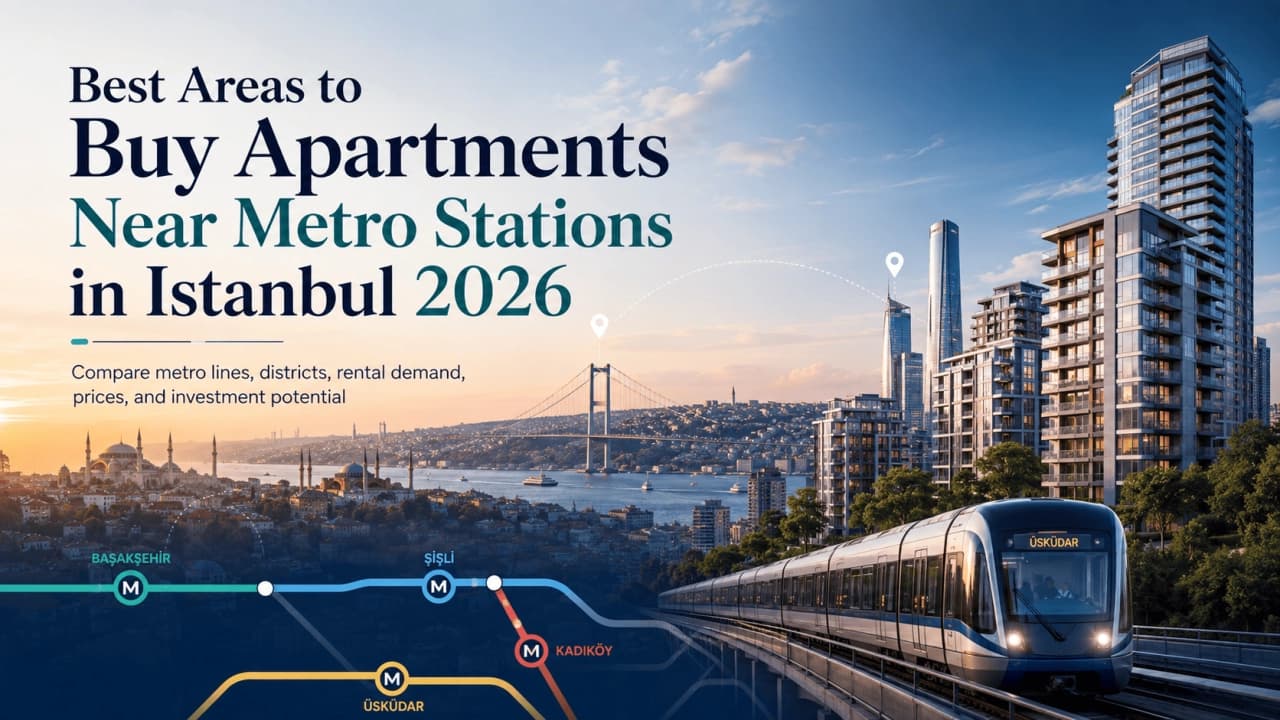
In a city as large and geographically complex as Istanbul, transportation can be just as important as the apartment itself.
A property may offer modern architecture, attractive amenities, and a competitive purchase price, but if residents face a difficult daily commute, its rental and resale appeal can be limited.
This is why apartments near metro stations in Istanbul deserve particular attention from foreign buyers and real estate investors.
Metro access can improve the practical value of a property by connecting residents with:
- Business districts
- Universities
- Hospitals
- Shopping centers
- Airports
- Interchange stations
- Central neighborhoods
- Other parts of the rail and public transport network
Istanbul currently has an extensive and expanding rail network. Metro Istanbul lists operating lines including M2, M3, M4, M5, M6, M7, M8, and M9, in addition to tram and funicular services, while its official network maps also show interchange connections with other transportation systems.
But simply buying an apartment advertised as “near metro” does not automatically create a good investment.
Investors must ask more detailed questions:
- How far is the apartment from the station entrance?
- Is the walk practical?
- Which metro line serves the station?
- Where does that line go?
- Does it connect to major employment centers?
- Are there useful interchange stations?
- What kind of tenants use the area?
- How much extra am I paying for metro access?
- Is the station already operating, under construction, or only proposed?
These questions are important because two apartments located near different metro stations can have completely different investment profiles.
An apartment near Levent on the M2 serves a different market from an apartment near Kartal on the M4. A property near Kağıthane benefits from different connections than one near Başakşehir or Üsküdar.
The purpose of this guide is therefore not simply to identify properties close to public transport.
It is to determine which metro-connected locations provide the strongest combination of accessibility, tenant demand, purchase price, and long-term resale potential.
Why Transportation Is Critical When Buying Property in Istanbul
Istanbul stretches across both Europe and Asia and contains residential, commercial, educational, healthcare, and industrial centers spread across a very large urban area.
For residents, daily travel can therefore become one of the most important aspects of quality of life.
A tenant may like an apartment but reject it if commuting to work requires:
- Multiple buses
- Heavy road traffic
- Long walking distances
- Unpredictable travel times
Metro-connected properties reduce some of this dependence on road conditions.
For investors, transportation therefore affects not just convenience but the size of the potential tenant and future buyer pool.
Transportation Expands the Tenant Pool
Suppose an apartment is located near a metro line that provides practical access to several employment centers.
The potential tenant pool may include people working in multiple districts rather than only those employed nearby.
This is particularly important for smaller investment apartments such as:
- Studios
- 1+1 units
- Compact 2+1 apartments
because these properties commonly target professionals, couples, and younger renters who may prioritize commuting convenience.
Transportation Matters to Families Too
Metro proximity is not only valuable for young professionals.
Families may also benefit from convenient access to:
- Schools
- Universities
- Hospitals
- Shopping
- City centers
However, families may place more importance on combining transportation with:
- Larger apartment layouts
- Parks
- Parking
- Schools
- Quiet residential streets
Therefore, the best metro location for a family investor may differ from the best metro location for a corporate rental investor.
How Metro Access Can Affect Property Value
Metro access can create value because transportation changes the practical accessibility of a location.
A neighborhood that once required a long car or bus journey may become much easier to reach when integrated into a rail system.
However, investors should avoid oversimplifying this relationship.
The correct statement is not:
“Metro station = guaranteed property appreciation.”
A better investment principle is:
Metro connectivity can strengthen property demand when it improves access to places where people genuinely need to travel.
The effect depends on several factors.
The Importance of the Metro Line
Not every station provides the same investment value.
A line serving major:
- Business centers
- Universities
- Transportation interchanges
- Central neighborhoods
- Airports
may create greater practical accessibility than a station serving a relatively limited corridor.
For example, the M2 connects central and northern European-side locations and currently carries roughly 500,000 passengers per day according to Metro Istanbul. The line serves important stations across the Yenikapı–Hacıosman corridor and includes access toward major central and business areas.
The M4 provides an equally important Asian-side corridor, connecting Kadıköy with locations including Acıbadem, Kozyatağı, Bostancı, Maltepe, Kartal, Pendik, and Sabiha Gökçen Airport. Metro Istanbul reports 23 stations along the line.
The investment value of a station should therefore be evaluated through the destinations it makes accessible.
How Metro Access Can Affect Rental Demand
For rental investors, metro accessibility can be particularly valuable because tenants frequently make housing decisions around daily commuting.
Consider two comparable apartments.
Apartment A
- Modern 1+1
- 400 meters from a metro station
- Direct rail access to major employment districts
Apartment B
- Similar size and condition
- 2.5 kilometers from the nearest station
- Bus or car required for most commuting
Apartment B might be cheaper.
That does not automatically make Apartment A the better investment.
But Apartment A may potentially benefit from:
- Larger tenant pool
- Easier marketing
- Greater appeal to professionals
- Reduced dependence on car ownership
- Stronger resale positioning
The investor should compare whether these advantages justify the additional purchase price.
Rental Demand Depends on Where the Metro Goes
Being near a station matters less if the line does not serve destinations important to the target tenant.
A professional working in Maslak may value access to the M2 corridor.
Someone commuting across the Asian side may prioritize the M4.
A tenant living around Kağıthane may benefit from the M7 and its interchange connections.
Metro Istanbul confirms that M7 currently connects locations including Mecidiyeköy and Kağıthane and integrates with M2 and Metrobus at Mecidiyeköy, M11 at Kağıthane, and M3 at Mahmutbey.
This illustrates an important investment principle:
Interchange quality can be as important as the station itself.
What Does “Near Metro” Actually Mean?
Property advertisements frequently use phrases such as:
- Walking distance to metro
- Metro nearby
- Close to metro
- Five minutes from metro
These descriptions should always be independently verified.
There is no reason for an investor to accept “near metro” without checking the actual route.
A practical investment framework can be used.
0–500 Meters: Excellent Metro Accessibility
For many buyers and tenants, this can represent genuine walking-distance convenience.
A property within this range may be particularly attractive to:
- Professionals
- Students
- Car-free households
- Corporate tenants
But investors must still check the quality of the walk.
500 Meters–1 Kilometer: Very Good
This can still provide strong accessibility depending on:
- Street gradient
- Crossings
- Pavements
- Station entrance location
- Weather exposure
A flat 900-meter walk may be easier than a steep 500-meter route.
1–1.5 Kilometers: Evaluate Carefully
At this distance, the property may technically be within walking range but no longer feel conveniently connected to many tenants.
The investor should physically examine the route.
Beyond 1.5 Kilometers
Marketing the property as “near metro” becomes less useful from an investment perspective unless:
- There is convenient feeder transport
- The station remains exceptionally accessible
- The local tenant market accepts the distance
These distance bands are not an official Istanbul transport standard. They are a practical property-investment framework for comparing apartments.
Walking Distance Matters More Than Straight-Line Distance
Online maps can show that a building is only 600 meters from a metro station.
But the actual pedestrian route might be:
1.1 kilometers
because of:
- Highways
- Railway lines
- Fenced developments
- Hills
- Limited crossings
- Large blocks
This is why investors should evaluate the route from:
Building Entrance → Actual Station Entrance
not simply measure the geographic distance between two map points.
Station Entrances Matter
Large metro stations may have several entrances.
One side of the station may be considerably closer to a property than another.
For investment analysis, ask:
- Which entrance is closest?
- Is that entrance always open?
- Does the route require major road crossings?
- Is the walk comfortable at night?
- Is the pavement suitable?
- Is the route uphill?
The more convenient the daily journey, the more meaningful the transportation advantage becomes.
Metro vs Marmaray vs Metrobus
Istanbul investors should not evaluate metro access in isolation.
The wider public transportation system contains several important forms of high-capacity transport.
Metro
Metro lines provide direct rail connections through many residential and commercial districts.
The city's current network includes major lines such as:
- M2
- M3
- M4
- M5
- M7
- M8
- M9
along with additional metro services.
For property investors, metro is particularly attractive because stations generally provide predictable fixed-location accessibility that future buyers can easily understand.
Marmaray
Marmaray provides another important rail axis because it connects the European and Asian sides through the Bosphorus rail tunnel.
Its value becomes particularly powerful where it integrates with metro lines.
For example, Metro Istanbul confirms that passengers on M4 can transfer to Marmaray at Ayrılık Çeşmesi.
For property investment, this means an apartment does not necessarily need to be located near the most central districts if its transport connections make those areas easily accessible.
Metrobus
Metrobus provides a high-capacity road-based transit corridor and integrates with several metro stations.
Examples include:
- M2/M7 integration around Mecidiyeköy
- M4 integration at Ünalan
- Other connections shown across Istanbul's public transport network.
For investors, being close to both metro and Metrobus can significantly broaden transportation options.
Interchange Stations Can Be Especially Valuable
A station serving only one line provides access to that corridor.
An interchange station can provide access to several.
From an investment perspective, this distinction matters.
Consider a tenant who changes jobs.
If the apartment is located near a highly connected interchange, the tenant may still be able to reach the new workplace conveniently.
This can make the location relevant to a wider range of residents.
Mecidiyeköy
Mecidiyeköy is a strong example.
The M7 integrates there with:
- M2
- Metrobus
giving residents access to several important transportation directions.
Kağıthane
Kağıthane is another important connection point.
The M7 integrates with M11 at Kağıthane, strengthening access beyond the immediate local corridor.
Kozyatağı
On the Asian side, Metro Istanbul states that M4 passengers can transfer to M8 at Kozyatağı.
Ayrılık Çeşmesi
M4 connects with Marmaray at Ayrılık Çeşmesi, creating an important cross-city rail interchange.
For investors, these examples demonstrate why evaluating connections is more useful than simply counting nearby stations.
Existing Metro vs Future Metro
Future metro development can create interesting investment opportunities, but it also introduces additional uncertainty.
Investors should classify transportation infrastructure into three categories.
Operating Station
This provides the highest level of certainty.
The investor can already evaluate:
- Actual travel time
- Passenger usage
- Walking route
- Interchanges
- Neighborhood behavior
- Existing rental demand
For conservative buyers, operating infrastructure provides the strongest evidence.
Under-Construction Station
An under-construction station can potentially create future value.
However, the investor must consider:
- Construction schedule
- Opening risk
- Exact station location
- Future interchange
- Whether the market has already priced in the improvement
Metro Istanbul maintains separate official network maps showing both operating rail systems and lines under construction, which provides a more reliable starting point than relying solely on developer marketing material.
Proposed or Conceptual Station
A proposed transportation project carries considerably greater uncertainty.
Investors should be very cautious when a property's entire sales argument depends on:
“A metro is planned here.”
Before attaching an investment premium to future transport, determine whether the project is:
- Officially approved
- Tendered
- Under construction
- Merely proposed
A useful hierarchy is:
Operating > Under Construction > Proposed
in terms of investment certainty.
Do Not Pay for Future Metro Access Twice
Imagine an area where a new metro line is already widely known.
Developers may have increased apartment prices in anticipation of the future station.
The investor therefore needs to ask:
Has the expected transportation benefit already been included in today's property price?
If the answer is yes, purchasing before the station opens does not automatically mean the investor is entering “early.”
Successful investment depends on the difference between:
Price Paid Today
and
Future Market Value
not simply on whether a new line is being built.
What Makes a Metro Station Good for Property Investment?
Not every metro station creates the same investment opportunity.
A useful evaluation model includes several factors.
Access to Employment
Stations that provide convenient travel to major employment centers can support professional tenant demand.
Examples of employment-oriented destinations include:
- Levent
- Maslak
- Şişli
- Ataşehir and surrounding business areas
For rental investors, commuting relevance should be one of the first considerations.
Interchange Connections
Stations connecting multiple transport systems can expand the tenant pool.
The strongest locations may combine:
Metro + Metro
or:
Metro + Marmaray
or:
Metro + Metrobus
rather than depending on one isolated line.
Universities
University access may create demand from:
- Students
- Graduate students
- Academic staff
- University employees
However, student-focused investment should also consider:
- Apartment size
- Rent affordability
- Furnishing
- Tenant turnover
Hospitals
Large medical centers can generate demand from:
- Doctors
- Nurses
- Healthcare employees
- Patients' families
- Medical professionals
A metro station serving a healthcare cluster may therefore have rental potential even if it is not located in a traditional business district.
Shopping and Daily Services
Transportation alone does not create a desirable neighborhood.
Tenants also need:
- Supermarkets
- Restaurants
- Shopping
- Parks
- Pharmacies
- Everyday services
A metro-connected apartment in a functioning residential neighborhood is generally more attractive than an isolated project located beside a station.
Housing Supply
Investors must also examine competition.
If thousands of nearly identical apartments surround one station, owners may compete heavily for:
- Tenants
- Buyers
Strong transportation cannot completely eliminate oversupply risk.
Purchase Price
Metro access has value, but investors should not pay an unlimited premium for it.
A good metro investment requires:
Transportation Advantage + Rational Purchase Price
rather than transportation access at any cost.
How to Measure the Metro Premium
The metro premium is the additional amount a buyer pays because one property has better transportation access than another.
Consider two hypothetical apartments.
Apartment A
- Purchase price: $220,000
- 350 meters from metro
- Similar size and building quality
Apartment B
- Purchase price: $190,000
- 2.5 kilometers from metro
- Similar size and building quality
Apartment A carries a:
$30,000 purchase premium
The investor should now ask:
- Can Apartment A achieve higher rent?
- Will it experience lower vacancy?
- Will more buyers want it at resale?
- Does the station provide useful connections?
- Is the $30,000 premium justified?
If Apartment A generates only a small additional rent and the station is not particularly useful, the premium may be excessive.
If it attracts significantly broader tenant demand and greater resale liquidity, paying more may be rational.
The key principle is:
Never pay a metro premium unless future tenants and buyers are also likely to value it.
Metro Access Does Not Replace Property Quality
Transportation is powerful, but it cannot rescue every property.
An apartment next to a metro station can still be a poor investment if it has:
- Bad layout
- Weak construction
- Excessive aidat
- Severe noise
- Poor natural light
- Overpriced purchase price
- Weak building management
Investors should therefore avoid making metro proximity the only selection criterion.
A stronger framework is:
Property Quality + Metro Access + Correct Price + Tenant Demand
Metro Access Does Not Replace Micro-Location
Two apartments can both be 500 meters from the same station and still have very different investment value.
One may be located:
- On a quiet residential street
- Near shops
- With easy pedestrian access
The other may be:
- Beside a highway
- On a steep hill
- Surrounded by industrial buildings
This is why micro-location remains essential.
Always visit or independently inspect the route between:
Property → Station → Daily Services
before purchasing.
Key Takeaways
Metro access is one of the most important transportation factors to consider when buying an apartment in Istanbul, but it should be evaluated as part of a wider investment strategy.
Istanbul's current rail network includes major lines such as M2, M3, M4, M5, M7, M8, and M9, with numerous integrations across the wider transportation system.
Major corridors demonstrate different investment profiles.
The M2 connects central and northern European-side destinations and carries around 500,000 passengers daily.
The M4 connects Kadıköy with major Asian-side locations including Kozyatağı, Bostancı, Maltepe, Kartal, Pendik, and Sabiha Gökçen Airport, while also providing transfers to Marmaray, Metrobus, and M8.
The M7 serves important European-side locations including Mecidiyeköy and Kağıthane and connects with M2, Metrobus, M11, and other rail services.
For property investors, however, the correct question is not simply:
“Is this apartment near a metro?”
The stronger questions are:
- How far is the actual station entrance?
- Is the walking route practical?
- Which line serves the station?
- Where can tenants travel without difficult transfers?
- Is it an interchange station?
- Which employment centers are accessible?
- Is the station operating or only planned?
- How much extra am I paying for this accessibility?
- Will future tenants and buyers value the same advantage?
The best transportation-based investment is therefore not necessarily the apartment closest to any metro station.
It is the property where:
Useful Metro Access + Strong Micro-Location + Correct Purchase Price + Real Tenant Demand
work together.
Best Metro-Connected Areas on Istanbul's European Side
The European side of Istanbul contains some of the city's most important business districts, established residential neighborhoods, new development corridors, and major transportation interchange points.
For property investors, the strongest metro-connected areas are not necessarily those located closest to the historic center.
A better approach is to identify locations where rail access connects residential demand with:
- Employment centers
- Business districts
- Universities
- Hospitals
- Shopping areas
- Other metro lines
- Marmaray
- Metrobus
The following areas deserve particular attention.
Levent — M2
Levent is one of Istanbul's most established business and premium residential districts.
Its investment appeal is strongly connected to the M2 Yenikapı–Hacıosman corridor, one of the most heavily used metro lines in Istanbul. Metro Istanbul reports that the M2 carries approximately 500,000 passengers per day and connects central and northern European-side locations through 16 stations.
Levent is especially relevant for property investors targeting:
- Corporate executives
- Finance professionals
- International employees
- High-income professionals
- Long-term business tenants
Because employment demand already exists in and around Levent, investors are not relying solely on future neighborhood development.
Best Property Types
Potentially suitable properties include:
- Premium 1+1 apartments
- Compact 2+1 apartments
- Furnished executive residences
- Modern apartments within walking distance of M2
Investment Strength
Levent's primary advantage is not affordability.
It is the combination of:
Employment + Metro + Centrality + Established Demand
For rental-focused investors, the main question is whether the premium purchase price still produces an acceptable net return.
Main Risk
Levent is already an established premium market.
Investors may pay substantially more for both the district and metro accessibility, so rental yield should be calculated carefully rather than assuming that high rent automatically means high return.
Şişli and Mecidiyeköy — M2 + M7 + Metrobus
Şişli and Mecidiyeköy represent one of Istanbul's strongest public-transport interchange environments.
The area benefits from both the M2 and M7, with Metrobus integration at Mecidiyeköy. Metro Istanbul confirms that M7 passengers can transfer to the M2 and Metrobus at Mecidiyeköy.
This provides access toward multiple parts of the city and makes the area particularly attractive to tenants who do not want to depend on a car.
Typical Tenant Profile
Potential tenants include:
- Young professionals
- Healthcare workers
- Corporate employees
- Expats
- Couples
- International residents
Best Property Types
For rental investment:
- Studio apartments in suitable micro-locations
- 1+1 apartments
- Compact 2+1 units
- Furnished residences
- Professionally managed apartments
Why Mecidiyeköy Is Important
From an investment perspective, Mecidiyeköy demonstrates why interchange quality matters.
A tenant is not limited to one metro corridor.
The area provides connections into multiple transport systems, potentially increasing the number of employment areas accessible from the property.
Main Risk
Centrality creates higher purchase prices, traffic, noise, and dense development.
Investors should inspect the street itself instead of assuming every property carrying a Şişli or Mecidiyeköy address offers the same residential quality.
Kağıthane — M7 + M11 Connection
Kağıthane has become particularly interesting because of its transformation from a formerly industrial area into a major modern residential and investment corridor.
The M7 runs directly through Kağıthane. Metro Istanbul also confirms integration at Kağıthane with the M11 Gayrettepe–Istanbul Airport–Halkalı line.
This strengthens Kağıthane's role as more than simply a local residential market.
Typical Tenant Profile
Kağıthane can appeal to:
- Young professionals
- Couples
- Business-district employees
- International tenants
- Small families
Best Property Types
The investment market is particularly suited to:
- 1+1 apartments
- Compact 2+1 units
- New-build residences
- Furnished professional rentals
Why Investors Consider Kağıthane
Its investment case combines:
- Relative proximity to central business districts
- M7 accessibility
- Airport-line integration
- New housing stock
- Urban regeneration
This combination can make Kağıthane relevant to investors seeking a balance between central connectivity and more accessible entry pricing than established premium districts.
Main Risk
Kağıthane is highly micro-location dependent.
Some developments have excellent station access, while others require steep or inconvenient walking routes.
The phrase “Kağıthane metro nearby” should therefore always be verified using the exact apartment address.
Maslak — M2 Business Corridor
Maslak is one of Istanbul's major corporate districts and sits within the wider M2 transportation corridor.
The M2 connects the northern European side with central Istanbul and includes stations serving the Levent and northern business axis.
For real estate investors, Maslak is particularly relevant when targeting corporate demand.
Typical Tenant Profile
- Corporate executives
- Financial-sector employees
- Technology professionals
- International employees
- Senior management
Best Property Types
- Premium 1+1 apartments
- Executive 2+1 residences
- Furnished corporate units
- Professionally managed residences
Investment Strength
Maslak combines:
Metro Connectivity + Corporate Employment + Modern Housing
This can support a relatively stable professional rental market.
Main Risk
Premium developments may carry substantial:
- Purchase prices
- Aidat
- Management fees
A luxury apartment can therefore be an excellent property while producing only a moderate percentage rental yield.
Başakşehir and Kayaşehir — M3
Başakşehir offers a substantially different investment profile from central districts such as Şişli or Levent.
It is more family-oriented and includes large modern residential developments, hospitals, and newer urban infrastructure.
The M3 Bakırköy Sahil–Kayaşehir Merkez line now operates across 20 stations and directly serves Başakşehir, the Çam and Sakura City Hospital area, and Kayaşehir before continuing south toward Bakırköy.
The current line also provides transfers to:
- M11 at Kayaşehir Merkez
- M9 at İkitelli Sanayi
- M7 at Mahmutbey
- M1B at Kirazlı
- Marmaray and Bakırköy rail connections farther south.
Typical Tenant Profile
Başakşehir is particularly relevant to:
- Families
- Healthcare professionals
- Long-term residents
- International families
Best Property Types
- 2+1 apartments
- 3+1 apartments
- Family residences in compounds
- Properties within practical walking distance of M3
Investment Strength
The M3 has made the district considerably better integrated with the wider city than a purely car-dependent suburban market.
For family rentals, this transportation improvement can complement:
- Larger apartments
- Hospitals
- Schools
- Modern residential facilities
Main Risk
Başakşehir covers a large geographical area.
A property can technically be located in Başakşehir while still being inconveniently far from the metro.
Micro-location remains essential.
Bakırköy — M3 and Marmaray Connectivity
Bakırköy has long been an established residential district on the European side.
The extension of M3 to Bakırköy Sahil has added another significant rail connection to an already mature part of Istanbul. Metro Istanbul states that the M3 began operating between Bakırköy Sahil and Kayaşehir Merkez following completion of the southern extension in March 2024.
The line also provides a transfer connection with the Marmaray corridor and Bakırköy rail station through Özgürlük Meydanı.
Typical Tenant Profile
- Families
- Professionals
- Long-term local residents
- International families
- Coastal lifestyle tenants
Best Property Types
- 2+1 apartments
- 3+1 apartments
- Modern coastal residences
- Renovated resale properties near rail access
Investment Strength
Bakırköy combines something relatively valuable:
Established Neighborhood + Coastal Lifestyle + Expanded Rail Connectivity
This can make the area attractive to buyers seeking both lifestyle and investment characteristics.
Main Risk
Building age varies considerably across Bakırköy.
Transportation quality should therefore be evaluated alongside:
- Structural condition
- Building age
- Parking
- Renovation needs
Ataköy — M9 + Marmaray
Ataköy is one of the strongest examples of multimodal transportation improving a premium residential location.
The M9 Ataköy–Olimpiyat line currently contains 14 stations. Metro Istanbul confirms that Ataköy station connects directly with the B1 Halkalı–Gebze Marmaray suburban railway.
M9 also integrates with:
- M3 at İkitelli Sanayi
- M1A and Metrobus at Yenibosna
- M11 at Olimpiyat.
Typical Tenant Profile
- Families
- Professionals
- International residents
- Premium tenants
- Buyers seeking coastal living
Best Property Types
- Sea-view 2+1 units
- Premium family apartments
- Modern waterfront residences
- Furnished apartments for international tenants
Investment Strength
Ataköy combines:
Coastal Residential Demand + M9 + Marmaray
This offers a different investment proposition from purely central business districts.
Main Risk
Premium coastal projects may be expensive and can carry significant management fees.
The transportation advantage should not be used to justify an unlimited price premium.
Basin Express Corridor — Transportation and Business Growth
The Basin Express corridor has developed around a mixture of:
- Business activity
- Hotels
- Residential towers
- New developments
- Airport-oriented accessibility
Its investment story is not based on one station alone.
The wider corridor benefits from access to transportation systems including the M9 and connections toward other metro lines.
For example, M9 connects Ataköy through Yenibosna and the İkitelli area toward Olimpiyat and provides transfers to several other rail systems.
Best For
- Corporate rentals
- Modern 1+1 units
- Investment-oriented residences
- Buyers seeking newer developments
Main Risk
The corridor contains many investment-focused developments.
Investors should evaluate future supply because a large number of similar units can increase both rental and resale competition.
Best Metro-Connected Areas on Istanbul's Asian Side
The Asian side has developed an increasingly integrated rail network.
The M4 provides a major east-west corridor, while M5 connects Üsküdar with northern and eastern residential districts. M8 acts as an important north-south connector between Bostancı, Kozyatağı, and Dudullu.
For investors, this creates several different strategies ranging from established lifestyle markets to more affordable growth corridors.
Kadıköy — M4
Kadıköy is one of the most established residential and lifestyle centers on Istanbul's Asian side.
It is the western terminus of the M4 Kadıköy–Sabiha Gökçen Airport line, which currently operates across 23 stations and extends all the way to Sabiha Gökçen Airport.
Kadıköy station also provides connections with:
- Ferries
- Sea buses
- T3 tram services.
Typical Tenant Profile
Kadıköy can attract:
- Young professionals
- Couples
- Families
- Expats
- Students
- International residents
Best Property Types
- Renovated 1+1 apartments
- 2+1 apartments
- Furnished urban units
- Modern residences near transportation
Investment Strength
Kadıköy's key advantage is the combination of:
Transport + Lifestyle + Established Residential Demand
The district does not depend solely on speculative future infrastructure to attract tenants.
Main Risk
Prime Kadıköy locations can carry high acquisition prices.
Investors seeking rental yield should calculate whether the lifestyle premium is adequately reflected in rent.
Acıbadem — M4
Acıbadem sits on the M4 corridor shortly after Kadıköy and Ayrılık Çeşmesi.
It provides a more residential environment than central Kadıköy while retaining strong access to the M4.
Typical Tenant Profile
- Professionals
- Families
- Healthcare workers
- Long-term residents
Investment Strength
Acıbadem can appeal to investors looking for a balance between:
- Residential quality
- Central Asian-side access
- Metro connectivity
Best Property Types
- 2+1 apartments
- Family-oriented residences
- Modernized resale apartments
Main Risk
Properties marketed under the wider Acıbadem name can vary significantly in actual walking distance to M4.
Kozyatağı — M4 + M8
Kozyatağı is one of the strongest interchange investment locations on the Asian side.
Metro Istanbul confirms that passengers can transfer between M4 and M8 at Kozyatağı.
This gives the area both east-west and north-south rail access.
Typical Tenant Profile
- Corporate professionals
- Finance employees
- Families
- Young professionals
- Tenants working around Ataşehir
Best Property Types
- 1+1 apartments
- 2+1 residences
- Corporate rentals
- Modern family apartments
Investment Strength
Kozyatağı demonstrates the value of an interchange.
Residents can use M4 to move toward Kadıköy or eastern Istanbul while M8 provides access toward Bostancı and Dudullu.
Main Risk
The investor should avoid paying an excessive interchange premium without comparing rental income with nearby non-interchange locations.
Bostancı — M4 + M8 + Marmaray
Bostancı offers one of the strongest multimodal transport environments on the Asian side.
M4 serves Bostancı, while M8 begins there. Metro Istanbul also confirms that the M8 Bostancı station connects with:
- Marmaray
- High-speed rail
- Sea lines
- Sea buses.
Typical Tenant Profile
- Professionals
- Families
- Long-term residents
- Coastal lifestyle tenants
Investment Strength
Bostancı combines:
Metro + Marmaray + Maritime Transport + Coastal Residential Demand
This makes it particularly attractive from a connectivity perspective.
Best Property Types
- 2+1 apartments
- Modern coastal residences
- Family apartments
- Renovated resale units
Main Risk
Premium pricing near the coast and transportation hubs can reduce yield.
Bostancı may be stronger for a combined lifestyle + resale + rental strategy than a pure high-yield strategy.
Maltepe — M4
Maltepe is directly served by the M4 corridor between central Kadıköy and the eastern Asian side.
It can offer a more accessible entry point than premium Kadıköy or Bostancı locations while retaining rail access.
Typical Tenant Profile
- Families
- Professionals
- Long-term residents
- Asian-side commuters
Best Property Types
- 1+1 apartments near transport
- 2+1 family apartments
- Sea-view residences where appropriately priced
Investment Strength
Maltepe can provide a useful middle ground between:
Price + Metro + Residential Demand
Main Risk
The district extends from the coastline toward inland neighborhoods.
Station accessibility and micro-location can therefore vary substantially.
Kartal — M4
Kartal has become one of the most important redevelopment markets along the M4 corridor.
The line directly serves Kartal before continuing toward Pendik and Sabiha Gökçen Airport.
Typical Tenant Profile
- Professionals
- Families
- Healthcare employees
- Airport-oriented tenants
- Long-term residents
Best Property Types
- Modern 1+1 units
- 2+1 apartments
- New-build residences
- Selected sea-view properties
Investment Strength
Kartal can be attractive because it combines:
- M4 access
- New residential development
- More accessible pricing than prime Kadıköy
- Mixed professional and family demand
Main Risk
Not every new high-rise in Kartal represents strong value.
Investors should compare purchase price, aidat, walking distance to M4, and future supply.
Pendik — M4
Pendik is another major location along the M4 corridor.
Metro Istanbul lists Pendik station before the line continues through Tavşantepe and eastern stations toward Sabiha Gökçen Airport.
The official M4 information also notes bus access from Pendik metro toward the high-speed train station.
Typical Tenant Profile
- Families
- Airport employees
- Professionals
- Long-term residents
- Asian-side commuters
Investment Strength
Pendik may suit investors prioritizing:
- Lower entry price
- Rail access
- Airport corridor
- Long-term residential demand
Main Risk
Distance from central Istanbul remains relevant.
Properties should ideally provide genuine walking access to M4 rather than merely being located somewhere within Pendik.
Üsküdar — M5 + Marmaray + Ferry
Üsküdar provides one of the strongest transport combinations on the Asian side.
The M5 Üsküdar–Sultanbeyli line begins at Üsküdar, and Metro Istanbul confirms direct interchange there with:
- Marmaray
- IETT buses
- Ferry piers.
As of 2026, the M5 has been extended through to Sultanbeyli, with the final Samandıra Merkez–Sultanbeyli phase entering service on May 22, 2026.
Typical Tenant Profile
- Families
- Professionals
- International residents
- Lifestyle buyers
- Cross-Bosphorus commuters
Investment Strength
Üsküdar combines:
Metro + Marmaray + Ferry + Established Neighborhood
This provides multiple alternatives for reaching the European side.
Best Property Types
- 2+1 apartments
- Family residences
- Premium renovated resale apartments
- Selected Bosphorus-view properties
Main Risk
Üsküdar contains both premium and conventional residential submarkets.
Investors should not evaluate the district using one general price assumption.
Ümraniye — M5
The M5 passes directly through Ümraniye and several surrounding residential stations before continuing eastward.
Ümraniye can appeal to investors seeking a more accessible price point than Üsküdar while maintaining direct metro access.
Typical Tenant Profile
- Families
- Professionals
- Office employees
- Long-term residents
Best Property Types
- 1+1 apartments in business-oriented micro-locations
- 2+1 family units
- Modern residential compounds
Investment Strength
The area combines significant residential density with direct M5 access.
Main Risk
Ümraniye is geographically large, and walking distance to metro varies considerably.
Dudullu — M5 + M8
Dudullu is one of the most interesting interchange locations farther inland on the Asian side.
Metro Istanbul confirms direct transfer between M5 and M8 at Dudullu.
This creates both east-west and north-south accessibility.
Typical Tenant Profile
- Families
- Industrial/business employees
- Professionals
- Long-term residents
Investment Strength
Dudullu can be particularly interesting for buyers looking for:
- Interchange connectivity
- Lower entry prices than central Asian-side districts
- Long-term residential demand
Main Risk
It does not have the same lifestyle premium as Kadıköy, Bostancı, or Üsküdar.
The investment thesis should therefore be based primarily on:
Price + Connectivity + Demand
rather than prestige.
Metro-Connected Area Investment Comparison
The following table provides a strategic comparison rather than a guaranteed return forecast.
| Area | Main Rail Access | Typical Tenant | Price Position | Investment Profile |
|---|---|---|---|---|
| Levent | M2 | Executives / Professionals | Premium | Corporate + liquidity |
| Şişli / Mecidiyeköy | M2 + M7 + Metrobus | Professionals / Expats | High | Strong rental demand |
| Kağıthane | M7 + M11 connection | Young professionals | Mid–High | Growth + rental |
| Maslak | M2 corridor | Corporate executives | Premium | Corporate rental |
| Başakşehir | M3 | Families | Mid-range | Family + long-term |
| Bakırköy | M3 + Marmaray connections | Families | Upper Mid–Premium | Lifestyle + resale |
| Ataköy | M9 + Marmaray | Families / International | Premium | Coastal + transport |
| Kadıköy | M4 | Professionals / Expats | Premium | Lifestyle + liquidity |
| Acıbadem | M4 | Families / Professionals | Upper Mid | Residential stability |
| Kozyatağı | M4 + M8 | Corporate / Families | Upper Mid | Interchange investment |
| Bostancı | M4 + M8 + Marmaray | Families / Professionals | Premium | Multimodal + lifestyle |
| Maltepe | M4 | Families / Professionals | Mid-range | Value + metro |
| Kartal | M4 | Professionals / Families | Mid-range | Growth + rental |
| Pendik | M4 | Families / Airport workers | More Accessible | Long-term growth |
| Üsküdar | M5 + Marmaray + Ferry | Families / Professionals | Premium | Connectivity + lifestyle |
| Ümraniye | M5 | Families / Professionals | Mid-range | Residential + business |
| Dudullu | M5 + M8 | Families / Workers | More Accessible | Interchange + value |
Which Metro-Connected Areas Stand Out?
Different areas suit different objectives.
For Corporate Rental Demand
Strong candidates include:
- Levent
- Maslak
- Şişli
- Mecidiyeköy
- Kozyatağı
These locations combine transport with major employment access.
For Young Professional Rentals
Consider:
- Kağıthane
- Şişli
- Kadıköy
- Kartal
Compact apartments can be particularly relevant when located within genuine walking distance of rail.
For Families
Potentially stronger options include:
- Başakşehir
- Bakırköy
- Bostancı
- Üsküdar
- Ümraniye
- Maltepe
Here, metro access should be combined with schools, parks, hospitals, and larger apartment layouts.
For Lower Entry Prices
Investors may compare:
- Pendik
- Dudullu
- Selected Ümraniye locations
- Selected Kartal locations
but lower purchase price should never compensate for poor walking access or weak apartment quality.
Key Takeaways
Istanbul's strongest metro-connected property markets serve very different investment strategies.
On the European side, M2 remains particularly important for premium business locations such as Levent and the northern business corridor, while M7 strengthens areas such as Şişli, Mecidiyeköy, and Kağıthane.
The M3 now creates a continuous connection between Kayaşehir and Bakırköy Sahil, with interchange opportunities to M11, M9, M7, M1B, Metrobus, and Marmaray-related rail infrastructure.
The M9 has strengthened the Ataköy–İkitelli–Olimpiyat corridor and connects Ataköy directly with Marmaray while providing other important interchanges.
On the Asian side, M4 remains the central east-west investment corridor, connecting Kadıköy with Acıbadem, Kozyatağı, Bostancı, Maltepe, Kartal, Pendik, and Sabiha Gökçen Airport.
The M5 now runs all the way from Üsküdar to Sultanbeyli and integrates with Marmaray, Metrobus, ferries, and M8 at key stations.
Meanwhile, M8 creates an important north-south Asian-side connection and integrates with Marmaray at Bostancı, M4 at Kozyatağı, and M5 at Dudullu.
For investors, however, the strongest lesson remains:
Do not choose a district because it has a metro station. Choose a property because that particular station materially improves the lives of your target tenants and future buyers.
The real investment equation is:
Useful Rail Connection + Walkable Micro-Location + Appropriate Apartment + Rational Purchase Price + Sustainable Demand
Best Metro Areas for Rental Income
Metro access can be especially valuable for rental investors because tenants often make housing decisions around one practical question:
How easily can I travel from this apartment to work, university, shopping, healthcare, and the rest of Istanbul?
However, the best metro-connected area depends heavily on the tenant profile.
A studio near a business district serves a different market from a 3+1 apartment near a family-oriented metro station.
Investors should therefore begin with the tenant rather than the station.
A useful sequence is:
Target Tenant → Required Destinations → Suitable Metro Corridor → Neighborhood → Apartment
rather than:
Metro Station → Any Nearby Apartment
Best Metro Areas for Professionals
Professionals generally prioritize:
- Shorter commuting times
- Direct rail access
- Interchange stations
- Modern apartments
- Reliable internet
- Shopping and restaurants
- Building security
- Practical layouts
Locations worth comparing include:
- Levent
- Maslak
- Şişli
- Mecidiyeköy
- Kağıthane
- Kozyatağı
- Kadıköy
Levent and Maslak
These locations are particularly relevant for tenants employed around Istanbul's major European-side business corridors.
Access to M2 gives residents direct rail connectivity through important central and northern districts. M2 remains an operating part of Istanbul's current rail network in 2026.
Suitable investment units may include:
- Furnished 1+1 apartments
- Compact 2+1 units
- Executive residences
The main challenge is price.
A premium business location can produce high rent while still generating only moderate percentage yield if the apartment is purchased too expensively.
Şişli and Mecidiyeköy
These locations can be particularly strong for tenants whose work or social life requires access to several parts of the city.
The combination of M2, M7, and wider public transport connectivity makes the area less dependent on one corridor. Both M2 and M7 remain operating metro lines in the current network.
Compact apartments can work especially well where:
- Walking distance is genuine
- The building is modern
- Aidat is reasonable
- Street noise is manageable
Kağıthane
Kağıthane may appeal to investors who want professional rental demand without paying the same premium as the most established central business districts.
M7 remains operational in 2026, while the wider Kağıthane transport environment gives the district an increasingly strategic position within the European-side network.
The strongest investment units are often:
- 1+1
- Compact 2+1
- Furnished modern apartments
But micro-location is critical.
A project with a Kağıthane address is not automatically a metro-oriented investment.
Best Metro Areas for Families
Families usually evaluate transportation differently.
They may be willing to live farther from the historic center if the neighborhood provides:
- Larger apartments
- Schools
- Parks
- Hospitals
- Parking
- Shopping
- Secure residential compounds
Metro access then becomes a way to improve the practicality of suburban or semi-central family living.
Potential areas include:
- Başakşehir
- Bakırköy
- Bostancı
- Maltepe
- Üsküdar
- Ümraniye
Başakşehir
Başakşehir can be particularly relevant for family investors because the M3 connects a large residential corridor with other parts of Istanbul.
The current M3 operates between Bakırköy and Kayaşehir as part of the 2026 network.
Family-oriented investors may prioritize:
- 2+1 apartments
- 3+1 apartments
- Parking
- Green space
- Schools
- Shorter walking distance to M3
Bostancı
Bostancı combines rail accessibility with a mature residential environment.
For many family tenants, this can be stronger than simply living next to a high-capacity transport corridor in a less established neighborhood.
The area is served within Istanbul's current M8 network and integrates into the wider Asian-side transport system.
Üsküdar and Ümraniye
The M5 corridor can be attractive to families seeking Asian-side residential living with direct rail connectivity.
As of 2026, Metro Istanbul lists M5 as the Üsküdar–Sultanbeyli line within the operating network.
The investment decision should still focus on the individual neighborhood.
A family tenant may prefer a slightly longer metro walk in exchange for:
- Better school access
- Quieter streets
- Larger apartment
- Better parking
Best Areas for Students and Young Professionals
Students and younger tenants often place particularly high value on:
- Public transport
- Walkability
- Smaller apartments
- Cafés
- Social life
- Universities
- Affordable commuting
Areas to investigate include:
- Kadıköy
- Şişli
- Kağıthane
- Selected parts of Maltepe
Kadıköy
Kadıköy is particularly attractive because transportation is combined with an established lifestyle environment.
The M4 remains the principal operating metro corridor extending from Kadıköy toward Sabiha Gökçen Airport in the current network.
The main limitation for investors is purchase price.
Lifestyle demand can support strong occupancy, but investors must still determine whether the rent justifies the capital invested.
Best Metro Areas by Budget
Budget should influence metro strategy.
There is no reason to buy the most central metro-connected apartment if doing so produces poor investment economics.
It is more useful to divide potential locations into broad strategic categories.
These categories are relative rather than fixed price rankings, because actual property prices vary by building, street, apartment quality, and market conditions.
Premium Metro-Connected Areas
Potential premium markets include:
- Levent
- Maslak
- Şişli
- Kadıköy
- Üsküdar
- Bostancı
- Ataköy
These areas can offer:
- Strong location recognition
- Established demand
- Better liquidity
- Lifestyle advantages
- Business access
But the investor may face:
- Higher acquisition price
- Higher aidat
- Lower percentage yield
Premium locations often work best for buyers prioritizing a combination of:
Capital Preservation + Quality + Rental Demand + Resale Liquidity
rather than maximum gross yield.
Mid-Range Metro Investment Areas
Potential examples include:
- Kağıthane
- Kartal
- Maltepe
- Ümraniye
- Selected Başakşehir locations
- Selected Kozyatağı surroundings
These locations may provide a more balanced relationship between:
- Purchase price
- Connectivity
- Rental demand
- New housing stock
For many investors, this middle category can be more attractive than either ultra-premium central property or very inexpensive peripheral property.
More Accessible Entry Markets
Investors with lower entry budgets may investigate:
- Pendik
- Dudullu
- Outer metro-connected Başakşehir locations
- Selected eastern Asian-side corridors
The advantage may be:
- Lower purchase price
- Larger apartments for the budget
- Longer-term growth potential
The disadvantage can be:
- Longer commuting time
- Weaker lifestyle premium
- Greater future supply
- Lower resale liquidity
The correct question is not:
“Where is the cheapest apartment near metro?”
It is:
“Where does my budget buy the strongest combination of real transport access and sustainable demand?”
How Much More Should You Pay for Metro Access?
There is no universal metro premium that investors should automatically accept.
The value of metro access depends on:
- Distance
- Line quality
- Interchanges
- Target tenant
- Alternative transportation
- Neighborhood
- Apartment price
Consider the following hypothetical comparison.
Apartment A
Purchase price:
$230,000
Distance to operating metro:
300 meters
Expected monthly rent:
$1,400
Apartment B
Purchase price:
$200,000
Distance to operating metro:
2.2 kilometers
Expected monthly rent:
$1,250
Apartment A costs:
$30,000 more
but generates only:
$150 more monthly rent
Annual additional rent:
$1,800
If the buyer evaluates only rental income, recovering the $30,000 premium through the additional rent alone would take many years before considering:
- Vacancy
- Aidat
- Taxes
- Opportunity cost
However, Apartment A may also provide:
- Lower vacancy
- Larger tenant pool
- Better resale liquidity
- Stronger future buyer demand
The correct analysis must therefore consider both:
Income Return + Resale Advantage
When Is a Metro Premium Worth Paying?
A premium may be justified when several factors align.
The Station Is Genuinely Walkable
A 300–500 meter convenient walk usually creates more practical value than a property requiring a shuttle or bus.
The Line Serves Important Destinations
A station is more valuable when tenants can reach:
- Business districts
- Universities
- Major transfer stations
- Central neighborhoods
without complicated journeys.
The Apartment Still Produces Competitive Rent
Paying more can be reasonable if tenants also pay more.
Resale Demand Is Broader
Future buyers may value transport accessibility even if they have different commuting patterns from the current tenant.
Nearby Supply Is Limited
A genuinely scarce walk-to-metro location can be more defensible than an area containing thousands of nearly identical apartments.
When Is the Metro Premium Too High?
Investors should be cautious when:
- Developer pricing is substantially above surrounding completed properties
- Metro access is already fully priced into the apartment
- Rent is only marginally higher
- Aidat is excessive
- The apartment layout is weak
- Numerous competing projects surround the station
Metro cannot justify an unlimited price.
Metro-Connected Property vs Car-Dependent Property
One useful investment comparison is between a metro-oriented apartment and a property where daily life depends primarily on private vehicles.
| Factor | Metro-Connected Property | Car-Dependent Property |
|---|---|---|
| Tenant Pool | Potentially broader | More limited to car users |
| Professionals | Often attractive | Location dependent |
| Students | Stronger potential | Usually weaker |
| Parking Dependency | Lower | Higher |
| Traffic Exposure | Reduced for rail trips | Greater |
| Resale Audience | Potentially broader | More lifestyle specific |
| Operating Metro Certainty | High | Not applicable |
| Parking Importance | Moderate | Often critical |
| Daily Convenience | Strong where walkable | Road dependent |
Neither category is automatically superior.
A car-dependent luxury family development may perform extremely well if:
- Schools are nearby
- Parking is excellent
- Residents have high car ownership
- Road access is strong
Meanwhile, a poor-quality apartment beside a metro station can still underperform.
The investment strategy must match the target buyer.
Existing vs Under-Construction vs Proposed Metro Stations
Future transportation can create investment opportunity, but the level of certainty differs dramatically.
Metro Istanbul currently reports 402.60 km of existing rail systems and 65.40 km under construction, while separately publishing maps for operational and under-construction networks.
For real estate investors, these categories should not be treated equally.
Operating Metro Station
This provides the highest degree of certainty.
Investors can directly evaluate:
- Actual walk
- Travel time
- Transfers
- Passenger activity
- Tenant behavior
- Existing rents
This is generally the safest transportation assumption.
Under-Construction Metro Station
Under-construction infrastructure can provide more potential upside, but it introduces timing risk.
Metro Istanbul currently lists projects under construction including:
- M1B Kirazlı–Halkalı extension
- M7 Kabataş–Yıldız
- M7 Mahmutbey–Esenyurt
- M10 Pendik–Sabiha Gökçen Airport-related section
- M12 Göztepe–Ümraniye.
These official listings provide a more reliable basis for analysis than developer advertising.
However, investors should still investigate:
- Construction progress
- Exact station location
- Expected interchange
- Whether local prices already reflect the project
Proposed Metro
A proposed line carries significantly greater uncertainty.
A property should not receive the same valuation premium simply because a future line appears in a long-term concept.
For conservative investment analysis, use:
Operating Infrastructure = Confirmed Value
Under Construction = Potential Value
Proposed = Speculative Value
Do Not Buy Only Because a Future Metro Is Coming
One of the most common speculative real estate strategies is:
“Buy before the metro opens.”
That can work, but the strategy is incomplete.
The investor must ask:
Was the Property Already Repriced?
Developers may increase prices as soon as a new metro project becomes widely known.
What Happens If Completion Takes Longer?
The buyer may wait several years while receiving no transportation benefit.
Is the Station Actually Close to the Property?
A district can receive a new metro line while a specific apartment remains kilometers from the station.
Does the Line Improve Useful Connectivity?
Not every new line creates the same economic benefit.
Future infrastructure should strengthen an investment thesis—not be the entire thesis.
How to Evaluate an Apartment Near Metro Step by Step
A systematic approach can prevent many purchasing mistakes.
Step 1 — Find the Exact Apartment
Do not start with the district.
Start with the exact:
- Project
- Building
- Block
- Apartment
Step 2 — Identify the Nearest Station
Confirm:
- Station name
- Metro line
- Whether it is operating
- Whether it is under construction
Use official network information rather than relying solely on a developer brochure. Metro Istanbul maintains separate operational and construction maps for this purpose.
Step 3 — Measure Actual Walking Distance
Measure:
Building Entrance → Station Entrance
not straight-line distance.
Then inspect:
- Hills
- Highways
- Crossings
- Pavements
- Lighting
Step 4 — Evaluate the Metro Line
Ask:
- Where does the line go?
- Which business districts does it reach?
- Which universities?
- Which transport hubs?
Step 5 — Evaluate Transfers
Determine whether the station or nearby stations connect with:
- Other metro lines
- Marmaray
- Metrobus
- Ferry
A one-line location can become significantly more useful through a strong interchange.
Step 6 — Identify the Target Tenant
Define whether the apartment is for:
- Professional
- Student
- Couple
- Family
- Corporate tenant
Then ask whether the transport network solves that tenant's needs.
Step 7 — Compare Purchase Price
Find similar properties:
- Near the station
- Farther from the station
- In competing neighborhoods
Calculate the actual premium being paid.
Step 8 — Compare Rent
Investigate whether rent genuinely rises with better station access.
Do not rely on the highest advertised listing.
Use realistic comparable properties.
Step 9 — Calculate Total Investment Return
Include:
- Purchase price
- Transaction costs
- Furnishing
- Aidat
- Management
- Vacancy
Metro access matters only within the wider investment economics.
Step 10 — Evaluate Resale
Ask:
If I sell this apartment five years from now, will transport still be one of its strongest selling points?
If yes, the metro advantage may support long-term liquidity.
Common Mistakes When Buying Property Near Metro
Metro-oriented investing can still fail when buyers make basic errors.
Believing “Near Metro” Without Measuring
Always verify the actual walking route.
Measuring Straight-Line Distance
A property may appear close geographically while roads or terrain make the walk much longer.
Buying Near a Proposed Station as if It Already Exists
Proposed infrastructure should carry a discount for uncertainty.
Paying Too Much for Metro Access
Transportation is valuable, but not at any price.
Ignoring Walking Conditions
Steep streets, highways, unsafe crossings, and poor pavements can destroy the practical advantage.
Ignoring Noise
Extremely close proximity to:
- Major roads
- Station entrances
- Commercial zones
can create noise.
The ideal property may be close enough to walk but far enough to remain residential.
Choosing the Wrong Side of a Station
Large stations can have multiple entrances.
A property 400 meters from the station center might be 900 meters from the useful entrance.
Ignoring Apartment Quality
A poor layout does not become a strong investment simply because the metro is nearby.
Ignoring Aidat
A high-maintenance residence can reduce net yield significantly.
Assuming Every Metro Station Creates Strong Rental Demand
Transport must connect residents with destinations they value.
Ignoring Future Housing Supply
Thousands of new apartments around a station can increase competition.
Ignoring Transfer Stations
Sometimes an apartment slightly farther from the center but close to a powerful interchange offers better practical connectivity.
Buying Only for Appreciation
Metro-oriented property should ideally work as:
Rental + Resale + Lifestyle
rather than depending solely on future price growth.
Frequently Asked Questions About Apartments Near Metro Stations in Istanbul
Is buying property near a metro station a good investment in Istanbul?
It can be.
Metro access can support rental and resale demand when the station provides genuinely useful connectivity and the apartment is purchased at a rational price.
Metro proximity alone does not guarantee investment performance.
How close should an apartment be to the metro?
A practical investment framework is:
- 0–500 m: excellent
- 500 m–1 km: very good
- 1–1.5 km: evaluate carefully
- Beyond 1.5 km: verify whether the property is genuinely metro-oriented
These are investment-analysis guidelines, not official Metro Istanbul standards.
Which Istanbul metro line is best for property investment?
There is no single best line.
Different lines serve different investment markets.
M2 may be particularly relevant for central business-oriented property, while M4 provides a major Asian-side corridor and M5, M7, M8, and M9 each serve different residential and interchange markets. These lines remain part of Istanbul's operating network in 2026.
Is M2 good for property investment?
M2 serves major central and northern European-side areas, making it particularly relevant to professional and corporate housing strategies.
The property still needs to be correctly priced.
Is M4 good for apartment investment?
M4 connects major Asian-side residential districts and continues toward Sabiha Gökçen Airport, making it useful for a wide range of tenant profiles. It remains operational in the current network.
Which metro areas are best for rental income?
Potential candidates include:
- Şişli
- Mecidiyeköy
- Kağıthane
- Levent
- Maslak
- Kadıköy
- Kozyatağı
- Kartal
The best choice depends on purchase price and tenant profile.
Is Kağıthane good for metro-based property investment?
Kağıthane can be attractive for young professional and corporate rental strategies, particularly where apartments offer practical access to M7.
However, walking conditions and project pricing vary considerably.
Is Kartal a good investment near M4?
Kartal can offer an appealing combination of:
- Modern housing
- M4 access
- Family demand
- More accessible pricing than prime Kadıköy
Investors should watch aidat and future apartment supply.
Is Başakşehir well connected by metro?
The M3 currently operates between Bakırköy and Kayaşehir, creating significantly stronger rail access for the broader Başakşehir corridor than a purely car-dependent model.
Exact property-to-station distance still matters.
Is Üsküdar good for metro investment?
Üsküdar benefits from M5 and wider multimodal transport connectivity.
It can be particularly attractive for buyers seeking an established residential location rather than a purely speculative development market. M5 remains operational between Üsküdar and Sultanbeyli in the 2026 network.
Should I buy near an existing or future metro?
Existing metro provides greater certainty.
Under-construction metro may provide more potential upside but introduces timing and execution risk.
Proposed infrastructure should be treated more cautiously.
Are apartments near metro more expensive?
They can carry a location premium, particularly where rail access materially improves commuting.
Investors should calculate whether higher rent, lower vacancy, and stronger resale demand justify the additional purchase price.
Can metro access improve rental demand?
Yes, where the line provides practical access to destinations important to tenants.
The effect is strongest when the apartment is genuinely walkable and the line connects to employment, education, and transport hubs.
Does Marmaray improve property attractiveness?
It can, particularly where a location also offers metro integration.
Cross-city rail access can expand the number of destinations tenants can reach without relying on cars.
Is an interchange station better than a normal station?
Potentially.
An interchange can provide several travel options and expand the tenant pool.
However, interchange locations may also carry higher property prices.
Should I buy directly beside the station?
Not necessarily.
Extremely close properties may experience:
- Noise
- Traffic
- Commercial congestion
A property several hundred meters away on a quieter residential street can sometimes provide a better balance.
What is the biggest mistake when buying near metro?
The biggest conceptual mistake is assuming:
Metro = Good Investment
A stronger formula is:
Metro + Location + Property Quality + Price + Demand = Investment Potential
Final Metro Property Investment Checklist
Before buying an apartment marketed as metro-connected, verify every item below.
Station
Walking Access
Connectivity
Property
Investment
Future Infrastructure
If several answers remain unclear, further due diligence is required before purchasing.
Conclusion
Buying an apartment near a metro station in Istanbul can be an effective real estate investment strategy.
In a metropolitan area where commuting has a major influence on daily life, reliable rail access can materially improve the convenience of a property.
That can support:
- Rental demand
- Tenant retention
- Resale liquidity
- Long-term residential appeal
But metro access should never be treated as a guarantee of investment performance.
Istanbul's rail network is already extensive and continues to develop. Metro Istanbul currently reports 402.60 km of existing rail systems and another 65.40 km under construction, while separately identifying active and future projects.
This creates opportunities across both sides of the city.
On the European side, investors can compare business-oriented corridors such as:
- Levent
- Maslak
- Şişli
- Mecidiyeköy
- Kağıthane
with more family-oriented or mixed markets such as:
- Başakşehir
- Bakırköy
- Ataköy
On the Asian side, major metro-connected investment locations include:
- Kadıköy
- Kozyatağı
- Bostancı
- Maltepe
- Kartal
- Pendik
- Üsküdar
- Ümraniye
- Dudullu
The right location depends on the objective.
For professional rental income, business connectivity may be most important.
For families, metro should be combined with:
- Schools
- Hospitals
- Parks
- Larger apartments
For long-term growth, under-construction rail infrastructure can be relevant—but investors should distinguish official projects from speculative proposals. Metro Istanbul currently lists active construction projects including M1B, extensions of M7, M10, and M12 among its ongoing works.
Most importantly, investors should never purchase a property merely because the brochure says:
“Near Metro.”
Measure the actual walk.
Check the station entrance.
Verify the line.
Understand the connections.
Identify the tenant.
Compare the rent.
Calculate the premium.
Evaluate the resale market.
The strongest metro-oriented investment is not necessarily the apartment located closest to the tracks.
It is the apartment where:
Useful Metro Access + Strong Micro-Location + Correct Purchase Price + Appropriate Apartment + Sustainable Tenant Demand
come together.
That is the difference between buying near transportation and making a genuine transportation-led property investment.