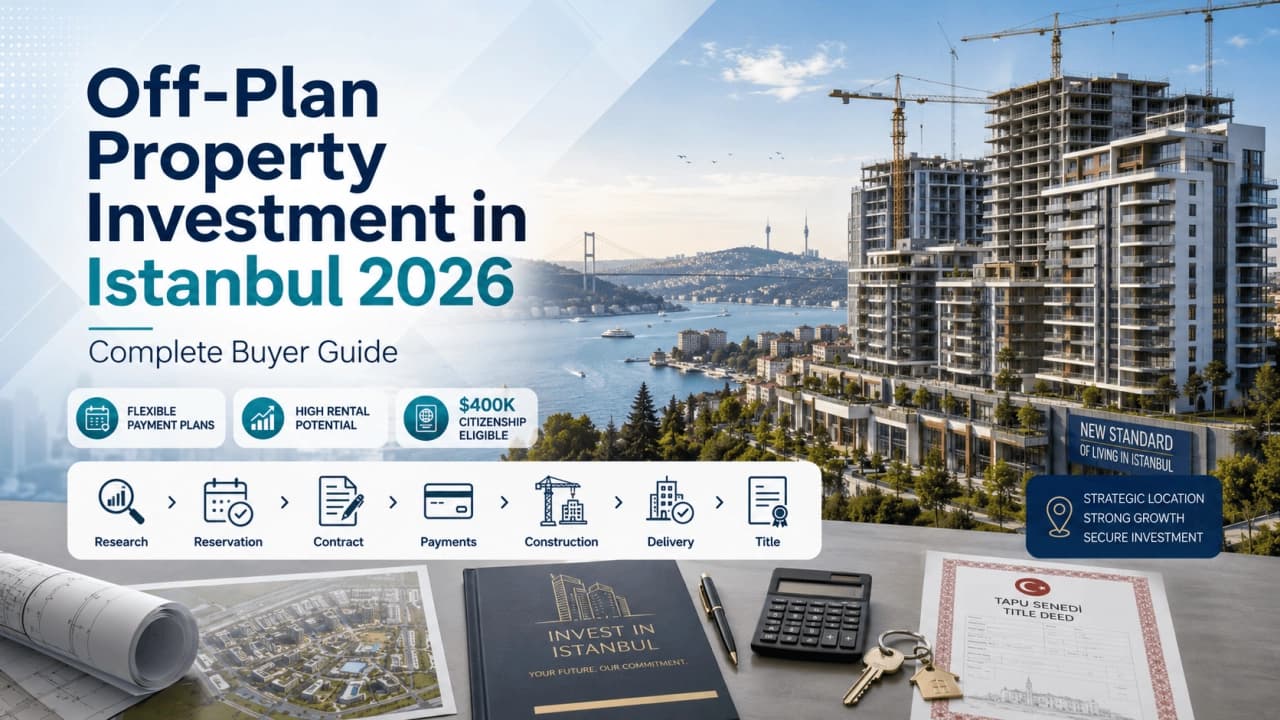
Introduction
Buying property before construction is completed can be one of the most attractive—and one of the most misunderstood—real estate investment strategies in Istanbul.
For some investors, off-plan property investment in Istanbul provides access to a new development at an early stage, when unit selection is wider and developers may offer structured payment plans or more competitive launch pricing.
For others, the uncertainty associated with construction progress, delivery dates, contracts, and future market conditions makes a ready property more appropriate.
The important point is that an off-plan apartment should never be purchased simply because it is advertised as:
- A launch opportunity
- A discounted property
- A guaranteed investment
- A high-return project
- A citizenship property
- A limited-time offer
A successful off-plan investment depends on several factors working together:
Developer + Location + Purchase Price + Contract + Construction Progress + Apartment Type + Future Demand
An attractive project in the wrong location can underperform.
A reputable developer can still launch a project at an excessive price.
A discounted apartment can become expensive if the payment plan, additional costs, or final specifications are unfavorable.
And a property that looks profitable on a brochure may perform very differently once the building is completed and dozens of similar units enter the rental or resale market.
Foreign buyers should therefore approach off-plan property as both:
a real estate investment
and
a development-risk investment.
This guide explains how off-plan property works in Istanbul, the different stages at which investors can buy, why developers sell apartments before completion, the potential advantages and risks, and how off-plan investments compare with ready properties.
What Is Off-Plan Property in Istanbul?
An off-plan property is generally an apartment purchased before the development has been fully completed.
At the time of purchase, the buyer may be evaluating the property using:
- Architectural plans
- Floor plans
- Project renders
- Show apartments
- Construction specifications
- Developer presentations
- Payment schedules
- Construction progress
Depending on the stage of development, the actual apartment may not yet exist in its final physical form.
This makes off-plan property fundamentally different from buying a completed apartment.
With a ready property, buyers can usually inspect:
- The exact unit
- The view
- Natural light
- Room dimensions
- Common areas
- Building management
- Parking
- Street conditions
With an early-stage off-plan purchase, some of these factors must be evaluated from contractual documents, technical plans, specifications, and projections.
The term off-plan is also used broadly in property marketing, but not every unfinished property represents the same level of risk.
Understanding the project's construction stage is therefore essential.
The Different Stages of New Development Property
A property can be marketed at several points between the initial project announcement and full completion.
Each stage offers a different relationship between price, risk, certainty, and potential appreciation.
Pre-Launch Property
Pre-launch refers to the earliest stage of marketing.
The project may be introduced to selected buyers or agents before a broader public sales campaign begins.
At this stage, developers may provide:
- Preliminary price lists
- Initial floor plans
- Early unit availability
- Promotional payment terms
The main potential advantage is early access.
Buyers may have a greater selection of:
- Floors
- Views
- Orientations
- Apartment layouts
However, pre-launch purchases can also involve the greatest uncertainty.
Investors should pay particular attention to:
- Project documentation
- Land ownership
- Developer credibility
- Contract terms
- Construction schedule
- Payment protection
The phrase “pre-launch price” should not automatically be interpreted as “below market value.”
A property's investment quality still depends on how the launch price compares with genuine alternatives in the surrounding market.
Early-Stage Off-Plan Property
At this stage, construction may have started but remains relatively limited.
Investors may be able to observe initial site activity while still gaining access to relatively broad apartment selection.
Potential advantages may include:
- Earlier entry
- Payment flexibility
- Wider unit selection
- Potential upside during construction
However, significant construction remains ahead.
The investor is therefore accepting more delivery uncertainty than someone purchasing near completion.
This stage may suit buyers who:
- Have a longer investment horizon
- Do not need immediate rental income
- Are comfortable with development risk
- Have carefully evaluated the developer and contract
Under-Construction Property
An under-construction apartment is part of a development where visible construction progress has already taken place.
Depending on the project, investors may be able to inspect:
- Building structure
- Block positions
- Surrounding roads
- Approximate views
- Construction quality
- Project scale
This can reduce some uncertainty compared with purchasing entirely from plans.
However, the apartment may still be months or years away from final delivery.
Investors should not confuse visible construction progress with guaranteed completion on a particular date.
Contractual delivery provisions remain important.
Near-Completion Property
Near-completion developments can provide a compromise between early-stage pricing and ready-property certainty.
At this stage, buyers may be able to see:
- The actual buildings
- Apartment orientation
- Views
- Landscaping progress
- Common areas
- Internal finishing
Delivery risk may be lower than at launch, although it has not disappeared completely until the project is finished and the relevant legal and property-transfer requirements are satisfied.
The trade-off is that early-stage pricing advantages may have reduced.
Ready New-Build Property
A ready new-build apartment is already completed or available for immediate delivery.
The buyer can usually inspect the exact property before purchasing.
Potential advantages include:
- Greater certainty
- Immediate physical inspection
- Faster furnishing
- Potential immediate rental operation
- Observable building quality
However, the price may already reflect much of the development's progress.
A completed unit is therefore technically a new-build property but is no longer an off-plan investment in the traditional sense.
Off-Plan Property Investment Process
Although individual developers and transactions vary, an off-plan purchase usually follows several broad stages.
A simplified investment journey may look like this:
Project Research → Unit Selection → Reservation → Legal Review → Contract → Payment Schedule → Construction → Delivery → Property Registration
Each stage deserves independent attention.
Project Research
The first step should be comparing the development with competing properties.
Investors should evaluate:
- District
- Micro-location
- Developer
- Transportation
- Apartment sizes
- Price per square meter
- Nearby projects
- Future supply
- Expected tenant profile
- Resale demand
Marketing materials should be treated as one information source—not the entire investment analysis.
Unit Selection
Choosing the project is only half the decision.
The exact apartment can substantially influence future value.
Consider:
- Floor
- Orientation
- View
- Noise
- Natural light
- Distance from elevators
- Apartment layout
- Balcony
- Net usable area
- Parking
- Storage
Two 1+1 apartments inside the same project may perform differently if one has a better orientation, usable layout, or view.
Reservation
Developers may use a reservation process to temporarily secure a specific apartment.
Before paying a reservation amount, buyers should understand:
- Whether the payment is refundable
- Under what conditions it can be retained
- How long the apartment is reserved
- Whether the final price is fixed
- What happens if legal review identifies a problem
Foreign buyers should avoid assuming that an informal payment automatically provides ownership rights.
In Türkiye, legal ownership of real estate is obtained through registration at the land registry. A preliminary real-estate agreement by itself does not transfer ownership.
Contract Review
The purchase contract is one of the most important documents in an off-plan transaction.
It should clearly identify the commercial obligations of both parties.
Important matters can include:
- Apartment identification
- Block
- Floor
- Unit number
- Apartment area
- Specifications
- Purchase price
- Payment schedule
- Delivery provisions
- Included fixtures
- Parking
- Storage
- Conditions for transfer
- Delay provisions
- Cancellation provisions
Because the buyer may be purchasing something that is not physically complete, contractual clarity becomes particularly important.
Independent legal review can be valuable before substantial funds are transferred.
Payment Schedule
Off-plan property is frequently associated with staged payments.
A simplified structure might involve:
Down Payment → Construction Installments → Final Payment → Delivery
Other developments may offer:
- Cash purchase discounts
- Monthly installments
- Quarterly payments
- Construction-linked payments
Payment flexibility can be useful, but investors should compare the total price under each option.
A property sold through installments may have a higher total price than the same apartment purchased with cash.
Therefore:
Flexible payment terms do not automatically mean a cheaper investment.
Construction Period
During construction, investors should monitor progress rather than simply waiting for the delivery date.
Useful information can include:
- Construction updates
- Site photographs
- Milestones
- Building progress
- Communication from the developer
For an international investor, this is one reason developer transparency and after-sales communication matter.
Delivery
At delivery, the buyer should verify that the property corresponds with the agreed specifications.
Potential inspection points include:
- Apartment layout
- Finishes
- Flooring
- Doors
- Windows
- Bathrooms
- Kitchen
- Electrical systems
- Plumbing
- Fixtures
- View
- Parking
- Storage
Defects or incomplete items should be documented appropriately before final acceptance where possible.
Property Registration and Ownership
A purchase contract and property ownership are not the same thing.
Official Invest in Türkiye guidance states that ownership rights to real estate in Türkiye are acquired through registration at the relevant land registry directorate. Preliminary agreements create commitments concerning a future transfer but do not themselves transfer ownership.
The same official guidance recommends checking whether restrictions such as mortgages, liens, or other encumbrances exist before completing the acquisition.
This distinction is particularly important for off-plan buyers because different projects may structure the timing of registration and delivery differently.
Why Developers Sell Apartments Before Completion
Selling apartments before completion serves several commercial purposes for developers.
Understanding these incentives can help investors interpret off-plan marketing more realistically.
Project Financing and Cash Flow
Early sales can provide developers with revenue during the construction period.
This can support:
- Construction cash flow
- Project financing
- Marketing
- Future development stages
For buyers, this is another reason developer financial strength matters.
The investor is not simply evaluating the apartment; they are also evaluating the organization responsible for completing the development.
Creating Early Market Momentum
Developers often want strong sales activity during a project's launch phase.
Early transactions can create:
- Market awareness
- Sales momentum
- Investor interest
- Social proof
This is why launch campaigns may emphasize:
- Limited units
- Early prices
- Special payment terms
- Temporary discounts
Investors should distinguish genuine value from marketing urgency.
A good investment should remain logical after the promotional language is removed.
Selling Different Units Throughout Construction
Developers may release apartments in phases rather than placing every unit on the market simultaneously.
Pricing can also change as:
- Construction advances
- Better units sell
- Demand changes
- The project approaches completion
An early investor may therefore gain greater unit selection.
However, there is no rule requiring a project's prices to increase simply because construction progresses.
Future pricing depends on the market as well as the developer.
Why Investors Buy Off-Plan Apartments in Istanbul
Buyers consider off-plan property for several reasons.
The strategy can be attractive when the project is carefully selected.
Potentially Lower Entry Price
One of the main investment arguments for off-plan property is the possibility of entering a project before completion pricing is reached.
For example, consider a hypothetical project:
- Launch price: $200,000
- Price later during construction: $220,000
- Completed-property price: $245,000
An early investor would appear to benefit from price appreciation.
However, this is only an illustration.
There is no guarantee that a project will increase in value during construction.
Prices can remain flat or decline depending on:
- Market conditions
- Currency movements
- Oversupply
- Location
- Developer pricing
- Economic conditions
The correct question is not:
“How much will this developer increase the price?”
It is:
“Is today's purchase price attractive compared with the property's likely market value and competing properties?”
Payment Flexibility
Many investors consider off-plan apartments because the purchase amount can sometimes be distributed over the construction period.
This may allow a buyer to:
- Preserve liquidity
- Avoid paying the entire purchase amount immediately
- Align payments with future income
- Purchase a higher-value apartment
Payment flexibility is useful, but only when the total acquisition price remains competitive.
Greater Apartment Selection
Early buyers often have access to more units.
This can allow the investor to select based on:
- View
- Floor
- Orientation
- Layout
- Balcony
- Building position
The best investment unit is not always the cheapest apartment in the project.
For example, paying slightly more for an efficient layout or desirable orientation can improve future rental and resale demand.
Potential Capital Appreciation During Construction
Off-plan investors may seek value growth between project launch and completion.
This can occur when:
- The developer raises prices
- The surrounding neighborhood improves
- New transportation opens
- Construction risk decreases
- Buyer confidence grows
- Completed apartments attract stronger demand
However, appreciation should be considered a potential outcome—not a guaranteed return.
Modern Construction and Facilities
Off-plan projects generally target current buyer preferences.
Features may include:
- Modern architecture
- Underground parking
- Smart home systems
- Security
- Landscaping
- Fitness facilities
- Swimming pools
- Children's facilities
- Reception services
These features can support rental and resale appeal, particularly among international buyers and professional tenants.
However, extensive facilities can also create higher monthly aidat after completion.
Main Advantages of Off-Plan Property Investment
When properly selected, off-plan property can offer several potential advantages.
Early Market Entry
The buyer enters before the property becomes a completed asset.
This can create opportunities where future development supports demand.
Flexible Payment Structures
Staged payments may reduce the need for full upfront capital.
Better Unit Selection
Investors entering earlier may have more freedom to choose desirable floors, views, and layouts.
Potential Appreciation
If the project and surrounding market develop positively, the apartment may increase in value before completion.
New Housing Stock
The buyer receives a newly constructed property rather than an apartment requiring immediate modernization.
Rental Appeal
Modern apartments can appeal to tenants seeking:
- Security
- Parking
- Contemporary design
- Professional building management
These advantages explain why off-plan property remains an important part of Istanbul's new-development market.
But every advantage has a corresponding risk.
Main Risks of Off-Plan Property Investment
Off-plan investment involves uncertainty that does not exist to the same extent when buying a completed property.
Understanding those risks is essential.
Construction Delay Risk
Projects may take longer than originally expected.
Possible causes can include:
- Construction issues
- Supply-chain problems
- Financing constraints
- Administrative processes
- Changes in project conditions
Investors who depend on an exact delivery date for relocation or rental income should treat this risk seriously.
Developer Risk
The quality and financial strength of the developer are critical.
Potential problems can include:
- Weak construction quality
- Poor communication
- Delivery delays
- After-sales problems
- Financial difficulties
Developer due diligence is therefore one of the most important steps in any off-plan investment.
Specification Risk
The finished apartment may differ in some respects from what the buyer imagined from marketing renders.
Contracts and technical specifications should clearly identify what is included.
Investors should distinguish between:
marketing illustration
and
contractual specification.
Market Risk
Property values are not guaranteed to rise during construction.
An investor may complete the purchase during a weaker property market than the one in which the initial contract was signed.
If similar apartments become available at lower prices, resale may become more difficult.
Location Risk
Some new developments are built in emerging neighborhoods.
This can offer long-term growth potential, but it also creates uncertainty about:
- Transportation
- Retail
- Schools
- Local services
- Future construction
- Tenant demand
An impressive project cannot completely compensate for a weak location.
Liquidity Risk
Selling before or immediately after completion may not always be straightforward.
The investor may compete with:
- The developer's remaining inventory
- Other investors
- Similar units in neighboring projects
Exit strategy should therefore be considered before entry.
Currency Risk
International buyers may invest using currencies different from the currency in which project prices, installments, costs, or future rental income are calculated.
Exchange-rate changes can influence real investment returns.
Off-Plan vs Ready Property
The following table summarizes the fundamental differences between buying before completion and purchasing a completed apartment.
| Factor | Off-Plan Property | Ready Property |
|---|---|---|
| Physical Inspection | Limited depending on stage | Exact unit can usually be inspected |
| Construction Risk | Higher | Much lower |
| Delivery Risk | Exists | Minimal |
| Unit Selection | Often wider early in project | Limited to remaining inventory |
| Payment Plans | Often available | Usually less flexible |
| Immediate Rental Income | No | Potentially yes |
| Appreciation During Construction | Possible | Not applicable in same way |
| Building Performance History | Unavailable | May be observable |
| Exact View | May rely partly on plans/renders | Observable |
| Aidat | May initially be estimated | Usually known |
| Tenant Demand | Projected | Can be researched more directly |
| Resale Competition | Future supply uncertain | Current supply visible |
| Investment Certainty | Lower | Higher |
| Development Upside | Potentially higher | More established |
Neither property type is automatically better.
Off-plan property may suit investors seeking:
- Earlier entry
- Payment flexibility
- Potential capital appreciation
- Modern construction
- Greater unit choice
Ready property may suit buyers prioritizing:
- Immediate inspection
- Immediate occupation
- Rental income
- Lower development uncertainty
- Observable market performance
Is Off-Plan Property a Good Investment?
It can be—but only when the fundamentals support the purchase.
A good off-plan investment is generally more than an apartment sold at an early stage.
Investors should look for a combination of:
- Reliable developer
- Strong location
- Competitive purchase price
- Clear contract
- Appropriate apartment type
- Realistic payment terms
- Sustainable tenant demand
- Future resale market
The greatest mistake is assuming that buying earlier automatically creates profit.
Early entry only becomes valuable when the asset itself is good.
A poorly located apartment bought at launch can remain a poor investment after completion.
A well-selected apartment from a reputable developer in a strong location can provide a much more compelling investment proposition.
Key Takeaways
Before investing in an off-plan apartment in Istanbul, understand exactly what stage of development you are entering.
The investment profile changes substantially between:
- Pre-launch
- Early construction
- Advanced construction
- Near completion
- Ready property
Earlier investment may provide more unit selection and potentially more upside, but generally involves greater uncertainty.
Later-stage purchases reduce some development risk but may come at higher prices.
Investors should evaluate:
- Developer credibility
- Project documentation
- Location
- Construction progress
- Apartment layout
- Net usable area
- Purchase price
- Payment schedule
- Delivery provisions
- Future rental demand
- Resale competition
For foreign buyers, it is also important to distinguish between signing an agreement and acquiring legal ownership. In Türkiye, property ownership is obtained through registration at the land registry; preliminary agreements do not by themselves transfer ownership.
Off-plan property should therefore be approached with both investment analysis and legal due diligence.
The strongest investment is not simply the project offering the largest discount.
It is the property where:
Developer + Location + Price + Contract + Construction + Future Demand
create a convincing long-term investment case.
How to Evaluate an Off-Plan Property Investment
Finding an off-plan project in Istanbul is easy.
Determining whether that project represents a good investment is much more difficult.
Developers may present impressive architectural renders, attractive launch campaigns, flexible payment plans, projected returns, and premium social facilities. None of these factors, however, guarantees that the apartment will perform well after completion.
A professional investor should evaluate an off-plan property using several separate criteria:
Developer + Location + Purchase Price + Payment Terms + Apartment + Rental Demand + Resale Potential
If one of these fundamentals is weak, the overall investment can become considerably less attractive.
The objective should not be to find the project with the largest advertised discount.
It should be to identify a property whose current purchase price is justified by its future market position.
How to Research the Developer
Developer selection is one of the most important components of off-plan property investment.
When purchasing a completed apartment, buyers can inspect the final product.
With off-plan property, part of the investment decision depends on whether the developer can deliver what has been promised.
Previous Completed Projects
Start by examining projects the developer has already completed.
Consider:
- Construction quality
- Delivery history
- Architecture
- Common areas
- Landscaping
- Building management
- Resident satisfaction
- Long-term maintenance
Whenever possible, visit an older completed project rather than evaluating only the developer's newest sales office.
A completed building can reveal far more about actual quality than a showroom.
Delivery History
Investigate whether previous projects were delivered broadly in line with their announced schedules.
Construction delays can occur for many legitimate reasons, so one delayed project does not automatically indicate a weak developer.
However, repeated or substantial delays may indicate greater development risk.
Investors should distinguish between:
- Occasional delays
- Consistent delivery problems
Construction Quality
A strong developer should demonstrate consistency in:
- Structural construction
- Materials
- Windows
- Insulation
- Plumbing
- Electrical systems
- Elevators
- Interior finishes
- Common areas
Premium marketing does not necessarily mean premium construction.
Financial Credibility
Off-plan investors are exposed to the developer for the duration of construction.
For that reason, financial credibility matters.
Buyers should be cautious when a project appears to depend heavily on aggressive early sales without a strong development track record.
Large discounts should never replace developer due diligence.
After-Sales Service
The relationship with the developer may continue after delivery.
Potential issues can include:
- Defects
- Warranty matters
- Title procedures
- Utility activation
- Building management
- Furnishing
- Rental support
A developer with competent after-sales operations can make ownership significantly easier, especially for foreign investors.
How to Evaluate Construction Progress
Construction progress can help investors understand how much development risk remains.
Early Construction
During early construction, investors generally face greater uncertainty.
The project may still require substantial work involving:
- Structural construction
- Exterior façade
- Mechanical systems
- Interior finishing
- Landscaping
- Infrastructure
Earlier entry may provide stronger commercial terms, but risk is higher.
Mid-Construction
At this stage, investors may be able to evaluate:
- Building position
- Scale
- Approximate views
- Construction speed
- Site organization
This can provide more confidence than purchasing entirely from architectural plans.
Near Completion
Near-completion projects provide considerably more observable information.
The investor may be able to inspect:
- Actual apartment layouts
- Building entrances
- Common areas
- Landscaping
- Materials
- Views
- Parking
The trade-off is that the property may already be priced closer to completed market value.
Do Not Evaluate Progress from Photos Alone
Developer updates can be useful, but investors should not rely exclusively on promotional photographs.
When practical, verify the site physically or through an independent representative.
The important question is:
Does actual construction progress reasonably correspond with the project's stated timeline?
Location Is More Important Than the Project
One of the most common mistakes in off-plan investment is becoming so impressed by the development that the buyer forgets to evaluate the neighborhood.
A luxury project cannot completely compensate for a poor location.
Evaluate the Micro-Location
Do not analyze only the district name.
Two developments in the same district can have completely different investment potential.
Consider:
- Walking distance to metro
- Main road access
- Traffic
- Surrounding buildings
- Schools
- Hospitals
- Offices
- Shopping
- Parks
- Noise
- Future construction
The difference between an apartment five minutes from a metro station and another property twenty minutes away can materially influence rental demand.
Understand the Future Neighborhood
Off-plan property is often sold in areas undergoing transformation.
Ask:
- What is already operating today?
- What is currently under construction?
- What is only proposed?
- What infrastructure has confirmed funding?
- What depends on future market conditions?
Investors should distinguish between existing infrastructure and marketing promises.
Transportation and Accessibility
Transportation is one of the most important drivers of both rental demand and resale liquidity in Istanbul.
A project with convenient access to:
- Metro
- Marmaray
- Metrobus
- Ferry services
- Major highways
can appeal to a larger number of tenants and future buyers.
Walking Distance Matters
Advertising may state that a project is “near the metro.”
Investors should verify the actual distance.
For everyday tenants, the difference between:
- 500 meters
and
- 2 kilometers
can be substantial.
Evaluate Real Commuting Patterns
Ask where the target tenant will probably work.
For example:
- Professionals working in Levent or Maslak may prioritize northern European-side connectivity.
- Financial-sector employees may prioritize Ataşehir.
- Airport-related tenants may place greater value on eastern Asian-side transportation.
Property selection should reflect realistic commuting behavior.
Future Infrastructure and Capital Appreciation
Infrastructure can significantly influence long-term property values.
Projects may benefit from future:
- Metro lines
- Rail connections
- Hospitals
- Universities
- Business centers
- Parks
- Roads
- Shopping developments
However, investors should be careful when future infrastructure forms the entire investment thesis.
Confirm What Is Real
There is an important difference between:
Operating → Under Construction → Officially Approved → Proposed
The earlier the infrastructure project, the greater the uncertainty.
A strong off-plan investment should ideally have multiple reasons to succeed rather than depending entirely on one future transport project.
How to Evaluate the Purchase Price
Off-plan pricing can be misleading if investors focus only on the headline discount.
The correct question is:
What am I actually paying compared with similar properties?
Compare with Ready Apartments
Research completed properties nearby.
Compare:
- Price
- Net area
- Building quality
- Amenities
- Transportation
- Rental income
If an unfinished apartment costs substantially more than high-quality completed properties nearby, the investor should understand why.
Compare with Competing New Projects
Do not evaluate one developer in isolation.
Compare similar developments based on:
- Price per square meter
- Construction stage
- Developer reputation
- Delivery
- Facilities
- Location
- Payment terms
A project may appear inexpensive only until it is compared with genuine alternatives.
Calculate the Total Purchase Price
The real investment cost can include:
- Apartment price
- Parking
- Storage
- Furnishing
- Legal expenses
- Transaction expenses
- Currency conversion
- Future setup costs
Use the all-in acquisition cost when comparing investments.
Price per Square Meter
Price per square meter is useful for comparing similar properties, but investors should avoid using it mechanically.
Compare Similar Properties
A waterfront project should not necessarily be compared directly with a standard residential development several kilometers inland.
Likewise, branded residences may command a different price structure from conventional apartments.
Compare like with like.
Use Net Area Where Possible
The most meaningful calculation is often:
Total Property Price ÷ Net Usable Area
rather than gross advertised area.
This is especially important when comparing developers that use different gross-area calculations.
A Cheap Square Meter Can Be Expensive
Low price per square meter may result from:
- Poor layout
- Weak location
- Large gross/common-area allocation
- Low-quality construction
- Limited rental demand
Investors should prioritize usable value rather than simply buying the cheapest square meter.
How to Evaluate an Off-Plan Payment Plan
Payment plans are one of the strongest marketing tools used by off-plan developers.
They can be genuinely valuable, but they should be analyzed separately from the property itself.
Cash Purchase
Cash buyers may sometimes receive:
- Lower prices
- Discounts
- Better unit selection
- Negotiation opportunities
However, paying everything immediately also increases the amount of capital exposed to the project before completion.
Down Payment and Installments
A typical commercial structure may involve:
Down Payment + Monthly Installments + Final Payment
This can help investors preserve liquidity.
For example:
- Property price: $250,000
- Down payment: $100,000
- Remaining balance: $150,000
- Payment period: 24 months
Instead of deploying the entire $250,000 immediately, the investor spreads part of the capital requirement over construction.
Developer Financing
Some projects effectively provide financing through installment structures rather than traditional bank mortgages.
The investor should compare:
Cash Price vs Installment Price
If:
- Cash price = $220,000
- Installment price = $250,000
then the payment flexibility has an economic cost of $30,000.
The investor should decide whether preserving liquidity is worth that premium.
Flexible Payment Does Not Mean Cheap Property
This distinction is extremely important.
A project can have an excellent payment plan and still be overpriced.
Always evaluate:
- Property value
- Payment structure
as separate questions.
How Off-Plan Investors Make Money
Off-plan investment can generate returns through several different mechanisms.
No mechanism is guaranteed.
Capital Appreciation During Construction
This is the most commonly promoted off-plan strategy.
Consider a hypothetical example:
Project Launch
Property price: $200,000
Mid-Construction
Comparable developer price: $220,000
Completion
Comparable market price: $250,000
On paper, the initial investor has gained $50,000 in property value.
That represents:
25% nominal appreciation
However, this example assumes that completed units are genuinely selling at $250,000.
A developer increasing its price list does not automatically prove that the market value has increased.
The relevant benchmark is:
What would a real buyer pay for this apartment today?
Rental Income After Completion
The second return mechanism is rental income.
An investor may hold the apartment after delivery and lease it to:
- Professionals
- Families
- Corporate tenants
- Expats
The quality of future rental income depends heavily on:
- Location
- Apartment size
- Purchase price
- Building facilities
- Aidat
- Competition
Rental projections should be based on comparable completed properties rather than developer forecasts alone.
Buying Below Future Replacement Cost
Construction costs can influence future new-build pricing.
An investor purchasing during an earlier stage may potentially acquire the apartment below the price at which a similar property could later be developed.
However, construction costs alone do not determine property values.
Demand still matters.
Selecting Better Units Early
Early entry can provide another less obvious advantage:
selection rather than discount.
The investor may secure:
- Better orientation
- Higher-demand floor
- More efficient layout
- Stronger view
- Better block
- Quieter position
These characteristics can improve both rental and resale potential.
Should You Buy at Project Launch?
Buying at launch can offer maximum selection and potentially the earliest pricing.
But it also involves greater uncertainty.
Potential Launch Advantages
- More apartment choice
- Early payment offers
- Potentially lower developer pricing
- Longer period for appreciation
Potential Launch Risks
- Minimal construction progress
- Longer delivery horizon
- Greater market uncertainty
- Greater developer exposure
- Limited rental evidence
Buying at launch is therefore most appropriate when the investor has high confidence in:
- Developer
- Location
- Contract
- Purchase price
A launch discount cannot compensate for weak fundamentals.
Best Off-Plan Apartment Types for Investment
The correct apartment type depends heavily on the future tenant and resale buyer.
Studio Apartments
Studios may provide:
- Lower acquisition cost
- Lower furnishing cost
- Potentially strong percentage yield
They can appeal to:
- Students
- Single professionals
- Corporate tenants
However, studio demand is highly location-dependent.
Their resale audience can also be narrower.
Studios generally make more sense near:
- Universities
- Business districts
- Transportation hubs
than in family-oriented suburban developments.
1+1 Apartments
For many investors, 1+1 apartments offer one of the strongest balances between:
- Purchase cost
- Rental demand
- Furnishing
- Resale
- Tenant diversity
Potential tenants include:
- Professionals
- Couples
- Expats
- Corporate employees
They can be especially suitable in:
- Kağıthane
- Şişli
- Bomonti
- Maslak
- Ataşehir
- Kartal
Why 1+1 Units Are Popular with Investors
They generally require less capital than larger apartments while still offering a separate bedroom and living space.
This can make them more flexible than studios.
However, investors should watch for oversupply.
If a project contains hundreds of nearly identical 1+1 apartments, owners may eventually compete heavily for tenants and resale buyers.
2+1 Apartments
2+1 apartments offer a wider residential market.
Potential tenants include:
- Couples
- Small families
- Professionals
- Expats
- Remote workers
They usually require more capital than 1+1 units but may provide stronger long-term resale liquidity because both investors and end-users can consider them.
Why 2+1 Can Be a Balanced Investment
A well-designed 2+1 can combine:
- Rental demand
- Family use
- Resale flexibility
- Long-term ownership appeal
This can reduce dependence on a narrow tenant profile.
3+1 Apartments
3+1 apartments primarily target families.
They tend to perform best in locations offering:
- Schools
- Parks
- Hospitals
- Parking
- Family-oriented compounds
- Long-term residential demand
They usually require significantly more capital.
Percentage-based rental yield may therefore be lower than for compact investment units, although tenant retention can be stronger.
Best Apartment Type by Investment Strategy
| Investment Strategy | Property Type Often Worth Evaluating |
|---|---|
| Professional Rental | 1+1 / compact 2+1 |
| Corporate Rental | Furnished 1+1 / premium 2+1 |
| Student Market | Studio / 1+1 |
| Family Rental | 2+1 / 3+1 |
| Resale Liquidity | 1+1 / 2+1 |
| Long-Term Family Market | 2+1 / 3+1 |
| Lower Entry Capital | Studio / 1+1 |
| Lifestyle + Investment | High-quality 2+1 |
| Citizenship Strategy | Property selected on investment fundamentals, not layout alone |
This is a strategic framework rather than a universal rule.
Micro-location remains critical.
How to Choose the Best Unit Inside an Off-Plan Project
Once the investor has selected the project, the next challenge is choosing the right apartment.
This can materially affect future returns.
Floor Level
Higher floors may command premiums because of:
- Views
- Privacy
- Lower street noise
However, excessively high premiums can reduce rental yield.
The best investment floor is often the one where future tenants value the benefit without requiring the investor to pay a disproportionate premium.
Orientation
Orientation influences:
- Natural light
- Heat
- View
- Comfort
A better orientation can improve both rental demand and resale.
View
Premium views can include:
- Bosphorus
- Sea
- Forest
- City
- Landscaped project areas
The investor should determine whether the view premium is justified.
A $40,000 view premium is economically attractive only if future buyers or tenants will also value it.
Layout Efficiency
Review:
- Corridor space
- Kitchen design
- Bedroom size
- Storage
- Bathroom position
- Balcony usability
A smaller apartment with an efficient floor plan can outperform a larger unit with wasted space.
Building Position
In large developments, individual blocks can have very different characteristics.
Consider:
- Main-road noise
- Commercial areas
- Entrances
- Schools
- Pools
- Playgrounds
- Construction phases
The cheapest block may not produce the strongest long-term demand.
How to Evaluate Project Facilities
Facilities can make a project more attractive, but they are not free.
Common facilities include:
- Swimming pools
- Gyms
- Sauna
- Turkish bath
- Children's areas
- Landscaped gardens
- Concierge
- Reception
- Security
- Meeting rooms
Ask Whether Tenants Will Pay for Them
For every major facility, consider:
Will this feature materially increase the rent or resale value?
If the answer is no, the facility may simply increase aidat.
More Facilities Can Mean Higher Costs
Large luxury projects often require:
- More staff
- More cleaning
- More maintenance
- Higher energy use
Investors should therefore consider the future maintenance structure before purchasing.
Aidat and Future Operating Costs
Aidat can substantially reduce net rental return.
An apartment generating attractive gross rent may become less compelling after monthly maintenance is deducted.
For example:
- Monthly rent: $1,500
- Monthly aidat: $250
Annual gross rent:
$18,000
Annual aidat:
$3,000
Before considering management, vacancy, repairs, or taxes, aidat alone consumes approximately 16.7% of gross rental income.
This illustrates why investors should not ignore operating expenses simply because the building offers impressive facilities.
How to Estimate Rental Potential Before Completion
An unfinished project does not have an established rental history.
Investors therefore need to use comparable properties.
Find Comparable Ready Buildings
Look for properties with similar:
- Location
- Construction quality
- Apartment size
- Amenities
- Tenant market
Use Conservative Rent Assumptions
Do not simply use the highest advertised rental listing.
Consider a realistic market range.
Adjust for Future Competition
If several thousand apartments are scheduled for completion nearby, future rental supply could increase significantly.
This should be incorporated into rental expectations.
Calculate Net Yield
Use:
Annual Rent − Operating Costs
rather than headline rent alone.
How to Evaluate Future Resale Potential
An off-plan investor should think about the eventual buyer before purchasing.
Ask:
Who will buy this apartment from me after completion?
Potential future buyers might include:
- Local families
- Foreign investors
- Professionals
- Citizenship applicants
- Lifestyle buyers
The broader the future buyer pool, the stronger potential liquidity may be.
Properties with Stronger Resale Characteristics
They often combine:
- Good transportation
- Practical layouts
- Competitive pricing
- Established or improving neighborhoods
- Quality construction
- Reasonable maintenance
Avoid Over-Specialized Units
Examples could include:
- Extremely large luxury apartments in weak locations
- Tiny units in family districts
- Apartments with unusual layouts
- Units carrying excessive project premiums
A property that fits only a narrow buyer group can be harder to sell.
Off-Plan Investment Evaluation Scorecard
Before purchasing, investors can score a project across core categories.
| Factor | Questions to Ask |
| Developer | Has the developer successfully delivered comparable projects? |
| Construction | Does progress match the development stage? |
| Location | Would tenants and future buyers genuinely want to live here? |
| Transportation | Is public transport practically accessible? |
| Price | Is the apartment competitive with ready and competing projects? |
| Net Area | Am I paying for usable living space? |
| Payment Plan | What is the true cost of installment flexibility? |
| Apartment Type | Does the layout match local demand? |
| Facilities | Do amenities justify the future aidat? |
| Rental Demand | Who will rent this apartment? |
| Resale Demand | Who will buy it later? |
| Competition | How many similar units will reach the market? |
A strong project should perform reasonably well across most categories.
A spectacular score in one area does not necessarily compensate for several weak fundamentals.
Key Takeaways
A successful off-plan investment requires much more than selecting an attractive development.
Investors should evaluate the developer's completed projects, construction progress, location, transportation, infrastructure, pricing, payment plan, apartment layout, maintenance structure, tenant demand, and exit strategy.
The most important principles include:
- Developer reputation matters because completion has not yet occurred.
- Location remains more important than project amenities.
- Payment flexibility should not be confused with investment value.
- Price should be compared with both ready properties and competing developments.
- Net usable area matters more than impressive gross-area marketing.
- Rental projections should be based on comparable completed properties.
- Future resale demand should be evaluated before purchasing.
Off-plan investment can generate value through early entry, payment flexibility, unit selection, and potential appreciation during construction.
But none of these benefits is automatic.
A developer increasing its list price does not necessarily mean the investor has achieved a real market gain.
A flexible installment plan does not necessarily mean the apartment is affordable.
And a luxury project does not automatically create strong rental demand.
The strongest off-plan investments are typically those where:
Reliable Developer + Strong Micro-Location + Competitive Price + Good Unit + Sustainable Demand
come together.
Legal Due Diligence Before Buying Off-Plan Property
Legal due diligence is particularly important when purchasing an off-plan apartment because the buyer may be committing substantial capital before the finished property can be physically inspected.
With a ready apartment, the buyer can usually inspect the exact unit, examine the building, review its management, and complete the title transfer within a relatively short period.
With an off-plan purchase, the buyer may instead depend on:
- The developer
- Project documentation
- Construction permits
- Technical specifications
- Contractual obligations
- Future delivery
- Future title registration
This creates an additional layer of legal and development risk.
For that reason, foreign buyers should distinguish between three separate questions:
- Is the project legally capable of being developed and sold?
- Does the contract adequately describe what the buyer is purchasing?
- When and how will the buyer obtain the legally registered property right?
These questions should be investigated before substantial funds are transferred.
Verify the Developer and Seller
The first legal question is not simply:
“Who built the project?”
It is:
“Which legal entity is actually selling the property and receiving my money?”
Large developments may involve several entities, including:
- Landowners
- Developers
- Contractors
- Joint-venture companies
- Sales companies
- Project-management companies
The company marketing the apartment may not necessarily be the registered owner of the underlying property.
Confirm the Contracting Party
Before signing, verify:
- Full legal company name
- Company registration information
- Authorized signatories
- Relationship with the project
- Relationship with the landowner
- Bank account receiving payments
Payments should correspond with the legally documented transaction structure.
An investor should be cautious if asked to transfer large amounts to unrelated individuals, unofficial intermediaries, or accounts that do not correspond with the transaction documents.
Review Previous Projects
Legal due diligence and commercial due diligence should work together.
Review whether the developer has:
- Completed previous developments
- Delivered properties
- Managed title transfers
- Resolved defects
- Operated after-sales services
A strong development history does not remove legal risk, but it provides useful context.
Verify the Land and Title Registration
One of the most important checks concerns the land on which the development is being constructed.
Türkiye's Ministry of Trade specifically advises purchasers of prepaid housing to investigate land ownership through the Land Registry and check the title record for annotations or declarations that could negatively affect the property.
Check the Registered Owner
Determine:
- Who owns the land?
- Is it owned by the developer?
- Is it owned by another company?
- Is the developer operating under a development agreement?
The contractual structure should make sense when compared with the land-registry records.
Check Mortgages and Liens
The title record should be reviewed for matters such as:
- Mortgages
- Liens
- Annotations
- Restrictions
- Rights belonging to third parties
Foreign buyers should not rely solely on statements such as:
“The title is clean.”
The relevant records should be independently checked.
Understand What Is Registered
Depending on the stage of construction, the relevant right may involve the underlying land, a construction servitude, or condominium ownership.
This distinction can also become important for buyers pursuing Turkish citizenship through a sale-promise structure, where TKGM applies specific requirements to the legal status of the property.
Verify the Construction Permit
A project should not be evaluated solely from architectural renders.
Where Türkiye's prepaid housing consumer regime applies, the Ministry of Trade states that a prepaid housing sale contract cannot be concluded before the building permit has been obtained.
Buyers should therefore verify the project's relevant permit documentation rather than relying on statements such as:
- “Permit is coming soon.”
- “Everything has been approved.”
- “Construction can start anytime.”
The exact documentation required in a particular transaction should be checked by a Turkish real estate lawyer familiar with the project.
Understand the Legal Form of the Contract
Not every document signed at a sales office has the same legal effect.
This distinction is particularly important for off-plan purchases.
For transactions falling under Türkiye's prepaid housing consumer rules, the Ministry of Trade states that the sale must follow a formal structure: either registration of the construction servitude in favor of the consumer together with a written contract, or a sale-promise agreement executed in official form before a notary. The Ministry also states that a seller cannot require payment under that regime before a valid contract has been formed.
This is significantly different from signing a simple reservation or marketing document.
Contract Does Not Automatically Mean Ownership
A contractual right and registered ownership are not the same thing.
A buyer should understand:
- What right exists immediately after signing?
- What will be registered?
- When will registration occur?
- What remains only a contractual obligation until later?
This distinction should be explained clearly before payment.
What Should Be Included in an Off-Plan Contract?
A high-quality contract should make it possible to identify exactly what the buyer expects to receive.
The Ministry of Trade's current guidance also emphasizes reviewing the independent-unit plan, site plan, floor plan, technical specification, gross and net areas, location, orientation, and promised interior characteristics before concluding a prepaid housing purchase.
At minimum, buyers should expect the documentation to address the following commercial issues.
Exact Property Identification
The contract should clearly identify:
- Project
- Block
- Floor
- Apartment number
- Apartment type
- Orientation
- Parking space where applicable
- Storage where applicable
Avoid relying on vague descriptions such as:
“Equivalent apartment within the project.”
The exact unit should be identifiable wherever possible.
Net and Gross Area
The contract should distinguish between:
- Gross area
- Net usable area
This is critical.
An apartment marketed as 120 m² may provide substantially less internal usable space depending on how gross area is calculated.
The Ministry of Trade specifically advises buyers to examine both gross and net areas in prepaid housing transactions.
Technical Specifications
The contract or its annexes should clearly describe important finishes and systems, including where relevant:
- Flooring
- Kitchen
- Bathroom
- Windows
- Doors
- Heating
- Cooling
- Appliances
- Smart home equipment
Marketing renders should not be treated as substitutes for contractual specifications.
Purchase Price
Confirm:
- Total price
- Currency
- Taxes included or excluded
- Payment method
- Installment price
- Cash price
- Penalties for late payment
If a project offers several payment structures, compare the total amount payable, not merely the monthly installment.
Payment Schedule
The contract should clearly identify:
- Deposit
- Down payment
- Installments
- Payment dates
- Final payment
- Conditions linked to construction or delivery
Keep verifiable records of every payment.
Delivery Date
The delivery mechanism should be defined clearly.
Do not rely only on marketing statements such as:
“Expected completion: Summer 2028.”
The contractual delivery obligation is more important than the brochure.
Delivery Date and Delay Protection
Construction delays are among the most important concerns for off-plan buyers.
Contractual Delivery Date
Where a purchaser qualifies for protection under Türkiye's prepaid housing consumer regime, the Ministry of Trade states in its March 2026 guidance that the statutory transfer or delivery period may not exceed 48 months from the contract date. Parties may agree to a shorter period, in which case the seller is bound by the agreed shorter period.
This is an important 2026 point because older online material may still refer to a previous 36-month limit.
However, whether those consumer-law protections apply to a particular foreign investor and transaction depends on the legal nature and purpose of the purchase. Buyers should obtain transaction-specific legal advice rather than assuming every investment purchase falls within the same consumer framework.
Delay Clauses
A professionally reviewed contract should address questions such as:
- What constitutes delay?
- Is there a grace period?
- What happens after that period?
- Is compensation provided?
- Can the buyer terminate?
- How are refunds handled?
- What constitutes force majeure?
The answers depend heavily on the contract and applicable law.
A buyer should therefore avoid relying on verbal promises concerning compensation for delay.
What Happens If Construction Is Delayed?
There is no single answer that applies to every off-plan transaction.
The buyer's options can depend on:
- Legal status of the purchaser
- Type of contract
- Cause of delay
- Contractual clauses
- Applicable consumer protections
- Stage of construction
Where the transaction falls under the prepaid housing consumer regime, the Ministry of Trade provides specific withdrawal and termination protections. Its current guidance states that consumers have a 14-day withdrawal right after formation of the contract and, subject to statutory conditions, a right to withdraw from the prepaid housing contract for up to 24 months. It also identifies situations in which termination may occur without certain charges, including cases where the seller fails to perform its obligations properly.
Those rights should not be advertised as universally applicable to every investor transaction.
Foreign investment purchasers should have a lawyer determine which protections apply to their specific contract.
Protection of Buyer Payments
Off-plan investors should also ask:
What protects my money if the project is not completed?
Under the prepaid housing consumer framework, Türkiye's Ministry of Trade states that projects containing 30 or more housing units must provide at least one qualifying protection mechanism before prepaid sales begin, such as:
- Building completion insurance
- Bank guarantee
- Progress-payment system
- Secured linked credit
Other methods may also be accepted if approved by the Ministry and capable of protecting consumer payments.
For projects below 30 units, the Ministry states that this specific security obligation does not apply, although the other prepaid housing rules remain relevant where the regime applies.
For a buyer, the practical question is simple:
Exactly what mechanism protects the money I am paying?
Ask for documentary evidence rather than accepting a verbal answer.
Project Changes After Signing
A buyer may select an apartment based on:
- View
- Layout
- Common areas
- Landscaping
- Facilities
Material project changes can therefore affect the investment.
Under the prepaid housing consumer framework, Türkiye's Ministry of Trade states that subsequent project changes must be communicated to the consumer in writing or through a durable medium. It also provides a mechanism for consumers to reject certain changes and withdraw under specified conditions.
From an investment perspective, the contract should also make clear which specifications are fixed and which may legitimately change.
Can You Sell an Off-Plan Apartment Before Completion?
This is one of the most common questions from speculative and short-horizon investors.
The answer is:
Possibly—but never assume it is automatic.
The ability to exit before completion depends on the legal structure of the buyer's rights and the contract.
Possible issues include:
- Assignment restrictions
- Developer consent
- Transfer charges
- Outstanding installments
- Notarial requirements
- Existing annotations
- Citizenship restrictions
Assignment of Contractual Rights
If the buyer does not yet hold completed registered ownership, what is being transferred may be a contractual position rather than an ordinary completed-property title.
The contract should therefore be reviewed for provisions governing:
- Assignment
- Developer approval
- Fees
- New buyer qualification
- Payment of remaining balance
An investor planning to sell during construction should investigate this before buying, not when they decide to exit.
Do Not Build the Investment Thesis Around an Unverified Exit
Some investors purchase at launch assuming:
“I'll sell before completion.”
That strategy can fail if:
- Assignment is restricted
- The developer charges substantial fees
- The developer is still selling competing inventory
- Market prices do not rise
- Demand weakens
An off-plan investment should still make financial sense if the buyer needs to hold through completion.
Off-Plan Property and Turkish Citizenship
Off-plan property can be relevant to Türkiye's Citizenship by Investment framework, but not every unfinished apartment or private purchase contract qualifies.
The official Invest in Türkiye guidance currently lists qualifying real estate acquisition at a minimum of USD 400,000 or equivalent foreign currency, together with a restriction preventing resale for at least three years, subject to the full program requirements.
Can a Sale-Promise Contract Qualify?
TKGM's current citizenship guidance recognizes certain transactions based on a notarized real-estate sale-promise agreement, but specific conditions apply.
For the sale-promise route, TKGM states that the property must have condominium ownership or construction servitude established.
Therefore:
A reservation form for a future apartment is not automatically a citizenship-qualified investment.
The transaction structure must satisfy the citizenship rules applicable at the time of application.
Multiple Properties Under a Sale-Promise Structure
TKGM states that where citizenship is pursued through a sale-promise structure, the required amount must be satisfied through a single sale-promise contract. Multiple properties may be included within that single contract, but multiple separate sale-promise contracts are not aggregated for that route under the current guidance.
This is a particularly important detail for investors considering multiple smaller off-plan units.
Three-Year Restriction
The general real-estate citizenship route includes a three-year restriction.
TKGM's guidance also describes the corresponding restriction for citizenship applications based on qualifying sale-promise agreements.
This means a citizenship-focused investor should not assume they can use a short-term assignment or pre-completion flip strategy.
Verify Citizenship Before Paying
Before purchasing an off-plan property specifically for citizenship, independently verify:
- Transaction structure
- Property status
- Seller eligibility
- Required value
- Payment documentation
- Registration/annotation requirements
- Three-year restriction
- Current TKGM rules
A statement in a brochure saying:
“Citizenship Eligible”
should never be treated as sufficient legal confirmation.
Hidden Costs of Buying Off-Plan Property
A developer's advertised apartment price is rarely the only amount the investor will spend.
The investment should be evaluated based on total acquisition and setup cost.
Title Deed Fees
When an actual property transfer takes place, title-deed charges need to be included in the acquisition budget.
Türkiye's Revenue Administration states that, for standard compensated real-estate transfers, title-deed duty is generally levied separately on the transferor and acquirer at 20 per thousand, or 2%, for each side, based on the applicable declared transfer/acquisition value rules.
The precise liability and transaction structure should be confirmed before closing.
VAT Where Applicable
VAT treatment can depend on matters such as:
- Nature of the seller
- Property
- Transaction
- Buyer's circumstances
- Potential exemptions
Do not assume that VAT is either always included or always payable.
Ask for the project's price quotation to specify clearly:
VAT Included / VAT Excluded / Applicable Exemption
and obtain tax advice where the amount is material.
Notary and Legal Costs
An off-plan transaction may involve expenses associated with:
- Notarial documentation
- Translation
- Power of attorney
- Independent legal review
Foreign buyers should budget for these before comparing projects.
Furnishing
A completed apartment may still require:
- Furniture
- Appliances
- Curtains
- Lighting
- Kitchen equipment
- Air-conditioning equipment where not included
A property marketed as “turnkey” should be checked carefully to determine what the term actually includes.
Parking and Storage
In some projects:
- Parking may be included.
- Parking may be allocated but not separately owned.
- Additional spaces may cost extra.
- Storage may be sold separately.
These details should be documented before purchase.
Aidat
Monthly maintenance can become a substantial operating expense in large residential compounds.
Potential costs may support:
- Security
- Concierge
- Swimming pools
- Fitness facilities
- Landscaping
- Elevators
- Shared heating or cooling
- Building staff
If the project is not yet operating, the final aidat may not be fully known.
Investors should therefore ask how estimated maintenance costs were calculated.
Currency Conversion
A buyer earning or holding capital in another currency may incur:
- Exchange-rate exposure
- Conversion spreads
- Banking charges
- International transfer fees
Installment plans extending over several years can increase currency exposure.
Property Management
Foreign investors planning to rent the apartment may also need:
- Leasing services
- Tenant management
- Rent collection
- Maintenance coordination
- Inspection
- Financial reporting
These costs reduce net investment yield.
Common Off-Plan Investment Mistakes
Many unsuccessful off-plan investments result from avoidable errors rather than from the concept of off-plan property itself.
Buying Only Because of a Launch Discount
A discount is meaningful only relative to genuine market value.
A project priced 20% above comparable properties and then discounted by 10% is still expensive.
Choosing the Wrong Developer
A beautiful apartment concept has little value if execution is poor.
Evaluate the organization responsible for delivery.
Ignoring the Land Registry
Do not assume that the developer's relationship with the land is straightforward.
Verify ownership and restrictions.
Signing Before Understanding the Contract
The contract should not be treated as paperwork to complete after deciding to buy.
It is part of the investment itself.
Paying Before Verifying Legal Structure
Where consumer prepaid-housing rules apply, Türkiye's Ministry of Trade imposes formal requirements on how the transaction is established.
Large payments should not precede proper legal review.
Trusting “Guaranteed Return” Marketing
Rental income and resale appreciation depend on actual future market conditions.
Ask:
- Who guarantees it?
- For how long?
- Under what contract?
- What expenses are deducted?
- What happens if payment is missed?
If there is no enforceable mechanism, treat the number as a projection.
Ignoring Net Square Meters
Always compare usable space.
A large gross area does not automatically mean a large apartment.
Assuming Delivery Cannot Be Delayed
Construction schedules can change.
The contract should be reviewed for delivery obligations and consequences of delay.
Ignoring Aidat
Extensive facilities can reduce net rental yield significantly.
Buying the Wrong Unit
The project may be good while the selected apartment is poor.
Avoid units with:
- Inefficient layouts
- Excessive road noise
- Weak natural light
- Overpriced views
- Unusual configurations
Ignoring Future Competition
A development with hundreds of investment apartments can create competition among owners.
Research both:
- Project inventory
- Nearby development pipeline
Investing Only for Citizenship
Citizenship eligibility and investment quality are two different tests.
A qualifying property can still be overpriced.
Planning to Flip Without Checking Assignment Rules
Before buying with the intention of selling during construction, confirm whether the contract can actually be transferred and at what cost.
Frequently Asked Questions About Off-Plan Property in Istanbul
Is off-plan property cheaper than ready property in Istanbul?
Sometimes.
Early-stage projects may offer more competitive pricing or payment terms, but off-plan property is not automatically cheaper.
Compare the apartment with equivalent completed properties and competing developments.
Is buying off-plan property risky?
It involves additional risks because the finished property does not yet exist or is not yet complete.
Important risks include:
- Developer risk
- Construction delay
- Contract risk
- Market risk
- Specification changes
- Liquidity risk
These risks can be reduced through careful project selection and due diligence but cannot be eliminated entirely.
Can foreigners buy off-plan property in Türkiye?
Foreign nationals who are legally eligible to acquire property in Türkiye can participate in relevant property transactions subject to applicable restrictions and transaction requirements. The specific legal structure of an off-plan purchase should be checked before signing.
Is off-plan property good for investment?
It can be when the project combines:
- Reliable developer
- Strong location
- Competitive price
- Good apartment
- Clear contract
- Sustainable future demand
Buying before completion alone does not create investment value.
How much deposit is required?
There is no single universal commercial deposit percentage for every Istanbul project.
Deposit and down-payment requirements depend on the developer and contract.
Can I pay for an off-plan apartment in installments?
Many projects offer installment structures.
Investors should compare the total installment price with the cash price because payment flexibility can carry an economic premium.
Can I sell an off-plan apartment before completion?
Possibly, depending on the legal structure and contract.
Assignment may require:
- Developer approval
- Fees
- Documentation
- Settlement of outstanding obligations
Verify these conditions before purchasing.
What happens if the project is delayed?
The answer depends on the contract and applicable law.
Where Türkiye's prepaid housing consumer regime applies, specific statutory protections exist, and the Ministry's current 2026 guidance states a maximum 48-month transfer/delivery period while allowing parties to agree to a shorter binding period.
What should I check before paying a developer?
At minimum, examine:
- Seller identity
- Developer
- Land title
- Encumbrances
- Building permit
- Contract structure
- Exact apartment
- Payment schedule
- Delivery provisions
- Buyer-payment protection
Can an off-plan property qualify for Turkish citizenship?
Potentially, but special requirements apply.
The current general real-estate threshold is USD 400,000, subject to the program conditions and three-year restriction. Certain notarized sale-promise structures may qualify where TKGM's specific property-status and procedural requirements are met.
Is a reservation agreement enough for citizenship?
It should not be assumed to be sufficient.
The citizenship framework requires specific transaction structures and registration/annotation requirements. Obtain confirmation before paying on the assumption that the purchase will qualify.
Is off-plan better than ready property?
Off-plan may be better for buyers prioritizing:
- Early entry
- Payment flexibility
- Unit selection
- Potential appreciation
Ready property may be better for buyers prioritizing:
- Physical inspection
- Immediate rental income
- Lower delivery uncertainty
- Observable building performance
Which apartment size is best for off-plan investment?
There is no universal answer.
1+1 and efficient 2+1 units often offer broad rental and resale appeal in professional markets, while larger apartments may be better in family-oriented districts.
The target tenant and future buyer should determine the choice.
Should I buy at project launch?
Buying at launch may provide stronger unit selection and potentially more favorable pricing, but it also exposes the investor to a longer construction period and greater uncertainty.
The developer, price, location, and contract should justify the additional risk.
What is the biggest risk of off-plan property?
There is no single risk.
The most dangerous situation is usually a combination of weaknesses:
Weak Developer + Weak Contract + High Price + Poor Location
A strong investment requires all four areas to be evaluated.
Final Off-Plan Property Investment Checklist
Before making a substantial payment, an investor should be able to answer all of the following.
Developer
- Who is legally selling the apartment?
- Who owns the land?
- What has the developer completed before?
- What is its delivery history?
Legal
- Has the title record been reviewed?
- Are there mortgages, liens, or restrictions?
- Has the relevant building permit been verified?
- Is the contract legally appropriate for the transaction?
- What right will be registered, and when?
Property
- What is the exact apartment?
- What is the net usable area?
- What is the orientation?
- What view is contractually supported?
- What parking or storage is included?
Financial
- What is the cash price?
- What is the installment price?
- What is the total amount payable?
- What additional taxes and fees may apply?
- What furnishing budget is required?
- What is the expected aidat?
Delivery
- What is the contractual delivery date?
- Is there a grace period?
- What happens in case of delay?
- What constitutes force majeure?
- What happens if specifications change?
Investment
- Who will rent the apartment?
- What are comparable rents today?
- How much competing supply is coming?
- Who will buy the apartment later?
- Can the contractual position be assigned before completion?
- What fees apply to assignment?
Citizenship
If citizenship is part of the strategy:
- Does the legal transaction structure qualify?
- Does the property meet TKGM requirements?
- Is the required investment amount satisfied?
- Are payment and valuation requirements satisfied?
- What three-year restriction will apply?
If any major question remains unclear, the investment is not yet ready for payment.
Conclusion
Off-plan property investment in Istanbul can provide international buyers with access to early-stage pricing, flexible payment structures, modern residential developments, greater unit selection, and potential capital appreciation during construction.
But those advantages come with risks that do not exist to the same degree when purchasing a completed apartment.
The investor is relying not only on the property market but also on:
- The developer
- The legal structure
- Construction progress
- Contractual protections
- Future delivery
That means off-plan property should never be evaluated solely from a brochure, showroom, discount, or payment plan.
A strong investment begins with the developer and the land.
It continues with a properly documented apartment, realistic purchase price, clear payment structure, defined delivery obligations, and credible future tenant demand.
The investor should then ask an equally important question:
Who will want this apartment after it is completed?
If the answer depends only on future foreign investors buying at higher prices, the investment thesis may be fragile.
A stronger property has genuine demand from:
- Residents
- Professionals
- Families
- Tenants
- End-users
- Future investors
Foreign buyers should also understand that off-plan contracts can have different legal structures. Under Türkiye's prepaid housing consumer framework, formal contract, disclosure, permit, delivery, and payment-protection rules apply where the transaction falls within that regime. The Ministry of Trade's March 2026 guidance specifically highlights building-permit verification, title-record checks, formal contracting, net and gross area review, payment protection, and a maximum 48-month statutory delivery period under that framework.
Citizenship-focused purchases require an additional layer of due diligence. The current official real-estate investment threshold remains USD 400,000 with the applicable three-year restriction, while sale-promise transactions have specific TKGM requirements and should not be confused with ordinary reservation agreements.
Ultimately, a good off-plan investment is not simply:
an apartment purchased before completion.
It is:
A correctly priced apartment + in a strong location + from a reliable developer + under a clear legal structure + with sustainable future demand.
When those fundamentals align, buying before completion can become a powerful real estate investment strategy.
When they do not, even the largest launch discount may not compensate for the risk.