
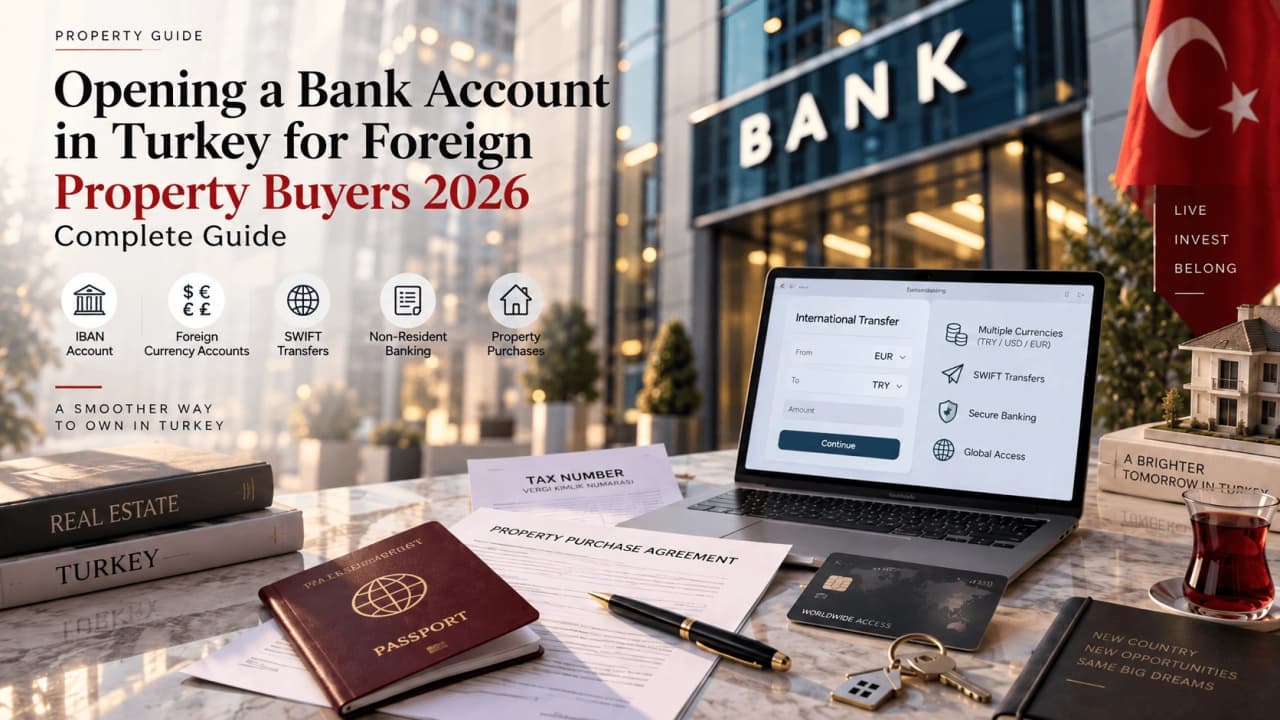
Opening a bank account in Turkey for property purchase is one of the most useful preparatory steps for many foreign buyers, even though having a personal Turkish bank account is not a universal legal prerequisite for every real estate acquisition.
A Turkish bank account can make it easier to:
- receive funds from abroad;
- hold Turkish lira;
- hold foreign currencies;
- pay a reservation deposit;
- coordinate the Döviz Alım Belgesi (DAB) process;
- pay the property seller;
- document payments;
- pay taxes and fees;
- arrange DASK and insurance;
- pay utility bills;
- pay monthly aidat;
- receive rental income;
- service a Turkish mortgage;
- manage the property after purchase.
But foreign buyers should understand an important distinction:
A Turkish bank account is useful, but it is not the same thing as a legal requirement to own property.
TKGM's foreign-buyer DAB guidance confirms that foreign currency can, for example, be transferred from the foreign buyer's overseas account directly to the seller's Turkish foreign-currency account, after which the seller can sell the relevant foreign currency to a bank for the Central Bank conversion procedure and obtain the required DAB in the buyer's name.
So the correct question is not simply:
“Do foreigners legally need a Turkish bank account to buy property?”
A better question is:
“Would opening a Turkish account make this particular property transaction safer, easier and more traceable?”
For many international buyers, the answer is yes.
This 2026 guide explains who can open a Turkish bank account, whether non-residents are accepted, which documents banks may request, how to obtain a Turkish tax number, how SWIFT transfers work, why banks ask about source of funds, how DAB fits into the payment process, and how to prepare a bank account before purchasing property in Istanbul.
Important: Bank onboarding policies are institution-specific and can change. A document accepted by one bank or branch may not automatically be sufficient for another. This guide describes the regulatory and practical framework reviewed in September 2026, not a guarantee that any particular bank will open an account for a particular applicant.
Can Foreigners Open a Bank Account in Turkey?
Yes.
Foreign nationals can open bank accounts in Turkey when they satisfy the relevant bank's identification, compliance and account-opening requirements.
However:
There is no single document list that guarantees account opening at every Turkish bank.
Banks operate under:
- banking regulations;
- anti-money-laundering obligations;
- sanctions and compliance policies;
- internal risk rules;
- customer identification requirements.
A bank may therefore accept one foreign applicant and require additional documentation from another.
Factors can include:
- nationality;
- country of residence;
- Turkish residence status;
- tax identification;
- address;
- occupation;
- source of income;
- intended account use;
- expected transaction size;
- sanctions/compliance profile.
Can Non-Residents Open Bank Accounts in Turkey?
Potentially, yes.
Foreigners should not assume that Turkish residence is universally required by law before a bank account can be opened.
Actual eligibility depends on the bank.
Türkiye İş Bankası, for example, currently tells individual applicants that account-opening documentation can include:
- a valid passport or, where applicable, residence permit;
- Foreign Identification Number or Tax Identification Number;
- proof of address in Turkey or, in applicable cases, the address printed in the passport.
This shows why foreign buyers should distinguish between:
Turkish legal residency
and
the bank's own customer-onboarding requirements.
Some banks or products may be more accommodating to non-residents than others.
Is a Residence Permit Required to Open a Turkish Bank Account?
Not universally.
Some banking relationships may require or strongly prefer a Turkish residence permit.
Others may accept a foreign customer using:
- passport;
- Turkish tax number;
- acceptable address evidence;
- additional compliance documentation.
Therefore:
“You always need a residence permit” is too broad.
But:
“You can definitely open an account without residency at every bank” is also wrong.
Ask the chosen bank what it requires for your:
- nationality;
- residence country;
- intended account;
- transaction purpose.
Is a Turkish Bank Account Required to Buy Property?
Not necessarily.
This is one of the most important distinctions in the article.
A foreign natural person buying real estate is subject to Turkey's foreign-currency conversion and DAB framework.
But this does not automatically mean the buyer must maintain a Turkish account in their own name.
TKGM's official DAB FAQ provides an example where:
- the foreign buyer sends USD directly from an overseas bank account;
- the money reaches the Turkish seller's USD account;
- the seller then sells the foreign currency through a Turkish bank for the Central Bank process;
- the DAB is prepared in the foreign buyer's name;
- the relevant bank transfer receipt and DAB are used for the property transaction.
Therefore:
Turkish account ≠ universal ownership requirement.
Nevertheless, opening one often makes the transaction substantially easier to manage.
Why Open a Turkish Bank Account Before Buying Property?
For many foreign buyers, a local account provides practical advantages.
Payment Control
The buyer can receive funds from abroad before closing rather than attempting a same-day international transfer.
Currency Management
The buyer may hold separate TRY, EUR or USD balances depending on bank products.
DAB Coordination
The bank can coordinate the foreign-currency conversion documentation required for a foreign-buyer property transaction.
Payment Evidence
Transfers generate an auditable payment trail.
Mortgage
A Turkish lending bank normally requires an operational banking relationship for loan repayment and disbursement.
Post-Purchase Costs
The same account can be used for:
- utilities;
- aidat;
- tax;
- insurance;
- property management.
Rental Income
Property owners may use the account for rental receipts and recurring expenses.
Remote Ownership
Mobile and internet banking can make management easier after the buyer leaves Turkey.
Step 1 — Get a Turkish Tax Identification Number
For many foreign buyers without a Turkish Foreign Identification Number, obtaining a Vergi Kimlik Numarası, or Turkish Tax Identification Number, is an important early step.
Turkey's Revenue Administration — Gelir İdaresi Başkanlığı (GİB) — currently provides an online:
Potential Tax Identification Number Application for Foreigners.
The official Digital Tax Office application asks for information including:
- name;
- surname;
- nationality;
- passport number;
- telephone number;
- address;
- identity information.
This allows many foreign applicants to begin the process digitally rather than treating a tax number as something that can only be issued at a physical tax office.
Do You Need a Tax Number to Buy Property?
Tax identification is relevant to the property transaction itself.
TKGM's published legal guidance notes that tax identification information is recorded together with the parties' identity information in the official property-sale documentation.
It also explains that where a foreign person has a Turkish Yabancı Kimlik Numarası (YKN), that foreign identification number can function as the tax identification number under the applicable framework.
So foreign buyers may encounter:
Turkish Foreign Identification Number — YKN
or
Turkish Tax Identification Number — VKN
depending on their status.
Tax Number vs Foreign Identification Number
These two numbers should not automatically be confused.
Vergi Kimlik Numarası
Tax Identification Number.
Commonly relevant to foreigners who do not yet have a Turkish Foreign Identification Number.
Yabancı Kimlik Numarası
Foreign Identification Number.
Normally an 11-digit number beginning with 9, issued within the relevant Turkish identity/residency framework.
For foreigners who have a YKN, Turkish regulations may use that number as the person's tax identification number in relevant procedures.
Does Getting a Turkish Tax Number Create Tax Residency?
No.
Obtaining a Turkish tax identification number for banking or property procedures should not be confused with automatically becoming a Turkish tax resident.
A tax identification number is an administrative identifier.
Tax residence depends on separate legal criteria.
Foreign property buyers should therefore distinguish:
having a Turkish tax number
from
being tax-resident in Turkey.
Step 2 — Prepare Your Passport
A valid passport is one of the primary documents used in foreign-customer identification.
MASAK's customer-identification framework requires financial institutions to identify customers before establishing relevant business relationships.
For non-Turkish natural persons, the required identification information includes matters such as:
- name;
- surname;
- date and place of birth;
- nationality;
- identity document type and number;
- address;
- signature;
- contact details;
- occupation/business information.
Identity information is verified through an accepted document such as the passport, residence document or another approved identification document.
Step 3 — Prepare Proof of Address
Proof of address is important because Turkish AML/KYC rules require address information to be obtained and verified in an ongoing banking relationship.
MASAK confirms that address information must be obtained and verified for both Turkish and foreign natural-person customers.
Depending on the bank, acceptable evidence may include:
- utility bill;
- bank statement;
- government-issued address document;
- Turkish residence documentation;
- address printed in the passport;
- another document accepted by the bank.
For example, İşbank currently identifies proof of a valid residence address in Turkey or, where applicable, an address printed on the applicant's passport among possible account-opening evidence.
Does the Address Need to Be in Turkey?
Not necessarily in every banking relationship.
This is bank-specific.
Foreign property investors may live permanently in:
- Europe;
- Gulf countries;
- North America;
- Asia;
- another jurisdiction.
A bank may accept an overseas address if its internal procedures allow it and the address can be properly verified.
However, another bank may request:
- Turkish address;
- residence permit;
- additional foreign address proof.
Do not assume that one branch's practice is a universal national rule.
Step 4 — Prepare a Turkish or Reachable Mobile Number
A mobile number is operationally important because Turkish digital banking commonly relies on:
- SMS verification;
- one-time passwords;
- application verification;
- security alerts.
For example, Ziraat's digital-banking system uses one-time SMS codes for certain transactions, including transfers to recipients that have not previously been registered.
Foreign buyers who will return abroad should think about this before leaving Turkey.
Do not open an account using a telephone number that will shortly become inaccessible.
International Mobile Access Can Matter
Foreign owners often discover this problem only after returning home.
If the bank's security system depends on:
SMS → Turkish SIM → phone
and the SIM stops functioning abroad, account access can become difficult.
Ziraat, for example, provides specific procedures for enabling internet/mobile banking access from foreign IP addresses and advises customers about overseas access settings.
When opening an account, ask:
- Will my mobile banking work abroad?
- Can my foreign phone number be registered?
- Will SMS arrive outside Turkey?
- Is foreign-IP access restricted?
- Can I change the phone number remotely?
- What happens if my SIM is lost?
These operational questions can become important when managing an Istanbul property remotely.
Step 5 — Explain Why You Need the Account
Banks are required to know their customers.
Turkey's AML legislation requires covered financial institutions to identify customers and take appropriate customer-due-diligence measures before transactions or relationships are established.
For a property buyer, the purpose is usually straightforward:
“I am opening the account to purchase and manage real estate in Turkey.”
You may be asked about:
- expected incoming amount;
- origin country;
- property price;
- occupation;
- source of income;
- expected transfer frequency;
- whether funds belong to you;
- whether the account will receive rental income.
Providing clear, consistent information reduces unnecessary friction.
What Documents May a Foreigner Need to Open a Bank Account?
A practical checklist can include:
Identity
- valid passport;
- residence permit if applicable;
- Foreign Identification Number if available.
Tax
- Turkish Tax Identification Number where required.
Address
- utility bill;
- foreign bank statement;
- Turkish address document;
- another accepted address proof.
Contact
- active mobile number;
- email address.
Financial Information
Depending on bank/compliance requirements:
- occupation;
- employer;
- income information;
- source-of-funds documentation;
- bank statements.
Property-Related Documents
For a large real-estate transfer, it can be useful to have:
- reservation agreement;
- property purchase contract;
- Tapu information;
- seller details;
- payment plan.
The exact list is bank-specific.
Example: İşbank Account-Opening Requirements
As a useful current example, İşbank's foreign-customer onboarding information lists:
- valid passport not older than 10 years or applicable residence permit;
- Foreign Identification Number or Tax Identification Number;
- proof of address in Turkey or, in applicable situations, the address printed in the passport.
This is an example of one bank's current requirements, not a nationwide guarantee.
Can Foreigners Open a Turkish Bank Account Online?
Potentially, but availability is not universal.
İşbank currently states that foreign nationals meeting the relevant requirements may initiate an account-opening application using:
- Foreign Identification Number;
- passport information;
through its digital onboarding system, with additional procedural details handled under the bank's onboarding rules.
However:
Do not assume every non-resident foreigner can open every Turkish bank account fully online.
Digital onboarding may depend on:
- Turkish YKN;
- NFC-compatible identification;
- phone verification;
- residency;
- bank technology;
- nationality;
- compliance checks.
Many international property buyers may still find branch onboarding more practical.
Can You Open an Account From Abroad Before Travelling to Turkey?
Some banking structures may support forms of remote onboarding, but this is highly bank-specific.
Ziraat currently publishes an international-transfer procedure under which a transfer from abroad can be used to initiate opening an account, subject to specified information and documentation being supplied to the relevant branch. Its published instructions refer to information including passport details, address and telephone information, together with a signed account-opening request.
This should not be interpreted as:
“Every foreigner can instantly open any Turkish bank account remotely.”
Before transferring funds, contact the chosen bank and confirm the exact current process.
Should You Open the Account Before Choosing a Property?
If you know you intend to purchase Turkish real estate, opening the account relatively early can be useful.
A practical sequence is:
Tax number
↓
Bank account
↓
Basic funding / compliance preparation
↓
Property selection
↓
Reservation / due diligence
↓
Purchase contract
↓
Transfer funds
↓
DAB
↓
Tapu closing
This reduces banking uncertainty when the transaction becomes time-sensitive.
What Type of Account Should a Property Buyer Open?
A foreign buyer will normally want a current / demand deposit account suitable for payments and transfers.
Depending on the bank, additional subaccounts may be available in:
- TRY;
- USD;
- EUR;
- GBP;
- other supported currencies.
A foreign-currency current account can be particularly useful where purchase funds originate overseas.
Ziraat, for example, currently offers foreign-currency current accounts that can receive and send foreign-money transfers.
TRY Account vs USD / EUR Account
A foreign property buyer often benefits from having both.
TRY Account
Useful for:
- taxes;
- local fees;
- aidat;
- utilities;
- local transfers;
- recurring payments.
Foreign-Currency Account
Useful for:
- receiving overseas funds;
- holding foreign currency before conversion;
- tracking purchase funds;
- DAB coordination where appropriate.
The exact structure should be discussed with the bank before the property payment.
What Is an IBAN in Turkey?
An IBAN identifies a bank account for payment purposes.
Turkish IBANs contain 26 characters and begin with:
TR
Ziraat specifically notes that providing the IBAN on incoming transfers improves speed and security.
For property payments, always verify the full IBAN independently before sending money.
Never Trust an IBAN Only Because It Was Sent by WhatsApp
Payment instruction fraud is a genuine transaction risk.
Imagine that the buyer receives an email:
“Our bank account has changed. Send €250,000 to this new IBAN.”
Before sending:
- confirm the instruction through a known channel;
- verify account-holder name;
- compare it with the contract;
- contact the seller/developer independently;
- do not rely on a newly supplied phone number in the suspicious message.
Large property transfers should be verified twice.
What Is SWIFT?
SWIFT is the international bank-messaging system commonly used for cross-border bank transfers.
A foreign buyer may send:
EUR/USD/other currency
from:
home-country bank
to:
Turkish bank account
using:
- recipient name;
- IBAN;
- bank/SWIFT information;
- payment reference.
The buyer's home bank and Turkish receiving bank may both conduct compliance checks before funds are credited.
How Long Does an International Property Transfer Take?
There is no universal guaranteed duration.
International transfer timing can depend on:
- sending bank;
- receiving bank;
- currency;
- correspondent banks;
- cut-off times;
- weekends;
- compliance review;
- transfer amount;
- documentation.
Therefore:
Do not schedule a property closing assuming an international transfer will definitely arrive the same day.
Send sufficiently early, while protecting the buyer contractually.
Correspondent Bank Fees
International SWIFT payments may pass through intermediary banks.
Potential costs can include:
- sender-bank fee;
- correspondent-bank fee;
- receiving-bank fee;
- FX conversion cost.
This matters if the seller expects an exact amount.
For example:
Seller must receive:
€300,000
Buyer sends:
€300,000
but intermediary charges reduce arrival to:
€299,850
The contract should make clear whether the buyer must ensure the full net amount reaches the seller.
Use a Clear Payment Reference
For a property-related transfer, a meaningful reference can help establish the audit trail.
For example:
Payment for Istanbul property – [Property / Contract Reference]
is much better than:
Private transfer
or
Gift
when the payment is actually consideration for real estate.
For citizenship transactions in particular, consistency between:
- buyer;
- seller;
- amount;
- contract;
- bank receipts;
- DAB;
- Tapu;
is very important.
Why Banks Ask About Source of Funds
A buyer transferring €300,000 or $500,000 should not be surprised if the bank asks:
“Where did this money come from?”
Turkey's banks operate under customer-due-diligence and AML obligations.
MASAK states that financial institutions must know their customers and obtain sufficient information concerning customer activities.
MASAK's banking suspicious-transaction indicators also specifically identify difficulty explaining:
- the purpose of a transaction; or
- the source of funds
as a potential risk indicator.
Therefore:
Source-of-funds checks are normal compliance procedures, not an accusation.
What Can Prove Source of Funds?
Depending on the source, documents may include:
Salary / Savings
- employment evidence;
- payslips;
- accumulated bank statements.
Business Income
- company financial statements;
- dividend evidence;
- tax records.
Sale of Another Property
- sale contract;
- previous title-transfer documentation;
- bank receipt.
Investment Liquidation
- brokerage statements;
- bank investment records.
Inheritance
- probate/inheritance documentation;
- bank transfer evidence.
Gift
- gift documentation;
- relationship explanation;
- donor source-of-funds evidence where required.
The bank decides what evidence it considers sufficient.
Source of Funds vs Source of Wealth
These concepts are related but different.
Source of Funds
Where the money for this transaction came from.
Example:
€400,000 from sale of an apartment in Germany.
Source of Wealth
How the buyer accumulated their overall wealth.
Example:
Twenty years of business ownership.
For a significant transaction, the bank may seek information about either or both depending on its risk assessment.
Do Not Wait Until Closing Day to Explain a Large Transfer
If you plan to send:
€500,000
to a newly opened Turkish bank account, contact the bank first.
Explain:
- purpose;
- expected transfer date;
- sending account;
- amount;
- currency;
- property transaction.
Ask what documentation the compliance team may require.
This can prevent a situation where the money arrives immediately before Tapu but is held pending documentation.
Can a Bank Delay a Transfer for Compliance Review?
Yes.
Banks have regulatory obligations to investigate transactions where necessary.
MASAK's framework requires suspicious transactions to be reported regardless of amount when the relevant suspicion exists, and regulated institutions may need additional information as part of their review.
Therefore:
“The money has left my overseas account”
does not necessarily mean:
“The money is immediately available for the property closing.”
Build time into the payment process.
Avoid Unnecessary Third-Party Transfers
Suppose the property buyer is:
John Smith
but the property money comes from:
Company XYZ Ltd
or
a friend's account.
This does not automatically mean the transaction is prohibited.
But it creates additional questions:
- Why is a third party paying?
- What relationship exists?
- Is the payment a loan, dividend, gift or company distribution?
- Who is the beneficial owner of the funds?
- Does the citizenship payment structure permit it?
Where possible, a clean:
buyer → seller
or clearly documented banking structure is easier to explain.
Do Not Split a Large Transfer to Avoid Bank Questions
Attempting to break one large property payment into many unusual smaller transactions merely to avoid compliance attention can create more—not less—banking risk.
The better strategy is:
prepare documentation and explain the legitimate transaction clearly.
Bank Account and DAB
The Döviz Alım Belgesi is one of the most important reasons banking must be coordinated carefully for foreign property buyers.
TKGM confirms that, for property purchases by foreign natural persons, the required foreign currency must be sold through a bank to the Central Bank framework and the resulting DAB presented for the title transaction.
The DAB process should occur before the relevant Tapu sale transaction.
Who Can Arrange the DAB?
TKGM's 2022/1 circular states that the foreign currency can be sold to the bank by:
- buyer;
- seller;
- their proxies;
- their representatives.
The bank-issued DAB must contain specific identifying information concerning the buyer and the relevant property transaction.
This is another reason why the buyer's own Turkish bank account is not necessarily a formal prerequisite.
Example: Buyer Uses Their Own Turkish Bank Account
A simple structure may look like:
Buyer overseas account
↓
Buyer Turkish USD/EUR account
↓
Bank performs required conversion / DAB process
↓
Seller paid according to agreed structure
↓
Tapu transfer
This gives the buyer strong control over the payment process.
Example: Buyer Does Not Have a Turkish Account
TKGM provides an alternative example:
Buyer's overseas USD account
↓
Seller's Turkish USD account
↓
Seller arranges bank conversion for buyer's DAB
↓
Bank documentation presented to Tapu
This structure can work under the published DAB framework.
However, the transaction should be coordinated with:
- receiving bank;
- seller;
- lawyer/adviser;
- Tapu requirements;
before funds are transferred.
DAB Amount Must Exclude Unrelated Costs
TKGM's circular states that the amount used for the property DAB should relate to the real estate sale / promise-of-sale consideration and should not include unrelated items such as commission or other expenses in the declared conversion amount.
Therefore separate:
property purchase price
from
agency commission
legal fee
furniture
other expenses
where appropriate.
Do not transfer everything under one unexplained payment label.
Bank Account and Turkish Citizenship by Property Investment
Bank documentation becomes even more important where the buyer intends to use the property for Turkish citizenship by investment.
TKGM states that citizenship-related property transactions require not only the DAB but also bank evidence of the payment from buyer to seller.
This makes a clean payment trail essential.
For citizenship purchases, the transaction should coordinate:
- buyer name;
- seller name;
- property;
- currency;
- transfer amount;
- DAB;
- bank receipt;
- valuation / TTB;
- Tapu value;
- citizenship annotation.
Citizenship Buyers Should Avoid Informal Payments
For an ordinary small commercial transaction, people sometimes use:
- cash;
- third parties;
- split transfers.
A citizenship property transaction is not the place for an unclear payment trail.
The banking evidence must support the investment structure.
Before moving funds, confirm:
who pays whom, through which bank, in which currency, and what appears on the receipt.
Does the Buyer Have to Pay the Seller From a Turkish Bank?
Not necessarily in every property transaction.
TKGM's published DAB example expressly allows the foreign buyer to send foreign currency from an overseas bank account directly to the seller's Turkish account before the seller arranges the DAB conversion.
For citizenship transactions, however, bank payment evidence must satisfy the applicable citizenship requirements.
Therefore avoid treating a general DAB example as a substitute for citizenship-specific transaction planning.
Turkish Bank Account and Mortgage
If the buyer is using Turkish mortgage financing, the banking relationship becomes more central.
The lender may use the account for:
- loan disbursement;
- mortgage-related fees;
- insurance;
- monthly installments;
- automatic payment.
For the financing rules, see:
Mortgage in Turkey for Foreigners 2026 — Article 23.
Bank Account and Property Deposit
A local bank account can make reservation payments easier and more traceable.
But opening the account does not answer:
whether the Kapora is refundable.
That remains a contract issue.
Use the banking system to document the payment, then rely on a clear reservation agreement to define:
- purpose;
- refund conditions;
- seller default;
- buyer default.
See:
Property Deposit in Turkey 2026 — Article 21.
Bank Account and Property Purchase Contract
The purchase contract should match the payment structure.
If the contract says:
EUR 300,000
but payment instructions suddenly demand:
USD to a third-party account
stop and reconcile the discrepancy.
The contract should identify or clearly support:
- purchase amount;
- currency;
- installment plan;
- payment recipient;
- DAB process;
- closing payment.
See:
Property Purchase Contract in Turkey 2026 — Article 20.
How Much Money Should You Transfer to Turkey Before Closing?
There is no universal amount.
A prudent approach is to transfer only what is required according to the documented transaction plan.
The buyer should maintain reserves for:
- purchase price;
- Tapu-related expenses;
- valuation;
- insurance;
- legal costs;
- bank charges;
- agency fee if applicable;
- post-purchase expenses.
Do not transfer the full purchase amount into an account before you understand:
- access;
- compliance status;
- transfer limits;
- conversion;
- DAB procedure;
- closing date.
Bank Transfer Limits
There is no single universal Turkish bank-transfer limit for every foreign customer.
Limits can depend on:
- bank;
- customer;
- transfer channel;
- internet banking;
- mobile banking;
- branch transfer;
- security status;
- currency;
- beneficiary;
- transaction history.
A property transaction may exceed normal digital limits.
Before closing, ask the bank:
“Can I transfer TRY 15 million / €300,000 from this account on the planned closing date?”
Do not discover the daily limit while sitting at Tapu.
Ask for a Limit Increase Before Closing
Where the bank permits it, arrange:
- transfer-limit increase;
- beneficiary registration;
- branch authorization;
- compliance pre-clearance;
before the transaction date.
If a branch visit is required for a large payment, know this in advance.
Mobile Banking Is Part of Property Management
A foreign buyer may later need to pay:
- electricity;
- water;
- gas;
- internet;
- aidat;
- tax;
- insurance;
- property manager.
Reliable mobile banking can therefore matter almost as much after purchase as during closing.
When opening the account, confirm:
- English interface if required;
- international login;
- transfer functionality;
- recurring payments;
- account statements;
- PDF receipts.
Keep Every Bank Receipt
For property purchases, maintain a digital transaction file containing:
- incoming SWIFT receipt;
- Turkish bank account statement;
- deposit receipt;
- DAB;
- seller payment receipt;
- mortgage documents if relevant;
- Tapu payment evidence;
- citizenship payment evidence if relevant.
Ziraat, for example, allows digital-banking users to obtain transaction receipts from account history and send them by email.
Do not rely on screenshots alone.
Download formal receipts.
Keep Documents for Future Resale and Tax Questions
Years later, you may need to prove:
- acquisition cost;
- property payment;
- banking source;
- capital invested;
- renovation expenses;
- tax basis.
Keeping organized bank documentation at the time of purchase is much easier than attempting to reconstruct the transaction five years later.
Can Someone Open the Bank Account With a Power of Attorney?
Potentially, but acceptance depends on the bank and the wording/form of the Power of Attorney.
Banks may require authority expressly covering matters such as:
- opening accounts;
- signing banking contracts;
- making transfers;
- receiving cards;
- internet banking;
- currency transactions.
A general property-purchase Power of Attorney does not automatically guarantee bank acceptance.
If banking authority is required, confirm the bank's requested wording before preparing the Power of Attorney.
For the broader POA process, see:
Power of Attorney in Turkey for Property Purchase — Article 19.
Can Your Real Estate Agent Open the Account for You?
Do not assume so.
An agent helping you purchase an apartment does not automatically have authority to:
- open a bank account;
- control your funds;
- make transfers.
If representation is genuinely needed, the authority should be formal and limited.
Never give:
- mobile banking password;
- SMS verification code;
- debit card PIN;
to an agent or salesperson.
Protect Your Online Banking Credentials
Banks will not need your full login credentials to “help process the property.”
Protect:
- password;
- OTP;
- SMS code;
- mobile approval;
- card PIN.
If someone asks you to send an OTP so that they can “complete the property transfer,” stop and contact the bank directly.
Beware of Fake Bank Accounts and Payment Instructions
Foreign property buyers are attractive targets for invoice and payment fraud.
Common warning signs include:
- last-minute IBAN change;
- new beneficiary;
- personal account replacing company account;
- pressure to transfer immediately;
- sender email with slightly changed domain;
- request to keep payment secret.
Always confirm high-value instructions independently.
Who Should Receive the Property Money?
The payment structure should logically match the legal transaction.
Potential legitimate recipients can include:
- registered seller;
- developer company;
- bank under an approved mortgage/closing arrangement;
- another party whose role is clearly documented.
If the contract seller is:
XYZ Construction A.Ş.
but the payment is requested to:
an employee's personal account
ask why.
The more complex the payment path, the more documentation you need.
Do Not Use Cash for a Major Property Payment Without Understanding the Consequences
Large cash payments create:
- weak traceability;
- source-of-funds issues;
- evidentiary difficulty;
- citizenship complications;
- security risks.
A bank transfer provides far stronger evidence of:
- sender;
- recipient;
- amount;
- date;
- currency.
For a foreign property transaction, a documented bank trail is generally much easier to defend.
Can You Transfer From a Company Account?
Possibly, depending on the transaction and reason for payment.
But if the buyer is an individual and the money comes from their company, the bank may want to understand whether it represents:
- dividend;
- salary;
- shareholder loan;
- distribution;
- another legitimate source.
For citizenship-related purchases, third-party/company payment structures require particularly careful review.
Do not improvise.
Bank Account Currency Strategy
A foreign buyer should decide:
What currency is my capital currently in?
What currency is the contract in?
What currency will reach Turkey?
What must be converted for DAB?
In what currency will the seller ultimately receive payment?
What conversion spread will the bank charge?
A poorly planned conversion can create significant unnecessary cost on a large property transaction.
Example of FX Cost
Suppose you transfer:
€400,000
A difference of just:
1%
in effective conversion value equals:
€4,000
Therefore, before converting a large amount:
- ask for the applicable exchange rate;
- understand the DAB process;
- distinguish market rate from bank customer rate;
- avoid unnecessary double conversion.
Banking execution is part of the property cost.
Avoid Double Currency Conversion
An inefficient structure might be:
EUR → USD → TRY
when only:
EUR → TRY
was necessary.
Each conversion can introduce spread and cost.
Before moving money, map the entire flow.
Can You Negotiate the Exchange Rate?
For very large foreign-exchange transactions, banks may in some circumstances provide transaction-specific pricing.
This is bank- and market-dependent.
If you plan to convert a substantial property amount, ask the treasury/branch team what rate will apply rather than assuming the small retail-screen rate is the only available rate.
Do You Need More Than One Turkish Bank?
Not necessarily.
One bank may be enough.
However, some investors maintain relationships with more than one institution for:
- financing comparison;
- transfer flexibility;
- different FX pricing;
- operational redundancy.
Do not open multiple accounts unnecessarily if they complicate compliance and administration.
Choosing a Turkish Bank for Property Purchase
Instead of asking:
“Which bank is best?”
compare:
| Factor | What to Check |
|---|---|
| Foreign Customer Acceptance | Does the bank accept your nationality/residency profile? |
| Documents | What exactly is required? |
| English Support | Branch / digital support available? |
| Foreign Currency | USD/EUR accounts available? |
| SWIFT | Incoming/outgoing transfer capability and cost |
| FX Pricing | Conversion rates/spreads |
| DAB Experience | Can branch handle foreign-buyer property DAB efficiently? |
| Transfer Limits | Can high-value property payments be executed? |
| Mobile Banking | Will it work abroad? |
| Mortgage | Relevant if financing is required |
| Post-Purchase | Utility/rent/property-management functionality |
For property buyers, a bank branch experienced with foreign real-estate transactions can be more useful than choosing purely by brand recognition.
Should You Open the Account Near the Property?
Not necessarily.
Modern Turkish banking is largely interconnected nationally.
However, opening at a branch experienced with:
- foreign customers;
- DAB;
- high-value property payments;
- citizenship transactions;
can make the process smoother.
An Istanbul buyer may benefit from using a branch accustomed to foreign real-estate transactions.
Bank Account Opening Checklist
Before Applying
Compliance
Account Setup
Property Purchase
Citizenship Buyers
Property Banking Red Flags
| Red Flag | Why It Matters |
|---|---|
| “You do not need a contract; just send money” | Payment occurs before legal terms are established |
| Personal account receives developer payment | Recipient may not match seller |
| IBAN changed at the last minute | Possible fraud |
| Buyer cannot identify account holder | Recovery risk |
| Agent requests mobile banking password | Serious security problem |
| Money sent from unrelated third party without documentation | Compliance/payment-trail issues |
| Large transfer arrives on Tapu day with no bank preparation | Funds may not be immediately available |
| Buyer does not know SWIFT fees | Seller may receive less than required |
| Buyer converts currency before understanding DAB | Documentation may become harder |
| Payment reference is vague or incorrect | Audit trail weakens |
| Citizenship buyer pays in cash | Serious documentary risk |
| Bank asks source of funds and buyer has no evidence | Transfer may be delayed |
| Buyer cannot access mobile banking abroad | Post-purchase management becomes difficult |
| Transfer limit checked only on closing day | Closing can fail |
| Buyer sends OTP to salesperson | Account security compromised |
Common Banking Mistakes Foreign Property Buyers Make
Mistake 1 — Waiting Until the Week of Tapu to Open an Account
KYC and compliance can take time.
Prepare earlier.
Mistake 2 — Assuming a Tax Number Guarantees Account Opening
It does not.
The bank still performs customer onboarding.
Mistake 3 — Assuming Residence Permit Is Always Required
Bank policy varies.
Mistake 4 — Assuming No Turkish Account Means You Cannot Buy
TKGM's own DAB examples show transaction structures where foreign funds move directly to the seller's Turkish account.
Mistake 5 — Sending the Full Price Before Due Diligence
Banking convenience does not replace buyer protection.
Mistake 6 — Not Preparing Source-of-Funds Evidence
Large real-estate transfers can legitimately trigger enhanced bank questions.
Mistake 7 — Using an Unrelated Third-Party Account
This complicates the payment trail.
Mistake 8 — Ignoring SWIFT Costs
The seller may receive less than the agreed amount.
Mistake 9 — Converting Currency Too Early
The DAB and closing structure should be established first.
Mistake 10 — Forgetting Mobile Banking Abroad
Foreign owners need long-term access.
Mistake 11 — Giving Online Banking Access to an Agent
Never share passwords or security codes.
Mistake 12 — Treating Bank Transfer as Proof the Property Is Safe
A bank can transfer money to a seller even if the buyer failed to conduct legal due diligence.
Banking does not replace:
Tapu check + contract review + legal due diligence.
Example Property Payment Workflow
Consider an international buyer purchasing an Istanbul apartment for:
€300,000
A possible workflow is:
Step 1
Buyer obtains Turkish tax number.
Step 2
Buyer opens a Turkish EUR and TRY account.
Step 3
Bank is informed that approximately €300,000 will arrive for a property purchase.
Step 4
Buyer provides source-of-funds documentation if requested.
Step 5
Buyer transfers funds from their overseas EUR account to their Turkish EUR account.
Step 6
Buyer completes legal due diligence and purchase documentation.
Step 7
Buyer/bank coordinates DAB according to the current foreign-buyer rules.
Step 8
Seller payment is made according to the documented closing structure.
Step 9
Tapu transfer is completed.
Step 10
Buyer keeps:
- SWIFT receipt;
- DAB;
- seller transfer receipt;
- Tapu documents.
This gives the transaction a clear financial audit trail.
Alternative Workflow Without a Turkish Buyer Account
Another structure supported by TKGM guidance may be:
Step 1
Buyer completes due diligence and contract.
Step 2
Buyer sends agreed foreign currency from their overseas account directly to the seller's Turkish foreign-currency account.
Step 3
Seller arranges conversion through the bank for the DAB in the buyer's name.
Step 4
Relevant bank receipt and DAB are prepared.
Step 5
Tapu transaction proceeds.
TKGM expressly describes such an example in its DAB FAQ.
This can eliminate the need for the buyer to open a Turkish account solely for the property payment.
However, a local account may still be valuable for ownership afterward.
After Buying: Why Keep the Account Open?
After the Tapu is issued, the account can continue to serve the property.
Possible uses include:
- electricity payments;
- gas;
- water;
- internet;
- DASK;
- home insurance;
- aidat;
- municipality payments;
- maintenance;
- property manager;
- rent collection;
- Turkish tax payments.
Foreign buyers should therefore think of the bank account not merely as a closing tool but as part of the property's operating infrastructure.
Rental Property Owners
If the apartment will be rented, keep rental cash flow separate and traceable.
A dedicated Turkish account can make it easier to monitor:
Rent
minus
Aidat
minus
Management
minus
Maintenance
minus
Tax / insurance
=
Net property cash flow
This also improves investment analysis.
Remote Owners Should Test Banking Before Leaving Turkey
Before flying home:
- Log in using mobile data or Wi-Fi.
- Make a small transfer.
- Download a receipt.
- Confirm SMS/security access.
- Check overseas access settings.
- Confirm registered telephone and email.
- Save the bank's international customer-service contact information.
It is much easier to fix digital banking while still in Turkey.
15 Questions to Ask the Bank Before Opening an Account
Foreign property buyers should ask:
- Do you open accounts for my nationality?
- Can I open the account as a non-resident?
- Do I need a Turkish residence permit?
- Is my Turkish tax number sufficient?
- What proof of address will you accept?
- Can I open TRY, USD and EUR accounts?
- Can I receive a large SWIFT transfer from abroad?
- What source-of-funds documents will you require?
- What are incoming SWIFT charges?
- What are outgoing transfer limits?
- Can I increase the transfer limit for the property closing?
- Can your branch handle DAB for a foreign property buyer?
- Will mobile banking work when I am outside Turkey?
- Can I receive OTP messages on my foreign number?
- What documents do you need before I transfer the purchase funds?
Get important operational answers before the money moves.
FAQ: Turkish Bank Accounts for Foreign Property Buyers
Can foreigners open a bank account in Turkey?
Yes. Foreign nationals can open accounts subject to the chosen bank's identification, compliance and customer-acceptance requirements.
Do I need a residence permit to open a Turkish bank account?
Not universally.
Requirements vary by bank and customer. İşbank, for example, currently lists a valid passport or applicable residence permit, a Foreign Identification Number or Tax Identification Number, and acceptable address evidence among its onboarding requirements.
Can I open a bank account in Turkey with only a passport?
A passport is central to identification, but a bank may also require:
- tax or foreign identification number;
- address evidence;
- contact details;
- additional KYC documentation.
A passport alone should not be assumed sufficient at every bank.
How do foreigners get a Turkish tax number?
Turkey's Digital Tax Office currently provides an online Potential Tax Identification Number Application for Foreigners, requesting passport and personal/address information.
Is a Turkish tax number the same as a residence permit?
No.
A tax number is an administrative tax identifier.
A residence permit concerns immigration/residency status.
Is a Turkish bank account mandatory to buy a house?
Not necessarily.
TKGM's DAB guidance includes a transaction example where the foreign buyer sends foreign currency directly from an overseas account to the seller's Turkish account and the seller then arranges the foreign-exchange conversion and DAB process.
Do foreign property buyers need DAB?
For purchases by foreign natural persons falling under the applicable framework, TKGM states that foreign currency must be sold through a bank under the Central Bank procedure and a DAB must be submitted for the title transaction.
Can the seller arrange DAB instead of the buyer?
Yes, within the applicable structure.
TKGM's 2022/1 framework allows the relevant foreign currency to be sold through the bank by the buyer, seller or their authorized representatives, provided the documentation is prepared correctly.
Can I send the property money from my overseas account?
Yes, depending on the transaction structure.
TKGM provides an explicit example of a foreign buyer transferring USD from an overseas bank account to a seller's Turkish USD account.
Can I hold euros or dollars in a Turkish bank?
Turkish banks offer foreign-currency accounts.
For example, Ziraat currently offers foreign-currency current accounts that support foreign-money transfers.
Product availability and supported currencies depend on the bank.
What is a Turkish IBAN?
A Turkish IBAN is the account identifier used for bank transfers. Ziraat states that Turkish IBANs contain 26 characters including the TR prefix.
Why does the bank ask where my money came from?
Turkish banks are subject to AML/KYC obligations.
MASAK requires financial institutions to identify customers and apply customer-due-diligence measures, while unexplained source of funds can be a risk indicator for suspicious-transaction review.
Can I transfer $400,000 into a new Turkish bank account?
Potentially, but contact the bank in advance.
A large incoming transfer may require supporting documentation regarding:
- origin of funds;
- purpose;
- sender;
- property transaction.
Do not assume it will be immediately available without compliance review.
Can I pay for Turkish property in cash?
A bank-transfer trail is generally much easier to document, particularly for foreign-buyer and citizenship transactions.
Citizenship-related property acquisition specifically requires relevant bank payment evidence under TKGM procedures.
Can I use someone else's bank account to buy the property?
Third-party payment structures can create additional legal, banking and compliance questions.
They should be reviewed before payment, particularly where citizenship is involved.
A direct and documented payment trail is usually clearer.
Can I open my Turkish account remotely?
Some banks provide digital or alternative onboarding options.
İşbank currently allows qualifying foreign nationals to initiate digital account-opening applications using foreign identification and passport information, while other bank procedures differ.
Will Turkish mobile banking work abroad?
It can, but security settings vary.
For example, Ziraat maintains specific procedures for customers who need internet/mobile banking access from foreign IP addresses.
Foreign owners should configure access before leaving Turkey.
Do I need a Turkish bank account after buying the property?
It is not necessarily legally mandatory simply because you own property, but it is highly useful for:
- utilities;
- aidat;
- tax;
- insurance;
- rental income;
- maintenance;
- property management.
Final Advice for Foreign Property Buyers
Opening a bank account in Turkey for property purchase is not merely an administrative task.
It is part of the financial infrastructure of the transaction.
A well-prepared buyer should know:
- which bank will accept their customer profile;
- which identity and address documents are required;
- whether a Tax Identification Number or YKN will be used;
- how the purchase money will reach Turkey;
- what source-of-funds evidence may be required;
- what currency accounts are needed;
- how DAB will be produced;
- who will receive the property payment;
- what transfer limits apply;
- how banking will continue after the purchase.
The most important practical rule is:
Build the banking structure before the property closing—not during it.
Do not wait until the day before Tapu to discover that:
- your account is not active;
- your transfer limit is too low;
- the bank needs source-of-funds documents;
- the money has not cleared;
- your foreign currency was converted incorrectly;
- your mobile banking cannot authorize the transfer.
For foreign property buyers, a strong transaction creates a clean financial chain:
Source of Funds
↓
Buyer's Bank
↓
Turkish Banking System
↓
DAB / Required Documentation
↓
Seller Payment
↓
Tapu Transfer
↓
Permanent Transaction Records
The buyer's own Turkish bank account can make this chain simpler, but it is not the only legally possible route.
TKGM's published rules confirm that, under the appropriate DAB structure, foreign currency can also be transferred directly from a buyer's overseas account to the seller's Turkish account before the required bank conversion procedure is completed.
So the strategic question is not:
“Must I have a Turkish bank account?”
It is:
“Which banking structure gives me the cleanest, safest and most documentable route from my money abroad to registered ownership in Turkey?”
That is the question a foreign property buyer should answer before transferring substantial funds.