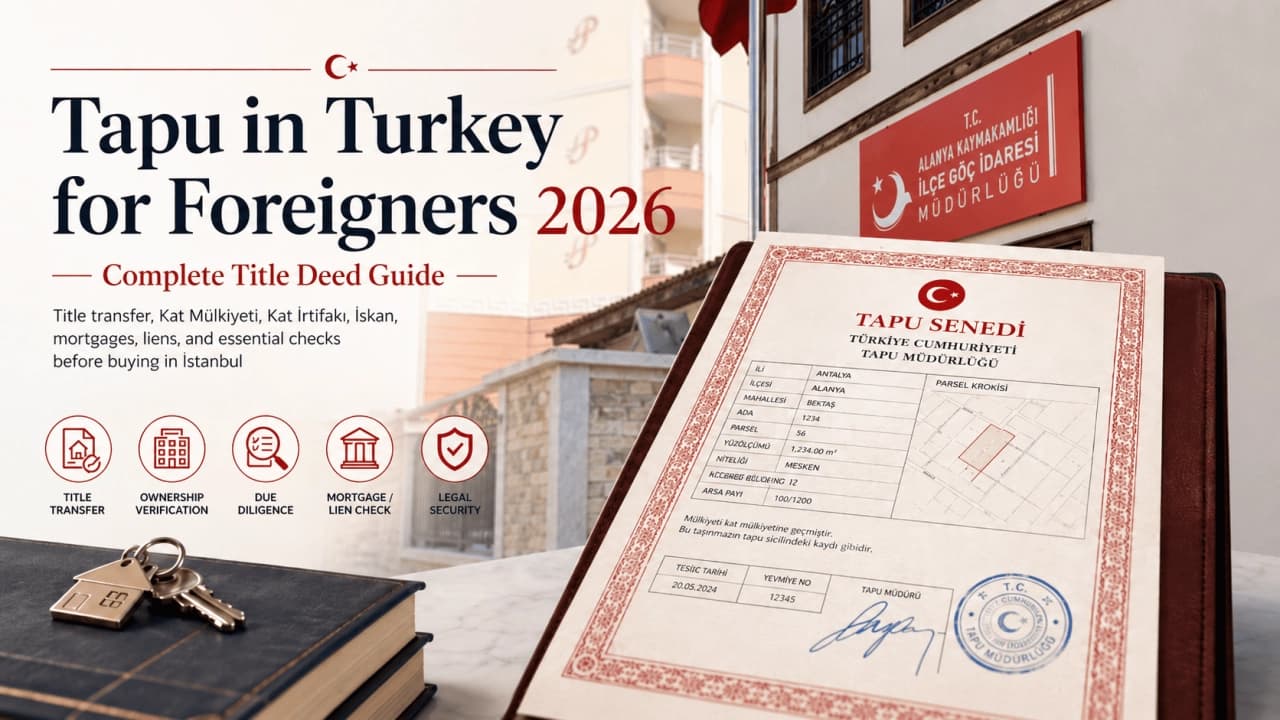
Introduction
For a foreign buyer purchasing an apartment in Istanbul, one document is more important than almost every brochure, reservation form, developer presentation, or sales promise:
The Tapu
The Turkish Tapu, or title deed, is connected with the official Land Registry record of ownership.
A buyer may have:
A signed sales contract
A reservation agreement
Developer invoices
Bank-payment receipts
Keys to the apartment
but those documents should not be confused with completion of the official Land Registry ownership-transfer procedure.
TKGM's official foreign-buyer procedure states that after the application has been examined, fees paid, and the parties complete the formal signing process, the Land Registry transaction is completed and the title deed is delivered to the foreign owner or authorized representative.
This creates one of the most important rules for buying property in Türkiye:
A sales agreement describes a transaction. The Land Registry process establishes the registered ownership position.
For foreign buyers, understanding the Tapu is therefore not optional due diligence.
It is one of the foundations of a safe property purchase.
What Is a Tapu in Turkey?
Tapu is the everyday Turkish term used for the title deed associated with a registered real-estate ownership record.
Türkiye's Land Registry and Cadastre system is administered by the:
Tapu ve Kadastro Genel Müdürlüğü — TKGM
or:
General Directorate of Land Registry and Cadastre
TKGM maintains the systems and procedures used for:
Property registration
Sale
Mortgage
Inheritance transfer
Other title transactions
and provides dedicated guidance for foreign property buyers.
Foreigners can also use TKGM's official Your Key Türkiye platform for updated information relating to property acquisition in Türkiye. TKGM describes the service as a multilingual portal created specifically to help foreigners access current information and procedures relating to Turkish real estate.
Why the Tapu Matters So Much
A property purchase has two very different dimensions.
Commercial Dimension
This involves:
Price
Negotiation
Deposit
Payment plan
Furniture
Delivery date
Legal Ownership Dimension
This involves:
Who owns the property
What exact property is registered
What share is owned
Whether an independent unit exists
Whether Kat Mülkiyeti or Kat İrtifakı exists
What rights or restrictions are registered
A foreign investor should never allow the commercial side of the transaction to replace the legal side.
A salesperson may say:
“This is Apartment 24.”
But the buyer should ask:
“What exactly is Apartment 24 in the Land Registry?”
That is a very different question.
Sales Contract vs Tapu
This distinction should be understood before paying a large deposit.
Suppose a buyer signs a contract with a developer stating:
Unit: B Block, Floor 8, Apartment 24
Purchase Price: $300,000
The contract shows what the developer has agreed to sell.
It does not by itself prove that:
Apartment 24 is a separately registered independent section
The seller is the registered owner
The property has no mortgage
The property has no attachment
The registered use matches the marketed use
The transaction has already transferred ownership
The formal Land Registry procedure still matters.
TKGM's official sale process for foreign natural persons requires an application to the Land Registry Directorate, examination of the documents, payment of applicable fees, formal execution of the transaction and delivery of the title deed after the procedure is completed.
Therefore:
Contract ≠ Completed Tapu TransferReservation Form vs Tapu
The difference is even greater with a reservation document.
A reservation form usually does nothing more than establish commercial terms such as:
Selected apartment
Deposit
Temporary price
Deadline for signing the main contract
It should not be interpreted as registered property ownership.
This becomes particularly important with:
Off-plan developments
Early construction projects
Installment purchases
A foreign buyer can potentially pay substantial amounts before becoming the registered owner.
The payment schedule and title-transfer schedule should therefore be understood separately.
What Information Identifies a Turkish Property?
Turkish Land Registry data identifies real estate through several specific pieces of information.
TKGM's data rules identify property characteristics including:
Province
District
Neighborhood or village
Location
Block — Ada
Parcel — Parsel
Property nature
Surface area
Kat İrtifakı / Kat Mülkiyeti status
Block/building information where applicable
Independent-section number.
For an apartment buyer, these identifiers are more reliable than a marketing description such as:
“Luxury apartment near the metro.”
İl — Province
İl identifies the province.
For example:
İstanbul
This sounds obvious, but Land Registry identification works from official administrative records rather than general real-estate marketing areas.
İlçe — District
İlçe identifies the official district.
Examples include:
Kadıköy
Üsküdar
Şişli
Kağıthane
Bakırköy
Başakşehir
A project's marketing name may mention a better-known neighboring district, but the official property record should be checked.
Mahalle — Neighborhood
Mahalle identifies the official neighborhood.
Micro-location matters enormously in Istanbul.
Two buildings in the same district can differ substantially in:
Transport
Market value
Building quality
Rental demand
Resale liquidity
The Land Registry identification helps establish exactly where the property is registered.
Ada — Block
Ada is a cadastral block identifier.
It groups parcels within the cadastral system.
For example:
Ada: 1245
This is not the apartment's building number.
It is part of the cadastral identification of the land.
Parsel — Parcel
Parsel identifies the specific land parcel within the cadastral block.
For example:
Ada: 1245
Parsel: 18
Together, Ada and Parsel are fundamental identifiers for the land underlying the development.
This becomes especially important when checking:
Land ownership
Off-plan projects
Parcel boundaries
Development documentation
Bağımsız Bölüm — Independent Section
For apartment buyers, one of the most important concepts is:
Bağımsız Bölüm
TKGM defines a bağımsız bölüm as a part of the principal property that is suitable for independent use, registered separately in the Land Registry and capable of being subject to independent ownership.
Depending on the approved architectural project, an independent section can include a:
Flat
Office
Shop
Store
Storage unit
Other independently usable section.
This is critical.
If you believe you are buying:
Apartment 24
you should verify the corresponding:
Bağımsız Bölüm No. 24
or whatever independent-section number actually applies in the registry.
Apartment Number and Independent-Section Number May Not Always Be the Same Thing
A building may have:
Door number
Internal project number
Sales unit number
Independent-section number
These identifiers can sometimes differ.
For example:
Marketing Unit: A-806
Door Number: 24
Registered Independent Section: 63
That is why checking only the sales brochure can be dangerous.
The buyer needs to verify:
Which registered independent section am I actually acquiring?
Property Nature — Niteliği / Cinsi
The official property record also contains information concerning the legal nature of the real estate.
This can help distinguish between property registered as:
Arsa — land/plot
Mesken — residence
Dükkan — shop
Büro — office
Other legally recorded property types
The approved architectural project plays an important role in determining how independent sections are recorded. TKGM states that the Land Registry does not independently reclassify the intended use of an independent section; registration follows the project approved by the competent authority.
This creates an important foreign-buyer rule:
Marketing description should never replace official property classification.
A unit advertised as a “residence” should still be checked in the official documentation.
Arsa Payı — Land Share
Another term foreign apartment buyers frequently misunderstand is:
Arsa Payı
The owner of an apartment does not merely own the internal physical space.
Under Türkiye's condominium system, the independent section is connected with a proportional share of the underlying land.
TKGM defines arsa payı as the common-ownership share allocated to independent sections according to the principles of the Condominium Law.
For example:
Your apartment might have an arsa payı represented as:
40 / 10,000
This does not mean you own only 40/10,000 of your apartment.
It means the independently owned apartment is legally connected with a proportional share of the underlying principal property.
Arsa Payı Cannot Normally Be Separated From the Apartment
TKGM explains that the land share allocated to an independent section is legally connected with that section.
When the independent section is transferred, its attached land share transfers with it.
The land share cannot ordinarily be transferred separately from the independent section to which it belongs.
Therefore:
Apartment Ownership + Attached Arsa Payı
operate together.
This should not be confused with buying an ordinary undivided share of a land parcel.
That distinction becomes important when discussing Hisseli Tapu later in this guide.
What Is Kat Mülkiyeti?
Kat Mülkiyeti is one of the most important title concepts for apartment buyers.
Under TKGM's current condominium framework:
Kat Mülkiyeti can be established on a completed structure.
TKGM's current circular states that because Kat Mülkiyeti is established on a completed building, the relevant cadastral/property-type conversion must have been completed as required before condominium ownership is established.
In practical terms, Kat Mülkiyeti means that the completed building has separately registered independent sections under the condominium ownership system.
For an apartment buyer, that usually means the purchased apartment exists as a defined independent section within the completed condominium structure.
What Does Kat Mülkiyeti Give You?
Kat Mülkiyeti connects several legal elements.
The buyer acquires ownership of the registered independent section together with rights linked to:
Its allocated land share
Relevant common areas
Appurtenances where applicable
TKGM explains that when an independent section is transferred, its associated land share and linked rights follow that transfer.
This makes Kat Mülkiyeti a central structure for completed apartment ownership in Türkiye.
Does Kat Mülkiyeti Mean the Property Is Completely Risk-Free?
No.
This is one of the biggest misconceptions foreign buyers make.
Kat Mülkiyeti answers important ownership questions.
It does not answer every real-estate due-diligence question.
A property with Kat Mülkiyeti can still potentially have issues involving:
Mortgage
Attachment
Registered annotations
Building maintenance
Structural condition
Earthquake risk
High aidat
Poor market value
Unauthorized later alterations
Therefore:
Kat Mülkiyeti is an important ownership status, not a universal certificate of property quality.
Kat Mülkiyeti Does Not Prove Earthquake Safety
This deserves separate emphasis.
A title deed is part of the property-ownership system.
It is not a structural engineering report.
The existence of Kat Mülkiyeti does not tell you:
Concrete strength
Reinforcement quality
Foundation condition
Earthquake performance
Unauthorized structural modifications
These require separate technical due diligence.
The investor should therefore distinguish:
Title Due Diligence
from:
Structural Due Diligence
Both matter.
Kat Mülkiyeti Does Not Automatically Tell You the Investment Is Good
Consider two apartments.
Apartment A
Kat Mülkiyeti
Excellent title structure
Poor location
Very high aidat
Overpriced
Apartment B
Kat Mülkiyeti
Clean transaction
Strong location
Reasonable price
Good rental demand
Both may have the same general condominium ownership category.
But they are not equally attractive investments.
Legal ownership quality and financial investment quality should be analyzed separately.
What Is Kat İrtifakı?
Kat İrtifakı is another major concept in Turkish property ownership.
TKGM describes it as the right established under the Condominium Law for independent sections of one or more buildings that are to be constructed or are under construction on land.
TKGM's current circular further explains that Kat İrtifakı can be established where:
The building has not yet been built
or:
The building has not yet been completed.
This is why Kat İrtifakı is especially common in:
New projects
Under-construction developments
Properties awaiting conversion into full Kat Mülkiyeti
Kat İrtifakı Does Not Mean “No Ownership”
Foreign buyers sometimes hear:
“This apartment has only Kat İrtifakı.”
and assume they own nothing.
That is too simplistic.
Kat İrtifakı is a legally recognized registered structure connected with defined future or developing independent sections.
The better questions are:
Is the construction complete?
What is shown in the approved project?
Which independent section is registered?
Why has Kat Mülkiyeti not yet been established?
What documents exist for the completed building?
Is conversion expected or required?
The answer depends on the specific property.
Kat İrtifakı Can Exist Before Construction Is Complete
This is one of its defining features.
Under TKGM's condominium circular, Kat İrtifakı may be created over land where the planned structure:
Has not yet been constructed
or:
Has not yet been completed.
For off-plan buyers, this can be very useful because it provides a registered structure for identified independent sections before the completed condominium phase.
But that does not eliminate:
Developer risk
Construction risk
Delivery risk
Project-compliance risk
What Happens When the Building Is Completed?
Once the building reaches the legal stage where full condominium ownership should be established, the property can move from:
Kat İrtifakı
to:
Kat Mülkiyeti
subject to the applicable procedures and building documentation.
TKGM's current framework states that if a building is complete and the building-use permit for the whole structure is presented during a request to establish Kat İrtifakı, Kat İrtifakı should not be established in that situation; the required property-type change should instead be completed and Kat Mülkiyeti established.
This illustrates an important principle:
Kat İrtifakı is associated with the construction/development stage; Kat Mülkiyeti is associated with the completed condominium structure.
Important 2026 Update to the Kat Mülkiyeti / Kat İrtifakı Framework
Foreign buyers should use current rules rather than old property blogs.
TKGM officially published a further amendment to its 2021/4 Kat İrtifakı and Kat Mülkiyeti Circular on July 2, 2026.
This is important for any article or due-diligence process in 2026 because:
Older explanations of condominium-registration procedure may not reflect TKGM's latest administrative framework.
For an individual purchase, the exact status of the specific unit and building should therefore be checked against the current registry and applicable TKGM procedures rather than relying on a several-year-old online guide.
Kat Mülkiyeti vs Kat İrtifakı
A simplified comparison is:
| Factor | Kat Mülkiyeti | Kat İrtifakı |
|---|---|---|
| Typical Legal Stage | Completed structure | Planned / under-construction / not fully completed structure |
| Independent Sections | Registered condominium sections | Defined sections linked to development |
| Building Completion | Required for establishment | Can exist before completion |
| Common in Ready Resale | Very common | Also possible depending on building history |
| Common in Off-Plan | Usually final future status | Very common during development |
| Technical Due Diligence Needed | Yes | Yes |
| Title Due Diligence Needed | Yes | Yes |
| Automatically Earthquake Safe | No | No |
| Automatically Good Investment | No | No |
The table is useful, but it should not be interpreted as:
Kat Mülkiyeti = Buy
and:
Kat İrtifakı = Reject
The correct decision requires more context.
Is Kat Mülkiyeti Always Better Than Kat İrtifakı?
For a buyer of a completed apartment, Kat Mülkiyeti can provide greater clarity that the property is operating within a completed condominium structure.
However, a property should not be selected solely by checking one word on the title.
For a Kat İrtifakı apartment, investigate:
Building completion
Approved project
Building-use documentation
Why conversion has not occurred
Independent-section identification
For a Kat Mülkiyeti apartment, still investigate:
Mortgage
Liens
Annotations
Building condition
Legal modifications
Structural condition
Market price
The right approach is:
Understand the Status → Investigate Why → Verify Supporting DocumentsWhat Is Arsa Tapusu?
Arsa means a plot of land.
An Arsa Tapusu generally refers to a title record where the real estate is registered as land rather than as a separately registered condominium apartment.
This is fundamentally different from purchasing a registered independent section under Kat Mülkiyeti.
For example:
Property A
Registered independent apartment:
Bağımsız Bölüm 12
Property B
A share in:
Ada 450 / Parsel 8 — Arsa
These are not equivalent ownership structures.
Why Arsa Tapusu Requires Extra Attention for Apartment Buyers
Suppose a salesperson says:
“This is your apartment on the second floor.”
But the title structure only gives the buyer:
a fractional share of the underlying land
without a separately registered independent section corresponding to that apartment.
The buyer needs to understand exactly what legal right is being acquired.
A physical apartment and a separately registered independent unit are not automatically the same thing.
For a normal apartment buyer, that difference is extremely significant.
Land Share Under Kat Mülkiyeti vs Buying a Share of Land
These concepts are often confused.
Apartment With Kat Mülkiyeti
You own a registered independent section.
That section automatically carries its allocated:
Arsa Payı
TKGM confirms that this attached land share follows the independent section and cannot ordinarily be transferred separately.
Ordinary Shared Land Ownership
You may instead own a percentage of the entire parcel itself.
That does not automatically create ownership of a separately registered apartment.
Therefore:
Arsa Payı attached to an apartment ≠ ordinary fractional land ownership
What Is Hisseli Tapu?
Hisseli Tapu generally refers to a situation where ownership is shared between more than one person.
For example:
Owner A: 50%
Owner B: 30%
Owner C: 20%
Shared ownership can arise in:
Land
Houses
Inherited property
Other registered real estate
It is important to determine whether the buyer is acquiring:
a registered independent apartment
or:
a fractional share in a larger property
because those are very different structures.
Hisseli Tapu Does Not Necessarily Identify a Specific Apartment for You
Imagine a building stands on one parcel.
Several people hold shares in the parcel.
The seller says:
“My 25% share corresponds to the third-floor apartment.”
That statement should not automatically be accepted as equivalent to:
separate registered ownership of the third-floor apartment.
Where a condominium independent section exists, that section has its own registered legal structure.
Where only undivided shares of the larger property exist, the buyer must investigate exactly what right the share creates.
This is one of the situations where independent legal review is especially valuable.
Hisseli Tapu vs Arsa Payı
These terms sound similar because both involve percentages.
But they should not be confused.
Arsa Payı
An allocated land share legally linked to a condominium independent section.
Hisseli Ownership
Several people directly own shares in the registered property.
For a normal condominium apartment:
You can own 100% of your independent apartment while that apartment itself carries a fractional arsa payı in the main property.
There is no contradiction.
Example: 100% Apartment Ownership With a Small Land Share
Suppose the title structure shows:
Independent Section: Apartment 15
Owner: Foreign Buyer
Ownership of Apartment: 100%
Arsa Payı: 50 / 10,000
The buyer owns the whole registered apartment.
The 50/10,000 does not mean the buyer owns only 0.5% of the apartment.
It refers to the land share attached to that independent section.
This distinction prevents a common foreign-buyer misunderstanding.
Example: Actual Shared Ownership
Now consider:
Property: One residential building / parcel
Buyer Share: 1/4
No separate registered independent section corresponding to the apartment being marketed
That can be a very different acquisition.
The buyer may be obtaining:
25% of the registered property
rather than:
100% registered ownership of one legally separate apartment
The physical arrangement should never be allowed to obscure the registered ownership structure.
What Are Common Areas?
Condominium ownership also involves common areas.
TKGM defines common areas as parts of the principal property outside the individual independent sections that serve:
Protection
Common use
Shared benefit
The condominium owners hold rights in those common areas according to the relevant condominium framework and their land shares.
Typical common areas can involve matters such as:
Entrances
Staircases
Structural/common building parts
Other areas designated for common use
The approved project and legal documentation determine the exact status.
What About Parking and Storage?
Foreign buyers frequently hear:
“The apartment comes with one parking space and one storage room.”
But the legal structure should be checked.
Depending on the project, a parking or storage area may be:
An independent section
An appurtenance linked to the apartment
Part of a common area with allocated usage
Merely a management arrangement
TKGM notes that spaces such as garages and storage areas must be identified appropriately in the approved project where they are to be treated as independent sections or appurtenances; otherwise their legal treatment can differ.
Therefore:
“Included parking” in a brochure is not enough. Ask how the parking right is legally structured.
Tapu Does Not Replace the Approved Architectural Project
The title record identifies ownership.
The approved architectural project helps establish how the building and independent sections are legally organized.
TKGM states that the nature of independent sections is registered according to the architectural project approved by the competent authority.
This makes project review particularly important where:
Apartment layout has changed
Two units have been combined
Balcony has been enclosed
Commercial space is used as a residence
Storage has been converted into living space
The physical property should correspond with the legal/project documentation.
A Bigger Apartment in Reality Is Not Always a Better Deal
Suppose the Tapu/project documents correspond to:
90 m² apartment
but the seller shows:
120 m² of usable space
because an owner has incorporated:
Common corridor
Terrace
Storage
Another area
That apparent extra space can require investigation.
The correct question is:
Is the additional area legally part of the registered and approved unit?
More physical space does not automatically mean more legally owned space.
Can Foreigners Own Turkish Property Directly?
Eligible foreign natural persons can acquire Turkish real estate directly in their own names subject to the legal restrictions applicable to foreigners.
TKGM's official foreign-buyer guide explains that acquisition by foreign natural persons is governed by Article 35 of the Land Registry Law and relevant territorial/security limitations. The guide also confirms that an eligible foreign natural person does not need a Turkish residence permit merely to buy real estate.
This means:
Property Ownership and Residence Status Are Separate Legal Questions.
A foreigner can potentially own a Turkish apartment without already holding a Turkish residence permit.
Foreign Ownership Still Has Legal Restrictions
Foreign property ownership is not completely unrestricted.
TKGM's official guidance identifies limitations including:
Eligibility under the foreign-acquisition framework
Territorial limits
Restrictions concerning military forbidden zones
Security-related areas
Total acquisition limits.
For an ordinary apartment in Istanbul, many of these checks occur within the official Land Registry process.
Nevertheless, a buyer should not assume that foreign nationality has no effect on the transaction.
Foreign Buyer Portal and Official Information
TKGM currently provides a Web Tapu Foreign Portal for foreign users who may not have a Turkish foreigner identification number or e-Devlet password.
TKGM instructs foreign applicants to access Web Tapu and select the FOR FOREIGNER section to use the dedicated foreign portal.
This is particularly useful because foreign buyers should rely on official systems rather than screenshots forwarded by:
Sellers
Brokers
Developers
whenever direct official verification is available.
Web Tapu Does More Than Show Information
TKGM describes Web Tapu as a platform through which applications can be made for transactions such as:
Sale
Mortgage
Inheritance transfer
Similar Land Registry procedures
without initially visiting the Land Registry office for the application stage.
The exact transaction procedure can still require formal signing and other required steps.
Parcel Inquiry Is Not the Same as Full Title Due Diligence
TKGM also provides an official:
Parcel Inquiry — Parsel Sorgulama
system for cadastral parcel information.
This is useful for checking:
Parcel location
Cadastral identification
Land context
But a map/parcel search should not be confused with a complete investigation of:
Ownership
Mortgages
Attachments
Annotations
Those require the relevant official Land Registry information and transaction-level due diligence.
Your Key Türkiye for Foreign Buyers
TKGM's Your Key Türkiye service is specifically aimed at foreigners and provides property-acquisition information in multiple languages.
TKGM describes it as an up-to-date platform through which foreign investors can obtain official information relating to real-estate acquisition in Türkiye.
For foreign buyers, this is preferable to relying on old blog articles when rules or procedures may have changed.
Why 2026 Buyers Need Current Tapu Information
Property law itself may be relatively stable, but administrative procedures continue to change.
A clear example occurred on:
July 2, 2026
when TKGM published an amendment to the 2021/4 Kat İrtifakı and Kat Mülkiyeti Circular.
Therefore, a buyer reading a:
2021
or:
2023
property guide should not assume every procedural statement remains current in 2026.
Use old content to understand concepts.
Use current TKGM information to verify the transaction.
Tapu Does Not Answer Every Due-Diligence Question
This is perhaps the most important lesson in Part 1.
A Tapu can help establish:
Registered property
Ownership
Property classification
Independent-section structure
Ownership share
But the buyer still needs to investigate additional questions.
Does the Seller Actually Have Authority to Sell?
Verify.
Is the Exact Apartment Correct?
Verify the independent section.
Is There a Mortgage?
Check the registered encumbrances.
Is There an Attachment?
Check.
Are There Annotations or Restrictions?
Check.
Does the Apartment Match the Approved Project?
Investigate separately.
Does the Building Have the Necessary Building Documentation?
Investigate separately.
Is the Building Earthquake Safe?
Requires separate technical due diligence.
Is the Apartment Fairly Priced?
Requires market analysis.
Clean-Looking Tapu Photo Is Not Enough
Foreign buyers sometimes receive a WhatsApp image of a title deed and are told:
“Everything is clean.”
That should not end the due-diligence process.
A document image may be:
Old
Incomplete
Missing later registrations
Related to the wrong independent unit
For an important transaction, ownership and restrictions should be checked through current official records and the formal Land Registry process.
Tapu Should Match the Property You Physically Inspected
Before purchase, connect three things:
1. Physical Apartment
What you visited.
2. Approved Project / Unit Identification
What the building documentation identifies.
3. Land Registry Independent Section
What you legally acquire.
All three should correspond.
A strong due-diligence principle is:
See It → Identify It → Verify ItExample: Safe Identification Process
Suppose you inspect:
Tower A, Floor 12, Apartment 1204
Before paying the full price, verify:
Tower/block identity
Official floor
Independent-section number
Property nature
Registered owner
Ownership share
Kat Mülkiyeti / Kat İrtifakı status
Relevant restrictions
Only after those elements correspond should the buyer treat the physical apartment and legal property as the same asset.
Common Tapu Misconceptions
“I Have a Sales Contract, So I Own the Apartment”
Not necessarily.
Registered transfer follows the formal Land Registry process.
“Kat Mülkiyeti Means There Is Nothing Else to Check”
Incorrect.
Ownership status does not replace legal, technical, and financial due diligence.
“Kat İrtifakı Means the Property Is Illegal”
Incorrect.
Kat İrtifakı is a formal legal structure recognized under the Condominium Law for planned or incomplete structures.
“Arsa Payı Means I Own Only Part of My Apartment”
Incorrect.
The land share is linked to the independent section.
“Hisseli Tapu Is the Same as Owning a Separate Apartment”
Not necessarily.
A fractional share in a larger registered property must be distinguished from separate ownership of a condominium independent section.
“The Brochure Says Residential, So the Tapu Must Be Residential”
Do not assume this.
Check the official property classification and approved project.
“The Tapu Proves the Building Is Earthquake Safe”
No.
Structural safety requires separate engineering due diligence.
“A Tapu Photo Is Enough”
For a major purchase, verify current official records.
Preliminary Tapu Checklist for Foreign Buyers
Before proceeding toward payment, identify at least the following.
Property Identity
Province
District
Neighborhood
Ada
Parsel
Building/block
Independent-section number
Legal Nature
Residential / commercial / land status
Kat Mülkiyeti
Kat İrtifakı
Arsa ownership
Shared ownership if applicable
Ownership
Registered owner identified
Seller matches owner or has proper authority
Ownership percentage confirmed
Apartment Structure
Physical unit matches registered independent section
Arsa payı understood
Parking/storage legal status understood
Additional Review Required
Mortgage check
Attachment check
Annotation check
Building documentation
Approved project
Structural due diligence
Market-price comparison
The second group of checks will be examined in detail in Part 2.
A Better Way to Think About Tapu
Do not think:
“Does this apartment have a Tapu?”
That question is too simple.
Instead ask:
“What exactly is registered, who owns it, what type of ownership exists, which independent section am I acquiring, what share comes with it, and what restrictions are registered against it?”
That is proper title due diligence.
Key Takeaways
A Turkish Tapu is central to understanding the registered ownership position of a property.
For foreign natural persons, the official purchase process runs through TKGM's Land Registry system. The transaction is examined, applicable fees are paid, formal signatures are completed and the title deed is delivered after the ownership-transfer process is completed.
For apartment buyers, several terms are particularly important.
Bağımsız Bölüm identifies the independently registered part of a building that can be subject to separate ownership.
Arsa Payı is the land share legally attached to that independent section and follows the apartment when ownership is transferred.
Kat Mülkiyeti applies to completed structures within the condominium ownership system.
Kat İrtifakı is a recognized legal structure for independent sections in buildings that are planned, under construction, or not yet completed.
Foreign buyers should also recognize the difference between:
owning 100% of a registered independent apartment with an attached arsa payı
and:
owning only a fractional share of an undivided property.
These are not the same ownership structures.
TKGM also published an amendment to its Kat İrtifakı / Kat Mülkiyeti administrative circular on July 2, 2026, reinforcing why current official information should be used for 2026 transactions.
Eligible foreign natural persons can directly own Turkish real estate subject to the applicable foreign-acquisition restrictions, and a Turkish residence permit is not itself a prerequisite merely to purchase property.
But seeing a title deed should never be the end of due diligence.
The central principle is:
A Tapu establishes an ownership structure; it does not automatically prove that the property is legally problem-free, structurally safe, correctly priced, or suitable for your investment objective.
A safer purchase therefore follows this formula:
Correct Owner + Correct Property + Correct Independent Section + Correct Ownership Type + Current Official Records + Wider Due Diligence = Safer Property Purchase
How to Check a Tapu Before Buying Property in Turkey
Understanding terms such as Kat Mülkiyeti, Kat İrtifakı, Arsa Payı, and Bağımsız Bölüm is only the first stage of title due diligence.
The next question is much more practical:
How do you verify that the apartment you are about to pay for is actually the property you think you are buying—and that the registered title does not contain an undisclosed legal problem?
For a foreign buyer, title due diligence should connect four different elements:
Seller
Property
Registered Rights and Restrictions
Purchase Transaction
A safe transaction requires all four to match.
The purpose of checking a Tapu is therefore not merely to confirm that a title deed exists.
It is to establish:
Who legally owns the property
What exact property is being transferred
What ownership share is being sold
Whether the apartment is the correct independent section
Whether mortgages or other restrictions are registered
Whether the person signing has authority to sell
Whether the final Land Registry transaction matches the commercial agreement
Only after these issues have been verified should the buyer proceed toward final payment.
Step 1 — Verify the Legal Owner
One of the first questions should be:
Who is the currently registered owner of this property?
Do not answer this question based on:
The estate agent
Developer brochure
WhatsApp message
Sales contract alone
An old photograph of the Tapu
The relevant issue is the current Land Registry record.
For a normal resale apartment, the person selling the property should either:
Be the registered owner
or:
Be legally authorized to act for the owner.
TKGM confirms that Land Registry applications may be made personally by the property owner or through an authorized representative.
Seller Name Should Match the Legal Transaction
Suppose the agent tells you:
“The apartment belongs to Mr. A.”
But the title record identifies:
Owner: Company B
That difference must be explained.
Perhaps:
Mr. A owns Company B
Mr. A is the company's authorized representative
Another contractual structure exists
But none of these explanations should be assumed.
The buyer should determine:
Who has legal authority to transfer this exact registered property?
Developer Brand vs Legal Owner
This is particularly important in new developments.
Imagine a project marketed as:
Istanbul Grand Residence
But the actual land or independent unit is registered to:
ABC Gayrimenkul Yatırım A.Ş.
while the sales office belongs to:
XYZ Pazarlama Ltd.
These may all be related businesses.
But from a title perspective, the relevant question is:
Which legal entity owns the property being transferred?
The brand advertised on the billboard is not necessarily the registered owner.
Step 2 — Verify the Exact Independent Section
For apartment purchases, confirming the seller is not enough.
You must also confirm:
Which apartment does the seller actually own?
As explained in Part 1, Turkish condominium records identify apartments through the concept of:
Bağımsız Bölüm — Independent Section
TKGM's digital systems record information including the relevant parcel and independent-section number.
This should match the apartment you physically inspected.
Physical Apartment vs Registered Apartment
A buyer may inspect:
Tower B
Floor 9
Apartment 904
But the registered information may use:
Independent Section No. 57
The two numbers do not necessarily have to be identical.
What matters is being able to connect them reliably.
The due-diligence process should establish that:
Apartment Visited
=
Unit in Approved Project
=
Independent Section Being Transferred
A Wrong Independent Section Can Be a Serious Problem
Suppose the sales contract says:
Unit A-904
but the Land Registry transfer actually relates to:
Independent Section 56
while the apartment being shown to the buyer corresponds to:
Independent Section 57
That is not a minor paperwork problem.
The buyer could potentially acquire the wrong legal asset.
Therefore, before signing the official transfer:
Check block/building
Check floor where relevant
Check independent-section number
Check project identification
Check physical unit
Step 3 — Verify the Ownership Share
Foreign buyers should determine whether they are acquiring:
100% of a Registered Independent Apartment
or:
A Fractional Share of the Property
These are fundamentally different purchases.
For example:
Ownership: 1/1
usually means the buyer will own the entire registered right being transferred.
By contrast:
1/2
or:
1/4
indicates fractional ownership.
As explained in Part 1, this should not be confused with Arsa Payı, which is the land share attached to a condominium independent section.
Full Apartment Ownership vs Hisseli Ownership
Consider:
Transaction A
Independent Section 25
Buyer acquires:
1/1 ownership
The apartment also has:
Arsa Payı 45/10,000
The buyer owns the entire independent apartment.
Transaction B
No separately registered apartment corresponding to the physical unit.
Buyer acquires:
1/4 share of the whole property
That is shared ownership.
The economic and legal consequences are different.
Step 4 — Check the Property Classification
The buyer should confirm whether the registered property is legally classified as:
Mesken / Konut
Office
Shop
Land
Another property type
This becomes especially important where the property is being purchased for:
Residence permit
Rental strategy
Commercial use
Citizenship investment
The title classification should correspond with the buyer's objective.
Do Not Trust “Home Office” Marketing Without Checking
A project may call a unit:
Home Office Residence
But that term can describe many different legal configurations.
For a buyer who specifically needs a residential apartment, the official property and project records should be reviewed.
Marketing terminology cannot substitute for Land Registry and approved-project documentation.
Step 5 — Check Kat Mülkiyeti or Kat İrtifakı
The title review should confirm whether the apartment currently has:
Kat Mülkiyeti
or:
Kat İrtifakı
As discussed in Part 1:
Kat Mülkiyeti relates to completed condominium ownership
Kat İrtifakı is commonly associated with buildings planned, under construction, or not yet fully completed
But neither category eliminates the need for further checks.
If It Is Kat Mülkiyeti
Confirm:
Correct independent unit
Correct owner
Mortgages
Liens
Annotations
Building documentation
Physical apartment vs approved project
If It Is Kat İrtifakı
Ask additional questions:
Is construction complete?
Has İskan been issued?
Why has Kat Mülkiyeti not yet been established?
Does the physical apartment correspond with the approved project?
Is the building awaiting formal conversion?
Are there developer-related encumbrances?
Kat İrtifakı is not automatically a reason to reject the property.
It is a reason to perform more contextual due diligence.
Step 6 — Check İpotek: Mortgage on the Property
One of the most important registered encumbrances is:
İpotek — Mortgage
A mortgage gives a creditor a registered security right over the property.
TKGM's electronic mortgage system records information including:
Mortgage amount
Mortgage rank
Creditor institution
Registration date
Relevant Land Registry information.
For buyers, the existence of a mortgage should never be ignored.
Does a Mortgage Mean You Cannot Buy the Property?
Not necessarily.
The critical question is:
Will the mortgage remain after the sale, or will it be released as part of the transaction?
A property may potentially be transferred while subject to a mortgage depending on the legal circumstances.
The buyer therefore needs to understand the intended structure.
TKGM's current systems also support electronic mortgage cancellation—or fek—after the relevant creditor sends the required release confirmation.
Do Not Accept “The Mortgage Will Disappear Automatically”
A developer or seller may say:
“Don't worry, the bank mortgage will be removed during the sale.”
That may be the intended transaction structure.
But it should be verified.
The buyer should determine:
Which bank holds the mortgage?
What amount is secured?
Which independent section is affected?
What payment is required for release?
When will the bank issue the release?
Will the title be transferred before or after release?
Will any mortgage remain afterward?
Example: Developer Mortgage
Suppose a project developer borrowed from a bank to finance construction.
The bank registered mortgages over multiple apartments.
The buyer is purchasing one apartment.
A possible transaction structure could involve:
Buyer pays the agreed release amount
Bank confirms discharge of mortgage over that specific apartment
Mortgage release reaches the Land Registry system
Buyer receives the apartment without that mortgage
But the buyer should not assume this structure exists merely because the sales representative describes it.
Verify it.
What Is Fek?
Fek refers to cancellation/release of the mortgage.
TKGM's E-İpotek system allows electronic tracking of mortgage release after repayment, while its E-Terkin system supports deletion of expired or released restrictive registrations including mortgages.
For a buyer, the important principle is:
Paid debt ≠ Automatically clean title until the mortgage registration has actually been released.
The registry result matters.
Multiple Mortgages
A property can potentially have more than one mortgage.
Mortgage priority or rank can also matter.
TKGM's systems provide information concerning:
Mortgage rank
Multiple mortgages
Creditor institution
Mortgage amount.
A buyer should therefore not stop after hearing:
“There is only a small bank loan.”
Review the complete encumbrance position.
Step 7 — Check Haciz: Attachment / Seizure
Another important term is:
Haciz
A haciz can arise where a creditor or public authority has taken enforcement action against the property.
This is significantly different from an ordinary mortgage.
TKGM's E-Terkin system treats haciz, mortgage and certain annotations as restrictive registrations that may need to be formally removed when their legal basis has ended.
Should You Buy a Hacizli Property?
A property subject to attachment should receive enhanced legal review.
Do not proceed simply because the seller says:
“The debt is almost paid.”
The buyer should determine:
Who registered the attachment?
Why?
What amount or obligation does it secure?
Does it legally prevent transfer?
Can it be removed?
When will removal occur?
What evidence confirms removal?
The answer depends on the specific registration.
Haciz Does Not Mean Every Transaction Works the Same Way
The effect of an attachment can depend on:
Type of enforcement
Authority
Court or enforcement-office decision
Other registered restrictions
Therefore, a responsible guide should not say:
“All Hacizli properties can be sold.”
or:
“No Hacizli property can ever be sold.”
The actual entry must be examined.
Step 8 — Check Şerh: Registered Annotation
Şerh is a broad category of registered annotation.
Different şerhler can have very different legal effects.
Examples can relate to:
Sale promises
Family residence
Lease rights
Contractual restrictions
Court-related matters
Legal prohibitions
This is why seeing the word:
Şerh
does not tell you enough.
You need to know:
Which şerh?
Some Şerhler Are More Important Than Others
An annotation may merely provide notice of a right.
Another may materially affect:
Sale
Use
Possession
Future transfer
TKGM maintains extensive separate administrative guidance concerning different kinds of annotations because their legal effects are not identical.
Therefore, the buyer or lawyer should identify and interpret each registered entry individually.
Do Not Ask Only “Is the Tapu Clean?”
The phrase:
“Clean Tapu”
is widely used in property sales.
But it is imprecise.
A stronger question is:
“Please identify every current mortgage, attachment, annotation, declaration and other registered restriction affecting this independent section.”
That creates a much better due-diligence standard.
Step 9 — Check Beyanlar and Other Registered Information
The title system can also contain:
Beyanlar — Declarations
or other recorded information.
These may provide legally relevant information concerning the property.
Not every declaration prevents a purchase.
But every material entry should be understood.
The buyer should avoid treating the title simply as:
Owner Name + Apartment Number
The complete registry position matters.
Step 10 — Use Current Official Records
A photograph of a Tapu from:
2022
does not prove the situation in:
2026
Between those dates, the property may have acquired:
Mortgage
Haciz
New annotation
Ownership change
The title investigation should therefore rely on current official information.
TKGM's E-Terkin guidance itself emphasizes obtaining an updated title record after restrictive entries such as mortgage or attachment have been removed.
Can Foreign Buyers Use Web Tapu?
Yes.
TKGM currently operates a dedicated:
WEBTAPU Foreign Portal
for foreign natural persons who may not have a Turkish YKN or e-Devlet password.
TKGM instructs foreign users to enter the official Web Tapu system and select:
FOR FOREIGNER
to access the foreign portal.
This is an important official channel for foreign property transactions.
What Is Web Tapu?
Web Tapu is TKGM's electronic Land Registry platform.
TKGM states that applications for transactions such as:
Sale
Donation
Inheritance transfer
Other Land Registry procedures
can be initiated electronically, with required information and documents submitted through the system.
For foreign buyers, the foreign portal provides a dedicated pathway for applications.
Do Not Give Your Web Tapu or e-Devlet Password to an Agent
TKGM specifically warns users not to give their:
e-Devlet password
Web Tapu password
Personal access credentials
to:
Agents
Brokers
Unauthorized intermediaries
or anyone claiming they need the password to speed up the transaction.
TKGM warns that misuse of these credentials can expose significant personal and property information and facilitate fraud.
Therefore:
An adviser may assist with a transaction. They should not need your personal government password.
Parcel Inquiry — Parsel Sorgulama
TKGM also provides the official:
Parsel Sorgulama
service.
This can be useful for verifying:
Parcel location
Ada / Parsel information
Cadastral context
TKGM lists Parcel Inquiry among its public electronic property services.
But it should not be confused with full title due diligence.
Parcel Map ≠ Complete Title Record
A parcel inquiry can help answer:
“Where is Ada 100, Parsel 20?”
It does not by itself answer:
Who currently owns the apartment?
Is there an İpotek?
Is there a Haciz?
Is there a restrictive Şerh?
Therefore:
Parcel Inquiry = Location / Cadastral Tool
while:
Land Registry Due Diligence = Ownership + Rights + Restrictions
Step 11 — Verify the Seller's Power of Attorney
The registered owner does not necessarily need to appear personally if a valid representative is properly authorized.
TKGM allows Land Registry applications to be made through an authorized representative.
Where someone signs for the seller, inspect the authority carefully.
A Power of Attorney Must Actually Authorize the Relevant Transaction
Do not assume that every general Power of Attorney automatically includes authority to sell real estate.
The document should be reviewed for the powers needed for the intended transaction.
Questions include:
Does it authorize sale?
Does it cover the relevant property or authority broadly enough?
Is it still valid?
Has it been revoked?
Does it satisfy TKGM requirements?
A lawyer should review the instrument where there is uncertainty.
Foreign-Issued Powers of Attorney
Foreign buyers and sellers frequently issue Powers of Attorney outside Türkiye.
TKGM has a dedicated 2015/5 Circular and supplementary guide explaining when foreign-issued Powers of Attorney can be accepted for Turkish Land Registry transactions.
The requirements depend partly on where and how the document is issued.
Apostille and Foreign Power of Attorney
TKGM's official guidance distinguishes between Powers of Attorney issued:
By Turkish consulates
In countries party to the Hague Apostille Convention
In countries outside that convention
The legal certification procedure can therefore differ.
For a foreign buyer, this means:
Do not copy a Power of Attorney template from the internet and assume it will be accepted by TKGM.
Confirm the required format before signing it abroad.
Translation of Foreign Power of Attorney
TKGM's current foreign-buyer document guidance states that where a foreign-issued Power of Attorney is used, the original or certified copy and its required translation must satisfy the applicable TKGM rules.
This should be prepared before the Tapu appointment.
Step 12 — Prepare the Foreign Buyer's Documents
TKGM's current foreign-purchase documentation page lists the principal documents currently relevant to purchase applications.
These include:
Tapu/title information for the property
Passport or national identity document showing nationality
Property valuation report for Turkish citizenship requests
Municipal Emlak Rayiç information
DASK for buildings
Identity Information Declaration Form and photograph
Foreign identification/tax identification process where applicable
Döviz Alım Belgesi
Bank-approved payment receipt for Turkish citizenship applications
Sworn interpreter where the party does not speak Turkish
Representation document where someone acts for a party.
This current list is important because older online guides can contain outdated requirements.
Important 2026 Point: Valuation Report Is Not Listed for Every Ordinary Foreign Purchase
Older foreign-property articles frequently state:
“Every foreign buyer must obtain a valuation report.”
The current TKGM purchase-document page now lists the:
Taşınmaz Değerleme / Eksper Raporu
specifically for:
Turkish citizenship requests.
This is an important distinction for 2026 buyers.
Do not rely on an old checklist without checking current TKGM rules.
Citizenship Transactions Still Have Additional Requirements
If the purchase is being structured for Turkish citizenship, the property file has additional requirements beyond an ordinary foreign-buyer transaction.
For example, TKGM's current purchase-document list identifies:
Valuation-related citizenship documentation
Bank-approved transfer receipt
specifically in connection with citizenship requests.
The citizenship investor should therefore follow the separate citizenship process described in our dedicated guide.
Step 13 — Döviz Alım Belgesi
A major requirement for foreign natural-person buyers is:
Döviz Alım Belgesi — DAB
TKGM confirms that foreign natural persons purchasing Turkish real estate must follow the foreign-exchange conversion framework introduced for such acquisitions.
Under this process, foreign currency is sold through a bank into the Central Bank mechanism, and the bank issues the Döviz Alım Belgesi for the Land Registry transaction.
DAB Is Required for Ordinary Foreign Purchases Too
The Döviz Alım Belgesi is not limited to citizenship transactions.
TKGM's current purchase-document page lists:
Döviz Alım Belgesi
among the normal foreign-buyer documents and states that the bank transmits it through KEP.
Therefore:
Foreign Buyer + Normal Property Purchase → DAB still matters
Citizenship adds further payment documentation, but DAB itself is part of the broader foreign-purchase framework.
Do Not Convert the Money Without Understanding the DAB Process
Before converting a large amount of foreign currency independently, coordinate the property payment structure with:
Bank
Lawyer/accountant where necessary
Seller
Tapu procedure
The DAB system has specific documentary requirements.
A buyer should not discover the required conversion process after the funds have already been moved in a way that creates documentation problems.
What Amount Appears in the Official Transaction?
TKGM states that the Turkish-lira equivalent shown in the Döviz Alım Belgesi is reflected in the official transaction as the amount relevant to the fee base under the applicable procedure.
This is another reason why:
Purchase price
Bank transfer
Currency conversion
Official declaration
should be coordinated rather than treated as unrelated steps.
Bank Receipt: Ordinary Purchase vs Citizenship Purchase
This distinction is important.
TKGM's current document list specifically identifies:
Bank-approved payment receipt
for:
Turkish citizenship applications.
TKGM's DAB guidance similarly explains that DAB is sufficient for the ordinary foreign acquisition requirement, while citizenship-by-property transactions additionally require the buyer-to-seller bank-transfer evidence.
Therefore:
Citizenship Transaction Has a Higher Payment-Evidence Layer
than the general DAB requirement alone.
Should Ordinary Buyers Still Pay by Bank?
Even where a citizenship-specific bank receipt is not required under the same rule, using traceable banking channels is generally much safer from a transaction-risk perspective.
A buyer should be able to document:
Amount paid
Date
Recipient
Currency
Contract reference
This is particularly useful if a dispute later arises.
Step 14 — DASK
For qualifying buildings such as:
Residence
Workplace
TKGM's current foreign-purchase document list requires:
Zorunlu Deprem Sigortası — DASK
where applicable.
DASK should not be confused with structural due diligence.
DASK Does Not Mean the Building Is Structurally Safe
DASK is an insurance requirement.
It is not:
Earthquake-resistance certificate
Engineering report
Building inspection
Structural guarantee
A buyer should therefore separately perform the earthquake-conscious due diligence described in our Earthquake-Safe Apartments in Istanbul guide.
Step 15 — Sworn Translator
A foreign buyer who does not know Turkish cannot simply rely on the estate agent to explain the official deed informally.
TKGM's current documentation requires an authorized:
Yeminli Tercüman — Sworn Interpreter
where a party does not speak Turkish.
TKGM's interpretation guidance also confirms that when a party does not know Turkish, an authorized sworn interpreter participates in the official transaction.
Do You Also Need Two Witnesses?
Not simply because you do not speak Turkish.
TKGM's specific guidance states that where the only issue is that a party does not know Turkish:
A translator is required
Two additional witnesses are not automatically required solely for that reason
Separate witness requirements can arise in other circumstances, such as certain situations involving inability to sign or other statutory cases.
Do Not Use the Seller's Salesperson as Your Informal Translator
The official transaction creates legally binding rights and obligations.
The buyer should understand exactly what is being signed.
The interpreter should translate the official transaction accurately—not simply summarize it as:
“Everything is standard, just sign here.”
Step 16 — Submit the Land Registry Application
The foreign buyer's sale transaction can be initiated through the applicable TKGM channels, including Web Tapu.
TKGM's standard process describes the transaction flow broadly as:
Buyer and seller agree
Application is made
Land Registry officer reviews the documents
Missing documents are communicated if necessary
Fees and revolving-fund charges are calculated
Payments are made
Official deed is prepared
Parties are called for signature
Registration is completed
Title deed is delivered to the owner or representative.
This is the legal ownership-transfer process.
Web Tapu Application Does Not Mean Ownership Has Already Transferred
Web Tapu can initiate and manage the application.
But the transaction still needs to progress to:
Examination
Fees
Formal deed
Required signatures
Registration
The buyer should not confuse:
Application Created
with:
Ownership Transferred
Step 17 — Document Review by the Land Registry
After application, TKGM personnel review the submitted documentation.
If documents are incomplete, the applicant can be notified.
TKGM's process guide describes review before the transaction proceeds to final deed preparation and signing.
This is another reason to prepare:
Passport
DAB
DASK
Ownership documents
Representation documents
Translator arrangements
before the anticipated signing date.
Step 18 — Pay Tapu Harcı
For ordinary property sales, the statutory Tapu Harcı is calculated separately for buyer and seller.
The standard rate is:
2% Buyer
and:
2% Seller
calculated on the relevant declared sale amount, which cannot be below the applicable municipal Emlak Vergisi value under the statutory framework. TKGM states the rate as binde 20 for each side.
Total statutory fee across both sides:
4%Example Tapu Harcı
Suppose the relevant transaction value is:
12,000,000 TRY
Buyer Side
12,000,000 × 2%
=
240,000 TRY
Seller Side
12,000,000 × 2%
=
240,000 TRY
Combined Statutory Amount
480,000 TRY
This example excludes separate TKGM revolving-fund charges.
Who Actually Pays the Seller's 2%?
The law calculates the title deed fee separately for buyer and seller.
But commercial contracts sometimes allocate transaction expenses differently.
For example, a developer may advertise:
“Buyer Pays All Tapu Costs.”
The buyer should therefore distinguish between:
Statutory Liability
and:
Commercial Cost Allocation
Before signing, ask:
Which fees am I contractually expected to pay?
Step 19 — Döner Sermaye Service Fee
In addition to Tapu Harcı, TKGM collects:
Döner Sermaye Hizmet Bedeli
for Land Registry services.
TKGM's 2026 tariff became effective on January 1, 2026.
The exact amount can depend on the transaction and applicable local coefficient.
Therefore, do not confuse:
Tapu Harcı
with:
Döner Sermaye Fee
They are separate charges.
Electronic Fee Payment
TKGM's E-Tahsilat system allows payment of:
Tapu Harcı
Döner Sermaye charges
through supported digital and banking channels.
TKGM states that payments are integrated with its systems and can be reflected electronically in the transaction workflow.
Use official payment channels.
Beware of Fake Fee Requests
Do not send:
Tapu fees
Government service charges
to an agent's private bank account simply because they claim:
“We will pay it for you.”
Use official payment references and retain receipts.
Step 20 — Review the Official Deed Before Signing
Once the Land Registry prepares the formal sale document, the buyer should review the transaction carefully.
Confirm:
Buyer identity
Seller identity
Property identity
Independent-section information
Ownership share
Official sale value
Any remaining restrictions
Special declarations
Do not treat the signing appointment as a formality.
This is the legal transfer.
Ask About Every Remaining Encumbrance
Before signing, the buyer should know whether any:
İpotek
Haciz
Şerh
Beyan
Other restriction
will remain registered after transfer.
Do not assume:
“If Tapu allows the transaction, the property must be completely free of all encumbrances.”
Some rights can survive transfer depending on their legal nature.
The buyer needs to know what will remain.
Step 21 — Sign the Official Transaction
After the documents and payments are complete, the parties or authorized representatives sign the formal transaction.
TKGM's foreign-buyer process states that after signing and registration, the title deed is delivered to the foreign owner or their authorized representative.
This is the point where the Land Registry ownership transaction becomes central—not the earlier reservation contract.
When Should the Buyer Release the Final Payment?
This is one of the most commercially sensitive questions in a property purchase.
There is no single payment schedule appropriate for every transaction.
But the buyer should avoid releasing the entire purchase price before understanding:
Seller ownership
Encumbrances
Tapu readiness
DAB
Mortgage release
Registration sequence
A strong transaction should coordinate:
Money Transfer
with:
Title Transfer
rather than treating them as disconnected events.
Example: Clean Resale Transaction
A simplified sequence could be:
1. Due Diligence Completed
Seller and property verified.
2. Deposit Paid
Limited amount under a written agreement.
3. Tapu Application Submitted
Required documents processed.
4. DAB Completed
Foreign-buyer requirement satisfied.
5. Final Registry Position Confirmed
Any agreed mortgage release completed.
6. Final Payment Coordinated
Payment made according to the agreed closing structure.
7. Official Deed Signed
8. Registration Completed
The exact order and timing should be designed for the transaction.
Example: Apartment With Mortgage
A safer transaction might require:
Seller Bank
Confirms the exact mortgage-release amount.
Buyer
Transfers part of consideration according to the agreed release structure.
Bank
Issues mortgage cancellation instruction.
Land Registry
Registers the mortgage release.
Remaining Purchase Price
Paid under the agreed closing arrangement.
Sale
Completed.
Again, transaction-specific legal advice is appropriate because mortgage-release structures vary.
Do Not Pay Full Price Based on a Promise of Future Mortgage Removal
A dangerous sequence is:
Buyer Pays 100%
→
Seller Promises to Pay Bank Later
→
Mortgage Remains
The buyer should understand and control the closing sequence before final payment.
Foreign Buyer Identification
TKGM's current document requirements include:
Passport or country identity document showing nationality
Identity declaration documentation
Foreign identification/tax identification handling where applicable.
Ensure the name used in:
Passport
Bank
Contract
Tapu
is consistent.
Name Transliteration Problems
Foreign names can be spelled differently in Latin characters.
For example:
Mohammad
vs:
Muhammed
or:
Aleksandr
vs:
Alexander
These differences should be handled consistently.
The ownership record should clearly identify the actual buyer.
Foreign Buyer Does Not Need a Residence Permit Just to Buy Property
As discussed in Part 1, foreign property ownership and Turkish immigration status are separate concepts.
The foreign buyer does not need to first obtain a property residence permit simply to purchase eligible Turkish real estate.
Residence applications occur under a separate legal framework.
Buying Through a Lawyer
A lawyer can help with:
Owner verification
Tapu review
Mortgage review
Haciz / Şerh interpretation
Contract
Power of Attorney
Closing structure
The strongest value of independent counsel is not merely attending the Tapu appointment.
It is identifying problems before the buyer's money becomes difficult to recover.
Sales Office Lawyer vs Independent Lawyer
A developer may provide:
“Free lawyer service.”
That can be convenient for administrative work.
But the investor should understand who that lawyer represents.
If the person is primarily working for:
Developer
Agency
Seller
their role is not necessarily equivalent to independent buyer representation.
For high-value transactions, independent legal review can reduce conflicts of interest.
Tapu Due Diligence Should Happen Before the Main Deposit
The ideal sequence is:
Candidate Property
→
Preliminary Title Check
→
Contract Review
→
Deposit
rather than:
Large Non-Refundable Deposit
→
Title Check
This is particularly important where the property has:
Hisseli ownership
Developer mortgage
Kat İrtifakı
Complex Power of Attorney
Existing annotation
What to Check Before Paying a Reservation Deposit
At minimum:
Property Identity
Ada
Parsel
Independent section
Building/block
Ownership
Current registered owner
Ownership share
Seller authority
Property Type
Residential / commercial
Kat Mülkiyeti / Kat İrtifakı
Major Risks
Known mortgage
Known Haciz
Known Şerh
A reservation payment should not replace due diligence.
What to Check Before Paying the Full Purchase Price
Before the final substantial payment, confirm:
Seller
Registered owner still matches
Power of Attorney remains valid if used
Property
Correct independent section
Correct ownership share
Physical unit matches legal unit
Encumbrances
Mortgage status verified
Agreed mortgage release completed or closing structure confirmed
Haciz status verified
Şerhler understood
Remaining registered restrictions accepted knowingly
Foreign Buyer Requirements
DAB completed
DASK ready
Identity documents accepted
Translator arranged where required
Tapu Process
Application approved for signing
Fees paid
Official transaction information reviewed
Only then should the buyer proceed according to the agreed closing structure.
Current Foreign Buyer Document Checklist
Based on TKGM's current foreign-purchase guidance:
Identity
Passport / national identity showing nationality
Required translation if applicable
Identity Information Declaration Form
Photograph
Property
Tapu or property information
Municipal Emlak Rayiç information
DASK for applicable buildings
Foreign Buyer Financial Documentation
Döviz Alım Belgesi
Citizenship Purchase Only Where Applicable
Citizenship valuation documentation
Bank-approved buyer-to-seller payment receipt
Language
Authorized sworn interpreter if buyer does not speak Turkish
Representation
Valid Power of Attorney / authority document where representative acts.
Common Tapu Due-Diligence Mistakes
Checking Only the Tapu Photograph
Use current official information.
Not Verifying the Seller
The person receiving your money should have a clear legal connection to the registered owner.
Buying the Wrong Independent Section
Always connect the physical apartment with its registered independent-section number.
Confusing Arsa Payı With Ownership Share
They are different concepts.
Ignoring Hisseli Ownership
Know whether you are acquiring:
100% of an apartment
or:
a share of a larger property.
Ignoring the Mortgage
Ask what happens to the İpotek at closing.
Believing a Paid Mortgage Is Automatically Removed
The release must reach the Land Registry and the registration must be cancelled.
Ignoring Haciz
An attachment requires legal analysis before purchase.
Ignoring Şerh
Every annotation should be identified and its effect understood.
Using an Old Registry Record
Encumbrances can change.
Giving an Agent Your e-Devlet Password
TKGM explicitly warns against this.
Using the Wrong Power of Attorney
Foreign-issued Powers of Attorney must meet TKGM requirements.
Assuming a Valuation Report Is Required for Every Foreign Purchase
TKGM's current 2026-facing document guidance lists valuation reports specifically for citizenship requests.
Forgetting the Döviz Alım Belgesi
DAB remains part of the foreign natural-person purchase framework.
Confusing DAB With Citizenship Payment Evidence
Citizenship transactions require an additional bank-transfer evidence layer.
Not Arranging a Sworn Interpreter
A foreign party who does not know Turkish requires an authorized translator for the transaction.
Paying All Money Before Mortgage Release Is Understood
Coordinate title and payment.
Assuming Tapu Office Due Diligence Replaces Buyer Due Diligence
The Land Registry handles registration legality.
It does not decide whether:
You are paying fair market value
The apartment is earthquake safe
The building is a good investment
The project has strong rental demand
The buyer remains responsible for investment due diligence.
Tapu Transfer Process Summary
A foreign buyer can think about the transaction in three phases.
Phase 1 — Before Application
Verify:
Owner
Unit
Ownership structure
Encumbrances
Contract
Phase 2 — Land Registry Preparation
Complete:
Web Tapu / application
Identity documents
DAB
DASK
Power of Attorney if applicable
Translator
Fees
Phase 3 — Closing
Verify:
Current title position
Mortgage/Haciz/Şerh situation
Official sale information
Payment structure
Then:
Sign → Register → Receive Ownership Record
TKGM's official foreign-sale workflow follows this broad progression from application and examination through fee payment, official deed, signature and transfer to the foreign owner or representative.
A Better Tapu Closing Formula
Do not use:
Tapu Appointment + Money = Safe Purchase
Use:
Verified Owner + Correct Independent Section + Known Encumbrances + Correct Documents + Coordinated Payment + Official Registration = Safer Closing
This is the core principle of a well-managed Tapu transaction.
Key Takeaways
Checking a Turkish Tapu should mean much more than looking at a photograph of a title deed.
A foreign buyer should first verify:
Registered owner
Exact independent section
Ownership share
Property classification
Kat Mülkiyeti / Kat İrtifakı status
Then investigate registered rights and restrictions.
A mortgage—or İpotek—should be understood in terms of its:
Creditor
Amount
Rank
Release procedure
TKGM's electronic systems support mortgage registration and electronic release tracking, but a mortgage that has economically been paid should not be considered legally gone until its registration has actually been removed.
Attachments (Haciz) and annotations (Şerh) also require review.
They do not all have identical legal consequences, which is why the buyer must understand each entry rather than merely asking whether the Tapu is “clean.”
Foreign natural persons can use TKGM's dedicated Web Tapu Foreign Portal, including users who do not have a Turkish foreigner identification number or e-Devlet password.
For current purchase applications, TKGM lists documents including:
Passport / national identity
Property information
Emlak Rayiç information
DASK where applicable
Identity documentation
Döviz Alım Belgesi
Sworn translator where needed
Valid representation documentation where applicable.
An important 2026 distinction is that TKGM's current document list identifies a real-estate valuation report specifically for Turkish citizenship requests, rather than describing it as a universal requirement for every ordinary foreign purchase. Citizenship transactions also require additional bank payment evidence.
The Döviz Alım Belgesi remains a core requirement for foreign natural-person property acquisitions, with the banking process connected electronically to the Land Registry procedure.
When the buyer does not understand Turkish, an authorized sworn interpreter is required for the official transaction.
The transaction then progresses through:
Application → Document Review → Fees → Official Deed → Signature → Registration
with the title deed delivered to the foreign owner or authorized representative after completion.
The central rule is therefore:
Never release substantial purchase funds simply because someone has shown you a Tapu. First verify what the current Land Registry record actually says and how the final payment and ownership transfer will occur.
A safer transaction combines:
Current Registry Check + Correct Owner + Correct Unit + Encumbrance Review + Correct Foreign-Buyer Documentation + Controlled Closing
That is the difference between simply seeing a title deed and performing genuine Tapu due diligence.
A Clean Tapu Does Not Automatically Mean a Safe Property
A foreign buyer can complete a title review, confirm the registered owner, identify the correct independent section, and find no unacceptable mortgage or attachment.
That is important.
But it is still not the end of property due diligence.
A Tapu primarily answers questions about:
Registered ownership
Property identity
Ownership structure
Registered rights
Registered restrictions
It does not automatically prove:
The building was constructed exactly according to its approved project
The apartment has never been illegally modified
The building is structurally safe
The property is earthquake-resistant
The building has good maintenance
The apartment is fairly priced
The project is a strong investment
This leads to one of the most important principles in this guide:
Clean Title ≠ Risk-Free Property
A safer purchase requires several layers of due diligence.
The Four Layers of Property Due Diligence
Foreign buyers should separate the investigation into four categories.
1. Title Due Diligence
Check:
Owner
Independent section
Ownership share
İpotek
Haciz
Şerh
Other registered restrictions
2. Building / Planning Due Diligence
Check:
Yapı Ruhsatı
Yapı Kullanma İzin Belgesi / İskan
Approved architectural project
Property classification
Later alterations
3. Technical Due Diligence
Check:
Structural condition
Building age
Earthquake considerations
Maintenance
Visible defects
4. Investment Due Diligence
Check:
Market price
Rental demand
Aidat
Location
Resale liquidity
A property should ideally pass all four tests.
Tapu vs İskan: What Is the Difference?
Foreign buyers frequently confuse:
Tapu
with:
İskan
They are not the same document.
Tapu
Tapu relates to:
registered property ownership and Land Registry status.
It answers questions such as:
Who owns the apartment?
What unit is registered?
What type of ownership exists?
What encumbrances are registered?
İskan
İskan is the common real-estate term used for:
Yapı Kullanma İzin Belgesi — Building Use / Occupancy Permit
It relates to the building's authorization for use following the applicable construction and administrative process.
Therefore:
Tapu = Ownership
while:
İskan = Building Use / Occupancy Documentation
A buyer should not treat these concepts as interchangeable.
Does Kat Mülkiyeti Mean the Building Has İskan?
In the ordinary condominium framework, transition from Kat İrtifakı to Kat Mülkiyeti for a completed building has traditionally involved presentation of the Yapı Kullanma İzin Belgesi to the Land Registry. TKGM's condominium-registration materials explicitly describe the occupancy permit as part of that ordinary transition process.
However, there is an important reason foreign buyers should not simply infer current İskan status from the words Kat Mülkiyeti alone.
Türkiye has had exceptional legal regimes, including the Yapı Kayıt Belgesi framework, under which title/property-type changes and Kat Mülkiyeti could in specified cases be established without requiring an ordinary Yapı Kullanma İzin Belgesi. TKGM's own guidance explicitly describes this exception.
Therefore:
Kat Mülkiyeti is strong ownership information, but if İskan matters to your due diligence, verify the İskan itself rather than assuming it from the Tapu.
This is a much safer rule.
Why This Matters for Older Apartments
Suppose you inspect two completed buildings.
Building A
Kat Mülkiyeti
Municipality confirms normal occupancy documentation
Apartment matches approved project
Building B
Kat Mülkiyeti
Historical regularization / Yapı Kayıt documentation involved
Later physical alterations exist
Both may show Kat Mülkiyeti.
But their administrative histories may be different.
Therefore, serious buyers should ask:
How was this building's current legal status established?
not merely:
Does it say Kat Mülkiyeti?
Tapu vs Yapı Ruhsatı
Another important distinction is between:
Tapu
and:
Yapı Ruhsatı — Building Permit
What Is Yapı Ruhsatı?
Yapı Ruhsatı is the building permit issued through the relevant planning/construction authority before construction under the ordinary legal framework.
It relates to matters such as:
Approved project
Planned building
Legal construction process
TKGM's condominium framework requires approved project/building-permit information in the establishment and registration process, and its current 2026 digital-building-model rules continue to operate around a building permit number and approved architectural project.
Tapu Does Not Replace Building-Permit Review
The Tapu tells you what is registered.
It does not by itself tell you whether every later physical alteration still corresponds with the originally approved building documentation.
For example, an owner may have:
Enclosed a balcony
Combined rooms
Moved structural walls
Incorporated common areas
Combined neighboring units
after the original title structure was established.
The physical apartment should therefore be compared with the approved project where significant discrepancies are suspected.
Physical Apartment vs Approved Project
This is one of the most useful checks in older and heavily renovated properties.
Suppose the approved independent section is:
95 m²
but the seller markets:
125 m² usable area
The additional space may have come from:
Terrace enclosure
Common-area incorporation
Storage conversion
Combination with another area
That does not automatically mean the property is unlawful.
But it should be investigated.
A useful rule is:
Do not pay for physical square meters until you understand whether they legally belong to the apartment.
Tapu Does Not Prove Earthquake Safety
A Tapu is not an engineering certificate.
Neither:
Kat Mülkiyeti
Kat İrtifakı
İskan
should be treated as a substitute for earthquake-conscious technical due diligence.
A title deed does not measure:
Concrete strength
Reinforcement
Foundation quality
Structural alterations
Current seismic performance
Therefore:
Legal Ownership Check + Structural Check
should remain separate.
This is particularly important for older Istanbul housing stock.
İskan Does Not Mean Earthquake-Proof Either
Even a building with normal construction and occupancy documentation can:
Be old
Have suffered deterioration
Have later unauthorized modifications
Have maintenance problems
A building's administrative history is important.
Its current physical condition is also important.
The buyer should therefore avoid the simplistic assumption:
“It has İskan, therefore it is earthquake safe.”
That conclusion does not follow.
Building Documents Foreign Buyers Should Consider
Depending on the property, due diligence may include review of:
Tapu
Approved architectural project
Yapı Ruhsatı
Yapı Kullanma İzin Belgesi
Management plan
Municipality records
Relevant regularization documents where applicable
TKGM's current document taxonomy itself treats Yapı Ruhsatı and Yapı Kullanma İzin Belgesi as distinct document types from title registration records.
The practical lesson is:
A complete property file contains more than one document.
Off-Plan Property: Tapu Due Diligence Becomes More Important
Off-plan buyers face a different risk profile because the finished apartment may not yet exist in final physical form.
The buyer may therefore need to investigate:
Land title
Developer's ownership rights
Kat İrtifakı
Approved project
Building permit
Developer mortgage
Construction agreement
Delivery obligations
In an off-plan transaction, understanding the underlying land is particularly important.
Who Owns the Land?
This should be one of the first off-plan questions.
Suppose a developer advertises:
Project X Residence
But the underlying parcel is owned by:
Another company
Multiple individuals
Landowners under a construction-for-share agreement
This does not automatically mean the project is unsafe.
Many Turkish developments are built through legitimate landowner/developer structures.
But the buyer needs to understand:
What legal right does the developer have to sell my future unit?
Developer Ownership vs Developer Contractual Rights
There are several possible structures.
Structure A
Developer owns the land.
Structure B
Land belongs to individual owners and developer has a construction-for-share agreement.
Structure C
Land belongs to another group company.
The sales structure should correspond with the developer's legal authority.
Do not assume:
Developer built it → Developer owns everything
That may not be true.
Kat İrtifakı in Off-Plan Purchases
Kat İrtifakı can give important clarity because future independent sections are formally defined within the project structure.
But it does not remove construction risk.
The buyer should still investigate:
Construction stage
Developer financial position
Completion obligations
Permit status
Mortgages
Unit identification
Kat İrtifakı answers an ownership-structure question.
It does not guarantee delivery.
Developer Mortgage Risk
Large developments often use bank financing.
That can create an:
İpotek
over:
Land
Multiple units
Individual apartments
The presence of financing is not automatically negative.
But the buyer must understand the release procedure for the exact apartment being purchased.
A dangerous scenario is:
Buyer pays developer in full while the bank still holds a mortgage over the unit and there is no controlled release mechanism.
Part 2 explained why mortgage release should be coordinated with final payment.
Off-Plan Reservation Agreements
A reservation agreement may help secure:
Price
Unit
Deposit terms
But it should not be confused with:
Tapu ownership
Kat İrtifakı registration
Notarized sale promise where relevant
The legal significance of each document differs.
Foreign buyers should know exactly which stage they are at.
New Build vs Resale Tapu Risk
New-build and resale properties have different title risks.
Neither category is automatically safer.
New-Build Tapu Risks
Typical issues can include:
Kat İrtifakı rather than final Kat Mülkiyeti
Developer mortgages
Project still under completion
Missing final occupancy documentation
Unit differences between brochure and approved project
High land-development complexity
New-build due diligence should therefore focus heavily on:
Developer + Project + Land + Registration Structure
Resale Tapu Risks
For resale apartments, common title issues include:
Mortgage
Haciz
Şerh
Shared ownership
Seller Power of Attorney
Historic modifications
Physical unit differing from approved plan
Resale due diligence often focuses more heavily on:
Current Owner + Current Encumbrances + Building History
Older Building Does Not Mean Bad Tapu
An old apartment can have:
Clear Kat Mülkiyeti
Clean title
Strong neighborhood
Good maintenance
Age alone does not create a title problem.
But older buildings generally justify more attention to:
Technical condition
Municipality/project history
Later modifications
New Building Does Not Mean Clean Transaction
Likewise, a brand-new project can still have:
Developer mortgage
Complicated land ownership
Delayed title conversion
Contractual risk
Therefore:
New vs Resale is not a substitute for due diligence.
Foreign Ownership Restrictions in Turkey
Eligible foreign natural persons can purchase different categories of Turkish real estate, including:
Residence
Workplace
Land
Agricultural property
subject to the applicable legal limitations.
TKGM's foreign-buyer guidance confirms that qualifying foreign natural persons can acquire different property types under the foreign-ownership framework.
However, foreign buyers are subject to restrictions that do not necessarily apply in the same way to Turkish citizens.
Nationality Eligibility
Foreign acquisition rights depend partly on the nationality framework established under Turkish law.
TKGM states that the foreign buyer must be a citizen of a country permitted to acquire Turkish real estate under the applicable Article 35 framework and must satisfy the relevant acquisition conditions.
Therefore:
Do not assume every nationality has identical acquisition rights for every property category.
The specific nationality should be verified before committing to the transaction.
30-Hectare Individual Limit
Under Article 35 of the Land Registry Law, a foreign natural person's total qualifying property and independent/permanent limited-right acquisitions across Türkiye cannot generally exceed:
30 hectares
subject to the statutory framework and presidential power regarding the limit.
This remains an active system concern: TKGM's recent institutional reporting confirms that its TAKBİS systems monitor the 30-hectare foreign-acquisition restriction.
For an ordinary Istanbul apartment buyer, this limit is rarely practically restrictive.
But it matters for:
Large land buyers
Agricultural investors
Portfolio acquisitions
10% District Limitation
The same legal framework provides that foreign natural persons' qualifying acquisitions cannot exceed:
10% of the privately owned area of the relevant district
in aggregate under the statutory rule.
This is not calculated individually as:
“You personally can own 10% of the district.”
It is a wider statutory foreign-acquisition limitation.
Military and Security Restrictions
Foreign ownership also remains subject to restrictions relating to:
Military forbidden zones
Security zones
Strategic/special security areas
TKGM's current foreign-property materials continue to maintain the military/security regulatory framework, and official guidance states that foreign acquisition is prohibited or subject to authorization in the relevant restricted areas.
For many ordinary urban Istanbul apartment transactions, these checks are handled through official Land Registry systems.
But the buyer should understand that:
A willing seller does not override statutory foreign-acquisition restrictions.
Special Security Areas
In certain designated special security areas, the acquisition may require approval through the competent provincial framework rather than being treated as an unrestricted foreign purchase. TKGM's official guidance describes this authorization mechanism.
This is particularly relevant for:
Land
Unusual locations
Security-sensitive areas
rather than typical central apartment purchases.
Foreign Buyers of Land and Agricultural Property
Foreigners can potentially acquire:
Arsa
Tarla
subject to applicable restrictions.
But unbuilt property creates an additional obligation.
TKGM's foreign-buyer guidance states that where a foreign natural person acquires an unbuilt property, a project appropriate to the property's nature must be developed and submitted for approval to the relevant ministry within:
Two Years
Failure to comply with the project requirement can trigger the statutory liquidation process.
This makes land purchasing very different from buying an apartment.
Example: Apartment vs Empty Land
Apartment
Foreign buyer purchases:
2+1 apartment in Istanbul
The unbuilt-land project obligation is not the main issue.
Empty Plot
Foreign buyer purchases:
10,000 m² undeveloped parcel
Now the buyer may face the project-obligation framework in addition to ordinary title due diligence.
Therefore:
Land should not be treated as simply a larger version of an apartment investment.
Agricultural Property Requires Additional Review
TKGM's foreign guidance states that where the acquisition concerns agricultural land, the relevant agricultural authority may need to assess the acquisition in accordance with applicable rules.
Agricultural investment therefore requires:
Land Registry review
Land-use analysis
Agricultural law review
before purchase.
Protected / SİT Areas
Properties within protected cultural or environmental areas can also require additional approvals or opinions.
TKGM's foreign-buyer guidance notes that acquisition in a protected SİT area can involve the competent cultural or environmental authorities depending on the nature of the protected zone.
This reinforces a general principle:
Title ownership does not override planning, environmental, cultural, or security law.
Tapu and Turkish Citizenship by Property Investment
Foreign citizenship investors need to understand that:
having a Tapu
does not automatically mean:
having a citizenship-eligible transaction.
The citizenship route has additional legal and financial conditions.
The current citizenship regulation maintains a real-estate threshold of:
USD 400,000
or equivalent foreign currency for qualifying property, together with a registration preventing sale for three years.
The Three-Year Citizenship Annotation
For a completed purchase used for citizenship, the relevant property is registered with the required:
three-year no-sale restriction
within the Land Registry framework.
Therefore, a citizenship Tapu can contain an additional citizenship-related restriction that would not normally appear in an ordinary investment purchase.
This is not a defect.
It is part of the qualifying citizenship transaction.
Tapu Alone Does Not Prove Citizenship Eligibility
A normal buyer may purchase:
$500,000 apartment
with a perfectly valid Tapu.
That does not automatically mean the transaction qualifies for citizenship.
The citizenship process separately considers matters including:
Eligible property
TTB investment-amount verification
Payment structure
Seller / transaction conditions
Three-year restriction
Uygunluk Belgesi
TKGM's current Foreign Affairs documentation continues to identify the 2024/4 citizenship circular and TTB as part of the applicable system.
Therefore:
Tapu Validity ≠ Citizenship Eligibility
Citizenship Transaction Should Be Structured Before Purchase
TKGM's citizenship guidance explicitly warns investors to examine the applicable citizenship rules before buying so that they do not discover after the acquisition that the investment conditions were not properly satisfied.
This is one of the strongest arguments for separating:
ordinary title due diligence
from:
citizenship due diligence.
Both are required.
Tapu and Residence Permit by Property
The same distinction applies to the property-based residence route.
Owning a Tapu does not automatically create a Turkish residence permit.
The Tapu can be evidence of property ownership.
But the immigration process separately evaluates:
Residential use
Current property-value requirement
Applicant
Address
Supporting documents
Therefore:
Tapu Ownership ≠ Automatic Residence Permit
Foreign buyers purchasing specifically for residence should check the separate immigration framework before buying.
Residential Classification Matters for Residence Buyers
A buyer seeking property-based residence should be especially careful when purchasing units marketed as:
Home office
Hotel apartment
Commercial residence
because the immigration route relies on residential-property conditions.
The title/property classification should therefore be reviewed alongside the residence requirements.
Buying Through Power of Attorney
A foreign buyer does not necessarily have to personally complete every Turkish Land Registry step.
TKGM allows transactions through appropriately authorized representatives.
As discussed in Part 2, foreign-issued Powers of Attorney must comply with the relevant authentication and translation rules.
A carefully drafted Power of Attorney can potentially authorize matters such as:
Purchase
Sale
Tapu application
Signing
Registration
depending on its wording.
Broad Power of Attorney vs Limited Power of Attorney
A buyer should understand how much authority they are granting.
Broad Power
May allow extensive property actions.
Limited Power
Can be drafted for a specific:
Property
Transaction
Purchase authority
For a high-value purchase, the investor should understand every authority granted before signing.
Do Not Grant Sale Authority Unnecessarily
If your objective is only to authorize someone to:
purchase a specific apartment for you
consider whether that representative truly needs authority to:
Sell your property later
Mortgage it
Transfer it to another person
Unnecessary authority creates avoidable risk.
The Power of Attorney should match the actual purpose.
Can a Tapu Transaction Be Completed While You Are Abroad?
Yes, in certain circumstances.
TKGM currently confirms that land-registry transactions can be performed without coming to Türkiye through its representation at the Berlin Consulate General.
TKGM's foreign procedure guide even gives the example of a foreign buyer in Berlin carrying out an Istanbul property transaction through the Berlin Land Registry Representation Office.
TKGM's current Foreign Affairs contact page continues to list the Berlin representation office as an active unit.
Berlin Is Not a Universal Worldwide Remote-Tapu System
Foreign buyers should not interpret this as:
“Every Turkish consulate in every country performs Tapu transfers.”
The current official TKGM information specifically confirms the Berlin representation.
Buyers elsewhere should verify whether:
A TKGM foreign office
Power of Attorney
Another authorized procedure
is appropriate for their situation.
Remote Transaction Still Requires Due Diligence
Being able to sign from Berlin does not remove the need to verify:
Property
Owner
Encumbrances
Payment
Contract
Remote convenience should never reduce legal diligence.
Tapu Fraud Prevention for Foreign Buyers
Property fraud often succeeds because buyers focus on the apartment and ignore the transaction controls.
Several simple rules materially reduce risk.
Never Trust Only a Tapu Photograph
A seller can send:
Old title
Outdated title
Title for another unit
Always verify the current registration through the appropriate official process.
Never Pay Based Only on a Salesperson's Statement
Statements such as:
“The mortgage will be removed.”
“İskan is coming next month.”
“The Tapu is residential.”
“This parking space belongs to you.”
should be supported by documents.
Never Give Away Government Login Credentials
As explained in Part 2, TKGM expressly warns property owners not to share:
e-Devlet password
Web Tapu password
with agents or other unauthorized parties.
Keep control of official accounts.
Verify Bank Accounts Before Payment
For large transfers, confirm:
Recipient
Seller
Legal entity
Contract
Payment reference
A developer sales agent's personal account should immediately trigger further investigation.
Match the Seller With the Tapu
If money is being paid to:
Company B
but the registered property belongs to:
Person A
the relationship needs to be legally explained.
Do Not Release Final Funds Before Understanding Encumbrances
For a property with mortgage:
Confirm creditor
Confirm release amount
Confirm release process
For a property with Haciz:
Obtain legal advice before proceeding
For a Şerh:
Identify exactly what it means
Verify the Physical Apartment
A foreign buyer should physically or independently verify:
Location
Building
Floor
Unit
Do not complete a high-value purchase using only:
Computer renders
Floor-plan PDF
WhatsApp video
unless that risk is explicitly understood as part of an off-plan strategy.
Check Property Price Separately From Legal Safety
A legally clean apartment can still be:
30% overpriced
Legal due diligence protects ownership.
Market due diligence protects investment capital.
You need both.
Developer Due-Diligence Questions
Before buying a new project, ask:
Who owns the land?
Who owns my independent unit?
Is Kat İrtifakı established?
Is there a mortgage?
Is the Yapı Ruhsatı valid?
What is the planned title-conversion process?
What delivery obligations exist?
Who signs the sale?
When is final ownership transferred?
Resale Due-Diligence Questions
For resale:
Who owns the apartment?
Is ownership 1/1?
Is there İpotek?
Is there Haciz?
Is there Şerh?
Does the physical apartment match the project?
Does İskan exist?
Has the building been materially modified?
Tapu and Property Taxes
Title transfer also interacts with tax and acquisition costs.
The Tapu transaction can involve:
Tapu Harcı
TKGM service charges
Municipal Emlak Rayiç information
After acquisition, the new owner may later have obligations involving:
Emlak Vergisi
Rental income tax
Valuable Housing Tax where applicable
These are covered in detail in the separate Property Taxes in Turkey for Foreigners guide.
The key point here is:
Receiving Tapu is the beginning of ownership obligations, not the end of the financial analysis.
Does Tapu Show Market Value?
Not in the sense foreign buyers often assume.
The Land Registry transaction includes a declared sale value.
That does not mean the Tapu functions as an independent market valuation report.
Do not use:
Tapu Transaction Value
as automatic proof of:
Fair Market Price
Perform a separate comparable-market analysis.
Does Tapu Guarantee Rental Rights?
Ownership gives you property rights subject to law and registered restrictions.
But the ability to operate a specific rental model can depend on other legislation.
For example:
Residential tenancy
Short-term tourism rental
Building rules
can involve separate requirements.
Therefore:
Tapu Ownership ≠ Automatic Permission for Every Commercial Use
Does Tapu Guarantee Residence Permit Eligibility?
No.
As explained earlier:
Immigration law is separate.
A valid residential Tapu can be necessary evidence for certain property-owner residence cases, but the immigration authority separately determines the residence application.
Does Tapu Guarantee Citizenship?
No.
A normal title transfer is not a citizenship approval.
The citizenship investment transaction must satisfy the separate qualifying framework.
Frequently Asked Questions About Tapu in Turkey
What is Tapu in Turkey?
Tapu is the common Turkish term for the title deed associated with the official Land Registry record of property ownership.
Is Tapu proof of ownership?
It is central evidence of the registered Land Registry ownership position.
Formal ownership transfer occurs through the Land Registry process rather than merely through a private reservation agreement.
What is Kat Mülkiyeti?
Kat Mülkiyeti is condominium ownership established for independent sections of a completed structure under the applicable framework.
What is Kat İrtifakı?
Kat İrtifakı is the registered construction-servitude structure commonly used for defined independent sections in buildings that are planned, under construction, or not yet completed.
Is Kat Mülkiyeti better than Kat İrtifakı?
For a completed apartment, Kat Mülkiyeti can provide clearer completed-condominium status.
But neither should be accepted or rejected without reviewing the wider building and title circumstances.
Does Kat Mülkiyeti prove İskan exists?
Do not rely on that assumption alone.
The ordinary Kat İrtifakı-to-Kat Mülkiyeti framework uses Yapı Kullanma İzin Belgesi, but exceptional Yapı Kayıt Belgesi rules have also allowed Kat Mülkiyeti establishment without an ordinary İskan in specified cases.
Verify the actual occupancy documentation separately.
What is Hisseli Tapu?
Hisseli Tapu describes shared ownership where multiple people own fractional shares of a registered property.
It should be distinguished from owning 100% of an independent apartment that merely carries an attached arsa payı.
What is Arsa Payı?
Arsa Payı is the proportional land share legally attached to a condominium independent section.
It is not the percentage of the apartment itself that you own.
Can foreigners own property directly in Turkey?
Eligible foreign natural persons can acquire Turkish real estate directly subject to the applicable nationality, area, security and other statutory limitations.
Is there a maximum amount of land a foreigner can own?
The statutory individual limit is generally 30 hectares nationwide, subject to the applicable legal framework.
Can foreigners buy agricultural land?
Potentially, subject to additional foreign-ownership, agricultural and project requirements. TKGM's guidance states that foreign buyers can acquire different property types but agricultural land can involve review by the competent agricultural authority.
What happens if a foreigner buys empty land?
For an unbuilt property, the foreign buyer can be subject to a requirement to develop and submit an appropriate project to the relevant ministry within two years.
Can foreigners buy property in military zones?
Foreign acquisition is subject to restrictions concerning military forbidden and security areas. Some acquisitions are prohibited, while particular security-area situations can require authorization.
Can I buy a property with a mortgage?
Potentially, but you need to understand whether the mortgage will remain or be released as part of the transaction.
Do not proceed without a clear closing structure.
What is Haciz?
Haciz is an attachment/enforcement registration affecting the property.
Its specific legal consequences should be reviewed before purchase.
What is Şerh?
Şerh is a registered annotation.
Different annotations have different legal effects, so the exact entry must be identified.
Does Tapu prove earthquake safety?
No.
A title deed is not a structural engineering assessment.
Does Tapu prove the apartment is a good investment?
No.
Investment quality depends on:
Price
Location
Rental demand
Building quality
Resale potential
in addition to legal title.
Can Tapu be used for Turkish citizenship?
A qualifying Tapu transaction can form part of the citizenship process, but the separate citizenship rules must also be satisfied.
The current qualifying real-estate framework uses at least USD 400,000 and a three-year Land Registry restriction, among other conditions.
Can Tapu be used for a residence permit?
Property ownership can support a property-owner residence application where the separate immigration conditions are satisfied.
Tapu ownership alone does not automatically issue a residence permit.
Can I complete a Tapu transaction from outside Turkey?
TKGM currently confirms that transactions can be performed through its Berlin Consulate General Land Registry representation without travelling to Türkiye.
Other foreign buyers should verify the procedure available for their location.
Do I need a lawyer to buy Turkish property?
A lawyer is not simply a replacement for the Land Registry process.
However, independent legal review can be especially useful where the property has:
Mortgage
Haciz
Şerh
Hisseli ownership
Complex developer structure
Foreign Power of Attorney
Off-plan transaction
Is a Tapu photo enough for due diligence?
No.
Use current official Land Registry information.
Registered ownership and encumbrances can change after an old Tapu document was issued.
Final Tapu Due-Diligence Checklist for Foreign Buyers
Seller
Registered owner verified
Seller identity matches records
Company authority verified if corporate seller
Power of Attorney checked where used
Property Identity
Province confirmed
District confirmed
Neighborhood confirmed
Ada confirmed
Parsel confirmed
Block/building confirmed
Independent section confirmed
Ownership Structure
1/1 vs fractional ownership confirmed
Hisseli Tapu risk checked
Arsa Payı understood
Kat Mülkiyeti / Kat İrtifakı confirmed
Registered Restrictions
İpotek checked
Haciz checked
Şerh checked
Beyanlar reviewed
Mortgage release coordinated if needed
Final current record checked before closing
Building
Yapı Ruhsatı checked where relevant
İskan / Yapı Kullanma İzin Belgesi checked
Approved architectural project reviewed where needed
Physical apartment matches legal/project structure
Later alterations investigated
Technical
Building age checked
Structural condition reviewed
Earthquake-conscious due diligence completed
Visible defects investigated
Off-Plan
Landowner verified
Developer authority verified
Kat İrtifakı checked
Building permit checked
Developer mortgage checked
Delivery terms reviewed
Title-transfer timing understood
Foreign-Buyer Restrictions
Nationality eligibility checked
Security restrictions checked
30-hectare limit considered where relevant
Land/agricultural rules checked where relevant
Two-year project requirement checked for unbuilt land
Financial Closing
DAB handled where required
Payment recipient verified
Final payment coordinated with title transfer
Tapu Harcı calculated
TKGM service charges included
Official receipts retained
Citizenship Buyers
USD 400,000 framework verified
TTB process verified
Payment evidence verified
Three-year restriction correctly registered
Uygunluk process understood
Residence Buyers
Property is legally residential
Current residence-property value requirement checked
Personal residential use planned
Immigration procedure reviewed separately
Red-Flag Checklist
Pause the transaction if you hear:
“Don't worry about the mortgage.”
Verify it.
“The apartment number doesn't match, but that's normal.”
Establish exactly why.
“The Tapu is land share only, but this specific apartment is yours.”
Obtain independent legal review.
“İskan will definitely come later.”
Verify current building status.
“Pay everything first and we will transfer Tapu next week.”
Understand the closing risk before doing so.
“You don't need to see the current registry.”
You do.
“Give me your e-Devlet password.”
Do not.
“This $400K Tapu automatically gives citizenship.”
It does not.
“This Tapu automatically gives residence.”
It does not.
The Foreign Buyer's Final Decision Framework
Before purchasing, ask six questions.
1. Do I Know Exactly What I Am Buying?
Can you identify:
Ada
Parsel
Independent section
Ownership share?
2. Do I Know Exactly Who Owns It?
Does the seller have legal authority?
3. Do I Know What Is Registered Against It?
Have you reviewed:
İpotek
Haciz
Şerh
Other restrictions?
4. Does the Physical Property Match the Legal Property?
Compare:
Physical apartment
Approved project
Title structure
5. Does the Building Pass Separate Due Diligence?
Check:
İskan
Building permit
Structural condition
Earthquake considerations
6. Does the Transaction Match My Objective?
Are you buying for:
Residence
Rental investment
Citizenship
Long-term capital growth?
The title and transaction structure should support that objective.
A Complete Safer-Purchase Formula
A common buyer thinks:
Tapu Exists = Safe Property
A much better formula is:
Correct Owner
Correct Independent Section
Correct Ownership Type
No Unaccepted Encumbrances
Correct Building Documentation
Technical Due Diligence
Fair Market Price
Controlled Payment and Registration
= Safer Property Purchase
That is the real role of Tapu due diligence.
Conclusion
The Turkish Tapu is one of the most important documents in any property purchase.
But a professional buyer should never treat it as the only document that matters.
The Land Registry record can establish:
Who owns the property
Which independent section is registered
What ownership share exists
Whether mortgages, attachments or annotations are recorded
But it does not automatically certify:
İskan
Building-permit compliance
Current structural condition
Earthquake safety
Fair market value
Investment quality
The difference between Tapu and building documentation is especially important.
Under the ordinary condominium framework, Yapı Kullanma İzin Belgesi has been part of the transition from Kat İrtifakı to Kat Mülkiyeti, but exceptional Yapı Kayıt Belgesi procedures have also allowed Kat Mülkiyeti to be established without an ordinary occupancy permit in specified cases.
Therefore:
Do not infer every building fact from the title alone. Verify the document you actually need.
Off-plan buyers face additional risks involving:
Land ownership
Developer authority
Kat İrtifakı
Yapı Ruhsatı
Developer mortgages
Delivery obligations
Foreign buyers must also remain within Türkiye's specific foreign-acquisition framework.
Current TKGM guidance confirms the applicability of restrictions including the nationwide 30-hectare individual acquisition limit and the statutory 10% district-level limitation, together with security-area rules.
Foreigners buying unbuilt land also face a distinct project requirement: the appropriate project must generally be submitted to the relevant ministry within two years, subject to the applicable framework.
Citizenship investors have an additional layer.
The current citizenship-by-property framework requires at least:
USD 400,000
of qualifying real estate together with a:
Three-Year No-Sale Restriction
and compliance with the wider investment-verification process.
Thus:
Ordinary Tapu Transfer ≠ Citizenship-Qualified Tapu Transaction
Likewise:
Tapu Ownership ≠ Automatic Residence Permit
The immigration route must be evaluated separately.
Foreign investors also do not necessarily have to travel to Türkiye for every title transaction. TKGM currently confirms that Land Registry transactions can be completed through its Berlin Consulate General representation under the applicable procedure.
Ultimately, the safest way to buy Istanbul property is not simply to ask:
“Does it have Tapu?”
Ask instead:
“What exactly does the current Land Registry record show, what building documents support the property, and does the physical apartment match the legal asset I am paying for?”
That is genuine due diligence.
The central principle of this complete guide is:
A Turkish Tapu Proves a Registered Ownership Position — A Safe Purchase Requires Verifying the Entire Property and Transaction